
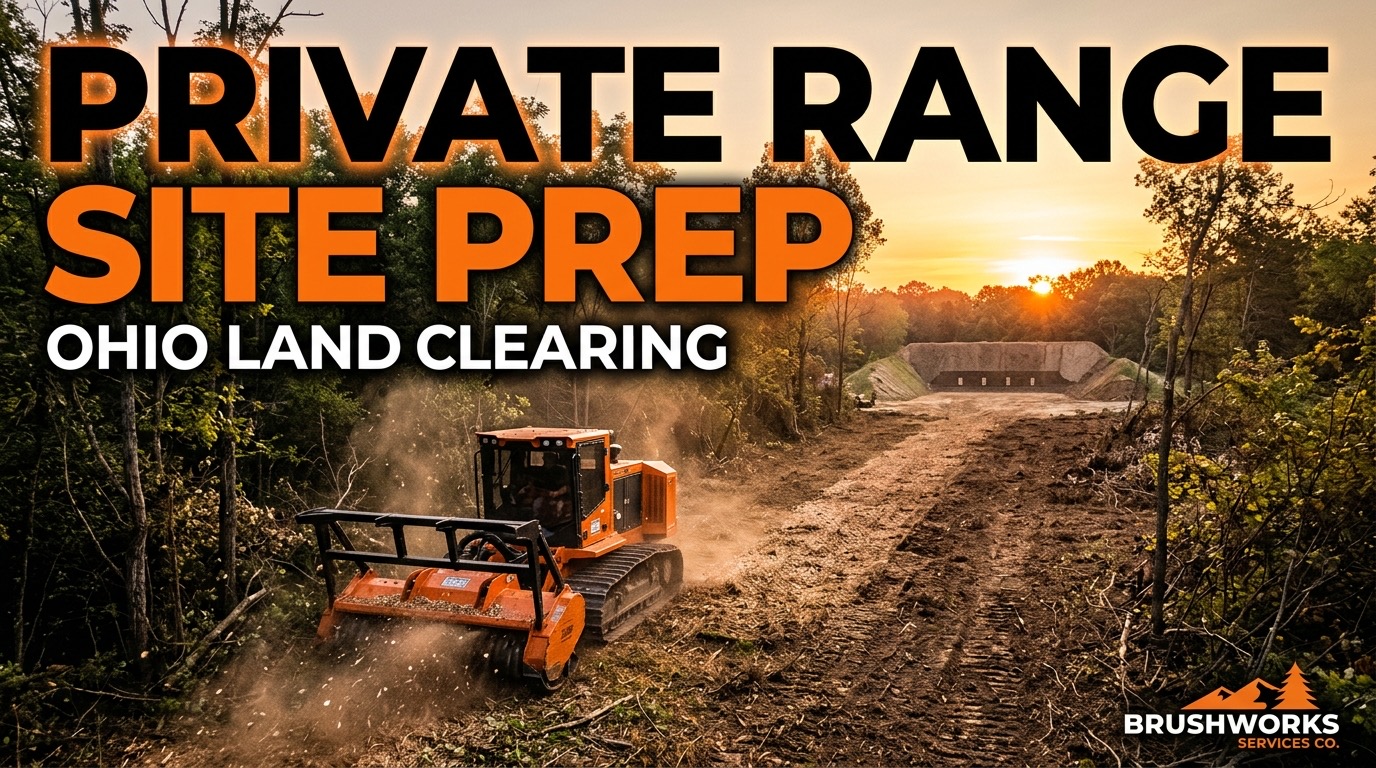
A good private range starts before the dirt work
A private shooting range sounds simple until you walk the ground. Pick a safe direction, clear a lane, build a berm, and start shooting. In real Ohio woods, it is rarely that clean. The best line may run through honeysuckle, dead ash, locust thorns, grapevine, old fence wire, a wet draw, and a hill that looks steeper from the seat of a machine than it did on the map.
Clearing is not the whole range build. It is the first phase that lets the rest of the work happen safely. Once the brush is gone, you can see the slope, soil, drainage, access, nearby structures, property lines, and where the berm or backstop actually needs to sit. Without that visibility, people tend to guess. Guessing is a bad way to build anything involving bullets, equipment, and neighbors.
Brushworks helps Ohio landowners open the ground before range construction. That may mean clearing one controlled lane through woods, cleaning up a backstop area, widening an access road for dump trucks, or reclaiming an overgrown field so the range designer, excavator, or owner can make good decisions.
Start with the safe shooting direction
The first question is not where the brush is thickest. It is where the range can point safely. The clearing plan should follow the shooting direction, not the easiest path for the machine. Backstop location, side buffers, topography, nearby homes, roads, trails, barns, livestock areas, and property lines all matter.
On rural property around Cincinnati and southern Ohio, the ground is rarely flat. Rolling hills can help if they put a natural rise behind the target area. They can also hurt if they create blind spots, drainage problems, or unsafe angles. A wooded hillside may look like a backstop until you realize the lane points toward a neighbor over the ridge. A low field may look open until spring rain turns it into mud.
Mark these before clearing starts
- • Intended firing line and target line
- • Backstop or berm location
- • Property lines and nearby structures
- • Roads, trails, driveways, barns, and livestock areas
- • Utilities, septic areas, tile outlets, wells, and drainage paths
- • Trees that should stay for screening, shade, or erosion control
If you are not sure about the layout, get that figured out before heavy clearing. Brushworks can help open the site, but the owner is responsible for making sure the range location is legal, safe, and allowed under local rules.
Know what kind of range you are building
A pistol practice bay, a 50-yard rimfire lane, a 100-yard rifle range, and a multi-lane training area all need different clearing. So does a range that will see regular classes, family use, farm pest control, or occasional sight-in days before deer season. The more people, vehicles, targets, and maintenance equipment involved, the more planning matters.
For a simple single-lane range, the clearing may be narrow and controlled. You might only need a clean line of sight, room around the firing area, and access to the target and berm. For a wider bay or multiple benches, the clearing footprint grows. You need room for shooters, benches, target stands, safe movement, target maintenance, and equipment access for the berm.
Do not forget the work area behind the range. A dirt contractor building a berm needs room to haul, pile, shape, and compact material. A tight opening through trees can make the clearing look finished, then stop the excavator from doing the job right. If stone, fill, topsoil, erosion control, or drainage work is coming next, clear for that work now.
Shooting lanes need more than a sight line
Landowners often picture the lane as the open area between the shooter and the target. That matters, but it is not enough. Limbs hanging into the lane become an annoyance. Brush on the sides blocks visibility. Vines pull trees down. Saplings grow back fast. Wet ground makes target checks miserable. If the lane is too tight, every future maintenance trip becomes another small clearing job.
A practical range lane has a clear center line, clean edges, safe visibility, and enough width to maintain it. That does not mean clear-cutting the whole woods. In many cases, leaving trees outside the lane helps with privacy, sound, shade, and the look of the property. The trick is removing the brush and problem trees that interfere with use while keeping the useful cover.
| Range element | Clearing focus | Common mistake |
|---|---|---|
| Firing area | Flat working room, safe footing, access, shade if desired | Leaving stumps and roots where benches or mats will go |
| Shooting lane | Clear sight line, side visibility, overhead limbs, maintenance access | Clearing too narrow and fighting regrowth all season |
| Target area | Room for target stands, backstop work, inspection paths | Forgetting equipment needs room to build the berm |
| Access route | Truck and equipment access for dirt, stone, targets, and maintenance | Opening a walking path when the next phase needs dump trucks |
If you plan to mow the lane later, say that up front. The clearing method, stump height, mulch depth, and finish expectations should match how you plan to maintain the range.
Backstop and berm access matter
The backstop is the heart of a safe range. Clearing around it deserves more attention than most people give it. A berm or bullet trap needs enough open room for construction, inspection, and upkeep. Trees growing right where the berm should go may need removed. Brush around the sides can hide erosion, animal holes, washouts, and target debris.
If you are building an earthen berm, the dirt contractor needs access with equipment. That may mean opening a route beside the lane, clearing a turn-in area, or making enough space behind the target line for machines to shape the berm without working blind. A clean target lane with no equipment access is only half ready.
Natural hillsides can be useful, but they still need inspection. Dead trees above the target area can fall into the range. Roots can create pockets where water starts cutting channels. Vines and brush can hide rock outcrops, old trash, fence wire, or stump holes. Clearing the face and work area lets you see what you actually have before anyone calls it safe or finished.
Drainage can make or break the range
Ohio clay does not forgive lazy drainage. A shooting lane that holds water will rut, grow weeds fast, and become a pain to maintain. A target area that sheds water wrong can wash out the base of a berm. An access road that crosses a wet draw may be fine in August and useless in April.
Clearing exposes those problems early. Once the brush is down, you can see where water wants to move. Low spots, old ruts, springs, ditch lines, field tile, and creek edges become easier to read. That is when you decide whether the range needs a slight reroute, a culvert, stone, ditch cleanup, erosion control, or a different target location.
This is one place forestry mulching helps. It opens the area without scraping everything to bare dirt. The mulch layer can reduce immediate erosion while the next phase is planned. It is not a substitute for drainage work, but it buys visibility without turning the whole lane into exposed soil on day one.
Where forestry mulching fits
Forestry mulching is a strong fit for early shooting range site prep because it handles the material that usually blocks the plan: honeysuckle, autumn olive, multiflora rose, cedar, grapevine, thorn trees, saplings, deadfall, and tangled field edges. The machine cuts and processes vegetation in place, leaving mulch instead of piles of brush that have to be burned or hauled.
For private ranges, mulching is often used to open the lane, widen the work area, clean up the access route, and reclaim the target area before dirt work starts. It keeps the job cleaner than pushing everything into heaps. It also gives the owner a better look at what should be kept for screening and what needs to go for safety and maintenance.
Mulching is good for
- • Opening shooting lanes through brush
- • Clearing target and berm work areas
- • Improving access for excavators and dump trucks
- • Removing invasive shrubs and saplings
- • Keeping useful trees outside the lane
It does not replace
- • Legal review of range rules
- • Engineered berm or backstop design
- • Grading, compaction, stone, or culverts
- • Professional tree work near hazards
- • Safe range planning and firearm rules
That line is important. Brushworks can help get the site opened up. The finished range still needs the right layout, backstop, signage, rules, and local approval where required.
Privacy, noise, and neighbor lines
Clearing too much can create problems you did not have before. Trees and brush can help screen the range from roads and neighbors. They can also soften the look of the project from the house, driveway, or property line. If privacy matters, clear with a scalpel, not a bulldozer mindset.
Sound is more complicated than leaving a few trees, but the layout still matters. Valleys, hills, barns, timber, and open fields all change how sound carries. If the range points toward a neighbor or road, clearing will not fix a bad direction. If a tree screen is useful, mark it before the crew arrives so it does not get removed by accident.
Property lines need to be settled before any cutting near a boundary. Do not rely on a fence that may be old, wrong, or moved. Use a survey, pins, or clear owner direction. A shooting range already invites extra attention. Accidentally clearing onto the wrong property makes the whole project harder than it needs to be.
Common Ohio range clearing problems
The same plants and site issues show up again and again on range projects. Honeysuckle creates a wall under the trees and blocks visibility. Multiflora rose and blackberry make walking the line miserable. Locust thorns scratch trucks and tires. Grapevine drags limbs into the lane. Dead ash can be brittle enough to become a hazard around the shooting area or access road.
Old farm ground adds its own surprises. Hidden fence wire, dumped concrete, old culverts, buried tile, scrap metal, and forgotten gates are common around field edges and back corners. A mulcher can find some of those the hard way. Walk the site first if you can. Flag the junk you know about. Tell the crew where old fence rows, wells, utilities, or debris piles may be hiding.
Slope is another big one in southwest Ohio. A range that looks good from a satellite image may have a cross slope that makes benches awkward, sends water across the lane, or forces the berm into a bad spot. Clearing gives you the truth on the ground.
Cost factors for shooting range clearing
Private range clearing is usually priced by the job because every site is different. Length alone does not tell the story. A 100-yard lane through light brush may be simple. A shorter lane through dead ash, locust, vines, steep ground, wet access, and hidden fence can take more time and risk.
The biggest cost factors are lane length, clearing width, brush density, tree size, slope, access, wet ground, debris hazards, overhead limbs, and how finished the site needs to be. If you need a road opened for dump trucks, a berm work pad cleared, or several alternate lanes marked and cut, that changes the scope.
The cheapest approach is usually to plan the full first phase before the machine shows up. Mark the lane, backstop, access, trees to save, and work areas. Then clear once with the next steps in mind. Piecemeal clearing costs more because every missed detail becomes another mobilization.
Planning a private range on your Ohio property?
Send the address, rough range length, target direction, and a few photos of the access and target area. We can help you figure out what needs cleared before berm work, gravel, or final setup.
What Brushworks needs to quote the clearing
Good photos and a rough plan make quoting easier. Start with the entrance, the firing area, the lane, the target or berm location, and the worst brush. If there is a steep slope, wet area, tight gate, dead tree, or hidden debris, send that too. A pin on a map helps, but ground photos tell the truth.
Tell us what the range will be used for in plain terms. Pistol only, rifle sight-in, family practice, training bay, long private lane, or access to an existing berm. Tell us what equipment needs to reach the site after clearing. If the next contractor needs a dump truck, skid steer, excavator, or dozer in there, we should clear for that from the start.
Also tell us what not to cut. Screening trees, boundary trees, shade near the firing line, and any trees you simply like should be marked clearly. The best clearing jobs remove what is in the way and leave the property better than it was.
How Brushworks approaches shooting range site prep
Brushworks clears private range sites, access roads, wooded lanes, overgrown fields, and target areas across Greater Cincinnati and southern Ohio. We do not treat a range like random brush clearing. We look at access, direction, slope, backstop work area, drainage, privacy, and how the site will be maintained after the first cut.
Sometimes the right answer is a narrow, clean lane through the woods with a wider work area at the target end. Sometimes it is opening an overgrown field edge and leaving a tree screen. Sometimes it is clearing access first so a dirt contractor can get in and build the berm correctly. The point is not to make the biggest mess possible. The point is to make the next phase easier and safer.
If you are planning a private range, walk the ground, think through the safe direction, check local rules, then clear with the whole project in mind. That order saves money, protects the property, and keeps the range from becoming a half-finished lane in the woods.
Frequently asked questions
Can I clear land for a private shooting range in Ohio?
Yes, private range clearing is common on rural Ohio property, but the range layout needs to be planned carefully. Clearing should follow the intended shooting direction, backstop location, side buffers, access route, drainage, and any local rules that apply to your county or township.
How wide should shooting lanes be cleared?
It depends on the type of range. A simple pistol lane may only need a narrow opening plus safe side buffers, while rifle ranges, multiple benches, and equipment access usually need more room. Plan the lane, berm work area, access road, and maintenance paths before cutting.
Can forestry mulching help with shooting range site prep?
Yes. Forestry mulching is useful for opening shooting lanes, clearing brush around future berms, reclaiming old fields, improving visibility, and creating access for dirt work. It does not replace engineered berm construction, grading, drainage, or safety planning.
What should be cleared around a shooting range backstop?
Clear enough room for the contractor building the berm or backstop to work safely. That usually means brush, saplings, vines, dead trees, overhead limbs, and access around the back and sides for inspection and maintenance.
Do I need permits for a private shooting range in Ohio?
Rules vary by township, county, zoning district, and property use. Before clearing, check local ordinances, noise rules, setbacks, wetlands, floodplain maps, and any HOA or deed restrictions. Brushworks can clear the site, but legal range approval belongs with the property owner and local officials.
What is the best time to clear a shooting range site?
Dry summer, fall, and winter windows are usually easiest in Ohio. Leaves are down in winter, visibility is better, and dry or frozen ground reduces rutting. Spring can work, but wet clay and soft access can make the job messier.
Related articles
Ready to clear the range site?
Send the range length, target direction, access photos, and the area you want opened. We will help you clear the ground so the next phase can happen without fighting brush.