
The Power of Visual Transformation
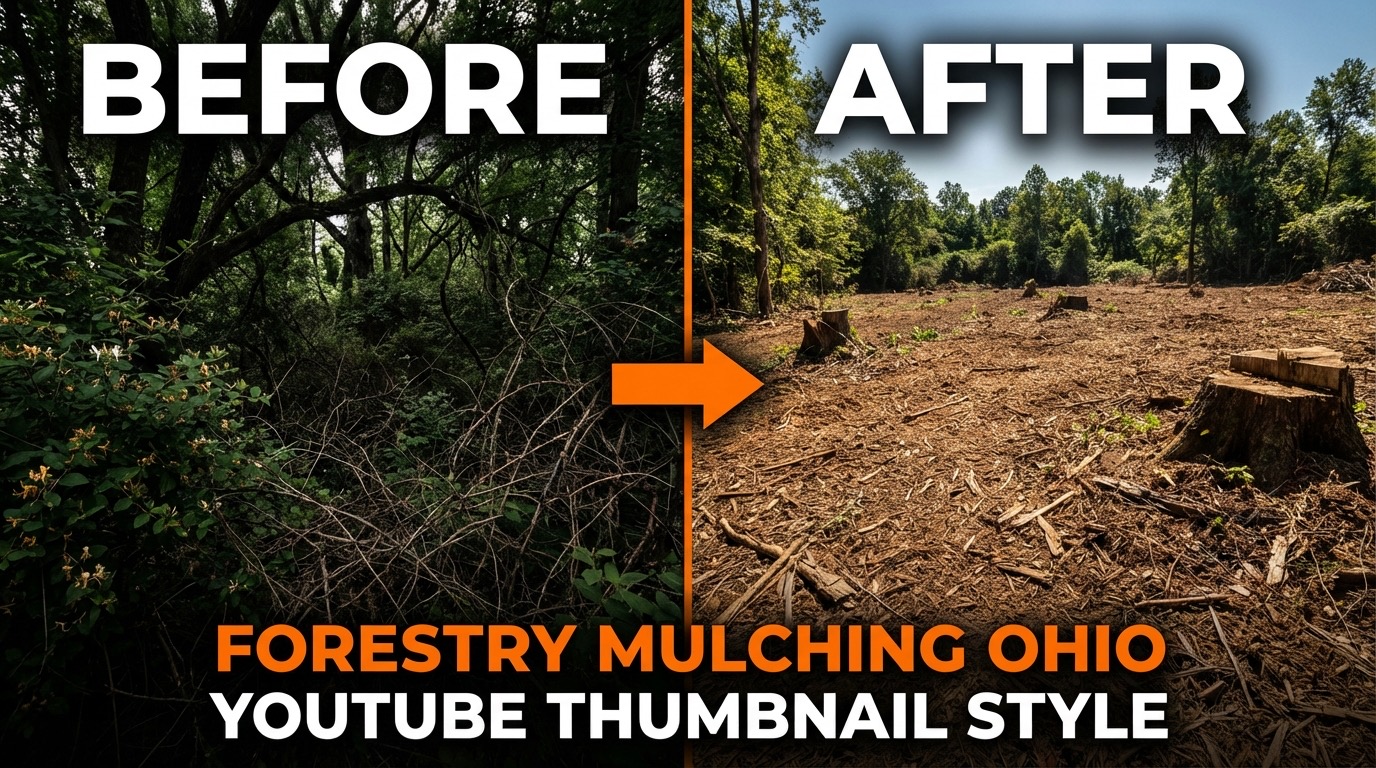
Before and after photos don't lie. When you see dense brush reduced to clean, walkable ground in a single day, it clicks: this isn't years of work. This is a decision followed by action. Here's what makes land clearing transformations so dramatic in Ohio:
The "Before" Reality
- • Dense honeysuckle thickets (often 8-15 feet tall)
- • Multiflora rose creating impenetrable barriers
- • Saplings so thick you can't walk through
- • Years of accumulated dead brush and debris
- • Hidden fences, junk, and forgotten structures
- • Lost property boundaries nobody can find
- • Completely invisible terrain underneath
The "After" Reality
- • Open, walkable ground covered in natural mulch
- • Mature trees left standing, brush gone
- • Visible property lines and boundaries
- • Usable space for any purpose you choose
- • Natural contours and terrain revealed
- • Wildlife habitat actually improved
- • Immediate transformation—same day
The change is often hard to believe even for the property owner standing there watching. We've had people ask if we're sure we cleared their property because they don't recognize it anymore. That's not exaggeration—that's what happens when 20 years of neglected growth disappears in an afternoon.
Common Ohio Property Transformations
Every property has its own story, but we see certain scenarios repeatedly across the Cincinnati area. Here are the transformations we help with most often:
1. The Overgrown Backyard
Before:
- • Half-acre to 2 acres behind the house
- • Hasn't been maintained in 5-20 years
- • Wall of honeysuckle blocking any view
- • Kids can't play there, can't even walk through
- • Property feels smaller than it actually is
- • Neighbors' debris thrown into the brush
After:
- • Open lawn space extending to property line
- • Beautiful mature trees now visible
- • Room for fire pit, garden, play area
- • Property feels twice as large
- • Natural mulch bed ready for grass or landscaping
- • "We never knew this was back here!"
Typical timeline: 1 day | Typical cost: $2,500-$5,000
2. The New Home Build Site
Before:
- • Raw wooded lot with dense understory
- • Can't even see where to put a house
- • No access for construction equipment
- • Saplings and brush everywhere
- • Ticks and mosquitoes make site visits miserable
After:
- • Building pad clearly visible
- • Access road cut through to site
- • Mature trees strategically preserved
- • Ground ready for survey stakes
- • Builder can finally see the vision
Typical timeline: 1-2 days | Typical cost: $3,000-$8,000
3. The Forgotten Farm Field
Before:
- • Old pasture or hay field not mowed for years
- • Cedars, autumn olive, and brush taking over
- • 10-15 years of woody growth
- • Too thick for a brush hog to handle
- • Fence lines completely buried
After:
- • Open field restored to original size
- • Fence lines exposed and accessible
- • Ready for mowing, grazing, or hay
- • 5-15 acres usable again
- • Property value significantly increased
Typical timeline: 2-5 days | Typical cost: $8,000-$25,000
4. The Hunting Property Overhaul
Before:
- • Woods so thick deer can't move through
- • Zero shooting lanes or visibility
- • No food plot locations available
- • Invasive honeysuckle dominating understory
- • Access trails nonexistent or unusable
After:
- • Clear shooting lanes to stand locations
- • Food plot areas opened up
- • Improved deer movement patterns
- • Trail system accessible by ATV
- • Native browse regrowth begins
Typical timeline: 3-7 days | Typical cost: $10,000-$40,000
5. The Steep Hillside Nobody Could Touch
Before:
- • 30-45+ degree slope covered in brush
- • Too steep for tractors or skid steers
- • Erosion concerns with any disturbance
- • Completely inaccessible and unusable
- • "No one will even quote this"
After:
- • Cleared with remote-control mulcher
- • No soil disturbance or erosion
- • Mulch layer stabilizes hillside
- • Views opened up
- • Actually usable hillside space
Typical timeline: 1-3 days | Typical cost: $4,000-$12,000
What You'll Actually See: The Transformation Process
Understanding the process helps you visualize your own property's potential. Here's exactly what happens during a forestry mulching transformation:
Hour 1-2: Equipment Arrival and Setup
Our mulching equipment arrives on a trailer. We walk the property with you one more time, confirm boundaries and any "save" trees, and begin work. The mulcher fires up—it's loud, but that's the sound of progress.
Hours 2-6: The Disappearing Act
The mulcher moves through vegetation like it isn't there. Brush, saplings, and small trees vanish into the rotating drum, emerging as a carpet of 2-4 inch chips on the ground behind. You'll watch areas you couldn't walk through become open ground in real-time. This is the part that makes people's jaws drop.
Hours 6-8: Finishing and Detail Work
We go back through for detail work—cleaning up edges, getting close to trees you're keeping, addressing any spots that need a second pass. The operator takes pride in leaving clean lines and a finished look.
End of Day: The Reveal
When the engine shuts off, you're standing on your property—maybe for the first time in years. The ground is covered in a layer of natural mulch, 2-4 inches deep. You can walk everywhere. You can see everything. Many clients spend the next hour just exploring their "new" land.
What the Ground Looks Like After
The mulch layer left behind is:
- • Walkable: You can walk on it immediately—it's firm, not spongy
- • Natural: Looks like forest floor, not industrial waste
- • Beneficial: Prevents erosion, suppresses weeds, adds nutrients as it breaks down
- • Temporary: Decomposes over 1-2 seasons, leaving improved soil behind
- • Grass-ready: You can seed directly into it or let native vegetation return
The Timeline: From Chaos to Clear
One of the most surprising things about land clearing is how fast it happens. Here's realistic timing for different project sizes:
| Project Type | Acreage | Typical Duration | Notes |
|---|---|---|---|
| Residential Backyard | 0.5 - 2 acres | 4-8 hours (1 day) | Most common project size |
| Building Site Prep | 1 - 3 acres | 1-2 days | Includes access road |
| Farm Field Reclamation | 5 - 15 acres | 2-5 days | Depends on brush density |
| Hunting Property | 10 - 50 acres | 1-2 weeks | Selective clearing, trails, plots |
| Commercial/Development | 20+ acres | 2-4 weeks | Full site preparation |
Compare this to traditional clearing methods—chainsaw crews, bulldozers, burn piles—that might take weeks or months for the same area. The efficiency of forestry mulching means your transformation happens in days, not seasons.
What Gets Revealed: Surprises Under the Brush
Over hundreds of clearing projects, we've uncovered just about everything imaginable hiding under decades of growth:
The Good Surprises
- • Beautiful mature trees you forgot were there
- • Natural springs and water features
- • Stone walls and historic foundations
- • Rock outcroppings perfect for landscaping
- • More usable flat ground than expected
- • Incredible views that were completely hidden
- • Old trails that can be restored
- • Natural clearings that just need brush removed
The "Interesting" Surprises
- • Old car bodies and farm equipment
- • Buried fence lines (great to find!)
- • Property markers thought lost forever
- • Old wells that need capping
- • Drainage issues now visible to address
- • Neighbor's junk thrown onto your land
- • Erosion channels requiring attention
- • More invasives than expected (treatment needed)
The key is that you can now see and address these things. Hidden problems remain problems. Revealed problems become solvable. Property owners consistently tell us they wish they'd done this years earlier—not just because of the transformation, but because they finally understand what they actually own.
After the "After": What Happens Next
The transformation doesn't stop when we leave. Here's what happens in the weeks and months following clearing:
Week 1-2: Settling In
- • Mulch layer settles and compacts slightly
- • You're probably still exploring your "new" property
- • Perfect time to plan next steps
- • Mark any areas for special treatment
Week 2-6: Green Returns
- • Grass begins poking through mulch
- • Native ground cover starts returning
- • Stumps may begin sprouting (expected—see maintenance below)
- • Wildlife starts using newly opened areas
Month 2-6: Establishment
- • Mulch continues decomposing, enriching soil
- • If seeded, grass is establishing
- • Some stump regrowth may need mowing or spot treatment
- • Property looks increasingly natural and established
Year 1-2: The New Normal
- • Most mulch has decomposed into topsoil
- • Ground cover or grass fully established
- • Regular mowing maintains open areas easily
- • Property feels like it's always been this way
About Stump Regrowth
Some species (especially honeysuckle, autumn olive, and willows) try to regrow from stumps. This is normal and manageable:
- • Light regrowth: Regular mowing keeps it controlled
- • Moderate regrowth: Spot treatment with herbicide eliminates it
- • Heavy invasive areas: May need follow-up treatment in year 1
We can advise on maintenance or connect you with vegetation management specialists if needed.
Visualizing Your Property's Potential
If you're looking at your overgrown land and trying to imagine what it could become, here are questions to ask yourself:
What's Under There?
- • Can you remember what the land looked like before it grew over?
- • Are there old photos from when the property was clear?
- • Do you know where property lines actually are?
- • Have you walked the perimeter recently (or can you)?
- • Are there mature trees hidden in the brush you'd want to keep?
What Could It Become?
- • Extended yard: Fire pit, garden, play area, outdoor living space
- • Pasture or hay field: Livestock, horses, hay production
- • Hunting land: Food plots, shooting lanes, trail access
- • Building site: New home, shop, barn, or outbuilding location
- • Orchard or vineyard: Agricultural production with a view
- • Wildlife habitat: Improved, managed woodland
- • Solar field: Renewable energy installation
- • Simply open: Just usable, maintained land
The beautiful thing about land clearing is that it gives you options. That overgrown hillside could become anything once you can actually walk on it and see it. The decision about what it becomes can wait until after the transformation.
Cost of Transformation: What to Expect
Investment in land clearing varies based on several factors, but here's a realistic picture of what transformations cost in Ohio:
| Vegetation Type | Per Acre Cost | Description |
|---|---|---|
| Light Brush | $2,000 - $3,000 | Saplings, honeysuckle, grass over 12" |
| Medium Brush | $3,000 - $4,500 | Dense brush, small trees up to 6" diameter |
| Heavy Brush | $4,000 - $5,500 | Thick understory, trees up to 8-10" diameter |
| Timber Clearing | $5,000 - $7,000+ | Larger trees, heavy clearing |
| Hillside/Slope | +25-50% | Steep terrain requiring specialized equipment |
Typical Project Costs
- • 1-acre backyard clearing: $2,500-$4,500
- • 2-acre building site: $4,000-$8,000
- • 5-acre field reclamation: $10,000-$20,000
- • 10-acre hunting property: $25,000-$45,000
- • Minimum project: $1,500 (mobilization + small area)
Volume discounts apply for larger projects. And remember—you're not just paying for clearing. You're paying for immediate results, no debris to deal with, no burning, and ground that's better off than when you started.
Get Your Transformation Estimate
Every property is different. Send us photos or give us a call, and we'll help you understand what your transformation would cost.
Why Before and After Photos Matter
We document every project with photos. Here's why that matters for you:
For Property Records
- • Document improvements for property value
- • Evidence for insurance purposes
- • Track changes over time
- • Show lenders or buyers what was done
- • Permit documentation if needed
For Satisfaction
- • Remember what it used to look like
- • Share with friends and family
- • Appreciate the transformation over time
- • Plan future improvements visually
- • Simply enjoy the dramatic change
We've had clients frame before/after photos to hang in their homes. When you've stared at an overgrown mess for years and finally see open, usable land, it's worth celebrating.
Ready to See Your Transformation?
Every overgrown property has potential hiding under the brush. Yours is no different. Whether you have a half-acre backyard or a 50-acre hunting property, the transformation is waiting to happen.
Your Next Steps
- Send us photos of what you're working with—aerials from Google Maps work great too
- Get a quote for your specific property and conditions
- Schedule the work when it fits your timeline
- Watch the transformation happen in a day or two
- Enjoy your "new" property for years to come
Frequently Asked Questions
How long does it take to clear land with forestry mulching?
Most residential projects (1-5 acres) complete in 1-3 days. A typical overgrown backyard or lot can be transformed in a single day. Larger properties or those with heavy timber may take a week or more. The speed is one of the biggest advantages over traditional clearing methods.
What happens to all the vegetation after mulching?
It becomes mulch, right where it falls. Our forestry mulcher grinds trees, brush, and vegetation into 2-4 inch chips that blanket the ground. This mulch decomposes over 1-2 seasons, returning nutrients to the soil and suppressing weed regrowth. No burning, no hauling, no debris piles.
How much does land clearing cost per acre in Ohio?
Forestry mulching typically costs $2,500-$5,000 per acre depending on vegetation density and terrain. Light brush runs lower ($2,000-$3,000), while heavy timber and steep slopes run higher ($4,000-$6,000+). Most residential clearing projects fall in the $3,000-$8,000 range total.
Will my property look like the after photos immediately?
Yes—the transformation is immediate. What you see in our after photos is exactly what your property looks like when we finish. The mulched surface is clean and walkable. Within weeks, grass begins growing through the mulch for an even more finished look.
Can you clear around trees I want to keep?
Absolutely. Selective clearing is one of forestry mulching's strengths. We can remove all the brush and unwanted saplings while leaving your desirable trees standing. Just mark what you want to keep, and we'll work around it.
What's the best time of year for land clearing in Ohio?
Late fall through early spring (November-March) is ideal when vegetation is dormant. However, we clear year-round. Summer work is fine—you just get heavier mulch from the green vegetation. Avoid extremely wet conditions when ground is soft.