
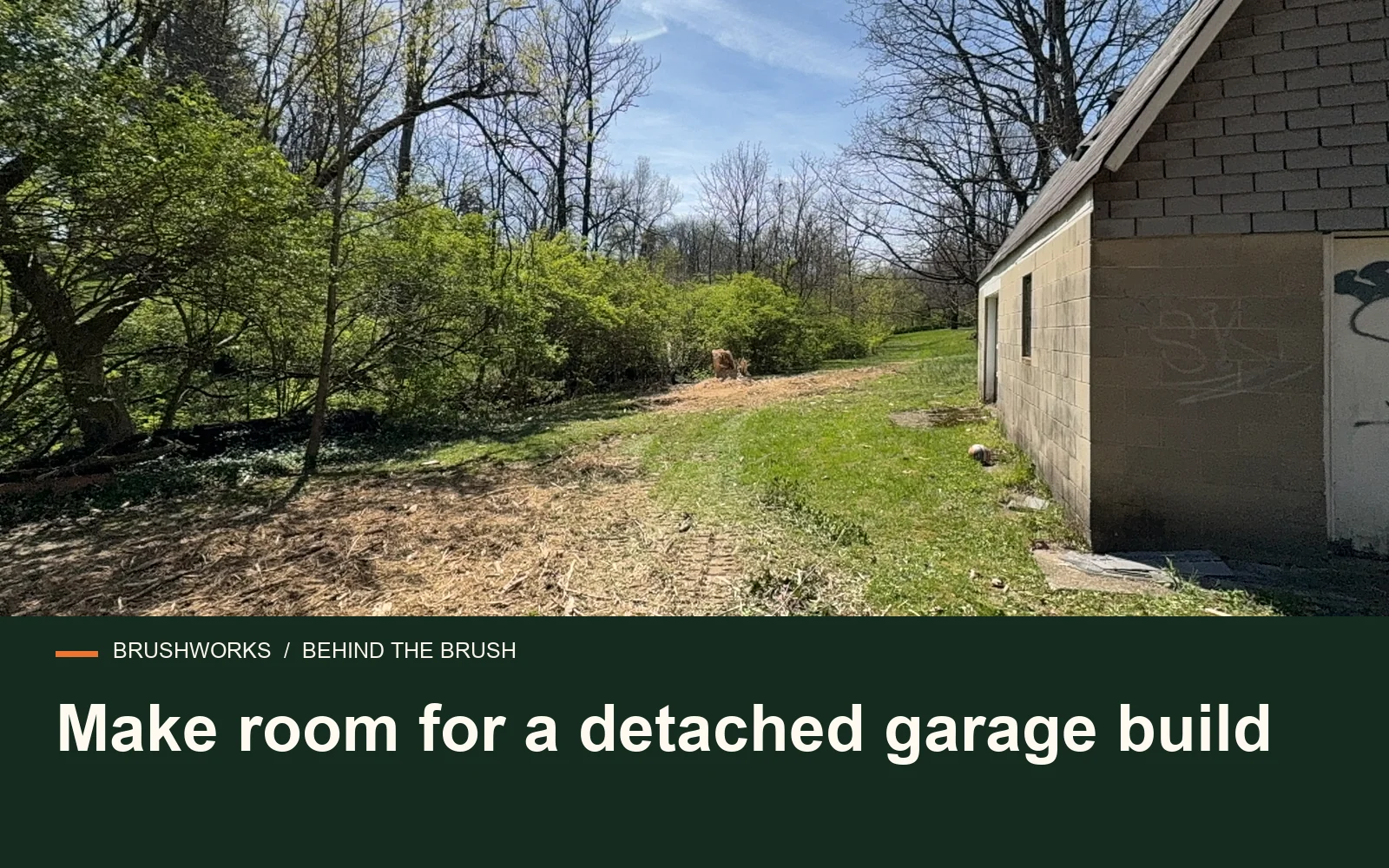
Before you start
- Mark doors and turning paths as well as corners.
- Protect existing house utilities and drainage.
- Coordinate root removal and pad work with the builder.
Start with the garage footprint, then clear the work area
A good rule is to think in zones. There is the building pad. There is the immediate working room around it. There is the access route from the driveway or road. Then there are drainage and utility paths. Clearing should cover all of those, not just the rectangle shown on a sketch.
This matters around Cincinnati, Loveland, Milford, Lebanon, Batavia, and the rest of southwest Ohio because many detached garages go behind older homes or out on rural acreage. The easy front yard is not where the garage is going. The garage usually sits past a narrow side yard, behind a barn, along a wooded edge, or beside an existing gravel drive that needs widened before heavy trucks can use it.
Mark the site before the clearing crew arrives
The cheapest mistake to avoid is clearing the wrong ground. Before anyone starts cutting, mark the rough corners of the garage, the garage door side, the driveway approach, and anything that absolutely needs to stay. Stakes, flags, paint, or even a clearly marked map can save a lot of backtracking.
Septic tank, leach field, well, propane tank, and utilities
Do not assume the operator knows what the builder wants. A detached garage site can be cleared several different ways depending on whether you want a gravel pad, concrete slab, post-frame building, block foundation, or future living space above it.
What needs removed before a garage build
Most garage sites have a mix of growth. The obvious work is trees and brush. The less obvious work is the stuff hidden under it. Old wire, buried chunks of concrete, tires, stumps, vines, broken fence posts, scrap metal, and forgotten drainage pipe can all be sitting in the exact area where a contractor plans to grade.
Forestry mulching handles brush, saplings, honeysuckle, autumn olive, grapevine, briars, and small trees well. It opens the site fast and leaves the ground covered with mulch instead of a pile of limbs. That is a strong first step when the garage area has grown up along a property edge or back field.
Larger trees are a different decision. If the trunk is inside the building pad, near the future driveway, or close enough that roots will interfere with excavation, it may need to come out completely. If it is outside the pad and healthy, saving it might make sense. Shade is valuable, but not when the tree leans over the roof, drops limbs on vehicles, or sends roots under the slab area.
Access can make or break the job
A lot of detached garage projects fail on access before they fail on the building pad. The site may be big enough, but the route to it is too narrow, too steep, too soft, or too tight for trucks. If a concrete truck cannot reach the pour, somebody is paying for pumping, extra labor, or a redesign. If a delivery truck cannot turn around, material staging becomes a headache.
Ohio clay gets slick when wet. A grassy path that looks fine in August can become useless after two days of rain in March. If the detached garage is being built behind a house, think about ground protection and timing before the yard becomes a construction road.
Drainage needs attention before the pad is built
Brush can hide water problems. That back corner with willows, soft grass, or moss is usually telling you something. If water already sits there, clearing the brush will not fix the drainage by itself. It will only make the problem easier to see.
A detached garage needs water moving away from the slab, doors, and driveway. Downspouts need somewhere to go. The driveway approach should not funnel water into the garage. If the site is at the bottom of a slope, drainage may matter more than the clearing itself. In Clermont County, Warren County, Hamilton County, and Butler County, clay soils can hold water long after the rain stops.
During clearing, keep an eye on natural flow. Do not bury a drainage swale under mulch piles. Do not block a ditch with chips. If the site will need tile, a culvert, a ditch cleaned out, or a little grading, it is better to know that before the garage is framed.
How much clearing should you do?
Some property owners want the smallest possible opening. Others want the whole back corner cleaned up while the machine is there. The right answer depends on privacy, budget, access, and how the finished garage will be used.
If the garage is just for storage, you may only need the pad, driveway approach, and enough room for maintenance. If it will hold a workshop, boat, camper, equipment, or business materials, you may want a wider gravel apron and better turnaround. If you will be backing trailers into it, clear enough room to make that possible without clipping trees every time.
Clearing a little extra while the equipment is already mobilized can be cheaper than calling everyone back later. But clearing everything can remove useful screening and shade. Walk it with the future use in mind.
Permits, setbacks, and utilities come before cutting
Brushworks is not your zoning office, and this is where homeowners need to slow down for a minute. Detached garage rules can change by city, township, HOA, county, and lot type. A building that works in rural Brown County may not work the same way in Indian Hill, Mason, Loveland, Anderson Township, or a subdivision with strict accessory structure rules.
Septic systems deserve special care. A leach field can look like open grass until a machine crosses it at the wrong time. If you have septic, mark the tank and field clearly. Do not use the future garage project as a reason to compact, rut, or damage a working system.
What the site should look like when clearing is done
After clearing, the garage site should be open enough to measure, grade, and build. You should be able to see the pad area, the access route, any remaining trees, and the spots that need additional dirt work. If forestry mulching was used, there will be a mulch layer on the ground. That is normal. It protects the soil during the transition, but it may need to be scraped or worked around where stone base and concrete are going.
If you are trying to keep costs in line, coordinate the order. Clear first. Recheck layout. Handle stumps and drainage where needed. Then bring in the gravel, excavation, or concrete crew. Doing those steps out of order can mean paying twice for cleanup.
Common mistakes we see on garage sites
The builder still needs room to work. Tight sites slow every trade down and make the finished garage harder to use.
A tree can be nice until it is dropping limbs on the roof, blocking drainage, or pushing roots into the work area.
Concrete, gravel, lumber, and equipment all need access. A garage site is not ready if only a pickup can reach it.
Clearing can reveal stumps, wet ground, or debris. Give yourself time to fix those before the build date.
Agree on the handoff
Before work begins, define what the next person needs to find on site. A rough mulched opening may still contain roots, stump remnants, and uneven ground. Grading, structural preparation, planting, surfacing, and specialist tree work are separate unless explicitly included.
Keep the marked work map with the quote. At completion, compare the limits and finish, document any follow-up, and decide who will maintain the area. Photos help record the result, but they do not replace checking the ground and access.
Plan the work for your property
Send the site address, recent photos, a marked clearing area, and the finish you want. We can discuss where clearing fits and what needs a different trade.
Discuss your project → Explore pricing