
Land Clearing for Drainage Swales Ohio
A drainage swale only works when water can move through it. Brush, saplings, vines, and hidden debris can turn a simple flow path into a soggy problem.
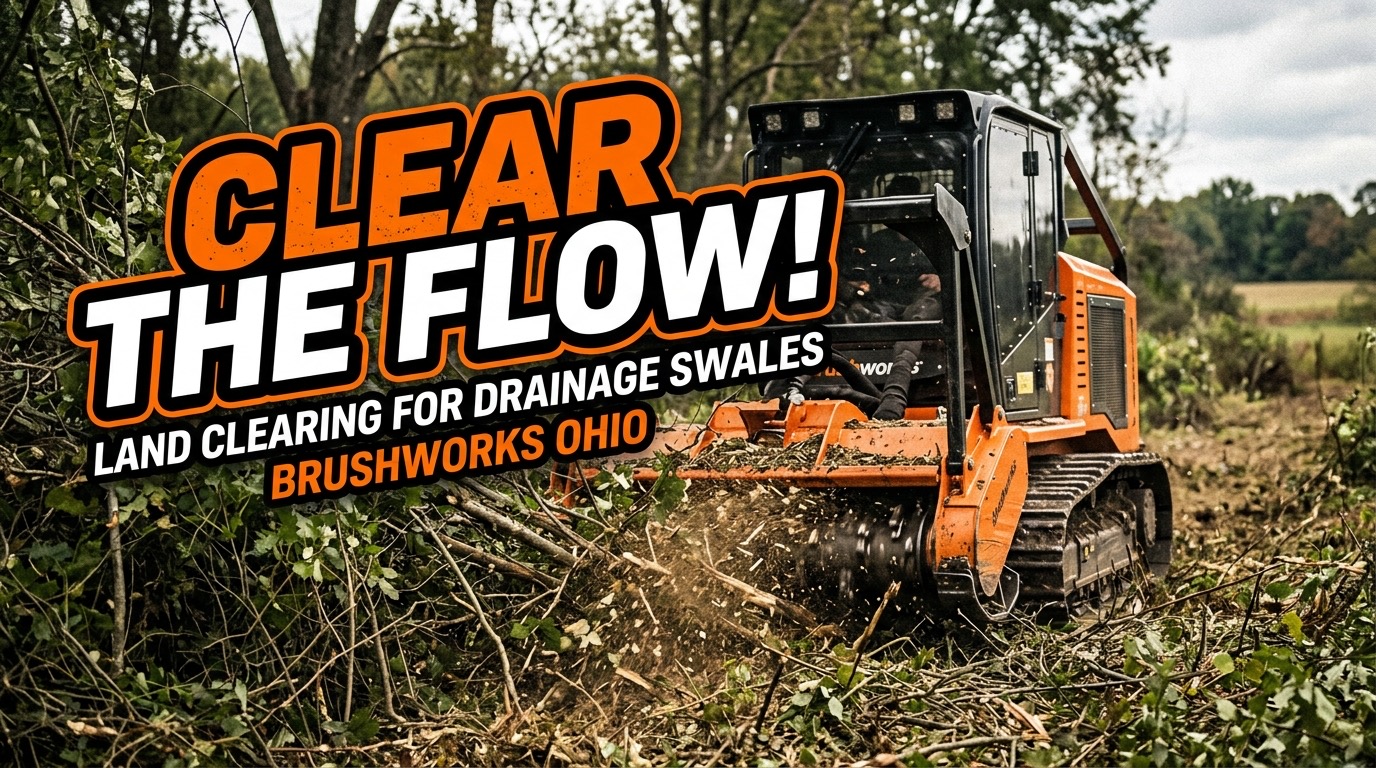
Land clearing for drainage swales in Ohio is not just about making a ditch look cleaner. A swale is a working part of the property. It collects runoff, slows it down, carries it away from buildings, and gives water a route that is less damaging than letting it cut its own path across a driveway, pasture, yard, building pad, or field edge.
When a swale gets swallowed by brush, it stops doing that job well. Honeysuckle fills the banks. Briars grab every low spot. Saplings grow in the flow line. Leaves and sticks collect around culverts. Old fence wire, trash, dead limbs, and sediment hide under the growth. After a hard Cincinnati storm, water backs up, jumps the swale, washes gravel, floods low lawn, or sits where equipment and people need to work.
Good clearing opens the swale without turning it into a bare scar. The goal is to remove woody growth, expose the flow path, make room for inspection and maintenance, and protect the soil that still needs to hold together during the next rain. That takes a little more thought than simply cutting everything to dirt.
For property owners around Cincinnati, Clermont County, Warren County, Butler County, rural Hamilton County, and the rest of southwest Ohio, drainage swale clearing usually sits between land clearing and drainage repair. Brushworks can help open the access and remove the overgrowth. If the swale needs regrading, pipe replacement, engineered stormwater work, or sediment excavation, that may bring in an excavating or drainage contractor after the site is visible.
Need a swale opened before the next storm?
Send the address, a few photos, and where the water is supposed to go. Brushworks can clear brush, saplings, vines, and access around drainage swales so the next step is easier to plan.
What a drainage swale is supposed to do
A drainage swale is a shallow, shaped channel that moves water across a property. Some are grassed waterways in fields. Some run along driveways. Some carry runoff behind homes in subdivisions. Others sit along barn pads, gravel lots, pond edges, commercial yards, private roads, and wooded property lines.
The shape matters. A swale usually works by being wide enough and shallow enough that water spreads out instead of cutting a deep rut. The bottom may be grass, stone, soil, or a mix depending on slope and flow. The sides should be stable enough to handle repeated rain. If the swale has a culvert, tile outlet, riprap, check dam, basin, or pipe crossing, that feature needs to stay visible and serviceable.
Brush causes trouble because it hides the shape and changes the flow. A few small plants on the banks are not always a problem. A thicket in the bottom is different. Woody stems trap leaves. Roots catch sediment. Vines pull dead limbs into the channel. Saplings narrow the swale until water concentrates into a smaller path. Once water concentrates, it cuts. Once it cuts, the repair usually costs more than the clearing would have.
Signs your swale needs clearing
The first sign is often standing water where it did not used to sit. You may see a damp strip that stays wet for days, a soft area beside the driveway, or a soggy patch near a fence line. In wooded areas, the sign may be less obvious: leaves piled at one choke point, mud washed across a lane, or water sneaking around the swale and carving a new route.
Look for brush growing in the low point, not just on the sides. Honeysuckle, willow, box elder, autumn olive, multiflora rose, grapevine, and volunteer saplings can all fill drainage paths quickly. In southwest Ohio, bush honeysuckle is a regular problem because it leafs out early, holds leaves late, and creates a dense screen that makes the ground hard to inspect.
Other warning signs include culvert ends you cannot see, outlet pipes buried in weeds, gravel washed into the yard, mulch or leaves stacked against stems, erosion cuts in the swale bottom, water flowing over a driveway during normal storms, or a stormwater area that cannot be mowed because the brush has taken over.
Clear the blockage, not the whole property
Drainage work rewards restraint. The answer is rarely to clear everything from tree line to tree line. The better question is what needs to be opened so water, equipment, and future maintenance have room.
On many jobs, the work area includes the swale bottom, the lower banks, the access route, and the inlet and outlet points. That may mean clearing a strip along a driveway ditch, opening a farm waterway, cutting back brush around a culvert, or mulching saplings along a subdivision drainage easement. The saved trees, privacy screen, pasture edge, or wooded buffer may still matter. Mark those before work starts.
Clearing too little can leave the same drainage problem in place. Clearing too much can expose soil and increase erosion. A swale should be open enough to work, but stable enough to survive the next heavy rain. When in doubt, keep useful grass and low cover where it protects soil, and remove woody stems that block flow or prevent inspection.
Why bare dirt is usually the wrong finish
A clean-looking dirt channel can fail fast in Ohio clay. When a storm hits bare soil, water picks up fine particles and carries them downstream. The bottom starts to rut. The sides slump. Sediment collects at culverts, pond edges, creek approaches, or the neighbor's low spot. A swale that looked neat for a week can become a muddy problem by the next rain.
That is why drainage swale clearing is different from building a trench. In a working swale, vegetation and surface protection often help. Grass, stable low cover, stone, riprap, erosion blanket, or a properly graded shape can slow water and hold soil. Brushworks' role is often to remove the woody mess that prevents the swale from being maintained, then leave the property owner or drainage contractor with a visible path to improve the finish if needed.
If the bottom is already eroded, the water is too concentrated, or the slope is steep, clearing alone may not fix it. It can reveal the problem. That is still valuable. Once the brush is gone, a drainage contractor can see whether the swale needs reshaping, stone, check dams, pipe work, stabilization, or a different outlet.
Where forestry mulching fits around swales
Forestry mulching can be useful when a drainage swale is blocked by brush, small trees, and vines. The machine grinds vegetation in place and leaves mulch on the ground. That can be a good fit on field edges, wooded drainage paths, rural driveways, detention basin access routes, barn lots, and overgrown property lines where the main problem is woody growth.
Mulching opens visibility. You can see the swale bottom, culvert ends, wet spots, slope changes, erosion, and debris that were hidden before. It can also create room for a mowing contractor, excavator, drainage crew, property owner, or inspector to get back in without fighting the same brush.
There are limits. Mulching is not sediment excavation. It is not final grading. It does not rebuild a washed-out channel or install pipe. In a swale bottom, mulch can move during heavy flow if too much material is left loose where water concentrates. The work needs to be planned so the swale is opened, not stuffed with ground-up debris.
Watch the inlet, outlet, and every crossing
Most drainage swale problems show up at choke points. The inlet is where water enters. The outlet is where it leaves. Crossings are places where water has to pass under a driveway, through a culvert, around a fence, under a farm lane, or into another drainage feature. If those points are blocked, clearing the middle may not solve much.
Before work starts, find where water comes from and where it is supposed to go. That sounds basic, but brush can make it hard. A swale may start at a downspout extension, roadside ditch, catch basin, field edge, hillside seep, or wet-weather flow path. It may end at a pond, creek, culvert, detention basin, tile outlet, roadside ditch, or lower field. If you only clear the visible section near the house, the real blockage may still sit downstream.
Culvert ends deserve special attention. They often hide under honeysuckle, cattails, briars, grass, leaves, and sediment. Water may be running around the culvert instead of through it. That can wash out a driveway or farm lane. Clearing around the ends lets you see whether the pipe is open, crushed, undersized, buried, or set too high.
Protect property lines and drainage easements
Drainage does not always stay inside one owner's comfort zone. A swale may run along a property line, through a subdivision easement, behind several homes, beside a shared driveway, or across ground that drains onto a neighbor. Before clearing, know where the work is allowed.
On private rural property, that may mean marking the boundary and talking to the neighbor if the swale crosses or receives water from their land. In a subdivision, it may mean checking HOA documents, recorded drainage easements, county stormwater maps, or builder plans. On commercial property, it may involve detention basin maintenance requirements and inspection access.
Do not assume that an overgrown drainage area can be changed however you want. Clearing brush is one thing. Redirecting water is another. A swale should move water along its intended path, not dump a new problem across a line, over a sidewalk, toward a foundation, or into a road ditch without permission.
Call 811 and mark private utilities
Even when the plan is clearing, not digging, utility awareness matters. Brush clearing can uncover or disturb things that were hidden under growth: cleanouts, drainage pipe, shallow electric lines, well lines, irrigation, invisible fence, propane lines, septic components, and old farm utilities.
Call 811 before any ground disturbance. Public locates are important, but they may not mark private lines. If the swale runs near a house, barn, pool, well, septic field, propane tank, transformer, meter, light pole, or outbuilding, take time to identify what may be underground. Mark it clearly before crews arrive.
Private drainage is easy to forget. Downspout lines, yard drains, sump discharge pipes, field tile, and old clay pipe can be buried shallow. If the clearing plan includes stump work, grading, or heavy passes over soft ground, those features need to be considered.
Ohio weather changes the work window
Southwest Ohio weather can make drainage clearing easier or harder depending on timing. Spring growth comes fast, but spring ground can be soft. Summer makes the problem obvious because vegetation is full, but heat, poison ivy, ticks, and dense leaves can slow inspection. Fall is often a good window because the ground may be firm, leaves are dropping, and the swale can be opened before winter storms. Dry winter weather can also work well when the soil carries equipment.
The main thing is to avoid making the drainage problem worse. Running heavy equipment through a wet swale can rut the bottom and create new channels. Cutting every bit of cover before a forecasted storm can leave exposed soil vulnerable. If the site is saturated, it may be smarter to clear access and high banks first, then return for more detailed work when the ground can handle it.
For Cincinnati-area properties with clay soil, patience matters. The right few dry days can make the job cleaner and reduce repair work afterward.
Maintenance matters after the first clearing
The first clearing is usually the hardest because the swale has had time to grow in. After that, maintenance should be simpler. Once woody growth is removed, the area can often be mowed, walked, inspected, or spot-treated before it turns back into a thicket.
Plan how the swale will be maintained after the clearing crew leaves. Can a mower reach it? Does it need a narrow access path along one side? Should certain trees be kept limbed up for shade and stability? Will the owner inspect culverts after big storms? Does the HOA or property manager need a recurring schedule? Those decisions affect how the first clearing should be shaped.
Regrowth is normal. Honeysuckle, willow, briars, and softwood saplings can come back from seed, root systems, and nearby edges. A swale that is easy to reach is much cheaper to manage than one that disappears again for five years.
How Brushworks approaches drainage swale clearing
Brushworks starts by looking at access, flow, vegetation, slopes, hidden debris risk, wet ground, culverts, outlets, nearby structures, and what the owner wants to happen next. Sometimes the job is a simple brush clearing project along a driveway swale. Sometimes it is opening a long rural waterway so an excavator can reshape the bottom. Sometimes it is restoring maintenance access around a detention basin, field edge, or subdivision drainage path.
We try to keep the scope practical. If forestry mulching will solve the access and visibility problem, we say that. If the swale needs drainage repair beyond clearing, we point that out before pretending brush removal will fix grade, pipe, or sediment problems. A good outcome is a swale that can be seen, maintained, and improved without unnecessary damage to the rest of the property.
If water is backing up, washing gravel, pooling near a building, or crossing a lane in a new place, do not wait until the whole swale is buried. Open the route, find the choke points, and decide what the drainage system really needs. Most drainage problems are easier to solve once the brush is out of the way.
Frequently asked questions
Can forestry mulching help clear an overgrown drainage swale?
Yes, forestry mulching can remove brush, saplings, honeysuckle, vines, and light woody growth around many drainage swales. It opens visibility and access. It does not replace engineering, grading, pipe work, erosion repair, or sediment removal when the swale shape itself needs to be rebuilt.
Should a drainage swale be cleared down to bare dirt?
Usually no. Bare soil can erode quickly during Ohio storms. The goal is often to remove woody blockage and restore access while keeping useful grass, stable vegetation, stone, or other erosion protection where it helps carry water safely.
What should be checked before clearing a swale?
Check the upstream and downstream flow path, culverts, outlets, property lines, utility marks, septic areas, wetlands, erosion spots, steep banks, hidden debris, and whether the swale is part of a regulated stormwater system or subdivision drainage plan.
When is the best time to clear drainage swales in Ohio?
Late summer, fall, and dry winter windows can work well because vegetation is easier to see through and the ground may carry equipment better. Wet spring weather can make access harder and increase rutting risk, especially in clay soil.
Can Brushworks clean sediment out of a swale?
Brushworks focuses on land clearing, brush removal, forestry mulching, and access around swales. Heavy sediment removal, reshaping, pipe repair, final grading, and engineered stormwater work may need an excavating or drainage contractor.
Related articles
Land Clearing for Utility Trenching Ohio
How to open routes before utility, drainage, water, electric, and fiber crews arrive.
Brush Clearing for Detention Basin Maintenance Cincinnati
Clearing outlets, slopes, spillways, and access paths for stormwater maintenance.
Clearing Brush Around Ponds Ohio
How to open overgrown pond edges while thinking about water, access, and erosion.
Have a swale buried in brush?
Use instant pricing for a starting point, or send photos of the swale, culvert, outlet, and access route.