
Autumn Brush Clearing Ohio: Fall Clearing Advantages and Leaf-Off Visibility
Fall is one of the best windows to clear brush in Ohio. The leaves are down, the bugs are gone, and the ground is usually firm. Here is how to use the season.
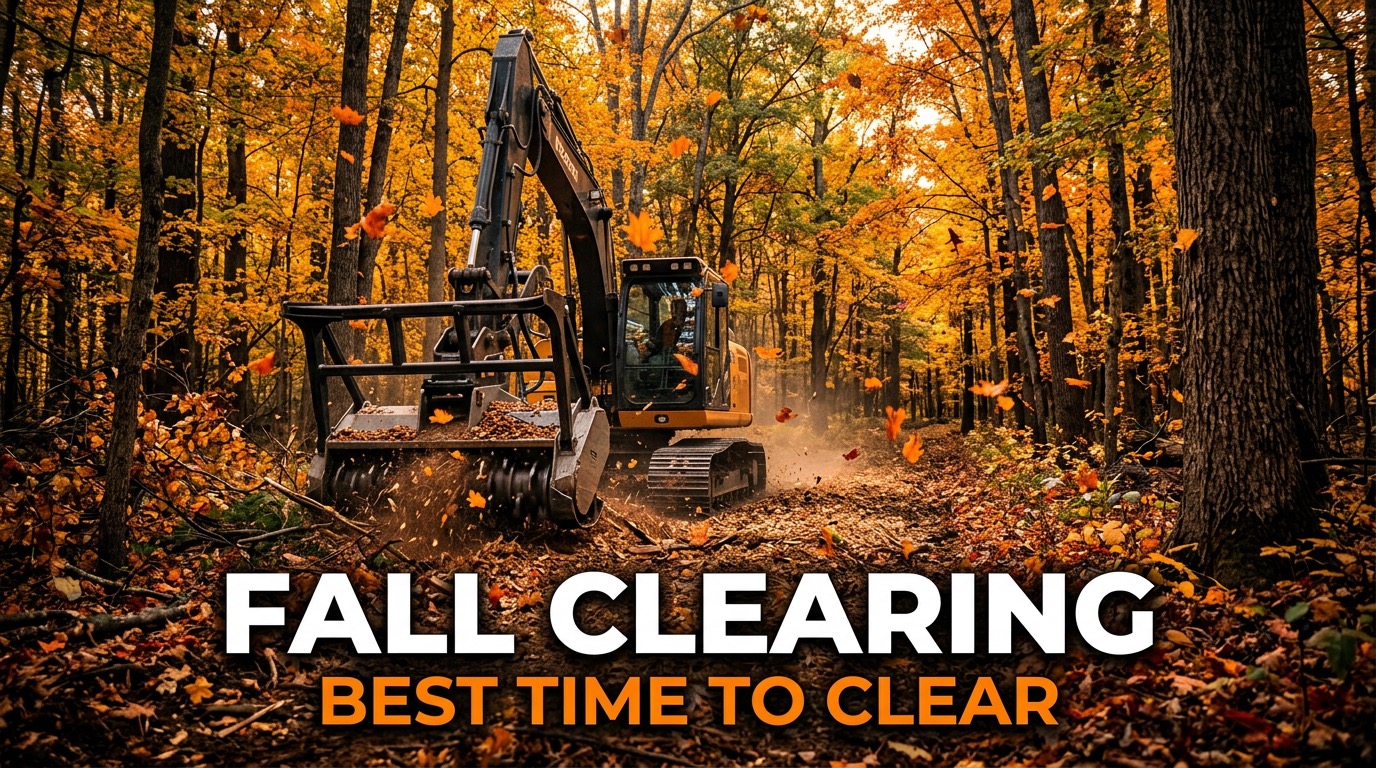
Most Ohio property owners think about brush clearing in the spring. The grass is greening up, the bugs have not arrived yet, and the back acres look worse than they did in October. The problem is that by spring, the calendar is crowded, the ground is often wet, and the leaves are already filling in. By the time the call gets placed, the cheapest, easiest clearing window of the year has already passed.
That window is autumn. Between roughly mid-October and the first hard freeze of December, Ohio properties hit a sweet spot that does not exist any other time of year. Leaves come down. Honeysuckle and other invasives stay green long enough to spot. The bugs and snakes go quiet. The soil firms up after summer humidity. Machines can move efficiently, crews can plan accurately, and the property owner can finally see what they actually own.
Autumn brush clearing in Ohio is not just a season-of-convenience. It is, for many jobs, the right time to do the work. Here is what fall clearing looks like across Cincinnati, southwest Ohio, and the rest of the state, and how to make the most of the season before the ground freezes.
Why fall is the best clearing season in Ohio
The biggest single advantage of fall brush clearing is leaf-off visibility. In summer, a wooded edge is a wall of green. You cannot see the fence row, the property corner, the creek, the rock pile, the old well cap, or the line of dead ash standing behind the honeysuckle. Crews are working blind, and so are you. In fall, that wall comes down piece by piece. By late October, most of the canopy has dropped. By early November, the understory is visible. You can finally walk the property and see what is actually there.
That changes the entire job. A crew that can see the work area can plan it accurately. The owner can mark what to keep and what to clear with real information instead of guesses. Property lines become visible. Drainage patterns are easier to read. Existing trees show their shape and health. Decisions about selective clearing get sharper because everyone can see what is being decided about.
The second advantage is ground conditions. Ohio soil, especially the clay-heavy ground around Cincinnati, Hamilton County, Clermont County, Butler County, and Warren County, is unpredictable in spring. Snowmelt, spring rain, and saturated subsoil can make spring clearing risky for ruts. Summer can swing the other way with hard, baked clay and dust. Fall, in most years, sits between those extremes. Soil drains, surfaces firm up, and machines can move across the property without leaving ugly tracks behind.
The third advantage is comfort and efficiency. Mid-50s and low 60s are the easiest temperatures for crews to work in all day. Cool weather means fewer breaks, longer productive hours, and less dust hanging in the air. The bugs are gone. The ticks are minimal. The snakes are tucked away. The neighbors are not running mowers next door. The whole site is quieter and more focused, which usually shows up in the finished result.
Book your fall clearing window
Fall calendars fill fast across Cincinnati and southwest Ohio. Send Brushworks the address and a few photos and we can scope the job before the season closes.
Leaf-off visibility changes how clearing gets planned
Most clearing problems on Ohio properties are not about big trees. They are about the middle layer: honeysuckle, autumn olive, multiflora rose, grapevine, callery pear, privet, locust sprouts, and bramble. In summer that layer is a wall. In fall, the wall thins out, and the property starts telling the truth.
That truth often surprises owners. A homeowner who thought the back of the lot was full of trees may find that most of the wall was invasive understory hiding a handful of good oaks and hickories. A landowner who pictured a clean creek may discover three downed trees across the channel and a tire stack from a long-gone tenant. A buyer walking a new property after closing may finally see the actual layout instead of the listing photos.
That information is the foundation of a good clearing plan. Without it, you are paying a crew to make judgment calls in the field. With it, you are giving them a map. Mark the trees you want kept. Mark the invasives you want gone. Mark the lines that need opened. Mark the wet pockets to avoid. Each one of those marks gets easier to place in mid-November than in mid-July.
For larger projects, fall visibility helps even more. Driveway routes, building pads, septic test areas, fence lines, food plots, trail networks, and pasture edges all benefit from being designed when you can see the ground. Excavators, builders, surveyors, and fence contractors do better work when the brush has been knocked back first and they can read the terrain.
Invasive species are easier to identify in fall
Ohio's biggest invasive problem is bush honeysuckle. The advantage in fall is that honeysuckle hangs onto its green leaves much longer than native trees. By the time native oaks and maples have dropped most of their canopy, honeysuckle is still green and easy to see. Across a hillside or along a fence row, the patches of honeysuckle stand out clearly against the leafless natives. That visibility is gold for a clearing plan.
Autumn olive does the same thing, holding its silver-green leaves into late fall. Callery pear (Bradford pear) flashes red and orange before turning. Multiflora rose holds leaves and bright red hips that mark every plant in a thicket. Even tree of heaven, with its long compound leaves, becomes easy to identify once the surrounding canopy is gone.
That matters because clearing without identification turns into a guessing game. A crew can mow a whole hillside without knowing which species are most aggressive, which root systems will resprout fastest, and where the worst seed sources live. With visible identification, the work becomes targeted. You can hit the honeysuckle thickets hardest, mark the autumn olive for follow-up treatment, and protect the desirable cover that is mixed in.
For property owners working through invasive removal in stages, fall is also the time to map the next round. Once the worst patches are mulched, the next worst patches are easier to spot before snow flies. That makes spring planning much more accurate than starting from scratch in March.
Ground conditions and equipment access in fall
Ohio's soil profile, especially in the southwest part of the state, is heavy on clay. Clay soils are slow to drain and quick to deform under weight when they are wet. That is why spring clearing carries real risk of ruts and tracks even on otherwise simple jobs. Fall conditions are usually much better. A late-September dry stretch firms up the topsoil. October rain rarely soaks deep enough to soften the clay below. Most fall weeks are workable, and the few that are not are easy to wait out for a few days.
Firm ground matters because it controls how much soil disturbance the job creates. A track machine on dry ground glides. The same machine on saturated ground digs trenches. For property owners who care about lawn edges, pasture surface, trail beds, or future landscape work, fall clearing is the cleanest season because the ground holds up to the work.
Access roads, driveways, and staging areas are also better in the fall. Equipment trailers can park in places that would be too soft in spring. The crew can stage materials, fuel cans, and trucks closer to the work. That reduces walk-out time and keeps the day productive. Small efficiencies add up over a multi-acre job.
The exceptions are creek bottoms, springs, low pockets, drainage swales, and septic fields. These places stay wet regardless of season. A fall job should still avoid them when soft, just like any other season. The difference is that in fall the soft spots are easier to see and easier to leave alone, because the rest of the property is firm enough that the crew is not tempted to cut corners.
What fall clearing looks like in practice
A typical Cincinnati-area fall clearing day starts cool, often in the 40s. Frost on the grass is common in early mornings by late October. The machines warm up, the crew walks the property with the owner, and the work area gets confirmed against any flags or markers. By mid-morning, the temperature is in the 50s and the work is moving. Mulchers cut through honeysuckle, autumn olive, multiflora rose, grapevine, locust sprouts, and saplings, leaving a uniform mulch layer behind.
Visibility on the site grows as the day goes. What started as a wall of brush turns into open ground, marked by stumps cut flush and a brown mulch surface. Property corners, fence lines, and good trees become visible. The owner can finally see how the project will sit on the land. Last-minute adjustments to the work area are easy because the crew can simply walk over and look at the next strip before cutting.
By late afternoon, the work area is opened, the equipment is staged for the next day or loaded for transport, and the property looks dramatically different than it did at sunrise. The mulch layer protects the soil heading into winter. The freshly opened ground rests over the cold months and is ready to be seeded, fenced, graded, or built on come spring.
That sequencing is one of the underrated advantages of fall clearing. You get the heavy lifting done before the holidays, the property settles over winter, and you start spring with a head start instead of a backlog. Builders, fence contractors, landscapers, and excavators all run on tight spring schedules. A property that is ready to go in March, before the rush, gets better contractors at better prices.
Common autumn clearing projects across Ohio
The most common fall clearing project across Cincinnati and southwest Ohio is invasive honeysuckle removal. Property owners who can finally see how bad the back acres have gotten book the work for late October and November. The combination of leaf-off visibility, firm ground, and honeysuckle's stubborn green leaves makes it the ideal moment for that kind of job.
Fence row clearing is another big fall category. Once the corn is out and the soybeans are off, farmers can finally see the fence line and reach it without driving across a crop. Brush rows that have been ignored for two or three seasons get mulched flat. New fence contractors can lay out work for the next spring. Pasture edges get pushed back and reclaimed.
Trail clearing, driveway widening, and access lane work all get easier in the fall. Trail networks for ATVs, UTVs, hunting, and walking can be cut cleanly when the trail line is visible. New driveway corridors can be opened with accurate sight distance and grade visibility. Existing driveways that have been narrowing every summer can be widened back to their original limits.
Hunting properties run heavily on fall clearing. Food plots get prepared for the next year. Shooting lanes get opened in time for late-season hunts. Edge habitat gets refined. Trail cameras get repositioned. Stand sites get cleaned up. Even properties that are not actively hunted benefit from fall wildlife habitat work because the visibility makes habitat planning accurate.
Construction prep, septic site work, and building pad preparation also fall in this window. A builder who has the clearing done in November can start staking, grading, and excavating in March without waiting in line. A pole barn site can settle and dry over winter so the spring concrete pour is on stable ground. A septic test area can be opened so the health district inspection happens before the spring backlog.
Forestry mulching versus burning and hauling in the fall
One question that comes up every fall is whether to mulch the brush or burn it. Burning has appeal in cool weather, when fire danger is lower than in summer and the brush is dry enough to light. But burning in Ohio comes with rules. Open burning ordinances vary by county, township, city, and time of year. Wind shifts can put a fire in a neighbor's tree line in minutes. Smoke complaints are real. And brush piles, even properly built ones, do not always burn clean.
Forestry mulching avoids all of that. The brush is cut, chipped, and left on site as a protective mulch layer. There are no piles, no permits to chase, no smoke to manage, and no fire risk to worry about. The mulch protects soil through winter, holds moisture into spring, and breaks down over a couple of seasons to feed the next round of growth. For most fall projects, that is the cleaner path.
Hauling is the other alternative. Cutting brush, loading it onto trailers, and trucking it off site works for small jobs near a usable dumping ground. For larger projects, the cost of haul time, dump fees, and labor adds up fast. Mulching keeps the material on site, which lowers cost and avoids the back-and-forth of repeated trips.
Burning, hauling, and mulching all have their place. Fall just happens to be a particularly good season for mulching because the cooler weather and dry ground make the work efficient, and the mulch layer benefits the property through the coldest months of the year.
How to prepare for an autumn clearing job
Good fall clearing starts with a property walk before the leaves are completely down. By late September or early October, you can usually see enough through the thinning canopy to mark out the work area. Walk the property with flags, ribbon, or paint and mark trees you want saved, lines you want opened, and any obstacles or sensitive areas to avoid.
Share what you know about the property. Septic locations, well caps, underground propane lines, invisible fence runs, irrigation, and old farm utilities can all be hidden in the brush. Property surveys, plat maps, builder sketches, and aerial photos are all helpful inputs. Even a phone screenshot of Google Earth with arrows drawn on it can save a crew time and avoid mistakes.
Think about access. Where will the equipment trailer park? Is the driveway wide enough? Are there low limbs that need to come down before a tractor and mulcher fit through? Is the staging area firm and dry? Most of these questions are easy to answer in a quick phone call, but they need to be answered before the truck shows up.
Decide on the end use. A fall clearing job done for a builder is different than one done for a hunting property, a horse pasture, a campsite, or a yard expansion. The clearing limits, edge treatment, and mulch density should match what the property is going to be used for next.
Schedule early. Fall calendars across Cincinnati, Hamilton County, Butler County, Warren County, Clermont County, and the rest of southwest Ohio fill up by early October. The good crews book out weeks in advance. If you want a November date, July is not too early to be on the calendar. By mid-September, the prime weeks are often gone.
When fall is not the right season
Fall is excellent for most clearing work, but it is not universal. A few situations are better handled in other seasons. Properties with extensive earthmoving needs (grading, pond work, basement excavation, large stump removal) may sequence differently. Sites with wet conditions that persist through the fall might be better tackled when the ground freezes hard in mid-winter. Pasture renovation that requires immediate seeding might fit early spring better than late fall.
If the property requires permits, environmental reviews, or coordination with multiple agencies, that paperwork can take longer than a season. Starting that process in fall for a spring job is often a better fit than rushing fall work that may need approvals.
For invasive species that respond best to specific herbicide timing, the chemical follow-up may shift the optimal mulching window. Bush honeysuckle, for example, can be effectively treated with cut-stump applications in cool weather, but other invasives have different cycles. A clearing plan that includes herbicide work should be timed accordingly.
Even with those exceptions, fall handles a wider range of clearing projects well than any other season. When in doubt, fall is a strong default.
How Brushworks approaches fall clearing
Brushworks runs fall clearing across Cincinnati and southwest Ohio with a simple priority: use the season's advantages on purpose. That means scheduling jobs for the leaf-off window when it matters for visibility, mapping invasives before the green is gone, working ground when it is firm enough to leave clean, and sequencing jobs so the property is ready for winter and prepared for spring.
On a site visit or photo review, we look at access, slope, brush type, good trees, wet areas, work limits, staging, and what comes after clearing. A property meant for a builder gets a different plan than a hunting tract or a backyard cleanup. A wooded lot gets a different equipment plan than an open field edge.
The fall window is short. From the first hard frost to the first deep freeze is about eight to ten productive weeks in most Ohio years. If your property has been waiting for the right time to get cleared, autumn is usually it. Send an address, photos, and the goal for the property, and we can build a plan that uses the season instead of fighting it.
Frequently asked questions
Why is fall a good time to clear brush in Ohio?
Leaves are down, so you can actually see the property. Bugs and snakes are mostly gone. The ground is usually firm enough to support machines without rutting. Honeysuckle and other invasives still hold green leaves into late fall, which makes them easy to spot and target. It is one of the most efficient clearing windows of the year in Cincinnati and across Ohio.
When does autumn brush clearing season start in Ohio?
Most Ohio properties become workable for fall clearing once leaves start dropping in October. The sweet spot usually runs from mid-October through mid-December, before the ground freezes hard and snow arrives. In a dry fall, work can stretch deeper into December. In a wet fall, soft soil can push some jobs into winter.
Is forestry mulching better in the fall than summer?
For most properties, yes. Fall mulching benefits from leaf-off visibility, cooler temperatures, dormant native plants, drier soil, and easier identification of invasive species like honeysuckle and autumn olive that hold their leaves longer. Summer mulching still works, but heat, dust, and dense foliage make the job slower and harder to plan.
Will fall clearing kill invasive honeysuckle?
Mulching honeysuckle in the fall removes the visible plant and most of the seed source for that year. The roots can resprout the following spring, so long-term control usually pairs fall clearing with a spot-treatment plan. The advantage of fall is that you can see what you are dealing with and target it cleanly without the wall of leaves that hides everything in summer.
Can the ground get too wet for fall land clearing in Ohio?
Yes. Wet clay holds water and gets soft fast after a rain. A good crew will check the ground before bringing heavy equipment onto a site. Most fall weeks in Ohio are workable, but some weeks are not, and it is better to wait a few days than to rut up a property that was supposed to be improved.
Should I wait until winter instead of clearing in the fall?
Both seasons work. Winter clearing is excellent when the ground is frozen because machines float over the soil with minimal disturbance. Fall clearing is usually easier on the schedule and more comfortable for the crew and the property owner. If you can book fall, take it. If fall fills up, winter is a strong second option.
Related articles
Winter Land Clearing Ohio
Frozen ground advantages and why dormant-season clearing is so clean.
Spring Land Clearing Ohio
Seasonal timing, ground conditions, and the right way to prep for spring work.
Bush Honeysuckle Removal Ohio
How to handle the invasive brush taking over Ohio woodlots and yard edges.
Ready to book your fall clearing window?
Send the address, photos, and the area you want opened. Brushworks can scope the job, hold a date in the fall calendar, and help you use the season instead of fighting it.