
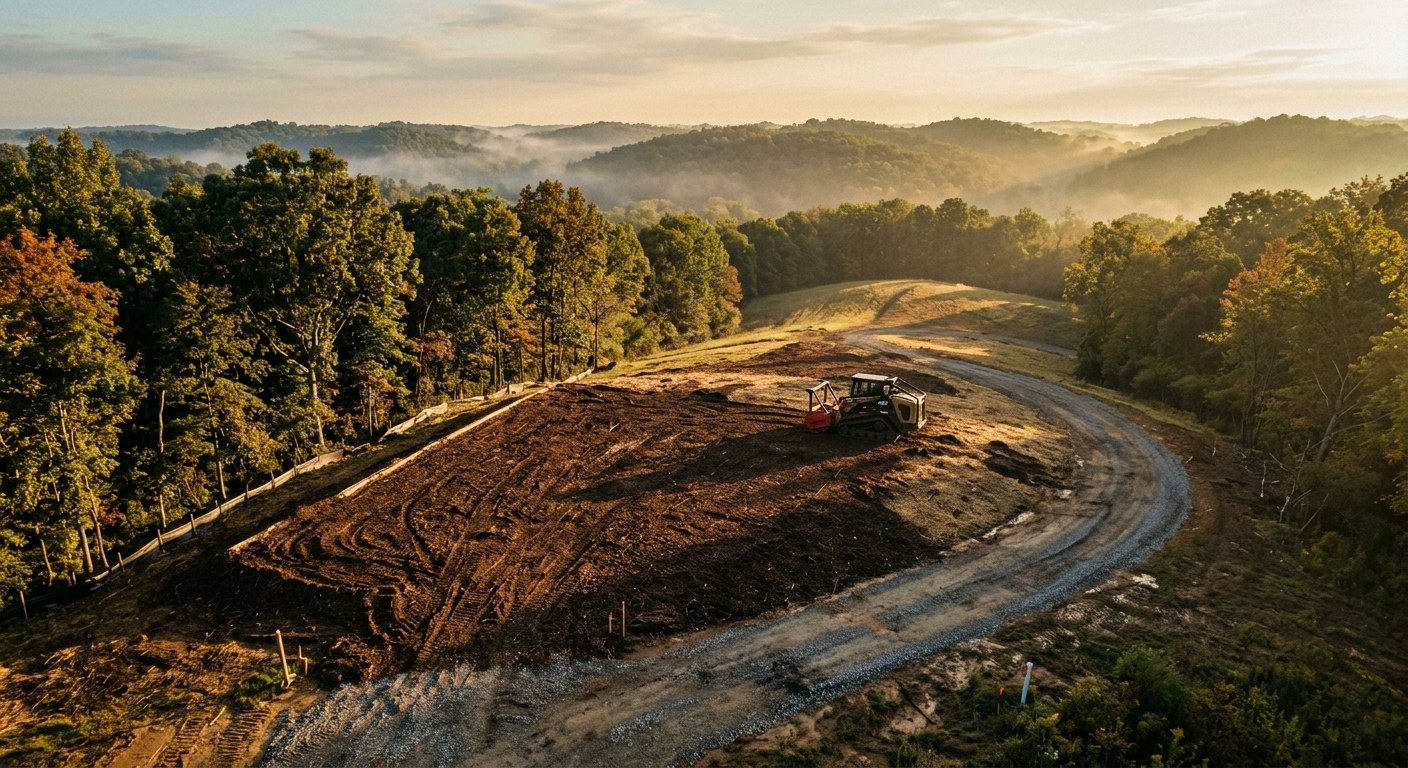
Why site prep makes or breaks a barndominium build
Most people fall in love with the barndominium idea because it looks simple. Big steel frame, open floor plan, shop on one side, living space on the other. And from the outside, a barndo on a finished lot looks straightforward. The reality is that the steel goes up in a few days. The site prep is what usually takes weeks.
Across southern Ohio, the properties where people build barndominiums are rarely nice flat open pastures. They are old family land, wooded hilltops, hobby farms, neglected acreage, or a back corner of a larger parcel. That means the first real cost is not the building. It is getting the site into shape so a builder and excavator can actually work.
When prep is rushed or skipped, the job gets expensive fast. Rutted driveways, soft pads, poor drainage, exposed tree roots, and buried fence wire can all blow up a schedule that looked reasonable on paper. Good prep prevents almost all of it.
What real barndominium site prep actually includes
There is no single step called "site prep." It is a stack of work that happens in a specific order, and each piece depends on the one before it. On most Ohio barndo builds, the pieces look like this.
The basic barndominium site prep stack
- • Clearing: brush, saplings, small trees, invasives, and debris around the building footprint
- • Selective tree work: removing only the trees that are in the way, protecting the rest
- • Driveway and access: cutting in a stable route that equipment and concrete trucks can actually use
- • Pad location and rough grading: picking the right spot and getting the ground close to level
- • Drainage: making sure water moves away from the pad, not toward it
- • Utility trenching: electric, water, septic, and sometimes gas
- • Final pad: compaction, stone, and a true build-ready surface
Clearing is where most projects start. A wooded Ohio hillside or an overgrown field has to become a workable, visible site before anyone can rationally talk about pad location, drainage, or access. That is why forestry mulching is often the first real step on a barndominium project.
Why forestry mulching is the right first step
Most Ohio barndominium sites benefit from forestry mulching before excavation. Mulching cuts and processes brush, saplings, and small trees in one pass, leaving a mulch layer on the ground instead of a pile of debris. The site becomes walkable and visible almost immediately, which changes the whole planning conversation.
Before mulching, you are squinting through a wall of honeysuckle and volunteer maples trying to guess where the pad should go. After mulching, you can actually see the slope, the sight lines, the drainage patterns, and any surprises the property was hiding. That is a better place to make a decision that will sit underneath your home for fifty years.
Mulching before excavation
- ✓ Reveals the real terrain
- ✓ Exposes stumps, old fence, and junk
- ✓ Leaves soil stable, not torn up
- ✓ Makes grading quotes more accurate
- ✓ Keeps surrounding trees undamaged
Skipping mulching
- ✗ Bulldozer operates blind
- ✗ Mixed debris piles through the topsoil
- ✗ Heavy rutting before building starts
- ✗ Surprise trees and fence wire slow the dig
- ✗ Excavation bill creeps up
This is one of those cases where spending a little money early actually saves money later. A well-cleared barndo site makes the excavator's job faster and cheaper. It also lets your builder commit to a pad location with a lot more confidence.
Picking the right pad location on Ohio land
A lot of first-time barndo owners have a dream spot picked out before they ever walk the property with an experienced eye. That spot might still be the right one. But in Ohio, you have to sanity-check it against a few real variables that can make or break the project.
Slope and sight line
Southern Ohio is not flat. Clermont, Brown, and Warren County properties often roll just enough that a pad location one hundred feet in the wrong direction adds thousands in fill dirt or cut work. The best pad spot is usually close to level already, with enough natural drop to move water away on its own.
Drainage
Water is the number one enemy of any rural Ohio build. Pad locations that sit in a low spot, at the base of a hill, or in the natural drainage path of the property will fight you forever. A good site visit will identify where surface and subsurface water actually wants to go, and place the pad out of that path.
Access and driveway path
Your pad is only as good as the route you use to reach it. A great building site with a bad driveway is a recipe for stuck concrete trucks, damaged lawns, and delayed framing. A lot of Ohio barndo projects end up moving the pad slightly just to get a cleaner approach for big trucks.
Utilities
Long utility runs add cost quickly. If the pad sits four hundred feet from the road, that is four hundred feet of electric, four hundred feet of water line, and a real conversation about generator service, cisterns, or well systems. Not necessarily a deal breaker, but it changes the budget.
Driveway access for barndominium builds
Access is often the most under-planned part of a rural Ohio build. The barndo itself may only need a modest driveway to look finished, but during construction you need a route that can handle concrete trucks, lumber trailers, dump trucks, steel delivery, and boom trucks. That is heavier traffic than the finished driveway has to support long-term.
A typical good-access plan includes a widened, reinforced driveway with turnaround space near the build site, proper culverts for any ditches or streams, and enough room for trucks to stage. Forestry mulching and brush removal are usually the first step here too, since most rural parcels have a driveway corridor that is choked with overgrowth long before the first load of gravel arrives.
Pro move
Cut and mulch the driveway corridor wider than you think you need. Trim it back later if you want. Oversized driveway prep is cheap now and painful to do after your home is framed.
How much barndominium site prep costs in Ohio
Barndominium site prep pricing varies more than most things in construction because the starting condition of the land is so different from one parcel to the next. Still, here is the rough cost range most Ohio customers run into.
| Phase | Typical range | Notes |
|---|---|---|
| Brush clearing and forestry mulching | $1,800 to $4,500 per acre | Covers building footprint plus work zone |
| Selective tree removal | $500 to $3,500+ | Depends on size, access, and haul requirements |
| Driveway clearing and rough cut | $1,500 to $6,000 | Length, slope, and vegetation drive price |
| Rough grading and pad prep | $4,000 to $15,000 | Separate excavator scope |
| Stone and final build-ready pad | $3,000 to $10,000 | Size and depth dependent |
| Utility trenching and installation | $2,500 to $12,000+ | Run length and utility count matter most |
Those are real Cincinnati-area ranges. Some builds come in well under these numbers on flat open land with existing access. Others, especially wooded hillsides with a long driveway and soft ground, run higher. The single best predictor is the condition of the land before anyone touches it.
Common mistakes that cost barndominium owners money
A lot of Ohio barndo projects hit avoidable snags because prep decisions get rushed. These are the ones we see most often.
Picking a pad spot from Google Maps
Aerial imagery hides slope, drainage, and vegetation. The pad spot that looks perfect from the air may sit in a seasonal wet zone or at the end of a gnarly access path.
Skipping real drainage planning
Barndominiums have huge roofs. Without a drainage plan, that roof water becomes your foundation's problem. Swales, tile, and pad elevation have to be thought through before the pour.
Under-sizing the driveway
A driveway that works for your pickup may not work for a pumper truck. Undersized driveways get beat up during construction and need redoing after occupancy.
Clearing too much
Some owners panic and strip the lot bare. That hurts privacy, resale, and windbreak. Mulching lets you target the building zone and keep mature trees that make the property feel finished.
Clearing order of operations on a typical Ohio barndo project
Here is a simple order most Ohio barndominium projects benefit from. It is not the only way, but it avoids the majority of expensive rework.
- Walk the land with a clearing contractor, builder, and if possible an excavator. Talk through pad, access, and drainage.
- Forestry mulch the building zone and driveway corridor to expose real terrain.
- Confirm pad location once you can see the ground, not just the treetops.
- Pull permits. Building, septic, driveway/culvert, and any zoning or environmental requirements.
- Rough-grade the pad and shape drainage before utilities go in.
- Run utilities: electric, water, septic, gas, and any low-voltage runs.
- Finish the pad with stone and proper compaction, ready for the slab.
- Coordinate steel delivery and start the vertical build.
Every step skipped or done out of order tends to add cost somewhere else. Site prep is unglamorous work, but it is where the smart money goes on a barndominium build.
Permits and local rules around Cincinnati
Barndominium permitting in Ohio is mostly handled at the county and township level. That means rules vary a lot from one parcel to the next, even within the same county. Rural Clermont, Warren, and Brown County parcels often have more flexibility than parcels inside village or city limits.
In most of the Greater Cincinnati area you will need a building permit, septic permit, and a driveway or culvert permit. Some jurisdictions have setbacks, minimum floor area, or residential design requirements that affect whether a barndominium style is accepted. Check with your local building department before any grading begins, and ideally before you commit to a floor plan.
Clearing and mulching itself rarely requires a permit on private rural land, but once you are moving soil, building, or running utilities, the rules kick in. A good local clearing contractor will know the jurisdictions they work in and can flag issues before they become expensive.
How Brushworks fits into a barndominium build
Brushworks is not a general contractor. We do not pour foundations or erect steel. What we do is turn raw Ohio land into a site where the people who do that work can actually operate. Forestry mulching, brush removal, selective tree work, and driveway corridor clearing are the pieces we handle, usually first, before excavators or builders arrive.
We work a lot with property owners who are in the early planning phase of a barndominium and need to see the land before they can commit to a layout. We also coordinate directly with builders and excavators when a project is already moving. That handoff matters. A clean, well-mulched site with the building footprint exposed and the driveway cut is something every excavator appreciates.
Ready to get your barndo site moving?
Start with instant pricing for your clearing scope, or send us a few photos and the address so we can build a plan with you. We work across Hamilton, Clermont, Warren, Butler, and surrounding Ohio counties.
Frequently asked questions
How much does it cost to clear land for a barndominium in Ohio?
Most Ohio barndominium sites run $3,000 to $12,000 for clearing alone, depending on acreage, density, slope, and finish level. Heavy wooded hillsides cost more. Open lots with light cover cost less.
Do I need to clear the whole property or just the building area?
Usually just the building area, driveway, utility runs, and a generous work zone. Leaving mature trees around the pad keeps privacy, reduces wind, and usually helps resale value.
Can forestry mulching handle barndominium site prep?
Forestry mulching is ideal for the clearing phase. It removes brush, saplings, and small trees in one pass and leaves stable ground. Final pad work still belongs to an excavator.
How long does clearing take?
For a typical rural Ohio barndo site, clearing alone usually runs a few days to a week. Full site prep, including driveway, pad, drainage, and utilities, often takes three to six weeks.
Do barndominiums need permits in Cincinnati area counties?
Most rural Ohio counties require a building permit, septic approval, and a driveway or culvert permit. Some townships have additional design or setback rules. Always check with the local building department before earthwork begins.
Related articles
Clearing Land for a Pole Barn in Ohio
Site prep, costs, and what to know for pole barn and shop builds on Ohio acreage.
Land Clearing for Home Building Ohio
A deeper look at pre-construction site prep for rural and semi-rural Ohio home builds.
Land Clearing Cost Per Acre Ohio
What drives clearing pricing across Cincinnati and southern Ohio and how to plan for it.
Your barndominium build starts at the dirt
Get the site right and the rest of the project is a lot less stressful. Send us your property address and a few photos and we will help you plan a real clearing scope.