
Brush Clearing for Municipal Properties Ohio
Municipal brush clearing is rarely just cosmetic. It is usually about access, drainage, visibility, public safety, and giving maintenance crews room to do the work they are already responsible for.
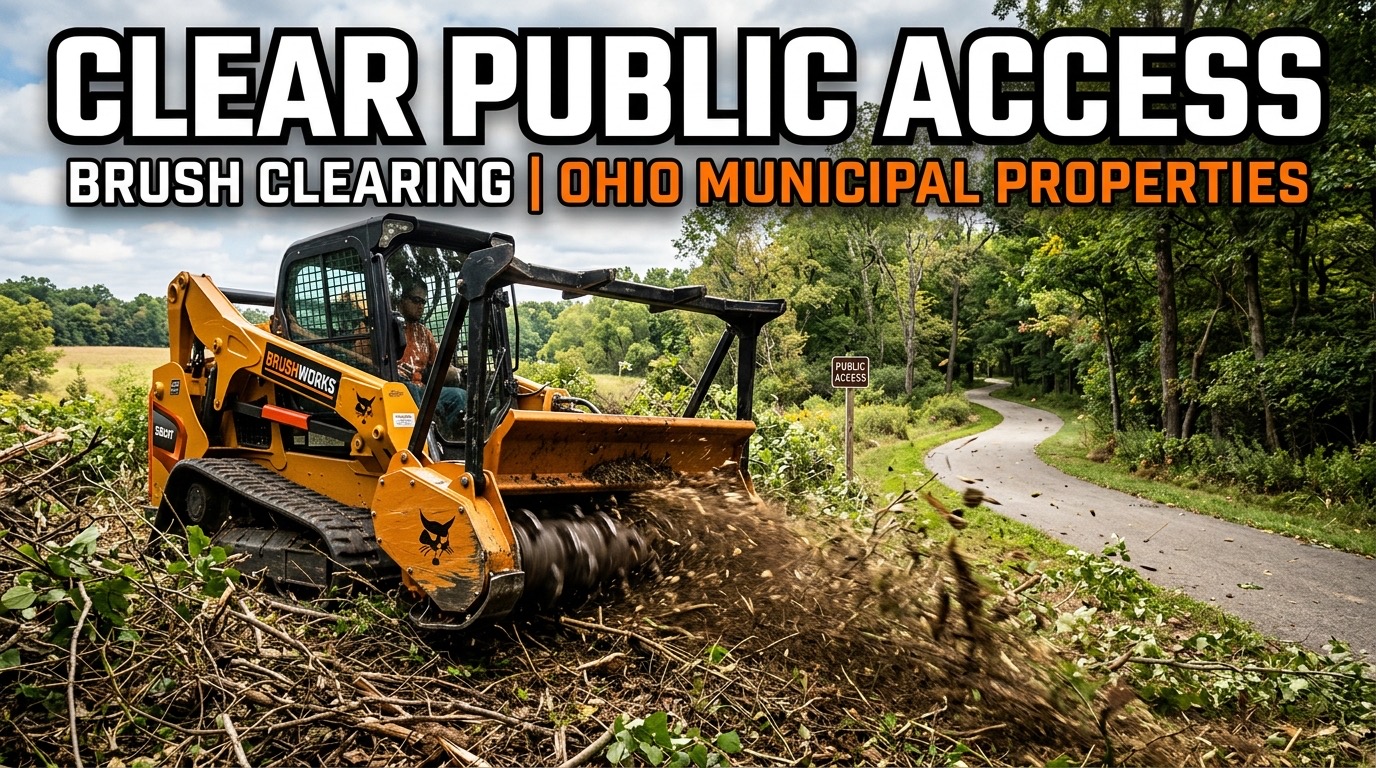
Every township, village, city, school district, park board, and public works department has a few places that quietly get away from them. A drainage ditch grows full of honeysuckle. A detention basin outlet disappears behind willow and grapevine. A public lot turns into a wall of brush. A trail edge closes in until mower crews cannot get through. A fence line behind a building becomes a dumping spot because nobody can see it from the road.
That kind of growth is easy to ignore until it blocks work. Then the phone calls start. A culvert will not drain. A resident complains about sight distance. A utility crew cannot reach a lift station. A parks crew cannot mow a boundary. Public works has equipment, but the job is too woody for a mower and too tangled for a clean hand crew day.
Brushworks clears overgrown land for public, commercial, and rural properties around Cincinnati and across southwest Ohio. For municipal sites, the goal is usually simple: open the area enough that it can be inspected, maintained, and used again. The best jobs start with a clear boundary, a practical scope, and a maintenance plan after the heavy growth is gone.
Need a municipal brush area opened up?
Send photos, a map pin, and the limits of work. Brushworks can help clear public lots, drainage access, park edges, fence lines, and overgrown maintenance lanes so crews can get back in.
Start with the reason for clearing
A municipal clearing job should begin with the reason the area needs attention. If the problem is drainage, the scope should follow the ditch, swale, inlet, outlet, basin edge, or access route. If the issue is public safety, the work may focus on road sight lines, hidden corners, trail visibility, or access for emergency vehicles. If the property is being prepared for mowing, inspections, or repairs, the cleared area needs enough working room for the equipment that will come next.
This sounds obvious, but it matters. A crew can clear a lot of brush and still miss the real problem if the scope is vague. "Clear the back side of the park" is not as useful as "open the maintenance lane from the gate to the basin outlet, clear ten feet around the outlet, and leave the marked trees." A tight scope helps the municipality control cost and helps the clearing crew avoid removing growth that should stay.
It also helps with public communication. Residents may ask why brush is being removed, especially around parks and neighborhood green space. A clear explanation keeps the conversation grounded: the work is to restore access, reduce blocked drainage, remove invasive growth, reopen a trail edge, or make a public asset maintainable again.
Common municipal sites that need brush clearing
Municipal overgrowth tends to show up in the same places. Road shoulders and right-of-way edges collect honeysuckle, locust, Bradford pear, grapevine, and volunteer trees. Stormwater areas grow fast because they hold moisture and often sit out of sight. Fence lines around public works yards, parks, ball fields, schools, cemeteries, and utility sites can go from manageable to tangled in a few seasons.
Public trails are another common problem. A trail may still be passable on foot, but the edges close in until mowing becomes difficult and sight lines get poor. Around Cincinnati and other wooded parts of Ohio, invasive shrubs can turn a trail corridor into a tunnel. Clearing the edges, corners, and access points can make the trail easier to maintain without turning the whole area into bare ground.
Unused public lots need attention too. A vacant parcel owned by a township or city can hide trash, old fence wire, dumping, encampment debris, dead trees, and drainage issues. Clearing it does not have to mean grading it flat. Often the first step is simply opening the property enough that officials can see what is there and decide what comes next.
Drainage work needs visibility first
Stormwater problems are hard to solve when nobody can see the structure. Ditches, swales, culverts, risers, outlets, headwalls, and detention basin bottoms can disappear under brush. The water still moves, but inspectors cannot see where it is blocked, undermined, or cutting a new path.
Brush clearing gives public works or an engineer a better look before repairs are planned. It can expose a crushed culvert, a clogged outlet, sediment buildup, beaver damage, erosion, or a ditch that has slowly filled with woody growth. It also gives mowing and excavation crews enough room to work without fighting vines and saplings at the same time.
The clearing plan should protect the parts of the stormwater system that need to stay stable. Around wet areas, heavy rutting can cause new problems. Mulching can be useful because it handles woody growth on site, but the operator still needs to know where pipes, outlets, soft ground, and slopes are located. If the site touches a creek, wetland, or regulated drainage area, the municipality should check the proper review path before work begins.
Rights-of-way and road edges need careful limits
Roadside brush clearing is useful when vegetation blocks signs, narrows shoulders, hides ditch lines, scrapes vehicles, or limits sight distance at entrances and intersections. It can also help road crews get to culverts, guardrail ends, mailboxes, and drainage structures.
The limit of work matters on road edges. Public right-of-way boundaries are not always obvious in the field. A tree may sit on private property even if its limbs hang into the road corridor. A fence may be old and inaccurate. A resident may have landscaping or personal items near the edge. Before clearing starts, the municipality should mark the intended limits and decide how property owner questions will be handled.
Traffic control is part of the planning too. Some sites can be cleared from inside the property with little road exposure. Others need cones, signs, spotters, lane control, or coordination with the road department. Brush clearing is not worth creating a roadside hazard. The crew, trucks, and debris path should be thought through before equipment unloads.
Forestry mulching can fit public property work
Forestry mulching is often a good match for municipal brush clearing because it can reduce woody growth without hauling piles of brush through town. The machine grinds brush, saplings, vines, and invasive shrubs into mulch and leaves the material on site. That can save time on public lots, basin edges, trails, and access lanes where the goal is to reopen the area rather than produce a manicured finish.
The mulch layer can help limit exposed soil compared with scraping the site bare. That matters on slopes, drainage edges, wooded parks, and rough public ground. It also makes the site easier to walk after clearing because the brush is not left in tangled piles.
There are limits. Forestry mulching is not a replacement for excavation, grading, hauling, stump grinding, tree removal, or finish mowing. Large trees, hazardous trees, utility conflicts, wet ground, steep banks, buried trash, and old wire may require a different plan. A good municipal scope separates brush clearing from the work that belongs to another trade or department.
Mark utilities and hidden hazards before work starts
Public property usually has more hidden infrastructure than it appears to have. Storm pipes, water lines, fiber, electric, gas, sanitary sewer, irrigation, private facility lines, old drain tile, and abandoned structures can all be present. A public locate is a start, but it may not cover every private or facility-owned line on the property.
Old municipal ground also collects debris. Brush can hide sign posts, concrete chunks, guardrail, trash, bottles, wire, dumped tires, fencing, culvert pieces, and metal that can damage equipment. Parks and school properties may have old play equipment footings, chain link fence remnants, or buried edging. Public works yards may have scrap hidden under weeds.
Mark what is known. Walk the site if it is safe. Tell the clearing crew about any past use of the property. If there is a chance of needles, hazardous dumping, unstable banks, or active encampments, handle that before a brush crew is expected to work through it. Clearing goes faster when the unknowns are reduced before the machine arrives.
Keep good trees and remove the growth causing the problem
Municipal clearing does not need to mean removing every tree in sight. In parks, cemeteries, trail corridors, school grounds, and public green space, good trees are part of the value of the property. The job is often to remove invasive understory, low-value saplings, vines, deadfall, and brush that blocks maintenance.
Marking trees to keep is worth the time. Mature oaks, maples, sycamores, and other desirable trees can often stay while the brush around them is cleared. Dead ash, leaning locust, Bradford pear, honeysuckle, autumn olive, and grapevine may be the real trouble. Vines should be handled carefully around trees the municipality wants to preserve because pulling or grinding too aggressively near the trunk can damage bark and roots.
This is especially important where residents use the area. A park edge can feel open and maintained without losing its shade. A trail can gain visibility without becoming a road. A cemetery fence line can be made accessible while keeping the older trees that belong there.
Plan for the crew that maintains it after clearing
Heavy clearing is only the first pass. If a municipal property gets cleared and then left alone for five years, the same problem will come back. Honeysuckle resprouts, locust sends shoots, vines return, and the first mowing after a long gap becomes difficult again.
The best time to plan maintenance is before the clearing job is finished. Decide whether the area should be mowable, walkable, inspectable, or simply open enough for periodic access. If it needs to be mowed, the final surface and width should match the mower. If crews need to inspect a basin outlet twice a year, the path should be easy to find and wide enough to maintain. If the area is a road edge, the follow-up may be scheduled trimming instead of another large clearing project.
Some regrowth may need targeted treatment where the municipality allows it and where the site conditions make sense. Other areas can be controlled with mowing or periodic brush cutting. The point is to avoid paying for the same rescue job over and over because no one owns the follow-up.
Think about neighbors and public expectations
Municipal work is visible. Even when the site is small, residents may notice trucks, noise, temporary mess, changed sight lines, or a row of brush that disappears overnight. A little communication can prevent confusion.
If the work is near homes, parks, trails, schools, or cemeteries, post the purpose in plain language. Tell people the clearing is for drainage access, safety, maintenance, invasive growth removal, or inspection. If some trees are being kept, say so. If the area will look rough for a short time before follow-up mowing or repairs, set that expectation.
Public property can carry a lot of opinions. Some residents want everything cleared. Others hate seeing any vegetation removed. A defined scope gives the municipality something to point to when questions come in. The work is not random. It is tied to a maintenance need.
Bid scopes should be specific enough to price
A municipal brush clearing quote is easier to compare when the scope is specific. Include the address or parcel, access points, estimated area, limits of clearing, trees to keep, debris expectations, work hours, traffic control needs, insurance requirements, prevailing wage questions if applicable, and whether the site must be left mowable.
Photos help, but they do not replace a map. A simple marked aerial image can save a lot of back and forth. If the work follows a ditch or fence line, mark the start and stop points. If only one side of a trail needs to be cleared, mark that. If there are wet areas or utilities, put them in the scope instead of hoping the crew finds them in time.
Municipal buyers also need to separate nice-to-have work from required work. Clearing around a basin outlet may be urgent. Cleaning up the whole back side of the property may be a later phase. Phasing can keep the first job affordable and still solve the maintenance problem that triggered the call.
How Brushworks helps municipal properties around Cincinnati
Brushworks can help Ohio municipalities, townships, public agencies, schools, and property managers open overgrown ground before maintenance, inspection, drainage repair, trail work, or mowing. We are a fit for brushy areas where access and visibility are the problem: public lots, rights-of-way, fence lines, detention basins, park edges, maintenance lanes, and overgrown corridors.
The useful starting point is simple. Send the location, photos, a rough map, and the reason the area needs to be cleared. If there are utilities, drainage structures, property limits, protected areas, traffic concerns, or trees that need to stay, include that up front. The more specific the scope is, the cleaner the job can be.
Municipal brush clearing is not glamorous work. It is the work that lets everything else happen. Crews can inspect the outlet. Mowers can reach the fence. Drivers can see the sign. A public lot can be walked without guessing what is under the vines. That is usually the win: the property becomes manageable again.
Frequently asked questions
What municipal areas usually need brush clearing?
Common areas include road shoulders, rights-of-way, drainage ditches, detention basins, park edges, public trails, unused lots, fence lines, lift station access, utility corridors, and maintenance lanes.
Can forestry mulching help with municipal brush clearing?
Yes. Forestry mulching can clear brush, saplings, invasive shrubs, vines, and overgrowth while leaving a mulch layer on site. It is often useful where a municipality needs access and visibility without hauling every piece of debris away.
What should a township or city mark before brush clearing starts?
Mark property limits, public right-of-way limits, utilities, culverts, drain outlets, structures, fences, trees to keep, sensitive areas, wet ground, traffic control needs, and any known debris or wire hidden in the vegetation.
How do municipalities keep cleared areas from growing back fast?
A maintenance plan helps. After heavy brush is cleared, crews can mow, trim, spot treat invasive regrowth where allowed, keep drains open, and schedule repeat clearing before saplings and vines take over again.
Does municipal brush clearing require permits?
It depends on the site. Work near streams, wetlands, public roads, utilities, stormwater infrastructure, or regulated areas may need review by the municipality, county, utility owner, or another authority before clearing begins.
Related articles
Brush Clearing for Detention Basin Maintenance Cincinnati
Clearing basin access, outlets, spillways, and slopes so stormwater areas can be inspected and maintained.
HOA Land Clearing Services Ohio
A practical guide to common area clearing, trail reopening, basin access, and fence line cleanup.
Brush Clearing for Rural Property Access Ohio
How to reopen lanes, gates, trails, and overgrown access routes without clearing more land than needed.
Need public property cleared for access or maintenance?
Use instant pricing for a starting point, or send photos and a marked map of the municipal area that needs clearing.