
Clearing Land for Modular Homes Ohio: Site Prep Before Delivery
A modular home can go up fast once the sections arrive. The land work has to be ready before that day, because delivery trucks, cranes, foundations, utilities, and drainage do not like surprises.
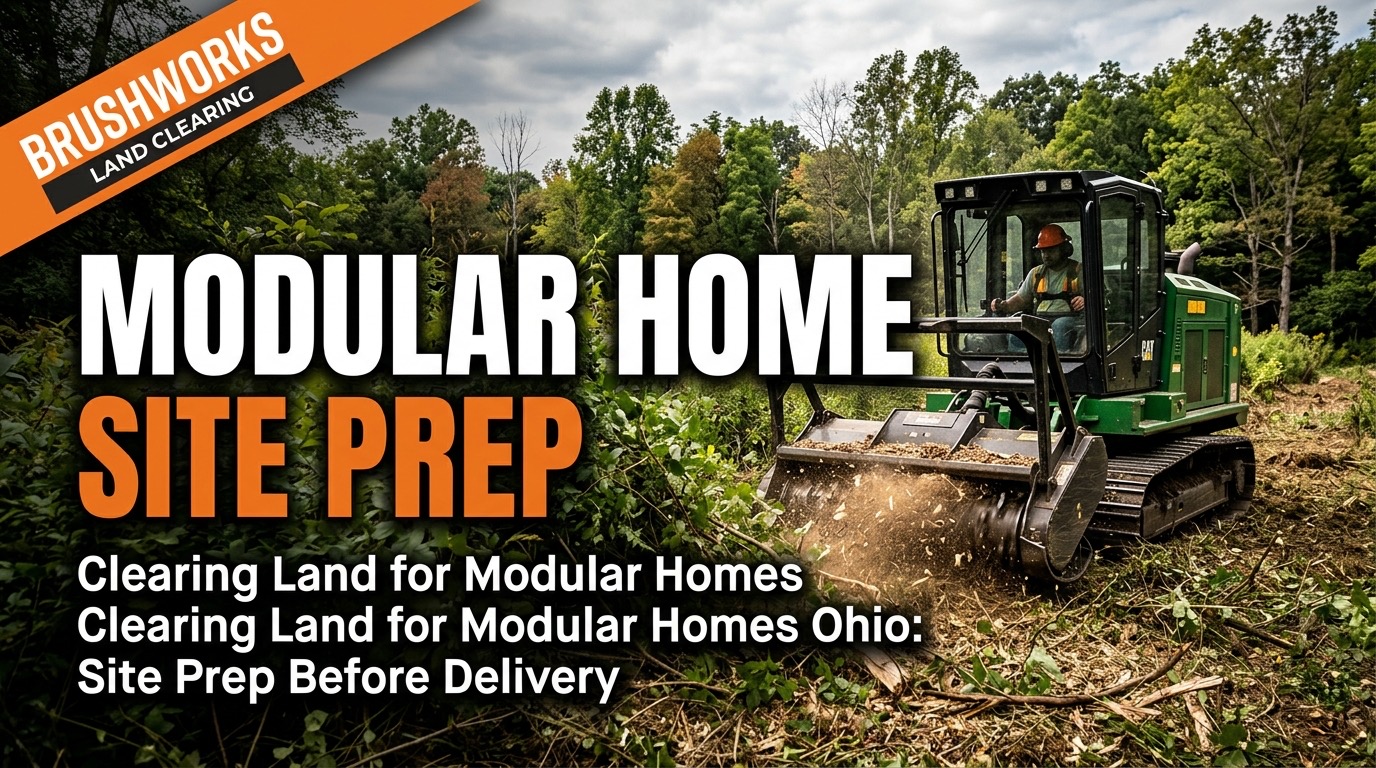
Modular homes change the construction schedule. A stick-built house can creep forward one crew at a time. A modular home has a harder deadline. The foundation needs to be ready. The driveway needs to handle delivery. The set crew needs room. The home sections need to reach the pad without low limbs, soft corners, tight turns, or a wall of brush at the end of the lane.
That is why clearing land for a modular home in Ohio should be treated as part of the building plan, not as a weekend cleanup. The work is bigger than knocking down a few saplings where the house will sit. You may need to open the driveway, clear the foundation area, make room for trucks and a crane, expose drainage problems, protect the septic area, and leave clear routes for electric, water, and future grading.
Brushworks clears wooded, brushy, and overgrown lots around Greater Cincinnati and southwest Ohio. We see the same issue often: the home location makes sense on paper, but the ground has not been opened enough for real construction. Honeysuckle hides the slope. Old fence line trees squeeze the entrance. Dead ash leans over the delivery path. Wet clay sits under grass that looked fine in photos. Clearing early helps everyone see the site before the expensive part starts.
Getting a modular home site ready?
Send Brushworks the property address, photos, the planned home location, and any site sketch from your modular builder. We can help clear access, open the pad area, and make the ground easier for the next contractor to read.
Start with the delivery route and the house footprint
The most common mistake is focusing only on the rectangle where the house will sit. That footprint matters, but the delivery route may be the harder problem. Modular home sections are wide, long, and heavy. They need a route that works from the public road to the foundation, with enough width, overhead clearance, turning room, and stable ground.
A driveway that works for a pickup may not work for a modular carrier. A farm lane that looks open in summer may be too narrow once the trailer has to swing around a curve. Low limbs, leaning cedars, old hedge trees, ditch banks, mailboxes, culvert edges, utility poles, and soft shoulders can all become delivery issues. Around Cincinnati and rural southwest Ohio, many lots have narrow entrances cut through old fence rows. Those entrances often need more clearing than the owner expects.
Walk the route as if you were driving the delivery truck. Look at the turn off the road, the gate, the slope, the ditch crossing, the overhead wires, and the last approach to the foundation. If the modular company provides delivery requirements, use those numbers. If they do not, ask before clearing too little.
The set area needs working room
Once the home sections reach the site, the set crew still needs space to work. Depending on the home, the foundation, and the builder's setup, that may mean room for a crane, transport trailers, support trucks, lifts, staging, and crew vehicles. If the clearing stops right at the foundation wall, the set day can get crowded fast.
The required room varies. Some modular homes can be set with equipment staged from one side. Others need a larger open area because of the number of sections, the slope, or how the home lines up with the driveway. A wooded lot with trees close to the foundation can create trouble even if the footprint is technically clear. Limbs can block the lift path. Stumps and roots can interfere with grading. Soft areas can keep equipment from getting into position.
Before clearing starts, ask the modular builder or set crew where they want access, where the crane or lift will sit, and how much room they need around the foundation. A few extra feet of clearing at the right time can prevent a much larger problem on delivery day.
Clear enough to build the foundation correctly
Modular homes still need proper foundations. Crawl space, basement, slab, piers, and frost wall designs all need excavation room. The foundation contractor needs to strip topsoil, manage spoil, shape the work area, set forms or walls, bring in gravel, and keep water out of the hole. That cannot happen cleanly if the site is boxed in by brush and trees.
Forestry mulching can open the site and remove dense brush, saplings, and small trees. It can expose the grade and make the building area walkable. It does not build the foundation. Organic material, mulch, roots, buried wood, and soft topsoil do not belong under structural fill or concrete. After clearing, the excavation contractor still has to remove unsuitable material, shape the subgrade, handle drainage, and compact what needs to be compacted.
Clearing first gives the foundation crew better information. They can see whether the planned house location is high enough, whether the slope is manageable, whether water moves across the site, and whether the driveway approach lines up with the final floor elevation.
Ohio drainage problems show up after the brush is gone
Brush hides water. Honeysuckle and briars can cover low pockets, old ditches, seep areas, wet clay, and ruts from past equipment. Once the site is opened, the actual shape of the land becomes easier to read. That matters for modular homes because the schedule often moves quickly once permits, financing, and delivery dates are in place.
Look for water paths before the foundation is committed. Where does stormwater come from? Does a neighbor's field drain toward the lot? Is there an old swale through the building site? Does water collect where the driveway needs to turn? Is the planned septic area downhill or uphill from the house? Will roof runoff have a clean place to go?
Southwest Ohio clay can hold water long after a rain. Ground that looks dry from the road can pump and rut under trucks. Clearing cannot fix poor drainage by itself, but it lets the excavation contractor see what needs to be fixed. It also helps you keep the driveway, foundation, and yard from fighting the same water problem later.
Think about septic, well, and utility routes early
A modular home site is more than the house and driveway. Septic approval, well location, electric service, water lines, propane, fiber, drainage pipe, and future outbuildings may all affect what should be cleared. If those routes are ignored, crews may have to come back and reopen parts of the property after the home is already set.
Before clearing, mark known septic areas, proposed leach fields, wells, underground utilities, overhead utilities, and private lines. Public utility marking through 811 is important before digging, but many rural and semi-rural properties also have private lines that are not located by the public utility ticket. Old electric runs to sheds, water lines to hydrants, invisible fence, irrigation, drain tile, and abandoned lines can be hidden under brush.
Utility routing can also change what trees stay. A beautiful tree may be in the wrong spot if electric service has to cross that same line. A brushy strip may need opened for trenching. A future garage, barn, or gravel parking pad may need access from the same cleared area. It is easier to make those choices before the site is crowded with contractors.
Mark trees to save before clearing starts
Not every modular home lot needs to be scraped open. Many owners choose modular construction because they found a quiet wooded lot, an old family parcel, or acreage with a good view. The point is to clear the right ground, not remove every tree.
Mark trees that should stay. Good shade trees, screening along the road, healthy trees outside the work zone, and trees that frame the finished yard can be worth protecting. Also mark trees that have to go: dead ash, split trunks, heavy leaners, trees wrapped in grapevine, thorny locust near the driveway, or limbs that will hang over the roof and delivery path.
Leave enough distance around the home for maintenance. A tree that feels harmless before construction may become a problem when it drops limbs on the roof, blocks sunlight from a wet side yard, or grows into the driveway clearance. If a large tree is questionable, get a qualified tree professional involved before the modular sections are on site.
Old fields and wooded lots need different clearing plans
An old field usually has brush problems. A wooded lot usually has access and tree problems. Many Ohio modular home sites have both. Former pasture ground may be full of autumn olive, honeysuckle, multiflora rose, blackberry, cedar, callery pear, volunteer maples, and small locust. Wooded parcels may have dead ash, grapevine, tight understory, steep slopes, and narrow trails that do not line up with the best building spot.
In an old field, the clearing plan often focuses on opening the house site, driveway, septic area, and future yard without disturbing more ground than needed. In a wooded lot, the plan may focus on selective clearing, overhead clearance, access widening, and enough work room for foundation and set crews. Fence rows are their own problem. They can hide wire, steel posts, old concrete, dumped debris, and thorn trees that are rough on equipment.
Tell the clearing contractor what the land used to be. If there was an old barn, orchard, dump area, farm lane, pond, or buried fence, it helps to know before equipment starts working.
Permits and local rules can affect where you clear
Modular home projects are local. The rules can change by county, township, city, floodplain, subdivision, and utility provider. Hamilton County, Clermont County, Warren County, Butler County, and the smaller townships around Cincinnati can all handle setbacks, driveway permits, culverts, septic approvals, stormwater, and erosion control differently.
Before major clearing, confirm the house location is legal. Check setbacks, zoning, septic approval, driveway entrance requirements, floodplain maps, HOA rules, building permits, and whether the driveway or culvert needs approval. If the site has a creek, wet area, steep slope, shared lane, utility easement, or stormwater feature, slow down and get the right answer first.
Clearing the wrong spot creates expensive rework. It can also upset neighbors or inspectors before the home project really starts. A marked site plan, approved driveway location, and clear understanding of septic boundaries make the clearing phase much cleaner.
What to have ready for a clearing quote
You do not need a perfect construction package to ask for a clearing quote, but a few details help. Send the property address, photos from the road, photos of the planned home location, a rough driveway path, and any site plan or aerial screenshot you have. If the modular builder has delivery notes, foundation drawings, or set requirements, include those too.
Useful markings include the planned house corners, driveway, septic area, well, trees to keep, trees to remove, property lines, wet areas, fences, gates, overhead lines, and any private utilities. Even rough markings are better than a verbal description. Standing on a brushy lot and saying "somewhere over there" is how projects drift.
Brushworks can often give a starting point from photos and maps, then refine the plan after seeing access and density. Thick honeysuckle, briars, vines, trees, slope, debris, wet ground, and haul-off needs all affect pricing.
After clearing, walk the site again
The best time to adjust the plan is after clearing and before excavation. Walk the site with the modular builder, foundation contractor, excavator, or site lead. Confirm the house location, the driveway approach, the delivery route, the set area, the septic protection zone, the utility routes, and the drainage plan.
Sometimes the cleared ground tells you something useful. The home may need to shift a few feet to avoid a wet pocket. The driveway may need a wider turn. A tree that looked fine from the road may be too close to the roof line. A future garage or parking pad may need a cleaner connection now instead of later.
That second walk is not wasted time. It is cheap insurance before concrete, gravel, home sections, and cranes arrive.
How Brushworks helps modular home projects
Brushworks handles the clearing phase for modular home sites, rural home sites, access lanes, wooded lots, and overgrown acreage around Cincinnati and southwest Ohio. We look at how the site will actually be used: delivery access, room around the foundation, brush density, tree risk, drainage clues, utility routes, and what the next contractor needs to do their job.
Our work is usually one step in a larger project. We do not replace the modular builder, excavator, surveyor, septic designer, or permitting office. We help open the land so those people can see it, price it, and build on it without guessing through brush.
If you are planning a modular home, start with the ground. Clear the route, open the house site, protect the septic area, and leave enough room for the set. The home may arrive in sections, but the site still has to work as one piece of land.
Frequently asked questions
How much land should I clear for a modular home in Ohio?
Clear the house footprint plus enough room for excavation, foundation work, delivery trucks, crane or set crew access, utility trenches, drainage, parking, and future maintenance. The needed opening depends on the home size, driveway approach, slope, trees, and how the modular company plans to set the sections.
Should land be cleared before or after the modular home company visits?
If the lot is heavily overgrown, a first clearing pass can make the site visible enough for accurate layout and pricing. If the lot is already walkable, have the modular builder, excavator, and clearing contractor agree on the house location, delivery route, and staging area before major clearing starts.
Can forestry mulching prepare a modular home site?
Forestry mulching can remove brush, saplings, invasive shrubs, and small trees so the site can be measured, accessed, and prepared. It does not replace excavation, foundation construction, compaction, gravel installation, septic work, utility trenching, or engineered drainage.
What should be marked before clearing land for a modular home?
Mark the planned house corners, driveway, delivery route, septic area, well, utilities, trees to save, trees to remove, property lines, setbacks, wet areas, overhead lines, and any location where trucks or equipment should not travel.
Do modular homes need special access for delivery?
Usually, yes. Modular home sections are large and need a route with adequate width, turning room, overhead clearance, firm ground, and a safe approach to the foundation. Tight bends, low limbs, narrow gates, steep grades, wet clay, and weak driveway edges can delay delivery.
Do I need permits before clearing for a modular home in Ohio?
Permit requirements vary by county, township, city, floodplain, subdivision, and utility provider. Confirm zoning, setbacks, driveway permits, septic approval, building permits, erosion control, and HOA rules before clearing, excavation, or delivery scheduling.
Related articles
Land Clearing for Barn Pads Ohio
How to clear access, drainage, and work space before building on rural land.
Driveway Access Clearing Ohio
What to know before cutting a route through wooded or overgrown land.
Clearing Land for Septic System Installation Ohio
How clearing, access, soil work, and protected areas affect septic installation.
Need your modular home site opened up?
Use the instant pricing tool for a quick starting point, or send photos, a site sketch, and the planned delivery route for a project quote.