
Driveway Access Clearing Ohio: How to Cut a Road Through Wooded Property
You bought the land. Now you can't get to it. Here's how to fix that.
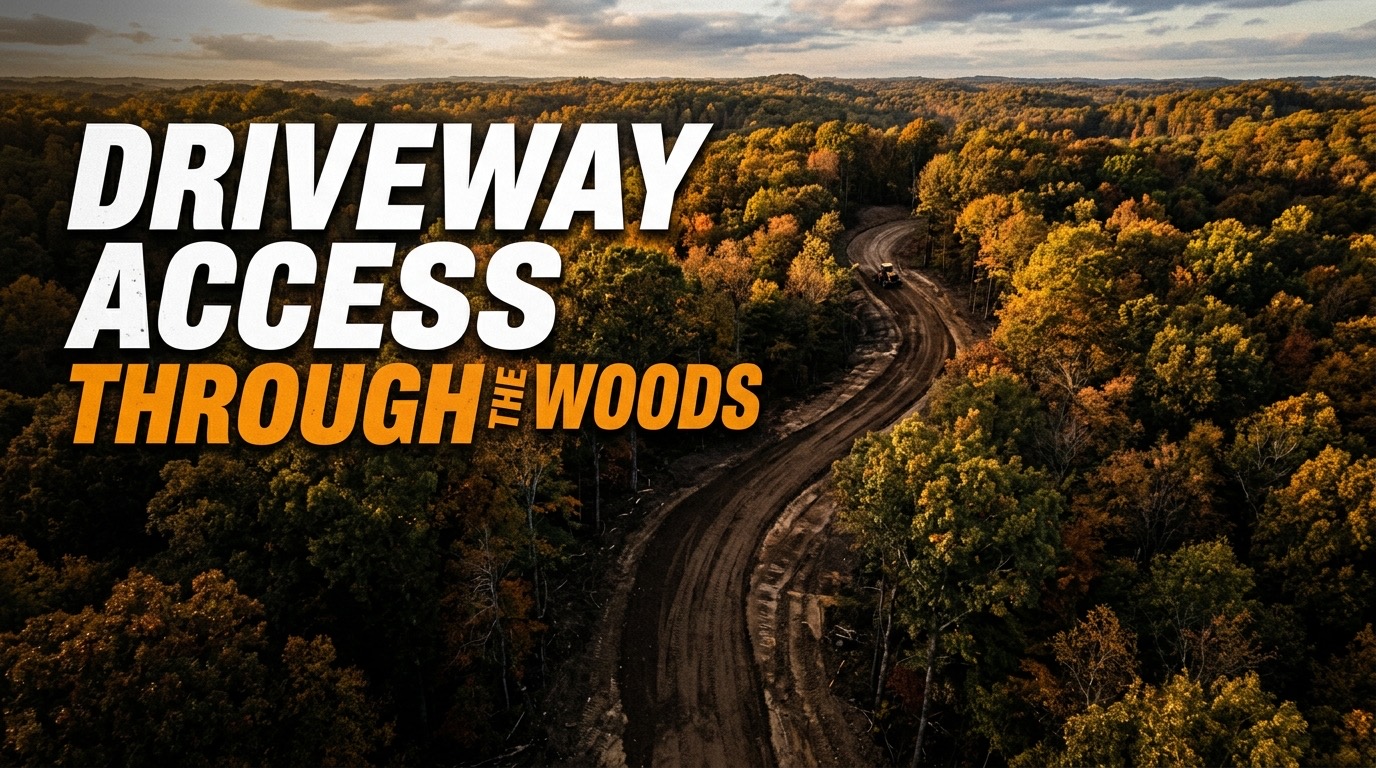
Every year, hundreds of Ohio landowners buy wooded acreage with big plans. A cabin. A homesite. Hunting camp. Maybe just a quiet place to get away from it all. Then they walk the property and realize: there's no way in.
No driveway. No path. Just trees, brush, and maybe a faded survey marker somewhere in the undergrowth. The county road is right there, but between it and your dream spot sits 200 feet of dense Ohio hardwoods.
This is one of the most common calls we get at Brushworks. And the good news is that cutting an access road through wooded property is one of the fastest, most satisfying land clearing projects there is. Half a day of work can open up an entire property.
Here's everything you need to know about driveway access clearing in Ohio, from costs and permits to the best clearing method and how to plan your route.
Why Access Clearing Is Usually the First Thing You Need to Do
It sounds obvious, but we see people try to skip this step constantly. They want to start building, install a septic system, dig a pond, or put up a barn. None of that happens without equipment access.
Excavators, concrete trucks, lumber deliveries, utility crews - they all need a path. And not just any path. They need something wide enough to maneuver, stable enough to support heavy loads, and graded well enough that a truck doesn't get stuck after a rain.
The access road isn't just your driveway. It's the lifeline for every project that comes after it. Get it right from the start, and everything else goes smoother. Try to cut corners here, and you'll pay for it with stuck equipment, delayed timelines, and repair bills.
Planning Your Route: What Most People Get Wrong
Before anyone fires up a mulcher or brings in a dozer, you need a plan. And the biggest mistake people make is choosing the straightest line between two points.
Straight lines look great on paper. In real life, Ohio terrain doesn't cooperate. Here's what to consider when mapping your driveway route:
Grade and Slope
Keep your grade at 10% or less if you can. That means no more than 10 feet of elevation change for every 100 feet of distance. Steeper than that, and you'll fight erosion, ice problems in winter, and traction issues during wet weather. In hilly parts of southern Ohio - Warren, Clermont, Hamilton, and Brown counties - you almost always need to snake the driveway to manage elevation changes. A switchback adds length but saves you from a driveway that turns into a waterfall every time it rains.
Drainage
Water is your biggest enemy. Every low spot on your route is a potential mud hole. Every point where water crosses the path needs a culvert or drainage solution. Walk the property after a rain and you'll see exactly where the water goes. Route around wet areas when you can. When you can't, plan for proper drainage infrastructure from the start.
Soil Type
Ohio has everything from sandy well-drained soils to thick clay that holds water like a sponge. Clay-heavy areas (common in Hamilton, Butler, and Clermont counties) need more gravel base. Sandy or loamy soils (more common in Warren and Clinton counties) drain better but can wash out on slopes. If you're not sure what you're dealing with, dig a test hole. What you find at 12-18 inches deep tells you what your driveway will sit on.
Tree Preservation
Not every tree in the path needs to go. A good clearing crew will walk the route with you first and flag trees worth saving. Big oaks, walnuts, and other valuable hardwoods can often be incorporated into the driveway design with a slight curve. This isn't just about aesthetics - mature trees along a driveway provide shade that reduces ice buildup in winter and keeps the surface cooler in summer.
Setbacks and Utilities
Before you clear anything, call 811 (Ohio Utilities Protection Service). Underground gas, electric, water, and telecom lines might cross your path. You also need to know your property setbacks - most Ohio townships require driveways to be a certain distance from property lines. Check with your local zoning office before you start.
Clearing Methods: Your Three Options
There are three main ways to cut an access road through wooded land. Each has tradeoffs in cost, speed, and final result.
1. Forestry Mulching (Best for Most Projects)
A forestry mulcher grinds everything - trees, stumps, brush, and undergrowth - into mulch right where it stands. The mulch stays on the ground, protecting the soil and preventing erosion. No hauling, no burning, no stump grinding as a separate step.
Pros:
- One machine does it all in a single pass
- Preserves topsoil (the mulch layer protects against erosion)
- No stumps to deal with later
- Leaves a walkable, drivable surface immediately
- Costs less than bulldozing in most situations
- Handles trees up to 8-10 inches in diameter (larger with the right equipment)
Cons:
- Very large trees (20+ inches) may need to be felled separately first
- The mulch layer compresses over time and may need gravel sooner on heavy-traffic drives
For a typical Ohio access road project with mixed brush, saplings, and small-to-medium trees, forestry mulching is the fastest and most cost-effective choice. We can clear a 12-16 foot wide path through 300 feet of woods in about half a day.
2. Bulldozing / Excavation
A bulldozer pushes everything out of the way - trees, stumps, roots, and topsoil. Then the debris gets pushed into piles for burning or hauling.
Pros:
- Handles any size tree
- Can grade the surface in the same operation
- Good for projects that need significant earth-moving anyway
Cons:
- Strips topsoil, leaving bare mineral soil that erodes quickly
- Creates large debris piles that need disposal
- Tears up the ground, especially in wet conditions
- Usually costs 40-60% more than mulching for the same length
- Requires follow-up work: stump removal, debris hauling, re-grading
3. Hand Clearing / Chainsaw Work
A crew with chainsaws drops the trees, bucks them up, and drags the logs out. Then stumps get ground separately.
Pros:
- Maximum precision around features you want to keep
- Low ground disturbance
- Can salvage lumber from valuable trees
Cons:
- Slow - a crew of 3-4 might take 2-3 days for what a mulcher does in hours
- Stumps remain and need separate grinding
- Brush and slash need chipping or hauling
- Most expensive option per linear foot
Driveway Access Clearing Costs in Ohio
Here's what you can expect to pay for driveway access clearing in the Cincinnati and SW Ohio area, based on real project data:
Cost Ranges by Method (2026)
Forestry Mulching: $1,500 - $4,000 for a typical 200-400 foot residential driveway
Bulldozing + Cleanup: $3,000 - $7,000 for the same distance
Hand Clearing + Stump Grinding: $4,000 - $8,000+
Costs vary based on tree density, tree size, slope, accessibility, and distance. These are clearing costs only - gravel, grading, and culvert installation are separate.
The variables that push costs up:
- Heavy timber - Lots of trees over 12 inches in diameter cost more to clear regardless of method
- Steep terrain - Slopes over 15% require more careful work and sometimes specialized equipment
- Long distances - A 600-foot driveway costs more than a 200-foot one (obvious, but worth stating)
- Wet or rocky ground - Both slow down equipment and can require site prep before clearing begins
- Remote location - Mobilization costs increase with distance from the Cincinnati metro area
Want a quick ballpark for your project? Our instant pricing calculator gives you a rough estimate in 60 seconds.
Ohio Permits and Regulations for Driveway Access
This is where people get tripped up. Ohio driveway permits depend on where your driveway connects to the public road system.
What You'll Typically Need
Driveway permit from the county engineer or township: Required when connecting to a public road. The application usually includes a site sketch showing driveway location, width, and distance from intersections. Fee is typically $50-$200.
Culvert installation: Almost every Ohio county requires a culvert pipe where your driveway crosses the road ditch. The county usually specifies the pipe diameter (commonly 12-15 inches) based on drainage flow. You buy the pipe, they inspect the installation. Budget $200-$500 for materials and installation.
Sight distance requirements: Your driveway entrance needs clear sight lines in both directions along the road. Most counties require 300-500 feet of visibility depending on the posted speed limit. This might mean clearing brush along the road frontage even if the county technically owns that right-of-way.
County-Specific Notes
Warren County: Apply through the county engineer's office. They're straightforward and usually process permits within a week. Rural areas along SR 28, SR 48, and back roads have the most driveway clearing projects.
Hamilton County: Slightly more involved process, especially in townships with zoning regulations. Anderson, Miami, and Symmes townships have specific standards.
Clermont County: Very common for access road clearing projects due to the rolling terrain and large rural parcels. County engineer's office handles permits efficiently.
Butler County: Standard county permit process. Liberty Township and Ross Township see the most rural access clearing work.
When You Don't Need a Permit
If you're clearing an internal access road that doesn't connect to a public road - say, a path from your existing driveway back to a barn site or hunting area - you typically don't need any permits for residential properties. Just stay on your own land and you're good.
The Clearing Process: What Happens Step by Step
Here's how a typical driveway access clearing project works when using forestry mulching (the method we use at Brushworks):
Step 1: Site Walk and Route Planning
We walk the property with you and flag the route. This is where we identify trees to save, drainage issues, grade changes, and any obstacles. The route might change from what you originally planned once you see the terrain up close. That's normal and usually makes for a better driveway.
Step 2: Mobilization and Setup
Equipment arrives on a trailer. For most access road projects, we use a compact track loader with a forestry mulching head. It's powerful enough to handle 8-10 inch diameter trees but nimble enough to work in tight spaces and around trees we're keeping.
Step 3: Clearing
The mulcher works from the road end inward, grinding everything in the path to ground level. The operator makes multiple passes - the first pass knocks down the standing vegetation, the second grinds stumps and levels the mulch. The result is a flat, mulch-covered path you can immediately walk or drive on.
Step 4: Shoulder Clearing
We typically clear 2-4 feet beyond the driveway width on each side. This gives you drainage room, sight lines, and space for future gravel shoulders. It also means branches aren't scraping your truck mirrors every time you drive in.
Step 5: Done
For many landowners, the mulched path is good enough to use immediately as a temporary driveway while they plan the next phase (grading, gravel, building). The mulch layer actually creates a surprisingly stable driving surface for light vehicles. We've seen people use mulched access roads for months before adding gravel.
After Clearing: Building a Permanent Driveway
Once the path is cleared, you have options for the final surface. Here's the typical progression:
Grading: A small excavator or skid steer smooths the surface, establishes proper crown (a slight high point in the center so water drains to the sides), and creates ditches along the edges. Cost: $500-$1,500 for most residential driveways.
Geotextile fabric (optional): On soft or clay-heavy soils, laying fabric before gravel prevents the stone from sinking into the mud. Worth the extra $0.50-$1.00 per square foot on problem soils.
Gravel base: Most Ohio driveways use a base layer of #4 limestone (large crushed stone) topped with #304 or #57 limestone. Plan on 4-6 inches total depth. At current prices, gravel runs about $1,000-$3,000 for a typical rural driveway.
Culvert at the road: If connecting to a public road, install the county-specified culvert pipe. This is usually handled by a separate excavation contractor or sometimes by the gravel delivery company.
Total cost from raw woods to finished gravel driveway: $3,000 - $10,000 for a standard 200-400 foot residential driveway, depending on terrain and soil conditions.
Common Mistakes That Cost Ohio Landowners Money
After clearing hundreds of access roads, here are the mistakes we see over and over:
Clearing too narrow. People try to save money by clearing the minimum width. Then the first delivery truck tears up the edges, branches scratch every vehicle, and there's no room for drainage. Clear wider than you think you need. You'll thank yourself later.
Ignoring drainage. A driveway without proper drainage is a temporary driveway. Water will find the low spots, wash out the gravel, and turn your investment into a muddy rut. Spend the money on culverts and ditches upfront.
Skipping the site walk. We've had people ask us to just clear a straight line from point A to point B. Then they discover there's a seasonal creek running through the middle of their route. Or a 6-foot elevation drop they didn't notice from Google Maps. Always walk it first.
Not checking property lines. Your neighbor might not appreciate you clearing trees on their side. Get a survey if there's any doubt about where your property ends, especially at the road frontage.
Clearing in mud season. March and April in Ohio can be a swamp. Heavy equipment on saturated ground creates ruts that take months to fix. If you can, schedule your clearing for late fall, winter, or dry summer conditions.
Special Situations
Steep Terrain
Southern Ohio's hills create challenges for driveway access. If your property drops 30 feet from the road to the building site, you'll need switchbacks or a longer, winding route to keep the grade manageable. We've done driveway clearing on slopes up to 35 degrees using our FAE RCU55 remote-controlled mulcher - equipment that goes where standard machines can't.
Shared Driveways
If two parcels share access, get a written easement agreement before clearing. Ohio law doesn't automatically give you the right to improve a shared drive without the other owner's consent. This trips up more people than you'd expect, especially with recently subdivided rural properties.
Wetland Areas
If your route crosses or runs near a wetland, you may need an Army Corps of Engineers Section 404 permit. Ohio EPA also has jurisdiction over isolated wetlands. If there's standing water, cattails, or spongy ground anywhere near your planned route, get a wetland delineation before you start clearing. The fines for unpermitted wetland disturbance are severe.
Emergency or Temporary Access
Sometimes you just need to get equipment in for a specific project - septic installation, barn construction, or a home build. In these cases, a mulched path without gravel might be all you need. The mulch surface works fine for construction traffic during dry conditions and costs significantly less than a finished driveway. You can always upgrade later.
Get Your Access Road Cleared
If you've got wooded property in Ohio that needs access, we do this work every week. Brushworks handles driveway clearing projects across Greater Cincinnati, including Warren, Hamilton, Clermont, Butler, Clinton, and Brown counties, plus Northern Kentucky and Southeast Indiana.
Most residential access roads take less than a day to clear. You go from no access to a drivable path in hours, not weeks.
Ready to Open Up Your Property?
Get an instant estimate or request a site visit. We'll walk your property, plan the best route, and give you a firm price.
Or call us directly: (513) 790-4150