
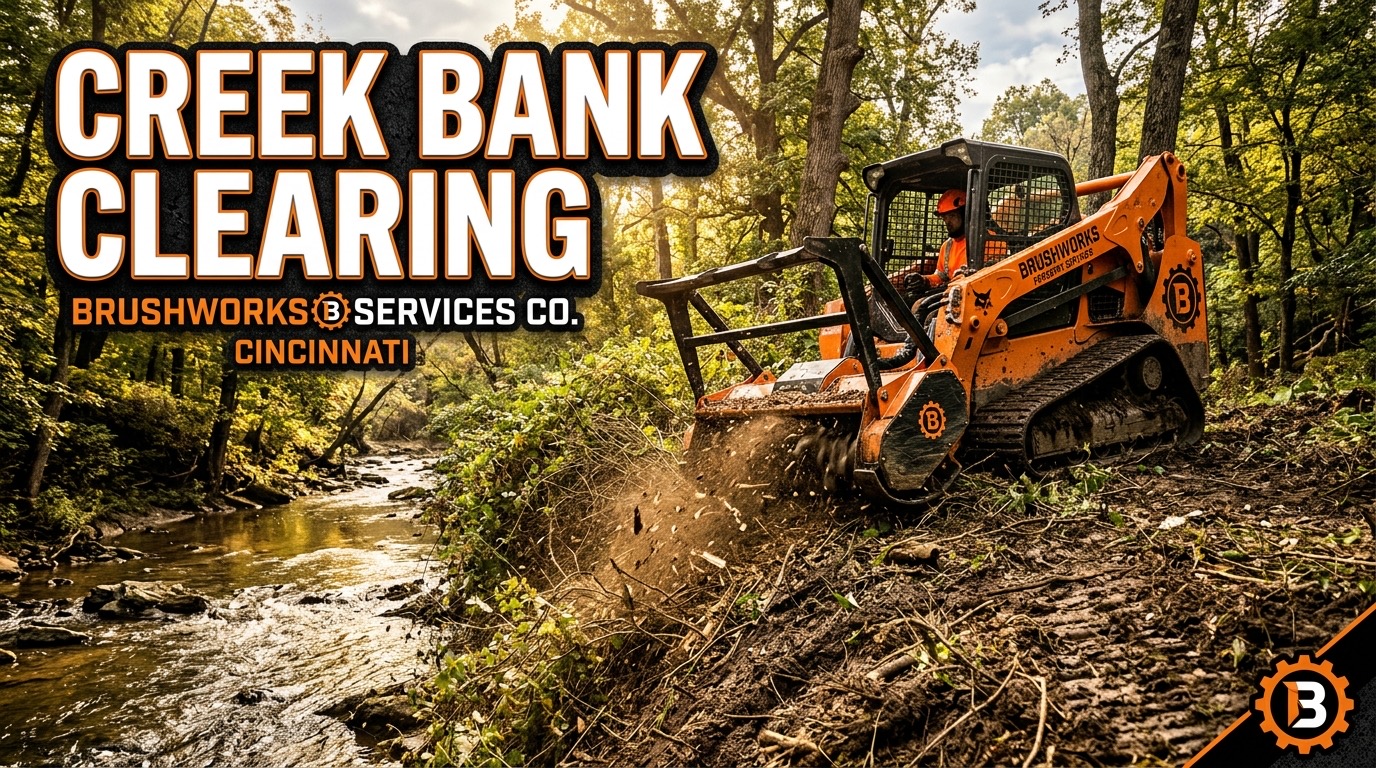
Creek banks are where small brush problems turn expensive
A messy creek bank looks like a simple cleanup job until you step into it. The ground is soft, the slope drops away, the trees lean toward water, and every vine seems tied into three other things. Around Cincinnati, that usually means honeysuckle, multiflora rose, grapevine, box elder, willow, cottonwood sprouts, and dead ash mixed together along a narrow strip of ground that nobody has touched in years.
The reason creek banks get out of hand is not laziness. Most landowners avoid them because they are awkward to maintain. A mower cannot safely ride the slope. A compact tractor gets sketchy near the edge. Chainsaw work turns into dragging brush uphill by hand. So the bank keeps growing until the creek is hard to see, the property line disappears, and water starts undercutting areas you actually care about.
Good creek bank clearing is not about scraping everything bare. That is usually the worst move. The goal is to open access, remove invasive growth, improve sightlines, keep useful roots in place, and leave the bank stable enough to handle Ohio rain. Done right, the property looks cleaner and the creek becomes manageable. Done wrong, you trade brush for erosion.
What makes Cincinnati creek banks difficult
Greater Cincinnati has a lot of small creeks, drainage draws, and seasonal runs feeding into the Little Miami, Mill Creek, East Fork, Great Miami, and Ohio River systems. Many of them cut through wooded residential acreage, farms, commercial lots, and old pasture. The banks can be steep, slick, and narrow. In spring, they are wet for weeks. In summer, the vegetation gets shoulder high fast.
The soil matters too. Southern Ohio clay and silt loam hold water, then crack when they dry. A creek bank that seems firm in August may be soft enough to swallow a tire in April. That changes the equipment choice and the timing. It also changes how aggressive the clearing should be. If the bank is already slumping, removing the wrong trees can make it worse.
Common creek bank problems we see around Cincinnati
- • Honeysuckle walls blocking access to the water
- • Multiflora rose and greenbrier tangled into fence lines
- • Dead ash trees leaning over the creek
- • Box elder and willow sprouts growing in tight clusters
- • Banks undercut by high-water events
- • Old dumped concrete, tires, wire, and fence debris hidden in brush
- • Narrow access where full-size equipment cannot safely work
That mix is why creek bank work needs a plan. It is not just clearing. It is access, slope, drainage, erosion, and property use all tied together.
What should come out and what should stay
Creek bank clearing is a sorting job. Some growth is making the problem worse. Some growth is holding the bank together. The trick is knowing the difference before the saw or mulcher starts working.
Usually remove
- • Bush honeysuckle that shades out bank-stabilizing groundcover
- • Multiflora rose blocking access and trapping debris
- • Grapevines pulling down desirable trees
- • Dead ash, especially where it leans over water or trails
- • Small invasive trees growing in dense clusters
- • Broken limbs and flood debris jammed against the bank
Often keep
- • Healthy mature trees with roots holding the slope
- • Sycamore, oak, maple, and other stable native trees
- • Native grasses and sedges near the waterline
- • Shade trees that keep the creek cooler
- • Root systems on outside bends where water hits hard
- • Buffer strips required by local rules or conservation plans
That does not mean every native tree is safe and every invasive plant is removed in one day. If a bank is fragile, heavy removal may need to happen in phases so new groundcover can take hold. A clean-looking bank that fails in the next storm is not a win.
How forestry mulching fits creek bank clearing
Forestry mulching can be a strong tool for creek bank work because it handles brush, saplings, vines, and small trees without hauling piles of debris up the slope. It also leaves mulch on the ground, which helps soften rainfall impact and reduce bare-soil exposure. On the right bank, that is a big advantage.
But it has limits. A mulcher should not be driven into saturated ground, unstable edges, or the creek channel. The operator needs room to work safely and enough stable ground to keep the machine out of the water. On steep or sensitive banks, we may work from the top, clear reachable material, and leave the lower edge more selective. For very steep sections, hand cutting and winching may be safer than forcing a machine where it does not belong.
Where mulching works well
- • Upper banks with stable access from a yard, field, or lane
- • Honeysuckle and rose thickets along the creek edge
- • Overgrown drainage corridors with small saplings
- • Farm creek crossings that need approach visibility
- • Residential acreage where hauling brush would tear up the lawn
The finish is not golf-course clean, and it should not be. A good creek bank finish has opened sightlines, manageable regrowth, and enough organic material left in place to protect the soil.
Permits and creek rules in Ohio
Most light vegetation maintenance on private property does not require a permit. That changes when work disturbs the stream bed, changes the bank shape, removes material from the channel, places fill, or affects wetlands. The line can get blurry, especially on small tributaries that only run part of the year.
If the project is only cutting and mulching brush above the ordinary high-water line, it is usually straightforward. If the plan includes grading the bank, armoring with rock, digging out sediment, building a crossing, or changing how water flows, talk to the county Soil and Water Conservation District before work starts. In some cases Ohio EPA, the US Army Corps of Engineers, township zoning, or county stormwater rules may be involved.
This is where being boring saves money. Make the phone call early. Ask whether your creek is regulated, whether the work area touches a mapped floodplain or wetland, and whether a buffer needs to remain. A half-hour conversation can prevent a stop-work order and a very expensive repair plan.
Best time to clear a creek bank in Cincinnati
Late summer, fall, and frozen winter windows are usually the cleanest times to work near a creek. The ground is firmer, water levels are lower, and the operator can see the shape of the bank without spring growth hiding everything. Winter is especially useful for dead ash and vine work because the leaves are off and the hazards are easier to read.
Spring is the hardest season. Cincinnati soils stay wet, banks rut easily, and the creek can come up fast after a storm. Urgent problems still need handled, especially debris jams or trees threatening structures, but routine cleanup is usually better once the bank dries out.
If seed, straw, live stakes, or other stabilization work is part of the plan, timing the clearing around that follow-up matters. Bare spots should not sit open through repeated storms. A good schedule leaves enough dry weather to clean up the bank and protect disturbed areas before the next heavy rain pattern.
What creek bank clearing costs around Cincinnati
Creek bank clearing is usually priced by access, slope, density, and risk, not just by acreage. A hundred-foot section behind a house may take longer than a quarter acre along a flat field if every limb has to be handled carefully and the machine has only one narrow way in.
| Project type | Typical range | What affects price |
|---|---|---|
| Small residential access corridor | $1,500 to $3,500 | Narrow access, hand work, debris hidden in brush |
| Long creek edge on acreage | $3,500 to $9,000+ | Length, slope, brush density, machine access |
| Drainage corridor cleanup | $2,500 to $7,500+ | Obstructions, wet areas, disposal needs |
| Steep or unstable bank | Site-specific | Safety, hand cutting, erosion controls, limited machine use |
Photos help, but creek work almost always needs an on-site look. The difference between a clean mulching pass and a slow selective clearing job is hard to judge from a driveway photo. We want to see the access route, the bank, the waterline, and where the material can safely land.
Need a creek bank opened up?
Send the address, a few photos from the top of the bank, and a rough length of creek you want cleared. We will tell you what is realistic, what needs to stay for stability, and what it should cost.
Mistakes to avoid
Clearing everything to the water
It looks clean for a week, then rain hits bare soil and the bank starts moving. Leave useful roots, keep a buffer where needed, and stabilize disturbed areas quickly.
Working wet ground because the calendar is open
Soft creek banks rut fast. A cheap dry-day job can become an expensive repair if the machine sinks or tears the edge apart.
Ignoring where water hits the outside bend
Outside bends take the force of high water. Be careful about removing trees and root mass there unless an erosion plan is ready.
Leaving invasive stumps untreated
Honeysuckle and other invasives come back hard from cut stumps. Clearing is the reset. Follow-up treatment and maintenance keep it from turning back into a wall.
How Brushworks approaches creek bank clearing
Brushworks clears creek banks, drainage corridors, fence lines, and overgrown acreage across Cincinnati and southern Ohio. We look at the whole setup before we price it: machine access, slope, waterline, tree condition, invasives, erosion risk, and what the property owner wants to use the creek edge for after we leave.
Some projects are a straightforward forestry mulching pass from the top of the bank. Some need selective hand cutting around good trees. Some need to wait for drier ground. Some should involve the county Soil and Water Conservation District before any work starts. The right answer depends on the site.
If you have a creek edge that has disappeared into brush, the first step is not guessing. Send photos and the address, then we can talk through access, risk, cost, and what a clean but stable finish should look like.
Frequently asked questions
Can I clear brush along a creek in Ohio?
Often yes, if the work is limited to vegetation maintenance above the stream channel. If the work changes the bank, disturbs the bed, adds fill, removes sediment, or touches wetlands, check with the county Soil and Water Conservation District before starting.
Is forestry mulching safe near a creek?
It can be, when the machine stays on stable ground and the operator avoids the waterline, saturated soil, and unstable edges. On steep or fragile banks, selective cutting may be safer than putting a machine close to the creek.
Should I remove all trees from a creek bank?
No. Healthy trees and roots often help hold the bank together. The better approach is selective removal: take out invasive shrubs, dead hazards, and problem trees while keeping useful root systems and shade where they protect the creek.
How much does creek bank clearing cost in Cincinnati?
Small residential access projects often start around $1,500 to $3,500. Longer creek edges, dense brush, steep banks, or limited access can run several thousand more. An on-site look is the only honest way to price it.
What is the best time to clear a creek bank?
Late summer, fall, and frozen winter windows are usually best because the ground is drier or firmer. Spring can work for urgent issues, but wet banks and high water make it harder to protect the slope.
Related articles
Erosion Control After Land Clearing Ohio
How to protect exposed soil after clearing, especially on slopes and drainage areas.
Wetland Adjacent Clearing Ohio
What to know when clearing near sensitive ground, water, or regulated buffers.
Driveway Access Clearing Ohio
A practical guide to opening routes through wooded or overgrown property.
Ready to clean up a creek bank without wrecking it?
Send the location, photos, and the rough length you want opened. We will give you a clear plan for access, selective clearing, erosion risk, and cost.