
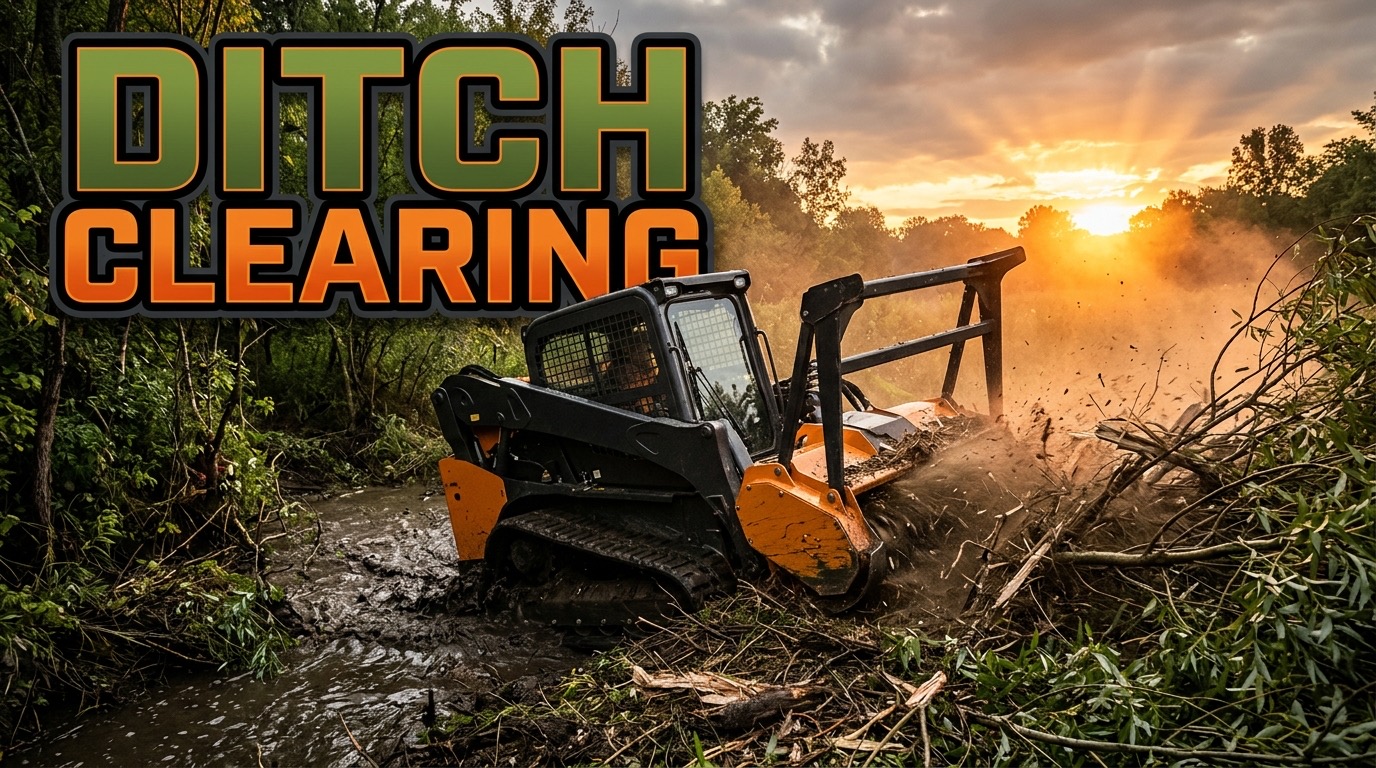
A blocked ditch does not stay a small problem
A drainage ditch is easy to ignore until it quits doing its job. For years it may move water off a field, along a driveway, behind a barn, or through the low side of a wooded lot without much attention. Then the honeysuckle fills in. A willow leans over. Leaves and silt collect behind a crushed culvert. One hard Cincinnati storm hits and the water goes wherever it wants.
That is usually when the call comes in. The driveway washed out. The field stayed wet for two weeks. Water backed up near a pole barn. The low corner behind the house turned into a mosquito pond. On rural Ohio property, drainage problems rarely fix themselves. A ditch that cannot carry water gets shallower, rougher, and harder to maintain every season.
Brushworks clears overgrown ditches, ditch banks, swales, access lanes, and drainage corridors across Greater Cincinnati and southern Ohio. Sometimes the job is vegetation clearing so an existing ditch can breathe again. Sometimes it is the first phase before an excavator comes in to clean sediment, reset grade, or replace a culvert. Either way, the goal is simple: get access, get visibility, and give water a clean path before it damages the property.
Start by figuring out what the ditch is supposed to do
Not every wet line on a property is the same thing. Some ditches are roadside drainage tied to county or township systems. Some are private farm ditches that carry field runoff. Some are shallow swales that move water away from a house pad, barn, driveway, pond, or gravel parking area. Some started as a ditch and turned into a small creek over time.
Before clearing starts, walk the ditch and understand where the water comes from and where it is supposed to go. Look upstream and downstream. Find the culverts. Find the low spots. Notice where water has been jumping the bank, cutting around a blockage, or washing sediment into the wrong place. A ditch is not just the section that looks ugly. It is part of a system.
Walk the ditch and mark these
- • Inlet points where water enters the ditch
- • Culverts, tile outlets, and old pipes
- • Fallen trees, brush jams, and beaver activity
- • Low spots where water backs up
- • Areas where the bank is eroding or slumping
- • Wet ground that may limit equipment access
- • Property lines and any public road connection
That walk-through keeps the clearing practical. If the real problem is a plugged culvert, clearing 500 feet of brush will make the place look better but it will not solve the water. If the real problem is a wall of willows trapping silt, cleaning the bank may be the exact first step you need.
Vegetation is usually the first thing that blocks flow
Ohio ditches grow fast. Willows, cottonwood sprouts, sycamore seedlings, honeysuckle, cattails, multiflora rose, grapevine, and tall weeds all like the moisture. One season of growth may not matter. Five seasons can turn a drainage line into a brush tunnel that catches every leaf, limb, and piece of trash that floats through.
Once water slows down, sediment drops out. That sediment gives more plants a place to root. The new plants catch more debris. The ditch gets shallower and narrower. During a normal rain it may still move some water, so the problem hides. During a hard rain, it backs up and spreads across the property.
Clearing the vegetation opens the system back up. It lets you see the ditch bottom, the bank condition, and the real grade. It also gives a mowing contractor, excavator, or property owner a way to keep the ditch maintained after the heavy work is done.
Ditch clearing is not the same as digging a ditch
This matters. Brush clearing and excavation are different jobs. Forestry mulching can remove the brush, saplings, vines, and small trees along a ditch bank. It can open an access lane so a machine can reach the problem area. It can reclaim an overgrown drainage corridor without piling brush everywhere. It cannot magically restore the bottom elevation of a silted-in ditch if several feet of material need removed.
If the ditch still has shape and the main problem is vegetation, clearing may be enough. If the ditch bottom has filled with silt, the banks have slumped, or the culvert is set wrong, an excavator may need to reshape it. The best order is often to clear first, inspect second, then dig only where digging is actually needed.
| Problem | Clearing helps by | May still need |
|---|---|---|
| Brush-choked banks | Removing saplings, honeysuckle, rose, vines, and deadfall | Routine mowing or spot treatment for regrowth |
| Plugged culvert access | Opening the inlet, outlet, and working room | Culvert cleaning, replacement, stone, or excavation |
| Silted ditch bottom | Exposing the channel so grade can be checked | Excavation and spoil handling |
| Wet field edge | Opening the drainage path and access route | Tile repair, ditch grading, or outlet work |
A good contractor should be honest about that line. If you need a mulcher, use a mulcher. If you need a bucket, use a bucket. Many ditch projects need both, just not always on the same day.
Access decides how clean the job can be
The ditch itself may only be ten feet wide, but the job often needs more room than that. Machines need a way in. Trucks need a place to park. If a culvert is being repaired later, the next contractor may need enough space for stone, pipe, spoil piles, and a small excavator. Clearing only the visible ditch and ignoring access is how a simple project turns into a muddy mess.
On Ohio farms and wooded lots, access is usually the hard part. The ditch may run behind an old fence row, through a grown-up field edge, along a creek bottom, or beside a driveway with soft shoulders. If the route in is full of locust thorns, dead ash, and hidden wire, that needs addressed before anyone worries about the ditch bottom.
Brushworks often clears a narrow working lane along one side of the ditch. That gives the crew visibility and creates a path for future maintenance. It also keeps the job from becoming a full clear-cut. The best drainage work leaves the property serviceable without stripping every tree on both sides.
Be careful around public roads and regulated drainage
A private ditch in the middle of your farm is one thing. A ditch tied into a township road, county road, subdivision drainage system, creek, wetland, or mapped floodplain is another. The difference matters because moving soil or changing flow can affect neighbors, public infrastructure, and downstream property.
Basic vegetation clearing is usually straightforward, especially when you are maintaining an existing ditch. Digging deeper, changing the alignment, piping a ditch, filling a wet area, or working close to a stream can trigger rules. In Ohio, those questions may involve the township, county engineer, soil and water conservation district, health department, or state and federal agencies depending on the site.
Brushworks can help clear the vegetation and open access, but permits and legal drainage approval belong with the property owner and the right local office. If the ditch touches a public road or carries water from neighboring property, check first. It is cheaper to ask a boring drainage question on Monday than to undo a mistake after the next storm.
What forestry mulching does well on ditch projects
Forestry mulching is a strong fit for ditch bank clearing because it processes brush in place. There are no big burn piles left on wet ground. There is no need to drag brush across the property. The finished mulch layer can help protect exposed soil while grass and low vegetation recover.
The machine can work selectively along the bank, removing problem growth while leaving useful trees, stable root systems, and shaded areas where they help. On steep or soft ground, an experienced operator can often reach material that would be slow and risky by hand. For longer drainage corridors, mulching is usually faster and cleaner than cutting everything with chainsaws and stacking piles.
Good fits for mulching
- • Overgrown ditch banks
- • Honeysuckle, rose, willow, and sapling removal
- • Access lanes along field edges
- • Culvert inlet and outlet cleanup
- • Clearing before excavation or inspection
Not a replacement for
- • Ditch regrading or reshaping
- • Culvert installation or pipe repair
- • Engineered erosion control
- • Permits where soil or water rules apply
- • Removing heavy sediment from the ditch bottom
Used the right way, mulching is the cleanup and access phase that makes the drainage fix easier. It gives everyone a clear look at the problem without turning the whole ditch into bare dirt.
Do not scrape the banks bare unless there is a reason
A ditch needs to move water, but the banks also need to stay in place. Scraping every bit of vegetation off both sides can create erosion problems, especially on Ohio clay slopes that see heavy spring storms. Bare banks wash. Washed banks fill the ditch. Then you are right back where you started, just with a uglier ditch.
The better approach is controlled clearing. Remove woody growth, vines, invasive brush, deadfall, and anything blocking flow or access. Keep stable grass and low cover where it protects soil. Leave strong trees where they are not causing blockage, bank failure, or maintenance problems. If the ditch needs grading, plan seed, straw, erosion blanket, stone, or another stabilization method after the dirt work.
This is especially important near creeks, ponds, and long slopes. Water has weight. When it concentrates in a clean ditch, it can cut fast if the banks are left raw. Good clearing should make the drainage easier to maintain, not create a new erosion channel.
Common Ohio ditch problems we see
Around Cincinnati, the same problems show up over and over. Bush honeysuckle grows thick along old ditch lines and blocks access. Willows root in wet bottoms and catch debris. Multiflora rose and blackberry turn a simple inspection into a blood donation. Dead ash falls across the channel. Grape vines pull limbs down into the water path. Cattails and sediment slowly narrow the bottom until the ditch is only a wet strip with weeds.
Old farm ground adds buried surprises. Fence wire, broken tile, dumped concrete, scrap metal, old culverts, and lost posts often sit right where the machine needs to work. Roadside ditches add trash, crushed pipe, and driveway pipes that are undersized or set too high. None of that means the job cannot be done. It means the quote should be based on what is actually there, not what the ditch looked like twenty years ago.
Photos help, but they do not show everything. If you know about old wire, tile outlets, wells, utilities, or buried debris, tell the crew before work starts. That saves time, protects equipment, and keeps the project cleaner.
Cost factors for drainage ditch clearing in Ohio
Ditch clearing is priced by the job because length alone does not tell the story. A thousand feet of light grass and small brush along flat access may be simple. Two hundred feet behind a barn with wet ground, willows, dead ash, hidden wire, and a plugged culvert may take more planning and care.
The biggest cost factors are ditch length, brush density, tree size, bank slope, ground firmness, access, debris hazards, culverts, proximity to roads or water, and whether excavation is part of the project. If the work can be done from one side with good access, it moves faster. If the machine has to pick through soft banks, fence rows, or tight residential areas, the job slows down.
The cheapest way to handle most ditch problems is to clear enough to see and service the system, then fix the real bottlenecks. That may be one day of mulching and a separate culvert cleanout. It may be clearing first, then bringing in an excavator for the bottom. What you want to avoid is paying for random clearing that never addresses the blockage.
Need a drainage ditch opened up?
Send the property address, photos of the ditch, culverts, access, and the area where water is backing up. We will help you figure out whether the job is vegetation clearing, excavation prep, or both.
How to prepare before you ask for a quote
You do not need an engineering plan to start the conversation. You do need basic information. Take photos from both ends of the ditch. Get close-ups of culverts, blockages, wet spots, washouts, and the worst brush. Take a few wider photos that show access from the driveway, field, or road. If the ditch runs through several properties or connects to a public system, say that up front.
Mark what matters. Property lines, septic areas, wells, utilities, tile outlets, fence corners, and trees you want to save should be clear before equipment arrives. If you already know the ditch needs excavation after clearing, tell us what contractor or equipment needs to get in there so the access lane is built wide enough the first time.
The more honest the site information, the better the plan. A ditch that is wet year-round is different from one that only carries stormwater. A ditch beside a house is different from a farm field outlet. A roadside ditch is different from a private swale behind a barn. Good clearing starts with those differences, not a one-size-fits-all price.
How Brushworks approaches ditch clearing
Brushworks clears drainage ditches, swales, culvert access, field edges, and overgrown water paths across Greater Cincinnati, Clermont County, Warren County, Brown County, Butler County, and nearby parts of southern Ohio. We look at the whole drainage path, not just the ugliest patch of brush.
Sometimes the right job is a clean mulched corridor down one side of the ditch so it can be inspected and maintained. Sometimes it is opening the inlet and outlet around a culvert. Sometimes it is clearing a field edge so an excavator can come behind us and restore the grade. Sometimes it is removing the honeysuckle and willows that turned a working drainage line into a swampy mess.
If water is backing up on your property, do not wait until the next storm proves the point again. Walk the ditch, take photos, check who owns or controls the drainage, and clear the access before the problem gets more expensive.
Frequently asked questions
When should I clear a drainage ditch in Ohio?
Clear it when brush, saplings, cattails, sediment, or fallen trees are slowing water down or backing it onto fields, driveways, yards, or building sites. Late summer, fall, and winter are usually easier because the ground is drier or firmer and vegetation is easier to see.
Can forestry mulching be used for drainage ditch clearing?
Yes, forestry mulching works well for opening the banks, removing brush, saplings, honeysuckle, willows, and access corridors along a ditch. It does not replace excavation when the ditch needs reshaped, regraded, or cleaned out with a bucket.
Do I need a permit to clear a drainage ditch in Ohio?
It depends on the ditch, location, and amount of soil work. Mowing or clearing brush on an existing private ditch is usually simple, but digging, reshaping, working near streams, wetlands, culverts, or regulated drainage systems can require local approval. Check with your county, township, or drainage authority before moving soil.
What causes drainage ditches to fail?
Most ditches fail because vegetation, sediment, fallen limbs, old fence wire, crushed culverts, or poor access stop water from moving. Once water slows down, more silt drops out, weeds grow thicker, and the ditch keeps getting shallower.
How much does drainage ditch clearing cost in Ohio?
Cost depends on length, brush density, bank slope, access, wet ground, trees, culverts, and whether the job is only vegetation clearing or includes excavation. Photos of the ditch, access points, and problem areas are the fastest way to get a real estimate.
What should stay after a ditch is cleared?
Keep stable grass, useful root systems, and enough cover to protect the banks from erosion. The goal is not to scrape everything bare. The goal is to remove the brush and obstructions that stop water while keeping the ditch stable.
Related articles
Erosion Control After Land Clearing Ohio
How to protect open soil and drainage paths after clearing work.
Creek Bank Clearing Cincinnati
Open overgrown creek edges without creating erosion problems.
Clearing Brush Around Ponds Ohio
Clean up wet edges, banks, and overgrown pond access without wrecking the shoreline.
Ready to reopen the ditch?
Send the photos, address, and what the water is doing now. We will help you clear the brush and access so the drainage problem can be fixed the right way.