
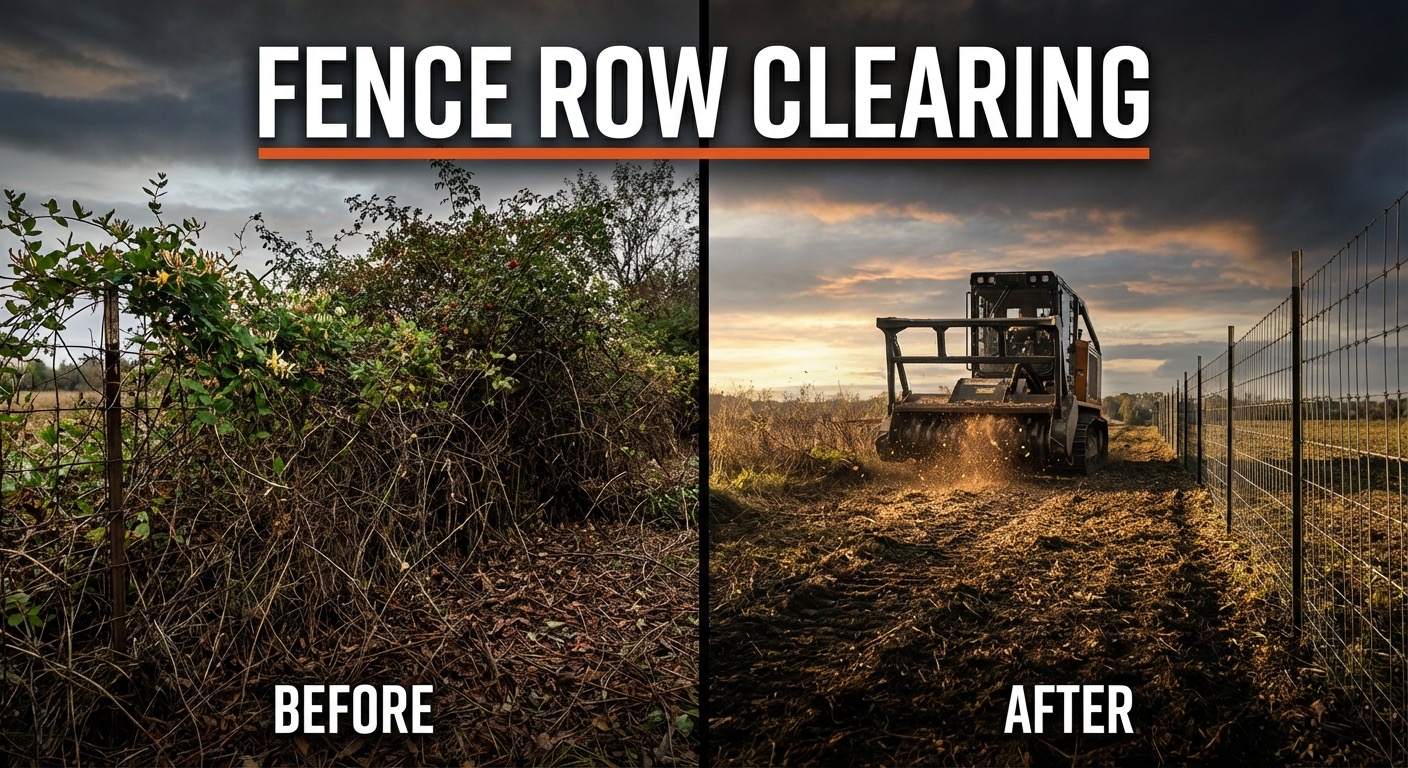
Why Fence Rows Get Out of Control
Fence rows are the perfect storm for vegetation growth. Understanding why helps you plan better maintenance going forward:
The Perfect Growth Environment
- • Bird highways: Birds perch on fence posts and wires, depositing seeds along the entire length
- • Protected from tillage: Equipment can't reach the fence line, so nothing disturbs growth
- • Edge habitat: Maximum sunlight on one side, sheltered on the other—ideal growing conditions
- • Mower limitations: Standard brush hogs can't get close enough to control growth
The Invasive Species Problem
- • Multiflora rose: Ohio's #1 fence row invader—thorny, aggressive, spreads rapidly
- • Bush honeysuckle: Forms dense 15-foot walls, spreads by bird-distributed berries
- • Autumn olive: Fast-growing, nitrogen-fixing, outcompetes native species
- • Osage orange (hedge): Historic fence plantings now massive, thorny obstacles
The Compounding Problem
Every year you skip fence row maintenance, the problem grows exponentially. A fence row that would take one pass to maintain annually becomes a multi-day project after five years. That brush doesn't just grow up—it grows out, claiming more of your productive field with each passing season. We've seen fence rows that started at 5 feet wide balloon to 40+ feet of impenetrable thicket.
The Hidden Costs of Overgrown Fence Rows
Neglected fence rows aren't just ugly—they're costing you money every year:
Lost Productive Acreage
Overgrown fence rows steal field edges. On a typical Ohio farm:
- • A 40-foot wide fence row on a quarter-mile fence line = 1.2 lost acres
- • Multiple fence rows on 100 acres could mean 5–10 acres lost
- • At $200–$400/acre corn revenue, that's $1,000–$4,000 annually
- • Land value impact: $10,000–$15,000 per lost tillable acre
Equipment Damage & Delays
Working around overgrown fence rows costs time and money:
- • Limbs catching equipment, causing breakdowns
- • Having to stop and trim before passing
- • Wider turns eating into productive time
- • Brush hiding drainage tile outlets, culverts, old equipment
Fence Damage & Replacement Costs
Vegetation destroys fence infrastructure:
- • Trees growing through woven wire fence
- • Root systems heaving posts out of alignment
- • Vines pulling down top wires
- • Can't inspect or repair fence you can't see
- • Complete fence replacement often needed: $8–$15/foot installed
Weed Pressure & Pest Habitat
Overgrown fence rows are weed seed factories:
- • Constant seed source for field edges
- • Resistant weed populations establish in untreated areas
- • Wildlife habitat (not always desirable near crops)
- • Deer cover adjacent to fields = crop damage
Fence Row Clearing Costs in Ohio
Fence row clearing is typically priced per linear foot rather than per acre, since the work is concentrated in narrow strips. Here's what to expect:
Light Overgrowth
$3–$4 per linear foot
Brush and saplings under 4" diameter, maintained within last 5 years. Clearing width up to 15 feet from fence line.
Moderate Overgrowth
$4–$6 per linear foot
Dense brush, small trees 4–8" diameter, 5–15 years of growth. Most farm fence rows fall in this category.
Heavy Overgrowth
$6–$8+ per linear foot
Large trees 8"+ diameter, 15+ years of neglect, may require multiple passes or specialized equipment.
Typical Project Examples
- • Quarter-mile (1,320 ft): $4,000–$10,500
- • Half-mile (2,640 ft): $8,000–$21,000
- • Mile (5,280 ft): $16,000–$42,000
Volume Discounts for Farm Projects
Farm fence row projects often involve multiple fence lines, qualifying for volume pricing:
- → 2,500–5,000 linear feet: 10% discount
- → 5,000–10,000 linear feet: 15% discount
- → 10,000+ linear feet: 20% discount
Example: Clearing 2 miles of fence rows (10,560 ft) at moderate overgrowth: Base cost $42,000–$63,000, with 20% discount = $33,600–$50,400.
For a detailed breakdown of clearing costs, see our land clearing cost per acre guide or get an instant estimate with our pricing calculator.
Why Forestry Mulching Is Ideal for Fence Rows
Traditional fence row clearing methods—chainsaw crews, dozers, and burn piles—create as many problems as they solve. Forestry mulching is purpose-built for this work:
Precision Control
- ✅ Work right up to fence line without damage
- ✅ Preserve trees you want to keep
- ✅ Navigate around posts and stays
- ✅ Selective clearing—take what you want, leave the rest
No Debris Problems
- ✅ No brush piles to burn or haul
- ✅ No logs stacked along fence to rot
- ✅ Mulch stays in place, enriching soil
- ✅ Field ready immediately after clearing
Farm-Friendly
- ✅ Single machine, minimal ground disturbance
- ✅ No ruts in wet field edges
- ✅ Works around drainage tile
- ✅ Fast—typically 500–1,000 linear feet per hour
Traditional Methods vs. Forestry Mulching
| Method | Pros | Cons |
|---|---|---|
| Chainsaw & Haul | Low equipment cost | Slow, labor-intensive, leaves stumps, debris disposal required |
| Dozer Push | Fast for large areas | Destroys fence, creates windrows, damages soil structure, leaves roots |
| Excavator & Grapple | Good for large trees | Leaves debris piles, tears up ground, can't work close to fence |
| Forestry Mulching | One pass, no debris, preserves fence, minimal ground disturbance | Higher hourly rate (offset by speed and no cleanup) |
For more on comparing methods, see our forestry mulching vs bulldozing comparison.
Clearing Fence Rows Without Damaging the Fence
One of the biggest concerns farmers have: "Can you clear the brush without destroying my fence?" The answer is yes—with the right approach:
Fence-Intact Clearing
Our mulching heads can work within inches of fence wire without contact:
- • We approach from the field side, clearing brush right up to the fence line
- • Vegetation between posts is mulched; the fence wire acts as a natural stop
- • Trees grown around wire require careful work—we cut as close as possible
- • Access from both sides (if available) gives best results
When to Remove Fence First
Sometimes, removing the old fence before clearing makes sense:
- • Fence is already compromised: Trees grown through wire, posts rotted, wire down
- • Planning fence replacement: Clear everything, then install new fence in clean corridor
- • Better access: Removing fence allows clearing from both directions
- • Cost savings: Wider clearing path = more efficient work = lower per-foot cost
If fence removal makes sense for your project, we can coordinate with fence contractors or you can remove it yourself before we arrive.
Dealing with Trees in the Fence
Large trees that have grown through the fence present challenges:
- • Wire inside trunk: Tree must be cut; wire will be trapped in stump
- • Leaning on fence: We can fell away from fence when possible
- • Roots under fence: Mulching doesn't disturb roots—fence stays stable
We'll walk the fence line with you before work begins to identify problem areas and plan the approach.
Best Time of Year for Fence Row Clearing in Ohio
Timing your fence row clearing project can save money and produce better results:
Best: Late Fall – Early Spring (Nov – Mar)
- ✅ Crops are out—no access issues through fields
- ✅ Ground is typically frozen or firm
- ✅ Vegetation is dormant—less regrowth energy
- ✅ Leaves are down—better visibility of fence line
- ✅ Off-season scheduling—better availability
- ✅ Ready for spring planting at field edges
Possible: Summer (Jun – Sep)
- ⚠️ Must work around standing crops
- ⚠️ Soft ground conditions may limit access
- ⚠️ Peak growing season—rapid regrowth
- ⚠️ Heavy foliage can hide fence location
- ⚠️ Heat and humidity slow work pace
- ✅ Good for non-cropped areas, pastures
Planning Around Your Farm Calendar
Ideal scheduling for crop farmers:
- • November–December: After harvest, before ground freezes hard
- • February–March: As ground thaws, before spring fieldwork
- • Between first and second cutting: For hay field fence rows
We understand farm schedules. Tell us your planting/harvest windows, and we'll work around them.
For more seasonal guidance, see our best time to clear land in Ohio guide.
How Wide Should You Clear?
The width of your clearing depends on your goals and budget. Here's a framework:
Clearing Width Options
| Width | Best For | Considerations |
|---|---|---|
| 8–10 feet | Walking access, fence inspection/repair | Minimum for maintenance access; brush will encroach quickly |
| 15–20 feet | Standard maintenance, tractor/mower access | Allows brush hog maintenance going forward; most common choice |
| 25–30 feet | Equipment turnaround, reclaiming field edge | Room for combines/planters to turn; maximizes tillable acres |
| Full width | Reclaiming entire fence row to property line | Complete reset; may involve neighbor coordination if on line |
Our Recommendation
For most farm fence rows, we recommend clearing 15–20 feet on each side of the fence. This provides room for ongoing brush hog maintenance, gives equipment operators a buffer, and reclaims meaningful acreage. Anything less becomes overgrown again within 2–3 years if not maintained.
Controlling Regrowth After Clearing
Clearing the fence row is step one. Keeping it clear requires a maintenance plan:
Mechanical Maintenance
- ✅ Annual brush hogging: Once or twice per season keeps regrowth manageable
- ✅ Rotary cutter: Works for grass and small brush up to 2" diameter
- ✅ Flail mower: Better mulching action, handles slightly larger material
- ✅ Periodic forestry mulching: Every 3–5 years for woody regrowth
Chemical Treatment
- ✅ Cut stump treatment: Apply herbicide to fresh cuts for persistent species
- ✅ Foliar spray: Spot treatment of regrowth in first 1–2 years
- ✅ Basal bark: For woody stems that escape mowing
- ✅ Target species: Multiflora rose, honeysuckle need herbicide for control
The Regrowth Reality
Be realistic about regrowth expectations:
- • Year 1: Vigorous regrowth from root systems—this is normal
- • Year 2–3: Regrowth slows as root reserves deplete (if maintained)
- • Year 3–5: Woody species establish if not controlled
- • Without maintenance: Back to original condition in 5–7 years
The mulch layer from forestry mulching suppresses regrowth for 1–2 seasons, buying you time to establish a maintenance routine.
Fence Row Clearing and Property Lines
Fence rows often mark property boundaries, which brings up important considerations:
Know Where Your Line Is
Before clearing, confirm your property boundary:
- • Old fence may not be on the actual property line
- • Vegetation often obscures survey markers
- • Consider a survey if boundary is disputed or unclear
- • County GIS/parcel maps provide approximate lines
Neighbor Coordination
Fence rows on property lines often benefit both parties:
- • Talk to your neighbor before clearing—they may want to participate
- • Split costs for boundary fence rows (common in Ohio)
- • Coordinate access from both sides for better results
- • Joint maintenance agreements prevent future disputes
Ohio Fence Law Basics
Ohio is a "fence out" state with specific rules:
- • Adjoining landowners typically share fence maintenance responsibility
- • Each owner maintains the right half (facing the fence from their property)
- • Line fences have specific statutory requirements (ORC 971)
- • Disputes can be resolved through township trustees
We're not lawyers—consult with an attorney or your township if you have fence line disputes.
Common Ohio Fence Row Invasives
Knowing what you're dealing with helps plan the clearing and long-term maintenance:
Multiflora Rose
The bane of Ohio fence rows. Originally promoted for "living fences," now a noxious weed.
- • Forms impenetrable thorny thickets
- • Roots sprout new canes when cut
- • Seeds viable in soil for 10–20 years
- • Control: Mulching + herbicide treatment required
Bush Honeysuckle
Non-native honeysuckle species (Amur, Morrow's, Tartarian) dominate fence rows.
- • Grows 10–15 feet tall
- • Birds spread seeds along fence lines
- • Leafs out early, stays green late—shades out native plants
- • Control: Mulching effective; cut stump treatment prevents regrowth
Autumn Olive
Fast-growing shrub/small tree with silvery leaves and red berries.
- • Fixes nitrogen—thrives in poor soil
- • Produces massive quantities of bird-spread seeds
- • Thorns make manual removal difficult
- • Control: Mulching + herbicide; persistent without treatment
Osage Orange (Hedge Apple)
Historic fence plantings now massive trees with brutal thorns.
- • Can reach 40+ feet tall with 2-foot diameter trunks
- • Wood extremely hard and durable
- • Thorns up to 1" long
- • Control: Large specimens may need chainsaw; mulching for small growth
For more on invasive species management, see our invasive species removal guide.
The Fence Row Clearing Process
Here's what to expect when you hire Brushworks for fence row clearing:
Step 1: Site Visit & Quote
We walk the fence lines with you to assess vegetation density, identify obstacles (tile outlets, old equipment, buried debris), and determine the clearing width you want. You receive a fixed-price quote—no hourly surprises.
Step 2: Pre-Work Preparation
Before we arrive:
- • Ohio811 utility locates completed
- • Access route to fence row identified
- • Any items to protect (trees, structures) flagged
- • Gate access/keys arranged if needed
Step 3: Clearing Operations
Our mulching equipment works systematically along the fence line:
- • Typical production: 500–1,000 linear feet per hour
- • Work proceeds from one end to the other for efficiency
- • Mulch is left in place—no debris removal needed
- • We can work around standing crops if necessary
Step 4: Final Walkthrough
Upon completion, we walk the fence line with you to confirm all areas meet expectations. We photograph before and after for your records.
Permits & Programs for Farm Clearing
Most routine fence row clearing on agricultural land doesn't require permits, but there are considerations:
Usually No Permit Needed
- ✅ Fence row clearing on active farmland
- ✅ Clearing for fence replacement
- ✅ Removing invasive species
- ✅ Maintaining existing field boundaries
- ✅ Access lane clearing
Check First
- ⚠️ Land enrolled in CRP (Conservation Reserve Program)
- ⚠️ EQIP or other NRCS program land
- ⚠️ Fence rows designated as filter strips
- ⚠️ Areas near streams (riparian buffers)
- ⚠️ Wetland-adjacent areas
USDA Cost-Share Programs
Some fence row work may qualify for USDA cost-share assistance:
- • EQIP (Environmental Quality Incentives Program): May cover brush management for grazing land improvement
- • CSP (Conservation Stewardship Program): Enhancements for brush control on enrolled land
- • Ohio SWCD programs: Local cost-share may be available
Contact your county NRCS office or Soil & Water Conservation District to explore options.
For more on permits, see our guide to land clearing permits in Ohio.
Service Area for Fence Row Clearing
Brushworks provides fence row clearing services throughout Southwest Ohio's agricultural areas, including:
Warren County
Clinton County
Highland County
Brown County
Clermont County
Adams County
Butler County
Hamilton County
We work throughout the Greater Cincinnati farming region. Contact us to confirm service availability for your location.
Frequently Asked Questions
How much does fence row clearing cost in Ohio?
Fence row clearing in Ohio typically costs $3–$8 per linear foot via forestry mulching, depending on vegetation density and width. A standard quarter-mile fence line (1,320 feet) runs $4,000–$10,500. Heavy overgrowth with large trees costs more than brush and saplings.
Can you clear fence rows without removing the fence?
Yes. Our forestry mulching equipment can clear vegetation right up to existing fence lines without damaging the fence. We work from both sides when accessible. If vegetation has grown through the fence, we can often mulch around it—though severely compromised fences may need removal first.
How wide should I clear around my fence row?
Most farmers clear 10–20 feet on each side of the fence for equipment access and maintenance. Minimum recommended is 8 feet for walking access. If you're replacing fence, consider clearing 15–20 feet to give contractors room to work and prevent immediate regrowth issues.
What's the best time of year to clear fence rows in Ohio?
Fence row clearing in Ohio works best from late fall through early spring (November–March) when crops are out, ground is firmer, and vegetation is dormant. Summer clearing is possible but may require working around crops and dealing with softer ground conditions.
Will brush grow back after fence row clearing?
Some regrowth is natural, but forestry mulching significantly slows it compared to cutting alone. The mulch layer suppresses new growth for 1–2 seasons. For long-term control, plan on maintenance clearing every 3–5 years or consider herbicide treatment for persistent species like multiflora rose.
Do I need a permit to clear fence rows on my farm?
In most cases, no permit is required for clearing fence rows on agricultural property in Ohio. Exceptions may apply if the fence row is in a designated wetland, riparian buffer, or conservation easement. Check with your county SWCD if you have conservation program land (CRP, EQIP, etc.).
Why Ohio Farmers Choose Brushworks
Farm Experience
- ✅ Understand agricultural schedules and priorities
- ✅ Work around crops and livestock
- ✅ Know the invasive species affecting Ohio farms
- ✅ Respect tile lines and drainage infrastructure
Transparent Pricing
- ✅ Fixed per-foot quotes—no hourly surprises
- ✅ Volume discounts for large projects
- ✅ Free on-site estimates
- ✅ No charge for tire kickers
Professional Results
- ✅ Fence-safe clearing techniques
- ✅ No debris piles to deal with
- ✅ Before/after photos for your records
- ✅ Maintenance recommendations included
Local & Responsive
- ✅ Based in Southwest Ohio
- ✅ Family-owned operation
- ✅ Quick response to inquiries
- ✅ Flexible scheduling
Ready to Reclaim Your Fence Rows?
Don't let another season go by watching your productive acreage shrink. Every year you wait, the problem—and the cost to fix it—grows.
Get Your Free Estimate
Contact us to schedule a free on-site assessment of your fence row clearing project. We'll walk the lines with you, identify the challenges, and provide a fixed-price quote with no obligation.