
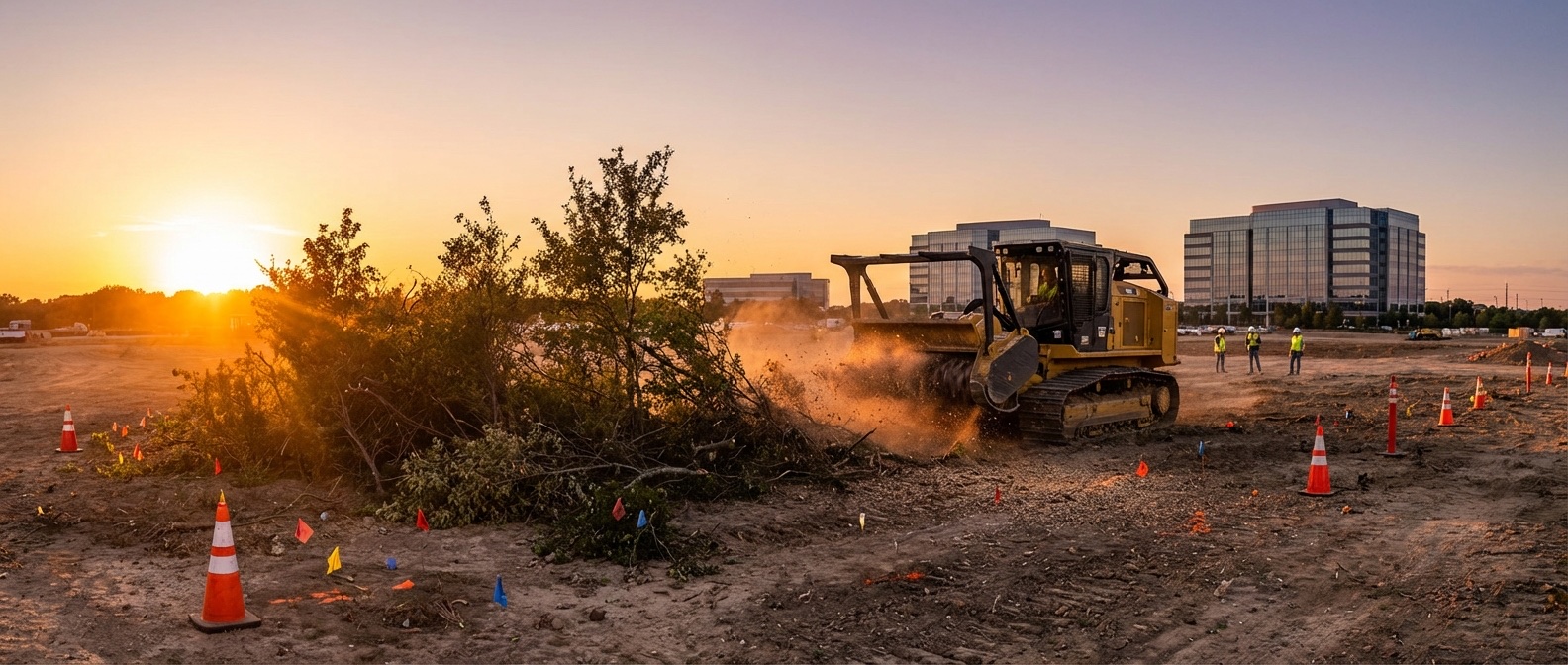
Why Builders Choose Forestry Mulching for Site Prep
Traditional construction site clearing creates problems: stripped topsoil, erosion headaches, burn pile delays, and expensive debris hauling. Forestry mulching eliminates all of these issues while delivering cleared land faster than conventional methods.
One Machine, One Pass
A single forestry mulcher cuts, grinds, and distributes vegetation in one operation. No felling crew, no hauling trucks, no burn pile supervision. What used to require multiple contractors now requires one.
Immediate Site Access
After mulching, your excavation crew can move in immediately. No waiting for debris removal, no navigating around burn piles. The site is cleared and ready for the next phase of development.
Erosion Control Built-In
The mulch layer left behind acts as natural erosion control. Critical for Ohio's clay soils and increasingly strict stormwater requirements. Often reduces the temporary erosion control measures needed during construction.
Topsoil Stays Put
Unlike bulldozing that strips and stockpiles topsoil, forestry mulching leaves soil structure intact. When construction's complete, you're not trucking topsoil back in for final grading and landscaping.
The Builder's Bottom Line
Faster site prep means earlier construction starts. Less erosion means fewer inspection delays. No debris hauling means lower clearing costs. Forestry mulching hits every metric that matters for construction projects: time, cost, and compliance.
Construction Site Clearing Services
Single-Lot Residential Clearing
For custom home builders and individual landowners developing their property:
- → Wooded lot clearing: Full lot or building envelope only
- → Selective clearing: Remove understory while preserving mature trees
- → Driveway routing: Cut access roads through wooded areas
- → Perimeter clearing: Create buffer zones required by zoning
- → Septic field prep: Clear and prep drain field areas
Most single-lot clearing completes in 4-8 hours, ready for foundation excavation the next day.
Subdivision & Multi-Lot Development
For developers clearing multiple lots and common areas:
- → Phased clearing: Clear lots as they sell or in construction phases
- → Road corridors: Clear street rights-of-way before infrastructure
- → Common areas: Park spaces, retention basins, buffer zones
- → Utility corridors: Clear paths for water, sewer, electric
- → Stormwater areas: Prep detention and retention basin locations
We work with your development timeline—clearing phases as needed rather than all at once.
Commercial & Industrial Site Prep
Large-scale clearing for commercial development:
- → Retail pad sites: Strip mall, standalone, and mixed-use locations
- → Office parks: Building sites plus parking and landscaping areas
- → Industrial facilities: Warehouse, manufacturing, distribution sites
- → Medical facilities: Hospital and medical office site prep
- → Agricultural buildings: New barn, equipment shed, processing facility sites
Commercial projects often benefit most from forestry mulching's speed and erosion control.
Infrastructure & Utility Projects
Clearing for infrastructure development:
- → Road construction: New road corridors and intersection improvements
- → Pipeline routes: Gas, oil, water main right-of-way clearing
- → Electric transmission: Power line corridor establishment
- → Communication lines: Fiber optic and broadband routes
- → Stormwater projects: Drainage improvements and new systems
Construction Site Clearing Costs in Ohio
Site clearing is often a small percentage of total construction costs, but it directly impacts project timeline. Here's what Ohio developers and builders typically pay:
2026 Ohio Construction Site Clearing Prices
| Vegetation Type | Price Per Acre |
| Light brush (saplings, honeysuckle, scrub) | $1,800 - $2,500 |
| Medium density (mixed brush, trees up to 6") | $2,500 - $3,500 |
| Heavy woods (dense trees up to 12") | $3,500 - $5,000 |
| Selective clearing (preserve specific trees) | +15-25% |
| Steep terrain (over 20% grade) | +20-30% |
| Minimum project | $2,500 |
Volume Discounts for Developers
- • 2.25 - 5 acres: 10% discount
- • 5.25 - 10 acres: 15% discount
- • 10+ acres: 20% discount
- • Multi-phase contracts: Additional pricing
Larger projects see significant per-acre savings.
Factors That Affect Pricing
- → Vegetation density and tree diameter
- → Terrain complexity and slope
- → Equipment access requirements
- → Selective clearing vs. full clear
- → Mulch management preferences
Sample Construction Site Projects
- Custom home lot, Clermont County: 1.2 acre wooded lot, building envelope + driveway → $4,800
- 12-lot subdivision, Warren County: 18 acres total, phased clearing over 8 months → $48,000
- Commercial pad site, Butler County: 8 acres heavy brush + selective tree preservation → $32,500
- Warehouse site, Franklin County: 25 acres medium density → $85,000
- Road corridor, Hamilton County: 3,200 linear feet x 60' wide → $28,000
The Construction Site Clearing Process
Understanding how forestry mulching fits into your construction timeline helps you plan effectively. Here's the typical process from first contact to cleared site:
Phase 1: Pre-Clearing Assessment
- 1. Initial contact: Share your site plan, aerial photos, and project timeline
- 2. Site review: We assess vegetation density, terrain, and access
- 3. Quote delivery: Detailed estimate within 24-48 hours for most projects
- 4. Coordination: Discuss timing with your construction schedule
Phase 2: Pre-Clearing Preparation
- 1. Survey coordination: Work with your surveyor to mark boundaries
- 2. Tree preservation: Flag trees to be saved (if selective clearing)
- 3. Utility locates: Complete Ohio 811 utility locate requirements
- 4. Erosion planning: Coordinate with any required SWPPP
Phase 3: Clearing Operations
- 1. Equipment mobilization: Mulcher transported to site
- 2. Systematic clearing: Work in planned pattern across the site
- 3. Mulch management: Distribute, windrow, or stockpile as specified
- 4. Quality check: Final pass to ensure complete clearing
Phase 4: Post-Clearing Handoff
- 1. Site walkthrough: Review completed clearing with your team
- 2. Documentation: Provide photos for your project records
- 3. Excavation coordination: Introduce your excavation contractor if helpful
- 4. Ongoing availability: Available for additional phases as needed
Timeline Reality Check
Most residential lots clear in a single day. A 10-acre subdivision typically takes 3-4 days. Your excavation crew can mobilize the day after clearing completes. Compare this to conventional clearing that might take 2-3 weeks and still leave you waiting for debris removal.
Working with Your Construction Team
Forestry mulching integrates smoothly with your existing contractors. Here's how we coordinate with the key players on your construction project:
Coordinating with Excavation Contractors
Your excavation crew is the next operation after clearing. We make their job easier:
- → Stump removal: Mulched stumps are ground below grade—no stump grinder needed
- → Debris-free site: No brush piles to push or haul before excavation begins
- → Mulch management: Can windrow mulch for easy dozer relocation or incorporate into soil
- → Access routes: Clear equipment access paths as part of the clearing
Many excavation contractors request forestry mulching because it makes their work faster and cleaner.
Supporting Surveyors
Survey work is easier when the site is accessible:
- → Clear sight lines for boundary and topographic surveys
- → Access paths to all corners and control points
- → Post-clearing survey coordination if needed
Erosion Control Integration
The mulch layer provides significant erosion protection:
- → Natural ground cover until grading begins
- → Reduced silt fence and straw wattle requirements in many cases
- → Mulch can be repositioned during construction as temporary erosion control
- → Often satisfies initial SWPPP requirements for cleared areas
Utility Installation Prep
Clear paths for underground and overhead utilities:
- → Water main and sewer line corridors
- → Electric and gas service routes
- → Stormwater pipe and inlet locations
- → Access for utility crews and equipment
Erosion Control & Environmental Compliance
Construction site clearing in Ohio increasingly involves environmental compliance. Forestry mulching makes compliance easier than traditional clearing methods.
Ohio EPA SWPPP Requirements
Sites disturbing more than 1 acre require a Stormwater Pollution Prevention Plan. Forestry mulching helps meet these requirements:
- ✓ Minimize soil disturbance: Mulching preserves soil structure unlike bulldozing
- ✓ Immediate ground cover: Mulch layer provides erosion protection from day one
- ✓ Phased clearing: Clear only what's needed for immediate construction
- ✓ Buffer zone preservation: Easily maintain vegetated buffers near waterways
Stream & Wetland Buffers
Many Ohio jurisdictions require setbacks from waterways. Forestry mulching allows precise clearing:
- → Clear up to buffer boundaries without impacting protected areas
- → No sediment runoff during the clearing process
- → Mulch in buffer zones stabilizes soil without adding fill
- → Selective removal in riparian areas when permitted
Managing the Mulch
The material left after mulching is an asset, not waste. Options include:
- → Leave in place: Provides erosion control until grading
- → Windrow: Push to perimeter with dozer for later use
- → Stockpile: Save for final landscaping and erosion control
- → Incorporate: Mix into topsoil during grading for soil improvement
- → Remove: Haul off-site if not wanted (rarely necessary)
The Compliance Advantage
Inspectors appreciate forestry mulching. Sites stay cleaner during construction, erosion controls are more effective, and documentation is simpler. When you're not fighting erosion issues, you're not fighting inspection delays.
Selective Clearing for Quality Development
Premium developments often preserve mature trees to enhance property values. Forestry mulching excels at selective clearing because of its precision.
What We Can Preserve
- ✓ Mature hardwoods and specimen trees
- ✓ Tree groupings and natural features
- ✓ Existing drip lines and root zones
- ✓ Natural drainage patterns
- ✓ Rock outcrops and terrain features
Selective Clearing Process
- → Walk site with you or your arborist
- → Flag or paint trees to preserve
- → Clear understory around preserved trees
- → Remove competing vegetation
- → Protect root zones during clearing
Why Developers Choose Selective Clearing
- Higher lot premiums: Wooded lots with mature trees command premium prices
- Faster sales: Trees sell homes—buyers pay more for established landscapes
- Reduced landscaping costs: Existing trees are worth thousands in installed value
- Environmental marketing: "We preserved the woods" is a strong selling point
- Zoning compliance: Many jurisdictions require tree preservation percentages
Forestry Mulching vs. Traditional Site Clearing
How does forestry mulching compare to conventional construction site clearing? Here's the head-to-head comparison:
| Factor | Forestry Mulching | Conventional Clearing |
|---|---|---|
| Timeline (per acre) | 1-2 days | 3-7 days |
| Equipment needed | Single machine | Multiple machines + trucks |
| Topsoil impact | Preserved | Disturbed/removed |
| Debris hauling | None | Multiple truck loads |
| Burn permits | Not needed | Often required |
| Erosion risk | Low (mulch cover) | High (bare soil) |
| Stumps | Ground below grade | Pushed to pile or ground separately |
| Site ready for excavation | Immediately | After debris removal |
| Cost (all-in) | $2,500-$5,000/acre | $3,500-$7,000/acre |
The Hidden Costs of Conventional Clearing
When comparing costs, consider what conventional clearing actually requires:
- → Felling crew + equipment (chainsaw crew or feller-buncher)
- → Skidder or forwarder to move logs
- → Dump trucks for debris hauling
- → Disposal or burn pit fees
- → Stump grinding (separate operation)
- → Extended timeline = extended carrying costs
- → Erosion control for bare soil
- → Topsoil replacement at finish
Forestry mulching bundles all vegetation removal into a single competitive price.
Best Timing for Construction Site Clearing
Timing your site clearing affects both the clearing operation and your construction schedule. Here's the strategic view:
Winter Clearing (Dec-Feb)
Excellent choice for spring construction starts.
- ✓ Frozen ground supports equipment
- ✓ Dormant vegetation clears faster
- ✓ No leaf cover obscures conditions
- ✓ Ready for spring foundation work
- ✓ Lower demand = faster scheduling
- ✗ Extreme cold may pause work
Spring Clearing (Mar-May)
Popular but plan around mud season.
- ✓ Immediate construction follows
- ✓ Growing season seed establishment
- ✗ Wet ground in early spring
- ✗ High demand season
- ✗ Weather delays possible
Summer Clearing (Jun-Aug)
Reliable conditions, peak demand.
- ✓ Consistent dry weather
- ✓ Long working days
- ✓ Firm equipment access
- ✗ Full foliage = more material
- ✗ Peak construction demand
- ✗ Longer scheduling lead time
Fall Clearing (Sep-Nov)
Excellent for next-year projects.
- ✓ Leaves falling improves access
- ✓ Stable weather conditions
- ✓ Site winters ready for spring
- ✓ Fall seeding opportunity
- ✗ Still high demand
Strategic Timing for Developers
Smart developers clear sites 2-3 months before planned construction. This provides buffer for weather delays, allows any erosion control to stabilize, and ensures your excavation crew isn't waiting on site prep. For phased developments, we can coordinate clearing with your sales and construction pipeline.
Ohio Service Area for Construction Sites
We serve construction projects throughout Southwest Ohio, Central Ohio, and Northern Kentucky. Our equipment transports efficiently to job sites across the region.
Cincinnati Metro
- → Hamilton County
- → Clermont County
- → Warren County
- → Butler County
- → All Cincinnati suburbs
Dayton Area
- → Montgomery County
- → Greene County
- → Miami County
- → Clark County
- → Dayton suburbs
Columbus Region
- → Franklin County
- → Delaware County
- → Licking County
- → Fairfield County
- → Columbus suburbs
Northern Kentucky
- → Boone County
- → Kenton County
- → Campbell County
- → Grant County
Southeast Indiana
- → Dearborn County
- → Ripley County
- → Ohio County
- → Franklin County
Rural Ohio
- → Brown County
- → Adams County
- → Highland County
- → Clinton County
Frequently Asked Questions
How much does construction site clearing cost in Ohio?
Construction site clearing in Ohio typically costs $2,500-$5,000 per acre depending on vegetation density. Light brush and saplings run $1,800-$2,500/acre, medium density mixed brush $2,500-$3,500/acre, and heavy wooded sites $3,500-$5,000/acre. Volume discounts apply for larger developments. Our minimum project is $2,500.
How long does it take to clear a construction site?
Most residential lots (0.5-2 acres) clear in one day. Multi-lot subdivisions of 10-20 acres typically complete in 3-5 days. Commercial sites of 20+ acres may take 5-10 days depending on vegetation density and terrain. We provide timeline estimates with every quote and coordinate with your construction schedule.
Does forestry mulching work for all construction site vegetation?
Forestry mulching handles trees up to 12 inches in diameter, brush, saplings, and stumps. For sites with larger trees, we can coordinate selective removal before mulching the remaining vegetation. Most Ohio construction sites fall well within our equipment capabilities.
What happens to the mulch after clearing?
The mulch stays on-site as a natural erosion barrier. For construction sites, it can be scraped and stockpiled, incorporated into topsoil, used for temporary erosion control, or spread in non-building areas. Many builders use it to protect exposed soil during construction phases.
Do you work with builders on multiple lot projects?
Yes! We regularly partner with builders and developers on phased clearing projects. We offer volume pricing, priority scheduling for repeat clients, and can coordinate clearing with your construction timeline. Many builders have us on retainer for new lot clearing as sales progress.
Can you clear a construction site in winter?
Absolutely. Winter is often the best time for construction site clearing. Frozen ground supports heavy equipment, dormant vegetation clears faster, and clearing before spring allows immediate construction when weather breaks. Many developers schedule winter clearing to stay ahead of the building season.
Ready to Clear Your Construction Site?
Whether you're developing a single lot or a major subdivision, we're ready to help get your site cleared and construction-ready. Fast quotes, reliable scheduling, and professional execution.
Get Your Construction Site Clearing Quote
Use our instant pricing calculator for a quick estimate, or contact us to discuss your development project in detail.
Or call us directly: (513) 790-4150
Information for Your Quote Request
- → Site address or coordinates
- → Total acreage and clearing area
- → Vegetation type (brush, woods, mixed)
- → Selective clearing needs (trees to preserve)
- → Construction start timeline
- → Site plan or aerial photos if available
- → Any special requirements (erosion, access, etc.)