
How to Clear a Wooded Lot in Ohio: Complete Step-by-Step Guide for Property Owners
Whether you're preparing land for a new home, creating usable yard space, or reclaiming neglected property, clearing a wooded lot is a significant undertaking. This comprehensive guide walks you through every step—from initial planning to final cleanup.
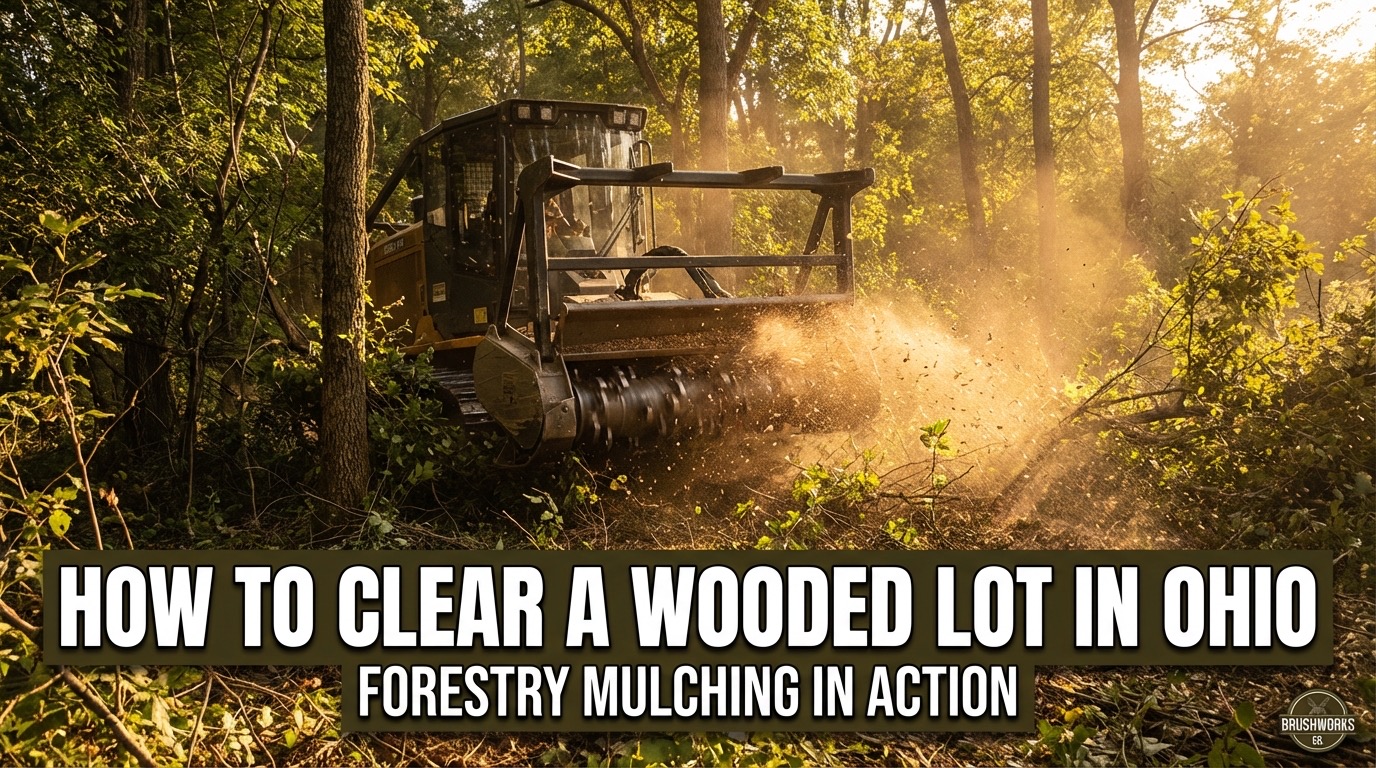
Quick Overview: Clearing a Wooded Lot
Before diving into details, here's what you need to know about clearing a wooded lot in Ohio:
| Factor | Typical Range |
|---|---|
| Cost per acre | $2,500 – $6,000+ |
| Timeline (1 acre) | 1-3 days (professional) |
| Permits required | Usually none (check local) |
| Best method | Forestry mulching (most cases) |
| Best season | Late fall through early spring |
Key takeaway: Most Ohio homeowners spend $3,000-$8,000 to clear a typical residential wooded lot (0.5-2 acres). The fastest, cleanest results come from professional forestry mulching, which handles everything from brush to 8" trees in a single pass.
Get an instant estimate for your wooded lot clearing project
Calculate Your PriceStep 1: Assess Your Wooded Lot
Before hiring anyone or renting equipment, walk your property and document what you're dealing with. This assessment directly impacts your approach, timeline, and budget.
Survey the Vegetation
Take inventory of what's growing on your lot:
- Underbrush density: Light (easy to walk through), Medium (pushing through), Heavy (impenetrable honeysuckle/multiflora rose)
- Sapling count: Trees under 4" diameter—how many per 100 sq ft?
- Mature trees: Count trees over 8" diameter. Note species if possible (oak, maple, walnut = potential value)
- Invasive species: Honeysuckle, autumn olive, multiflora rose, Bradford pear—these need complete removal
- Desirable trees: Mark any trees you want to keep (use flagging tape)
Evaluate the Terrain
Cincinnati's hilly landscape means terrain significantly impacts clearing:
- Slope grade: Flat (0-10°), Moderate (10-25°), Steep (25°+). Slopes over 25° require specialized equipment
- Wet areas: Note any low spots that stay wet—these may be seasonal drainage or wetlands
- Rock outcroppings: Exposed limestone is common in Ohio and affects equipment choice
- Access points: Where can equipment enter? Minimum 8-10' wide path needed for mulching equipment
Identify Obstacles & Utilities
Hidden hazards that can derail your project:
- Utility lines: Call 811 before any work. Underground electric, gas, water, and fiber are invisible until you hit them
- Property lines: Know exactly where your land ends. A survey saves disputes later
- Structures: Old fencing, abandoned wells, septic components, foundations from demolished buildings
- Debris: Old dumps were common on rural Ohio properties—buried metal, glass, and concrete
Step 2: Check Permits & Regulations
Good news: Ohio is relatively permissive about clearing private property. But there are exceptions you need to verify.
What Usually Doesn't Require Permits
- ✓ Clearing brush and undergrowth on your own property
- ✓ Removing trees on private residential land (most Ohio counties)
- ✓ Creating trails or clearing for personal use
- ✓ Forestry mulching operations
When You DO Need Permits or Approval
- HOA properties: Most homeowners associations require approval for tree removal. Check your covenants
- Floodplain areas: FEMA-designated floodplains may restrict clearing near waterways
- Riparian corridors: Clearing within 50-100 feet of streams may require Ohio EPA consultation
- Conservation easements: If your property has a conservation easement, clearing may be restricted or prohibited
- Historic districts: Some municipalities protect trees in historic areas
- Burning debris: Always requires a burn permit from your local fire department
- Zoning for future use: If clearing for construction, ensure your planned use is zoned correctly
Pro tip: Call your county zoning office and describe your project. A 5-minute phone call can prevent costly mistakes. In Hamilton County, contact (513) 946-4500. Clermont County: (513) 732-7213. Warren County: (513) 695-1208.
Step 3: Decide on a Clearing Method
Your assessment determines which method (or combination) makes sense. Here's how each option handles different wooded lot scenarios:
Forestry Mulching: Best for Most Wooded Lots
A forestry mulcher grinds trees, brush, and stumps into mulch on-site. It's the gold standard for residential wooded lot clearing.
✓ Ideal When:
- Trees are under 8-10" diameter
- You want one-pass complete clearing
- No hauling or burning desired
- Immediate usable land needed
- Erosion control matters
✗ Not Ideal When:
- Large timber needs removal first
- You want stumps completely gone (below grade)
- Land will be graded immediately
Cost: $2,500-$5,000/acre | Speed: 1-3 acres/day
Selective Logging + Mulching: For Valuable Timber
If your lot has mature hardwoods worth selling, this two-phase approach maximizes value.
✓ Ideal When:
- Mature oaks, walnuts, cherry present
- Trees over 16" diameter
- You're not in a rush
- Timber value offsets clearing cost
✗ Not Ideal When:
- Only small/low-value trees present
- Access is difficult for log trucks
- You need the land cleared quickly
Cost: $3,000-$6,000/acre (may be offset by timber sale) | Speed: 1-2 weeks total
Bulldozing + Burning/Hauling: Traditional Method
Heavy equipment pushes everything into piles for burning or hauling. Still used for large commercial projects.
✓ Ideal When:
- Complete stump removal required
- Site will be excavated anyway
- Large trees need pushing
- Grading is part of the plan
✗ Not Ideal When:
- Erosion control matters
- Budget is limited
- Neighbors are nearby (burning)
- No immediate construction planned
Cost: $4,000-$10,000+/acre | Speed: 1-3 days clearing + burning time
DIY Hand Clearing: Only for Small Areas
Chainsaws, loppers, and sweat equity. Realistic only for small sections.
✓ Ideal When:
- Area is under 1/4 acre
- Brush is light to moderate
- You have time and fitness
- Budget is extremely tight
✗ Not Ideal When:
- Any significant tree removal needed
- Dense honeysuckle/multiflora present
- Terrain is steep
- Your time has value
Cost: $0-$500 (equipment/disposal) | Speed: 40-100+ hours per acre
Step 4: Prepare the Site
Before clearing day, prepare your property to ensure efficient, problem-free work:
Call 811 (Ohio Utilities Protection Service)
Call at least 48 hours before clearing begins. They'll mark underground utilities for free. This is legally required and prevents catastrophic (and expensive) accidents.
Mark Property Boundaries
Flag or stake your property lines clearly. If you're unsure, hire a surveyor ($300-$600). Clearing your neighbor's trees is an expensive mistake.
Flag Trees to Keep
Use bright flagging tape to mark any trees you want preserved. Walk the property with your clearing contractor to confirm.
Clear Access Path
Equipment needs entry. Remove any obstacles (parked vehicles, lawn furniture, temporary fencing) from the access route. Mulchers need 10-12' wide path minimum.
Notify Neighbors
Courtesy goes a long way. Let adjacent property owners know heavy equipment will be working. This prevents complaints and builds goodwill.
Document "Before" Condition
Take photos and video of the lot before work begins. Useful for insurance purposes, dispute resolution, and satisfying "before/after" curiosity.
Step 5: The Clearing Process
Here's what happens during professional forestry mulching (the most common method for Ohio wooded lots):
Day 1: Equipment Arrival & Initial Pass
- Mulcher arrives on trailer (typically 8-10 AM after morning dew dries)
- Operator does a quick walk-through to confirm marked trees and boundaries
- Work begins at the easiest access point, establishing a "working area"
- First pass clears underbrush and smaller saplings to create maneuvering room
- Progress: roughly 0.5-1 acre for heavily wooded lots
Day 2+: Complete Clearing
- With initial space created, operator tackles denser sections
- Larger saplings and small trees (4-8") processed on second pass
- Stumps ground down to grade or below
- Final cleanup pass for any missed areas
- Mulch redistributed as needed for even coverage
What you'll see afterward: The ground covered in 2-6 inches of wood chips and mulch. You can walk on it immediately. Within a few months, grass will begin growing through. Within 2-3 years, most mulch decomposes into soil.
Step 6: Post-Clearing Considerations
Your lot is cleared—now what? Plan for these common next steps:
If Planting Grass
- Wait 2-4 weeks for mulch to settle
- Overseed directly into mulch (it works!)
- Or rake mulch aside, seed, replace mulch as cover
- Best timing: early fall or mid-spring
If Building
- Mulch layer doesn't affect excavation
- Remove mulch from building footprint
- Consider stump grinding if stumps are in foundation area
- Allow 2-4 weeks for soil to settle before surveys
Managing Regrowth
- Some species (honeysuckle, autumn olive) may resprout
- Spot-treat with herbicide or hand-pull in first year
- Second mulching pass after 1-2 years eliminates most regrowth
- Regular mowing prevents new woody growth
Erosion Control
- Mulch layer naturally prevents most erosion
- On steep slopes, consider erosion blankets for bare areas
- Plant groundcover or grass within first growing season
- Install French drains if water pooling is an issue
Wooded Lot Clearing Costs in Ohio: Complete Breakdown
Here's what Ohio property owners actually pay to clear wooded lots:
| Lot Condition | Cost Per Acre | Example: 1 Acre |
|---|---|---|
| Light woods (brush, saplings under 3") | $2,000 – $3,000 | $2,500 typical |
| Medium woods (mixed brush, trees 3-6") | $3,000 – $4,500 | $3,750 typical |
| Heavy woods (dense, trees 6-10") | $4,000 – $5,500 | $4,750 typical |
| Mature timber (requires logging first) | $5,000 – $8,000+ | $6,000+ typical |
Add-On Costs to Consider
- Steep terrain (25°+ slope): Add 25-50% for specialized equipment
- Limited access: Add 10-20% if equipment entry is difficult
- Complete stump removal: $150-$300 per large stump if needed below grade
- Debris hauling (if not mulching): $500-$2,000+ depending on volume
- Soil testing: $50-$200 if testing for septic or planting
Frequently Asked Questions
How much does it cost to clear a wooded lot in Ohio?
Clearing a wooded lot in Ohio typically costs $2,500-$6,000 per acre depending on tree density, terrain, and method. Light wooded areas with mainly brush and small saplings cost $2,500-$3,500/acre with forestry mulching. Heavily wooded lots with mature trees requiring removal can run $4,000-$6,000+ per acre when factoring in logging and stump removal.
Do I need a permit to clear a wooded lot in Ohio?
In most Ohio counties, you don't need a permit to clear trees on private residential property. However, check for local zoning restrictions, especially in subdivisions with HOA rules, floodplain areas, or properties with conservation easements. If you plan to burn debris, you'll need a burn permit from your local fire department.
What is the fastest way to clear a wooded lot?
Forestry mulching is the fastest method for clearing wooded lots up to 8-inch diameter trees. A professional crew can clear 1-3 acres per day depending on density. For lots with larger timber, combining selective logging (to remove valuable trees) with forestry mulching for the remainder is the most efficient approach.
Should I sell the timber before clearing my wooded lot?
If your lot has mature, valuable hardwoods (oak, walnut, cherry) over 16 inches in diameter, selling timber first can offset clearing costs—sometimes generating $500-$5,000+ per acre. However, for lots with mostly small trees or low-value species, the logging hassle often isn't worth it. A forester can assess timber value for free.
How long does it take to clear a 1-acre wooded lot?
With professional forestry mulching equipment, a 1-acre wooded lot with brush and saplings up to 6 inches typically takes 4-8 hours. Heavily wooded lots requiring tree removal take 1-3 days depending on tree size and quantity. DIY clearing with hand tools can take weeks to months for the same area.
What happens to the stumps when clearing a wooded lot?
With forestry mulching, stumps are ground down to ground level or slightly below as part of the clearing process—no additional charge. The remaining mulch decomposes naturally over 2-3 years. If you need stumps removed completely (for construction), stump grinding or excavation costs an additional $100-$300 per stump.
Ready to Clear Your Wooded Lot?
Get a fast, accurate estimate for your Ohio property. Our instant pricing calculator gives you real numbers based on your lot's specific conditions.