
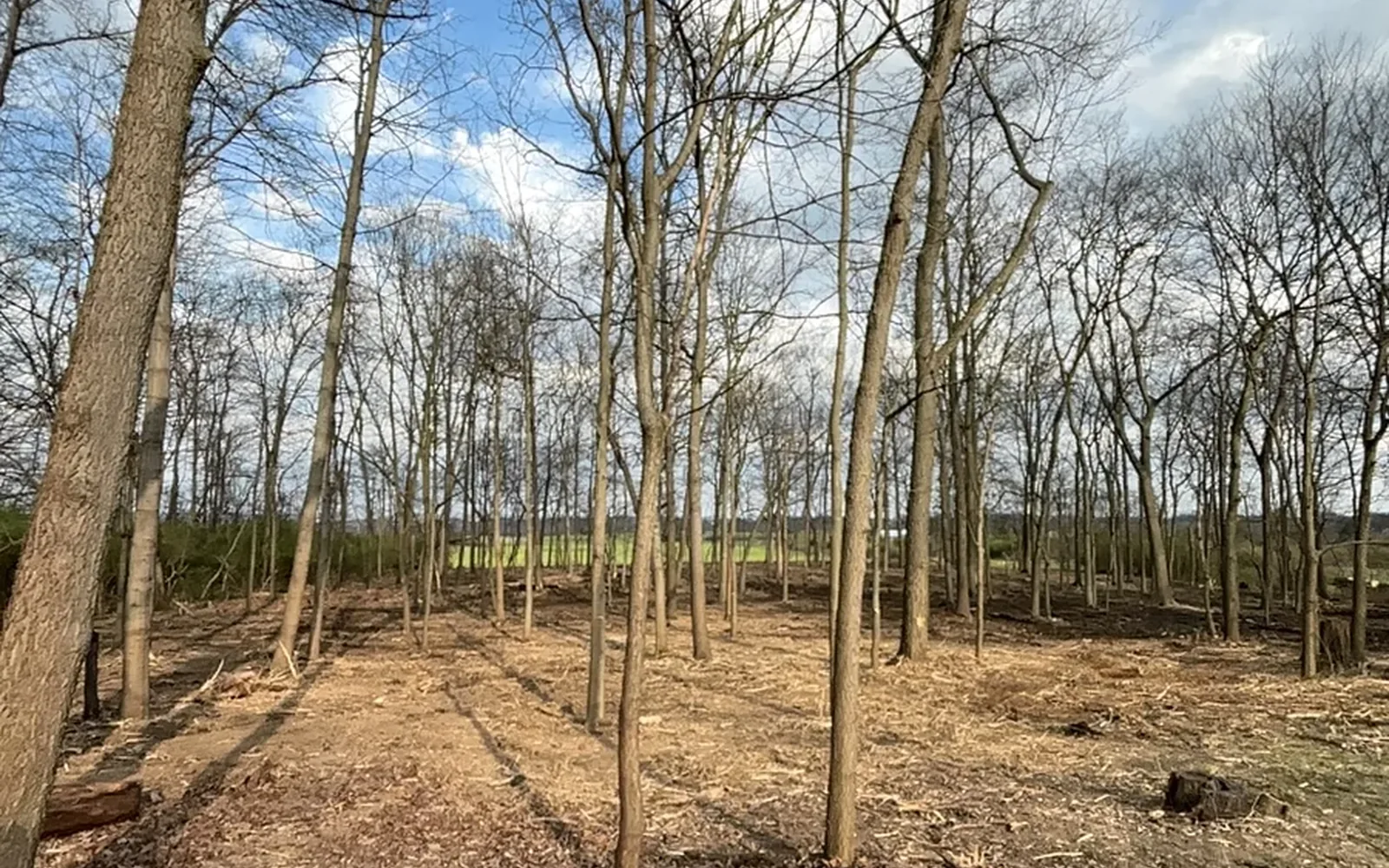
Land Clearing for Equipment Storage Yards Ohio: Site Prep for Trucks, Trailers, and Heavy Equipment

An equipment yard looks easy on paper. Clear a spot, spread some stone, park the trucks. Then spring rain hits Ohio clay and the yard turns into ruts, soft corners, blocked trailers, and a mud trail all the way to the road.

Published May 17, 202612 min read
Land Clearing for Equipment Storage Yards Ohio: Site Prep for Trucks, Trailers, and Heavy Equipment
Field guide from Brushworks Services Co. — practical land clearing advice for Ohio property owners.

Land clearing for equipment storage yards is less about making a bare spot and more about making a working surface. The yard has to carry weight, drain water, leave room for trailers to swing, and stay open enough that crews can find what they need without backing through brush.

We see this around Cincinnati and across southwest Ohio with contractors, farmers, landscapers, excavators, tree services, small fleets, and rural property owners. Someone has a corner behind the shop, a wooded strip beside the barn, or an overgrown acre along the driveway. It seems like wasted ground until the equipment starts stacking up in the wrong places.

A good storage yard keeps machines organized and out of the way. A bad one becomes a mud lot with expensive iron sitting in standing water. The difference is in the site prep before the first load of gravel shows up.

Start with what the yard has to hold

Do not start with the chainsaw. Start with the equipment list. The amount of land you clear depends on what will live there and how often it moves.

A compact tractor and a few attachments do not need the same layout as a forestry mulcher, dump truck, gooseneck trailer, skid steer, fuel tank, spare attachments, and a pile of material. Trucks need drive aisles. Trailers need swing room. Tracked machines need firm approaches. Attachments need enough space that nobody has to drag a grapple across the yard just to reach the bucket behind it.

We like to walk the site and think through a normal workday. Where does the truck enter? Where does a trailer back in? Where can a machine unload without blocking the driveway? Where do attachments sit so the operator can grab them quickly? Where will snow, brush, logs, stone, or spare mats go? Those questions decide the footprint better than acreage alone.

For a small rural storage pad, a quarter acre can be plenty. For a busy contractor or farm yard, half an acre can disappear fast once turning lanes, fence lines, drainage, and future growth are included. If the business is growing, clear the yard for the next few years, not just the equipment you own today.

Why Ohio equipment yards fail

The most common failure is stone over topsoil. It looks fine when it is dry. Then April rain hits, the topsoil holds water, and every tire track pushes gravel down into mud. By summer, the owner has bought three more loads of stone and still has soft spots.

Southwest Ohio is tough on storage yards because our clay soils do not drain quickly. Around Cincinnati, Loveland, Milford, Batavia, Lebanon, Hamilton, and the surrounding townships, you can have firm-looking ground on top with wet clay just a few inches below. Heavy equipment finds that weakness immediately.

The second failure is no drainage path. A yard built flat will hold water. A yard sloped the wrong way sends water toward the shop, the neighbor, the road, or the lowest corner where your heaviest machine is parked. Water needs a route before stone goes down.

The third failure is not enough room. A tight yard gets torn up at the edges because drivers have to turn in the same narrow spots every day. Trailers clip brush. Trucks push gravel into the grass. Operators park wherever they can instead of where the yard was supposed to function.

Planning an equipment yard on rough ground?

Send the address, photos, and a list of what you need to store. Brushworks can clear the footprint, open the access, and help you think through drainage before the yard turns into a mud bill.

Forestry mulching is usually the first pass

Most equipment-yard sites start as brush, small trees, vines, honeysuckle, briars, or neglected field edge. Forestry mulching is a clean way to open that ground without creating a pile of debris that has to be burned or hauled away.

The mulcher grinds brush and small trees in place. That leaves the site open enough to see grade, stumps, wet spots, old fence, junk, utility poles, drainage swales, and anything else hiding under the growth. It also gives the grading crew a cleaner surface to work from.

Mulching is not the finished storage surface. A mulch layer will not support loaded trucks. It is the clearing step that lets the real base work happen. Larger trees may need to be felled first. Large stumps may need to be pulled, ground, or worked around depending on the final yard plan.

For equipment storage, the best clearing is selective. Drop what is inside the footprint, remove brush around the perimeter, and keep useful trees outside the work zone when they provide shade, screening, or wind protection. Do not leave weak trees leaning over trucks or trailers. A dead ash tree over a parked machine is not shade. It is a future claim.

Access matters before the yard itself

A storage yard is only useful if trucks can get in and out without drama. The entrance, driveway, gate, and approach often need as much attention as the pad.

Wide equipment trailers do not like sharp turns, tight trees, soft shoulders, or blind approaches. If the gate is too narrow or the driveway has no shoulder, drivers will cut the same corner every time and destroy it. If the first fifty feet off the road stays wet, the yard will look fine while the entrance becomes the actual problem.

Before clearing, think about the biggest truck that will use the yard. A pickup with a utility trailer is one thing. A dump truck and gooseneck is another. A lowboy hauling a tracked machine needs more swing room than most owners expect. Clearing an extra ten or fifteen feet at the approach can save years of edge repair.

Visibility matters too. Brush at the entrance can block sight lines onto rural roads. Around Ohio townships and county roads, that is more than an annoyance. It can become a safety issue, especially with loaded trailers pulling out slowly.

Build the base for the heaviest thing you own

Equipment storage yards need stronger base than normal residential driveways. A thin cap of #57 stone over soft ground will not hold a skid steer, dump truck, mini excavator, forestry head, or loaded trailer for long.

The usual sequence is simple: clear the vegetation, strip organic material, shape the subgrade, install geotextile fabric where the soil is soft, place larger base stone, compact it, then finish with a smaller surface stone if needed. The exact stone mix depends on local supply and the equipment load, but the principle does not change. The strength is underneath.

On clay ground, fabric is cheap insurance. It keeps the stone from pumping down into the soil and keeps mud from working up through the base. If the yard will carry trucks after rain, fabric often pays for itself by preventing the first round of repairs.

One warning: do not bury brush or topsoil under the yard. It will rot, settle, and create soft spots. The site may look clean the day it is covered, but organic material under stone is a slow-motion pothole.

Drainage is not optional

Water needs to leave the yard on purpose. If it does not, it will leave by making ruts.

A working storage yard should have a small crown or cross slope, clean edges, and a defined place for runoff. That may be a grass swale, a culvert, a stone trench, or a shallow ditch along the edge. The goal is not to send water onto a neighbor or public road. The goal is to move it away from the storage surface and let it spread or drain where it belongs.

Drainage should be planned while the site is open. It is much easier to shape a swale before stone is placed than to cut one through a finished yard later. The same goes for culverts under the entrance. If water crosses the driveway now, solve that before you build the storage pad behind it.

Low spots deserve special attention. Every property has the spot where water naturally wants to sit. If that spot is inside your planned equipment yard, either move the yard, raise the base, or build drainage strong enough to handle it. Hoping gravel will fix a wet hole is how people buy the same stone twice.

Fence lines, screening, and security

Equipment yards need visibility and security at the same time. You want to see the machines, inspect them, and move around them. You also may want screening from the road or a neighboring house. The trick is keeping a clean perimeter instead of letting brush become the fence.

Brushy fence lines hide damage, trespassers, dumped trash, groundhog holes, and low branches that scrape equipment. They also hold moisture against trailers and attachments. Clearing the inside of the fence line gives you a maintenance lane. If privacy matters, keep a deliberate screen outside the working area or plant one later where it can be maintained.

Commercial yards may need zoning-approved screening, especially if they sit near residential property. That can mean fencing, evergreen rows, berms, or a combination. If you are building a contractor yard, landscape yard, or truck storage area near Cincinnati suburbs, ask about screening rules before you clear every tree on the edge.

Permits and zoning around Cincinnati

Private farm and personal equipment pads are often straightforward. Commercial storage yards can be different. If the yard supports a business, stores fleet vehicles, serves employees, or changes traffic entering a public road, local rules may apply.

Cincinnati, Hamilton County, Clermont County, Warren County, Butler County, Brown County, and township zoning departments all handle this differently. Some care most about land use. Some care about driveway access. Some care about stormwater or outdoor storage screening. If the site is near a creek, wetland, steep slope, or floodplain, the review can get more serious.

Do the boring calls early. Ask zoning whether equipment storage is allowed. Ask the county engineer about the entrance if you are changing road access. Ask about stormwater if the disturbed area is large or the yard will be used commercially. It is better to learn the rule before the trees are down and the stone is ordered.

Layout mistakes that cost money later

The cheapest yard to build is not always the cheapest yard to use. A poor layout burns time every day.

One common mistake is parking trailers nose to tail with no room to pull the middle one. Another is putting attachments wherever they fit instead of where the machine can reach them. Fuel tanks get placed in the way of snow piles. Drainage ditches get blocked by pallets. Gates swing into parked equipment. The yard works for two weeks, then the daily routine breaks it.

Leave a main lane that stays open. Put attachments along one edge where they can be reached without blocking traffic. Keep a turnaround if trailers will be moving often. Leave room to plow snow or push spoil. Keep fuel and maintenance areas close enough to use but away from drainage paths and brush.

Most owners know their equipment. They just have not drawn the movement pattern on the ground. Walk it before clearing. It is easier to adjust flags than move a finished gravel yard.

Maintenance after the yard is built

A gravel equipment yard still needs maintenance. The good news is that a well-built yard needs small maintenance, not constant rescue.

Plan on grading the surface when potholes start forming. Add stone before soft spots get deep. Keep drainage swales open. Cut brush along the perimeter once or twice a year. Watch the entrance because that is where heavy turning and road runoff usually cause the first damage.

Do not let vegetation creep back to the edge of stored equipment. Tall grass and brush hide leaks, pests, nails, scrap, and tire damage. A clean edge makes the yard easier to inspect and safer to work in.

If the yard gets busier than expected, expand before it becomes a mess. A crowded yard is hard on equipment and people. Clearing an additional bay or lane early is usually cheaper than rebuilding the whole traffic pattern after the surface is destroyed.

How Brushworks approaches equipment-yard clearing

We start with access, use, and water. What needs to get in? What needs to park? Where does water go now? Those three answers shape the clearing plan.

From there, we open the footprint with forestry mulching, remove trees that do not belong, clean up fence lines and the entrance, and leave the site ready for grading and stone. If the yard needs more than clearing, we help think through the next steps so the finished surface matches the way the property will actually be used.

Brushworks works across Greater Cincinnati and southwest Ohio, including Loveland, Milford, Batavia, Lebanon, Mason, Hamilton, West Chester, Amelia, Goshen, Blanchester, Hillsboro, and the rural properties between them. We clear for contractors, landowners, farms, small fleets, and property owners who are tired of using the good part of the driveway as a storage yard.

If you have a wooded corner, rough field edge, or overgrown lot that could become equipment storage, send photos and a list of what you need to park. We will help you figure out what to clear, what to keep, and what needs solved before the stone trucks roll in.

Frequently asked questions

How much land should I clear for an equipment storage yard?

Start with the equipment list, not the acreage. Count trucks, trailers, implements, attachments, spare materials, and turning room. A small contractor yard may need a quarter acre once drive aisles are included. A farm or land clearing yard with trucks, trailers, and tracked equipment may need half an acre or more. Clear extra room around the finished pad so gravel trucks and grading equipment can work without tearing up the edges.

Can forestry mulching prepare a wooded area for equipment storage?

Yes. Forestry mulching is usually the first pass on wooded or brushy equipment-yard sites. It clears honeysuckle, saplings, vines, briars, and small trees so the ground can be inspected and graded. It does not replace excavation, stump work, base stone, compaction, or drainage, but it makes those steps cleaner and faster.

What surface is best for storing heavy equipment in Ohio?

Most rural Ohio equipment yards use a compacted gravel base over firm subgrade. Heavy machines, dump trucks, and trailers need more than a thin layer of driveway stone. Soft clay usually needs topsoil stripped, geotextile fabric, a thick base of larger crushed stone, and a finer surface layer. Asphalt and concrete can work near shops, but gravel is usually the practical first choice for larger rural yards.

Do equipment storage yards need drainage?

Yes. Drainage decides whether the yard stays useful or turns into ruts. A good yard has slope, swales, culverts where needed, and a place for water to leave the pad without running toward buildings, neighbors, or public roads. Around Cincinnati, clay soils make drainage planning especially important.

Do I need a permit for an equipment yard in Ohio?

It depends on location and use. A private farm equipment pad may be simple. A commercial contractor yard, landscape yard, trucking yard, or rental-equipment storage area can trigger zoning, driveway, stormwater, screening, and township or city review. Check local rules before clearing if customers, employees, public roads, or business storage are involved.

What should be cleared around equipment storage areas?

Clear the pad, the entrance, turning room, trailer swing areas, fence lines, drainage paths, and enough perimeter space for mowing or brush maintenance. Avoid leaving brush tight against stored equipment because it hides pests, blocks visibility, traps moisture, and makes the yard harder to secure.

Related articles

Ready to turn rough ground into a working equipment yard?

Send the address, photos, access notes, and what you plan to store. We will help you clear the right footprint, protect the useful trees, and set the site up for a yard that holds up in Ohio weather.