
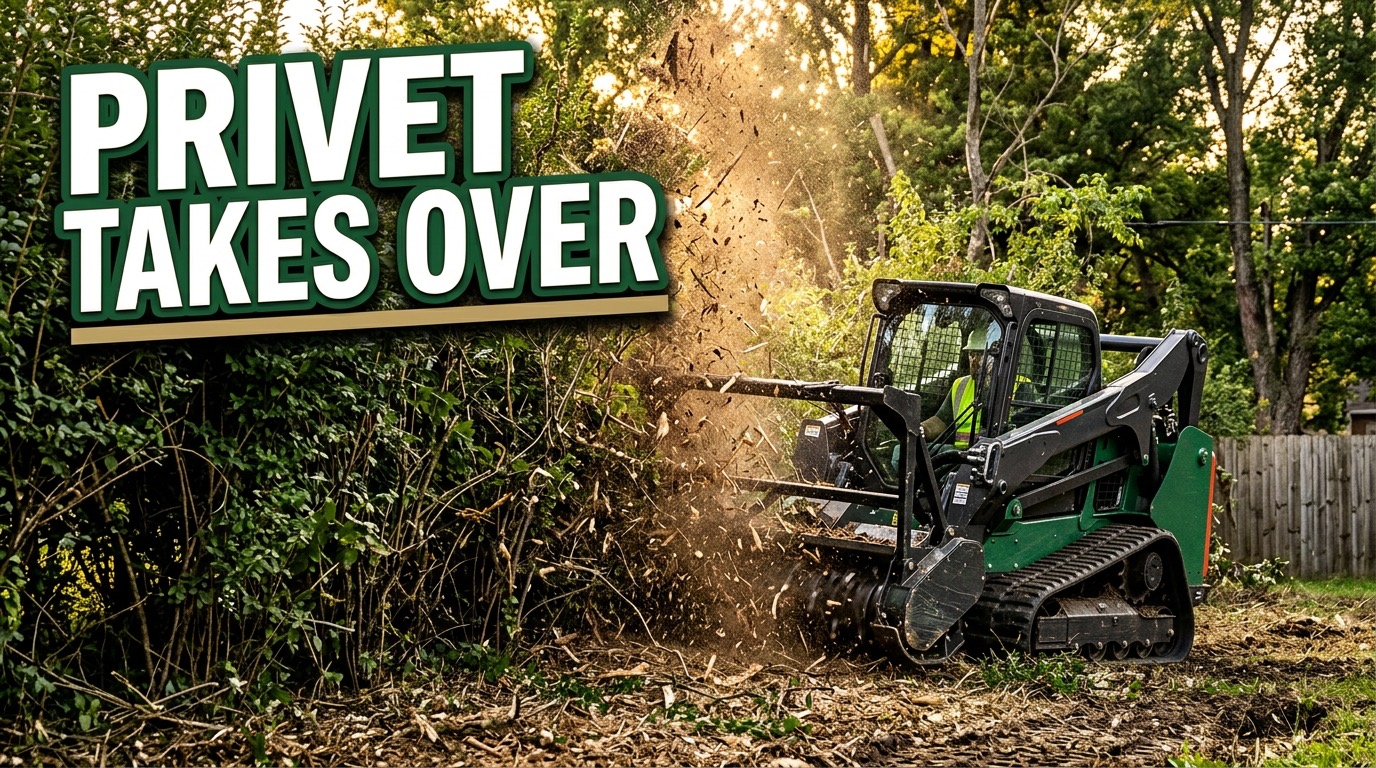
Why privet becomes such a mess around Cincinnati
Privet looks harmless when it is trimmed into a hedge along a driveway. The trouble starts when it gets ignored or escapes into the edge of a property. Around Cincinnati, Loveland, Milford, Mason, Lebanon, and the rural edges of Clermont and Warren County, privet shows up in fence rows, old landscaping beds, creek bottoms, backyard tree lines, and abandoned lots. Birds eat the fruit and move the seed. Stems layer into the ground. A hedge that used to be waist high becomes a green wall you cannot see through or mow around.
The frustrating part is how clean it can look from a distance. Privet leafs out early, stays green late, and forms a dense screen. That sounds useful until you walk behind it and find dead limbs, trash, poison ivy, honeysuckle, vines, hidden stumps, uneven ground, and saplings that have been protected by the hedge for years. Once privet closes the edge, everything behind it gets harder to inspect and harder to maintain.
Brushworks clears overgrown privet hedges, invasive shrub thickets, and property edges across Greater Cincinnati. The goal is not just to knock the green wall down. The goal is to open the ground so you can use it, see it, mow it, fence it, plant it, or hand it off to the next contractor without fighting the same hedge six months later.
How to tell privet from ordinary brush
Privet is a shrub, but old privet does not act like a little landscape plant. It can form multiple woody stems from the base, grow taller than a person, and pack itself so tightly that walking through it feels like crawling through a cage. Leaves are usually small, oval, and glossy. Many privet patches hold leaves longer than native shrubs in the fall, which makes them easier to spot after surrounding woods start to thin out.
In late spring and early summer, privet can produce clusters of white flowers with a strong smell. Later, it can produce dark berries that birds spread. That is one reason a hedge near a house can turn into seedlings along the back fence, down a creek bank, or inside the woods. If you have a row of shrubs that keeps popping up in places nobody planted, privet may be part of the problem.
Signs you are dealing with a privet problem
- • A dense green wall blocks the property edge
- • Multiple stems grow from the same base instead of one clean trunk
- • The shrub leafs out early and holds leaves late into fall
- • Seedlings show up beyond the original hedge line
- • Mowing stops several feet short because the edge is too thick
- • Vines, poison ivy, honeysuckle, or dead limbs are hidden inside it
- • You cannot see the fence, creek, slope, drainage, or neighbor line behind it
You do not need a perfect plant ID before calling for help, but good photos matter. Take wide photos of the hedge, close-ups of leaves and stems, and a few shots from the backside if you can get there safely. If the hedge hides a fence, creek, ditch, or drop-off, mention that early.
Cutting privet once usually does not solve it
Privet is one of those plants that teaches people the difference between clearing and control. Clearing is the first pass: cut it, mulch it, open the edge, and make the ground reachable. Control is what keeps it from turning back into a hedge. If you only cut old privet at the base and walk away, the stumps often resprout with a pile of fresh shoots. Those shoots grow fast because the root system is already established.
That does not mean cutting is pointless. It means the first pass needs to set up the second pass. Once the hedge is opened, you can mow new growth while it is soft, treat cut stumps where appropriate, spot spray regrowth with a qualified applicator, or convert the area to turf, native planting, gravel, pasture, or a maintained edge. The expensive mistake is spending money to clear privet and leaving the site too rough to maintain.
On Cincinnati properties, privet often grows where access is already awkward: behind garages, along steep creek banks, around old fences, beside drainage ditches, and at the back of rental properties. That is why planning the finish matters. A mulched strip that can be mowed is useful. A rough strip full of shin-high stubs and hidden holes is an invitation for the privet to come right back.
When forestry mulching makes sense for privet
Forestry mulching is a strong fit for heavy privet because it handles dense stems and brush in place. Instead of cutting every stem by hand, dragging piles across the yard, and burning a weekend, the machine can reduce the hedge, vines, and small volunteer trees into a mulch layer. That is especially helpful when the privet line is long, tangled, or mixed with honeysuckle and grapevine.
The right machine depends on the site. A compact machine may be better for tight residential access, narrow gates, and backyards. A larger mulcher may make sense for long property lines, acreage, or field edges. If the hedge is near utilities, fences, retaining walls, septic components, patios, or a neighbor's property, the work needs more caution than an open field job.
| Privet situation | Good approach | Watch for |
|---|---|---|
| Overgrown landscape hedge | Cut or mulch the hedge, grind or treat stumps if needed, reshape the edge | Utilities, irrigation, patios, hidden edging |
| Back property line | Open a maintainable strip wide enough for mowing and inspection | Fence wire, neighbor boundaries, poison ivy |
| Creek or ditch edge | Clear selectively and protect enough roots and cover to avoid erosion | Slope, soft soil, drainage rules |
| Acreage thicket | Mulch stems and trails first, then plan follow-up control | Seed bank, resprouts, uneven ground |
Mulching does not magically kill every privet root. What it does well is turn an inaccessible hedge into ground you can manage. That is usually the turning point.
Do not ignore what is hiding inside the hedge
Privet is good at hiding problems. We have seen old wire, landscape blocks, metal posts, concrete chunks, trash, stumps, down limbs, thorny rose, poison ivy, and washouts tucked inside what looked like a simple shrub line. If the hedge has been there for years, assume there is more than leaves and stems.
Before clearing, mark anything you know about. Flag sprinkler heads, shallow utilities, dog fence wire, septic lids, cleanouts, property pins, old fences, gate posts, and trees you want saved. If the hedge sits on a boundary, do not guess at the line. A few feet can matter when a neighbor likes the screen or when an old fence has drifted from the legal boundary.
For commercial lots, rentals, and HOA edges, inspect for dumping and debris before machine work. Hidden metal can damage equipment. Hidden trash can turn a simple clearing job into a cleanup job. Nobody likes that surprise, especially when a project is tied to a sale, tenant turnover, fence repair, or city complaint.
Need a privet hedge opened up?
Send photos of the hedge, the access route, and what you want the ground used for next. We will help you decide whether it needs mulching, selective cutting, stump work, or a follow-up control plan.
Residential privet removal is different from acreage clearing
A backyard privet hedge in Cincinnati has different rules than a five-acre thicket in rural Clermont County. Residential sites usually have tighter access, more hardscape, more neighbors, and a higher finish standard. The owner may want the hedge gone because it is crowding a fence, blocking light, dropping berries, hiding poison ivy, or making the backyard feel smaller than it is.
On acreage, the goal is often access and long-term maintenance. Privet may be mixed with bush honeysuckle, autumn olive, grapevine, dead ash, and small trees. The landowner may be opening trails, reclaiming a field edge, cleaning a creek corridor, preparing for new fence, or making the property safer to walk. The finish does not always need to look like landscaping, but it does need to be reachable afterward.
Be honest about the finish you want. If you want a clean backyard ready for planting, say that. If you want a rough property line opened for a mower, say that. If you want privacy preserved in some spots and removed in others, mark it. A good clearing plan is specific. A vague plan usually turns into either too much removal or not enough.
Creek banks and drainage edges need extra care
Privet loves creek banks and drainage edges because birds spread the seed and the soil often stays moist. Clearing those areas can help water move, open access, and let native plants come back, but it needs a little restraint. If you strip every root and leave bare soil on a steep bank, the next Cincinnati storm can move that soil somewhere you do not want it.
On creek edges, the better approach is often selective clearing. Remove the privet wall, vines, deadfall, and problem stems. Keep useful native trees and roots where they are helping hold the bank. Leave mulch or plan seeding where bare soil is exposed. If the work is near a regulated waterway, wetland, or major drainage structure, check the rules before anyone starts pushing material around.
Drainage ditches have their own concerns. The goal is not just to make them pretty. The goal is to restore access and flow without filling the ditch with chips, logs, or disturbed soil. Privet removal around drainage should include a plan for where material lands and how the area will be maintained after the first heavy rain.
Best timing for privet removal in southwest Ohio
Late fall, winter, and early spring are often the easiest seasons for privet removal in Ohio. Surrounding trees have fewer leaves, visibility improves, ticks and poison ivy are less aggressive, and the hedge is easier to see as its own problem. Winter work can also be easier on lawns and fields if the ground is firm or frozen.
Summer removal still makes sense when a project is ready now. Fence crews, pool builders, drainage contractors, and real estate deadlines do not always wait for perfect conditions. The tradeoff is thicker foliage, more insects, more active vines, and softer ground after storms. If the hedge is tight to a lawn, wet weather can limit machine access more than the calendar does.
If you are planning a bigger project, clear the privet before the other contractor is scheduled. Fence installers, landscapers, excavators, and surveyors work faster when they can see the ground. Waiting until the week before usually costs more and leaves fewer options.
What affects the cost of privet hedge removal?
Privet removal cost depends on length, height, stem size, density, access, slope, hidden debris, cleanup expectations, and what has to happen after clearing. A narrow hedge along a driveway is not the same job as a quarter acre of privet mixed with honeysuckle and old fence wire. The hard part is usually not the individual stem. It is the access, volume, and finish.
The biggest time killers are tight gates, hand work near structures, steep creek banks, soft ground, wire inside the hedge, and a finish standard that changes after work starts. If you need roots gone for a new patio or fence post line, say so before quoting. If mulch can stay in place and the goal is rough access, that is a different job. If material must be hauled away, that changes the price again.
Good photos make the first conversation much better. Send a wide shot of the whole hedge, a photo showing how equipment can reach it, close-ups of stem size, and pictures of anything nearby that could be damaged. Tell us whether the property is residential, rental, HOA, farm, wooded acreage, or commercial. That context keeps the estimate tied to the real work.
How to keep privet from taking the edge back
The maintenance plan does not need to be fancy. It needs to be realistic. If the cleared area can be mowed, mow it before sprouts get woody. If it is a creek edge or wooded border, walk it a few times during the growing season and handle new shoots while they are small. If herbicide is part of the plan, use the right product, timing, and applicator for the site. If you want native plants to replace the privet, get them established before the invasives get the first move.
Privet control fails when the edge gets forgotten again. After the first clearing pass, the site will look dramatically better. That is the best time to set the new habit: mow the line, inspect the fence, seed bare spots, keep vines from climbing, and decide what belongs there. A property edge that gets touched a few times a year stays easy. One that gets ignored for five years becomes another clearing bill.
For Cincinnati homeowners, that might mean reclaiming ten feet of backyard and planting a better screen. For a rural landowner, it might mean reopening a trail so you can reach the back field. For a property manager, it might mean keeping a rental from looking abandoned. The same rule applies: open it once, then keep it open.
How Brushworks approaches privet jobs
Brushworks treats privet removal as a property-use problem. First we ask what the hedge is blocking. Then we look at access, hazards, slope, property lines, trees to save, and how clean the finish needs to be. That keeps the work aimed at the outcome instead of just chewing a random strip through the shrubs.
Some jobs need a clean residential finish. Some need rough acreage access. Some need selective creek bank clearing. Some need the hedge opened enough for a fence crew or surveyor. The method changes, but the principle stays the same: remove the privet that is stealing usable ground, protect what should stay, and leave the area maintainable.
If privet has swallowed the back of your Cincinnati property, do not wait until you need that edge next week. Take photos, mark what matters, and decide what the ground should do when the hedge is gone. We can help turn the green wall back into usable space without pretending one cut fixes an invasive shrub forever.
Frequently asked questions
Is privet invasive in Cincinnati?
Yes. Several privet species spread into Cincinnati yards, creek edges, fence rows, and wooded lots. Birds move the seed, and neglected hedges can turn into dense thickets that shade out native plants and block access.
Can forestry mulching remove privet hedges?
Forestry mulching can clear heavy privet stems, tangled hedges, vines, and brush quickly. For long-term control, the site still needs follow-up mowing, stump treatment, spot spraying by a qualified applicator, or repeat cutting depending on the location.
Will privet grow back after cutting?
Usually, yes. Privet resprouts hard from stumps and roots when it is only cut. The first clearing pass should make the area accessible so the regrowth can be treated or mowed before it becomes another wall.
What is the best time to remove privet in Ohio?
Late fall through early spring is often easiest because leaves are down on surrounding trees, visibility is better, and poison ivy and ticks are less active. Privet can still be cleared in summer when access, fencing, or construction work cannot wait.
Should I pull privet roots out?
Small privet can sometimes be pulled when the soil is moist. Large old hedges usually need cutting, mulching, grinding, or excavation depending on the future use of the site. Pulling every root is not always practical on larger Cincinnati properties.
How do I keep privet from coming back?
Keep the cleared area reachable. Mow new sprouts, spot treat regrowth where appropriate, seed or stabilize bare ground, and check the edge a few times during the growing season. Privet control fails when the area gets abandoned again.
Related articles
Ready to clear the privet?
Send the address, photos, and what you want the area used for next. We will help you open the hedge and plan the follow-up so it does not come right back.