Why Property Line Clearing Matters More Than You Think
Most Ohio property owners have no idea where their property lines actually are. They might have a general sense, maybe a fence that's been there since the 1970s, or a row of trees that "everyone knows" marks the boundary. But general sense and legal reality are two very different things.
We see this constantly in Greater Cincinnati. Someone buys a 5-acre parcel in Clermont County, assumes the tree line is the boundary, and starts making plans. Then the neighbor puts up a fence 30 feet inside what they thought was their land. Or they build a shed that turns out to be 10 feet over the line. Now there are lawyers involved and nobody's happy.
Clear property lines prevent all of this. When you can physically see the boundary, marked by survey pins and a cleared strip of land, there's nothing to argue about. The line is right there.
Beyond disputes, cleared property lines serve practical purposes. You need them for fence installation. You need them for building permits (setback requirements in Ohio are measured from the property line). You need them to manage invasive species that creep in from neighboring parcels. And you need them to maintain access to all edges of your land.
In rural Ohio, overgrown property lines also create habitat for problem wildlife. Coyotes, groundhogs, and feral cats use thick boundary vegetation as travel corridors. Clearing the line doesn't eliminate wildlife, but it removes the dense cover that concentrates them along your property edge.
Step 1: Know Where Your Lines Are Before You Clear
This is where most people make their first mistake. They eyeball the boundary, fire up a chainsaw, and start cutting. Then they find out they cleared 15 feet of their neighbor's trees. In Ohio, you're liable for the value of those trees, and mature hardwoods can be worth thousands of dollars each.
Before you touch anything, find out exactly where the line is.
Check Your Deed and Plat Map
Your deed has a legal description of the property boundaries, but it reads like a puzzle. "Beginning at an iron pin at the northeast corner, thence South 42 degrees 15 minutes West a distance of 312.5 feet to an iron pin..." You need a surveyor to make sense of it, but it's a starting point.
The plat map is more useful for a quick visual. Every Ohio county recorder's office has these on file, and most counties now have online GIS mapping tools. Hamilton County, Clermont County, Warren County, and Butler County all have free online parcel viewers. These give you approximate boundaries overlaid on aerial photos.
Key word: approximate. GIS maps are accurate to maybe 5 or 10 feet. That's fine for getting a general picture, but not for clearing. Don't clear based on a GIS map alone.
Find Existing Survey Markers
If your property was surveyed before, there should be iron pins or rebar stakes at the corners and sometimes along the boundary. These are usually driven flush with the ground or a few inches below the surface. Bring a metal detector. Seriously. A $30 metal detector from any hardware store will find iron pins that have been buried under leaves and dirt for decades.
Look for survey markers at corners first. If you find all four corners (or however many your parcel has), you can string a line between them to see the boundary. This isn't as precise as a surveyor's work, but it's a lot better than guessing.
Hire a Licensed Surveyor
If you can't find markers, or if there's any doubt about the boundary, get a survey. A standard boundary survey for a residential lot in the Cincinnati area costs $300 to $800. For larger rural parcels, $500 to $1,500. The surveyor will set new pins, flag the line with ribbon or stakes, and give you a map showing exact dimensions.
This isn't optional if you're planning to clear significant vegetation. The cost of a survey is nothing compared to the cost of a property dispute.
Need your property lines cleared? Get an instant estimate for professional boundary clearing.
Get Instant PricingWhat Grows Along Property Lines in Ohio (And Why It's a Problem)
Property lines are where nobody mows, nobody clears, and nobody pays attention. That neglect creates a perfect environment for the worst vegetation Ohio has to offer.
Bush Honeysuckle
Ohio's number one invasive shrub. It loves property line edges where it gets partial sunlight. A single honeysuckle bush can produce thousands of berries that birds spread across both sides of the boundary. Within 5 years, an unmanaged property line becomes a solid wall of honeysuckle 10 to 15 feet tall. We pull this out of boundary clearings on almost every job in Hamilton, Clermont, and Warren counties.
Multiflora Rose
If honeysuckle is Ohio's most widespread problem, multiflora rose is the most painful. Literally. These thorny thickets grow along fence rows and property boundaries, grabbing anyone who walks through. The thorns are curved and sharp enough to rip through heavy work gloves. Multiflora rose is impossible to walk through and nearly impossible to clear by hand.
Wild Grape and Poison Ivy Vines
Both climb trees along boundaries and create dense canopy that blocks sunlight. Wild grape vines can kill trees by weighing down branches until they snap. Poison ivy vines grow as thick as your arm on old trees along neglected property lines, creating a hazard for anyone who tries to clear by hand.
Volunteer Trees
Ash, elm, box elder, and tree of heaven all seed heavily along boundary areas. Left alone for 10 years, these turn a clearable boundary strip into a dense woodland that requires serious equipment to open up. The longer you wait, the bigger they get and the harder the job becomes.
How We Clear Property Lines
Professional property line clearing in Ohio follows a straightforward process. We've done hundreds of these jobs across the Greater Cincinnati area, and the approach is consistent regardless of property size.
1. Walk the Line
Before any equipment moves, we walk the boundary with the property owner. We need to see the survey markers (or flags from a recent survey), understand what should stay and what should go, and identify any obstacles like buried utilities, drainage tile, old fence wire, or wells.
This walk also settles the most important question: how wide do you want the cleared strip? Most residential properties go with 10 to 15 feet. Farm properties often want 20 to 30 feet. The width affects cost and equipment choices.
2. Forestry Mulching
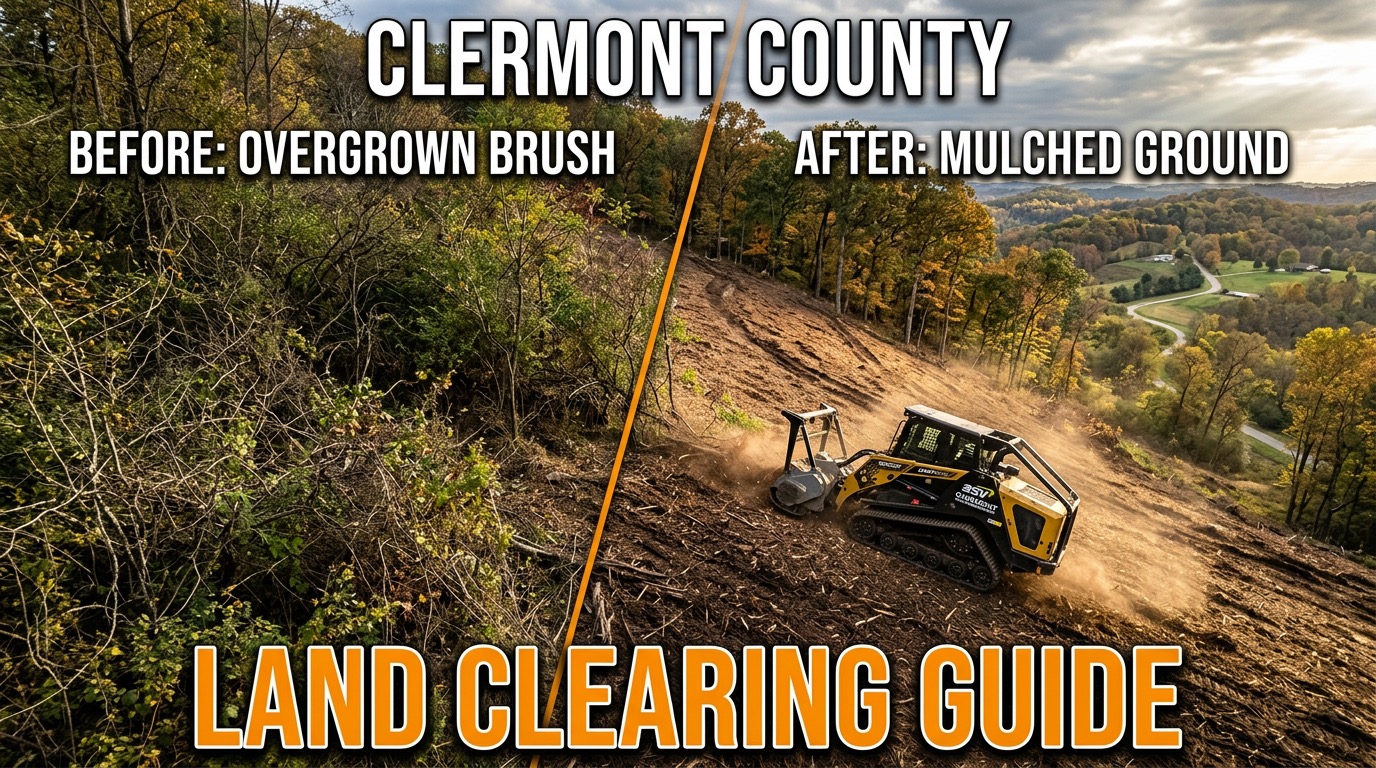
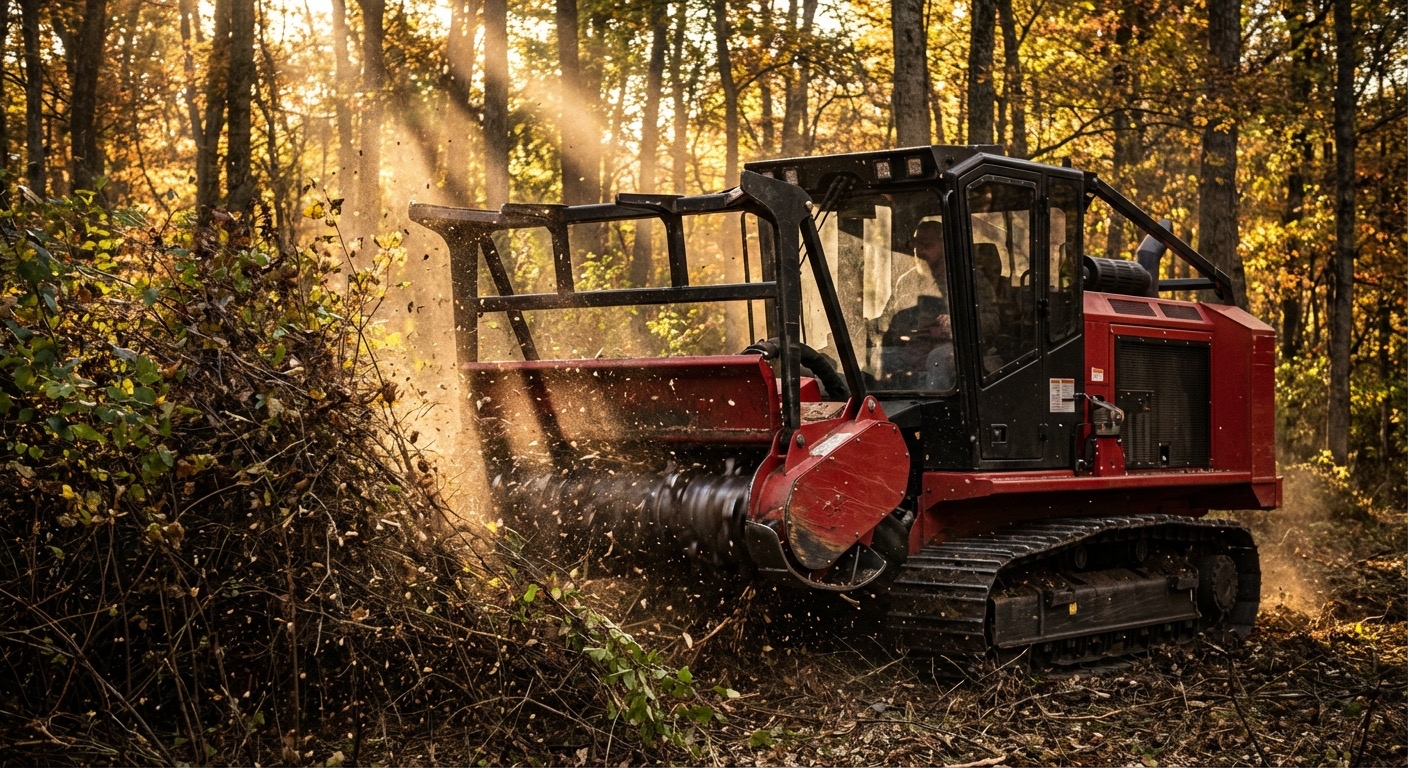
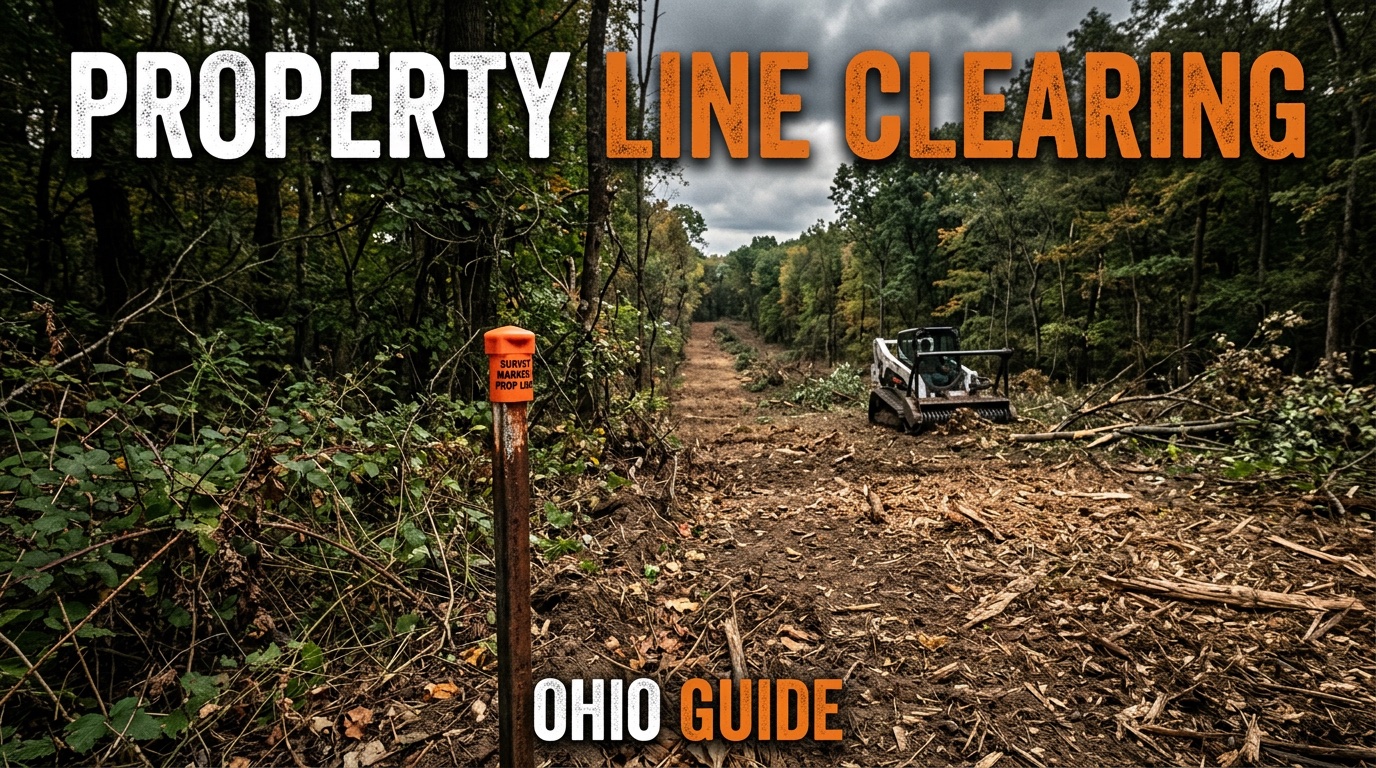
A skid steer with a forestry mulching head chews through brush, small trees, and invasive vegetation, turning it all into ground-level mulch in a single pass. For property line work, this is the best method because it's precise. The operator can clear right up to the boundary without crossing it, and the mulching head handles everything from honeysuckle thickets to 6-inch diameter trees.
The mulch stays on the ground. It suppresses regrowth, prevents erosion, and breaks down over one to two seasons. No burning, no hauling, no debris piles.
3. Selective Preservation
Good property line clearing isn't about removing every tree. Mature oaks, hickories, and walnuts along the boundary add value to the property and provide shade. We work around desirable trees and only remove the junk: invasives, dead trees, volunteer scrub, and anything the property owner wants gone.
This is where dendrology knowledge matters. Knowing which trees are worth keeping and which ones are problems requires actual tree identification skills. A honeysuckle and a dogwood look similar from 50 feet away if you don't know what you're looking at.
4. Marker Exposure
After clearing, we make sure all survey pins and markers are exposed and visible. Some clearing jobs reveal pins that have been buried under brush for decades. If markers are missing, we note the locations so the property owner can have a surveyor reset them.
Property Line Clearing Costs in Ohio
Cost depends on four things: length of the boundary, width of the clearing strip, density of vegetation, and terrain.
Residential Properties (Under 2 Acres)
Standard suburban lots in the Cincinnati area have 200 to 400 linear feet of boundary that typically needs clearing (back and side lines, not the front road edge). With moderate overgrowth, expect $800 to $2,500 for forestry mulching a 10 to 15 foot strip along the boundary.
Properties with heavy honeysuckle infestation or dense multiflora rose run higher because the material is thicker and takes longer to process.
Rural Properties (2 to 20 Acres)
Longer boundary lines and typically heavier growth. A 10-acre parcel might have 2,000 to 3,000 linear feet of boundary. Clearing a 15 to 20 foot strip along all boundaries costs $2,500 to $6,000 depending on vegetation density and terrain.
Hilly terrain adds cost. Cincinnati sits in some of Ohio's most rugged landscape, and boundary lines on steep slopes require specialized equipment or more time with standard machines. Expect 20 to 40% more for properties with significant grade changes along the boundary.
Large Parcels (20+ Acres)
Farm properties and large rural tracts might have a mile or more of boundary. At this scale, pricing typically runs $1,500 to $3,000 per 1,000 linear feet of clearing, depending on width and vegetation. A 40-acre parcel with a mile of boundary and moderate growth costs $8,000 to $15,000 for full perimeter clearing.
Don't Forget the Survey
If you need a boundary survey before clearing, add $300 to $1,500 depending on lot size and complexity. Worth every penny when you consider the alternative.
Ohio Property Law You Need to Know
Property boundaries in Ohio are governed by state law and local ordinances. Here's what matters for clearing work.
The Massachusetts Rule (Trees on Boundary Lines)
Ohio follows the Massachusetts Rule for trees along property boundaries. If a tree trunk sits entirely on your property, it's your tree and you can remove it. If the trunk straddles the property line (the actual line runs through the trunk), the tree belongs to both property owners and neither can remove it without the other's consent.
Branches and roots that cross the line can be trimmed back to the property line by the affected neighbor. But you can't kill the tree in the process. If trimming branches would kill the tree, you need the neighbor's permission.
Tree Damage Liability
Ohio courts take tree damage seriously. If you cut down a neighbor's tree, even accidentally, you can be held liable for the replacement value. For a mature oak or walnut, that can be $5,000 to $20,000. Some Ohio cases have awarded triple damages for willful destruction of trees. This is why a survey before clearing isn't optional if there's any question about the boundary.
Adverse Possession
Here's one that surprises people. In Ohio, if your neighbor has been openly using a strip of your land for 21 years or more (mowing it, maintaining it, treating it as their own), they can claim legal ownership through adverse possession. Clearing your property lines regularly prevents this. A visible, maintained boundary line shows continuous ownership and makes adverse possession claims nearly impossible.
Fence Law
Ohio is a "fence out" state for agricultural land, meaning livestock owners are responsible for keeping their animals contained. In residential areas, local ordinances govern fencing. Either way, you need to know where the line is before building a fence. Ohio law requires fences to be placed on or inside your property line. A fence on the wrong side of the line is an encroachment and your neighbor can demand you move it.
Ready to clear your property boundaries? Contact Brushworks for a free property assessment.
Get a Free QuoteCommon Property Line Problems in Greater Cincinnati
We work across Hamilton, Clermont, Warren, Butler, and Brown counties. Each area has its own common property line issues.
Suburban Neighborhoods (Anderson, West Chester, Mason, Loveland)
The typical problem is honeysuckle and brush that's been growing between backyards for 20+ years. The original developer cleared lots but left boundary areas alone. Now there's a 20-foot wall of invasive vegetation between properties that blocks views, harbors pests, and creates maintenance headaches.
These jobs are smaller in scope but require more precision because neighboring structures, fences, and landscaping are close. Equipment access through backyard gates can be tight.
Rural Properties (Batavia, Georgetown, Williamsburg, New Richmond)
Longer boundary lines, heavier growth, and more uncertainty about where the line actually falls. Old farm properties that have been subdivided multiple times create confusing boundaries. We've worked properties where the "property line" everyone agreed on turned out to be 40 feet off from the surveyed boundary.
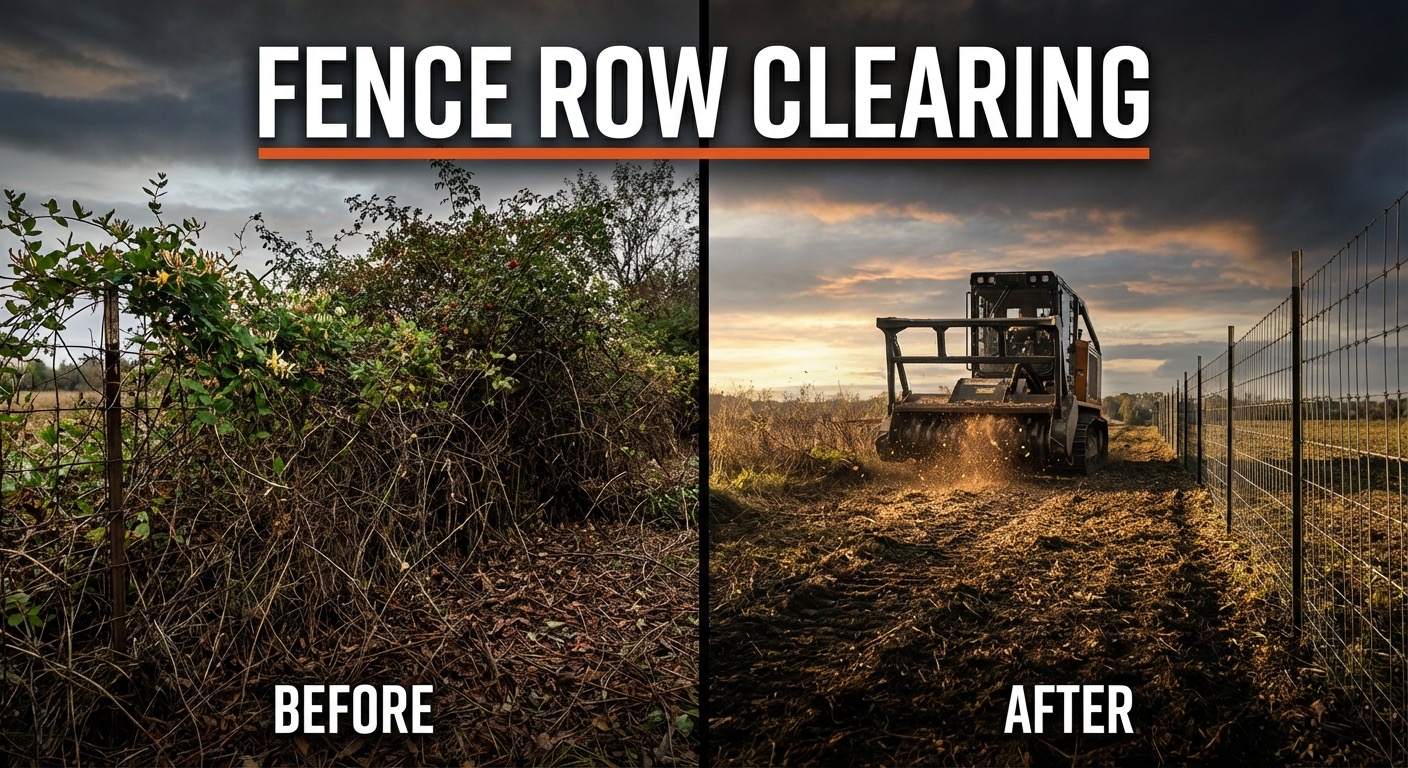
Fence row clearing is a big part of rural boundary work. Old barbed wire fences buried in multiflora rose and honeysuckle are everywhere in southern Ohio. We can mulch up to the fence without damaging it, or clear the row entirely if the fence is being replaced.
Hillside Properties (Mt. Adams, Columbia Tusculum, Indian Hill)
Cincinnati's topography creates unique boundary clearing challenges. Property lines that run up steep hillsides are the hardest to clear and the most likely to be overgrown. Standard equipment can't operate safely on slopes over 30 degrees, which is common in the Cincinnati basin. For these jobs, we use our FAE RCU55 remote-controlled mulcher, which handles slopes that would be impossible for manned equipment.
Dealing with Neighbors During Property Line Clearing
Property line clearing involves a shared boundary. Even though you're only clearing your side, the work affects both properties. How you handle the neighbor relationship matters.
Talk to Them First
Before scheduling any clearing work, let your neighbor know what you're planning. Show them the survey if you have one. Explain what you're clearing and why. Most neighbors are fine with it. Many are relieved because the overgrowth was bothering them too.
Some neighbors will want to split the cost and clear their side at the same time. This is the best outcome. One mobilization of equipment to clear both sides costs less than two separate jobs, and both properties benefit.
When Neighbors Don't Agree
You have every right to clear vegetation on your side of the property line. You don't need your neighbor's permission to do this. But if the clearing will change drainage patterns, remove shade trees the neighbor relies on, or otherwise affect their property, be prepared for a conversation.
Rarely, neighbors will object to boundary clearing because the overgrowth gives them "privacy." This doesn't override your right to manage your own property. But handling it with a heads-up conversation instead of surprising them with a mulcher in the backyard goes a long way.
Document Everything
Before clearing, take photos and video of the boundary area showing its current condition. Keep a copy of your survey. If there's any chance of a dispute, put your clearing plans in writing and share them with the neighbor via email (so there's a record). This protects you if questions come up later.
Maintaining Clear Property Lines
Clearing the line is a one-time job. Keeping it clear is ongoing maintenance. Here's how to prevent regrowth from undoing your investment.
First Year: Monitor and Spot Treat
Honeysuckle, multiflora rose, and tree of heaven will try to come back from root systems and seed in the soil. Walk the cleared line every 4 to 6 weeks during the growing season (April through October in Ohio). Pull or spray any new invasive growth while it's small. This takes 30 minutes to an hour per visit and prevents a full re-infestation.
Annual Maintenance
After the first year, one or two maintenance passes per year keeps the boundary clear. For narrow strips (10 to 15 feet), a brush mower or string trimmer handles annual maintenance. For wider strips, a yearly brush hog pass keeps everything in check.
Some property owners schedule an annual maintenance clearing with us. A quick mulching pass once a year costs a fraction of the initial clearing and keeps the line permanently visible.
Plant a Boundary
If you want something more permanent, plant a managed boundary. Native grasses like switchgrass or big bluestem create a visible property line that requires minimal maintenance. A row of native shrubs (not invasive ones) can provide screening while still marking the boundary. Just keep plantings on your side of the line and maintain them so they don't become the next overgrowth problem.
When to Clear Property Lines in Ohio
Property line clearing works year-round in Ohio, but some seasons are better than others.
Late fall and winter (November through March) are ideal. Leaves are down, so you can see the full extent of the vegetation and locate survey markers more easily. The ground is firmer (or frozen), which reduces rutting from equipment. Dormant vegetation is easier to mulch. And scheduling is more flexible because it's our slower season.
Spring (April and May) works but the ground can be soft from snowmelt and rain. Wet clay soil tears up under tracked equipment. If your property has heavy clay (most of Cincinnati does), spring clearing may need to wait for a dry stretch.
Summer (June through September) is fine for clearing but everything is in full leaf, making it harder to see the line and assess what's actually growing there. The upside is that herbicide treatments on fresh-cut stumps are most effective during active growing season.
The best approach: clear in late fall or winter when visibility and ground conditions are best, then treat any regrowth with herbicide the following summer.
DIY vs. Professional Property Line Clearing
Can you clear your own property lines? Sometimes. It depends on what you're dealing with.
DIY makes sense when: The boundary is lightly overgrown with small brush and saplings under 3 inches in diameter. You have a chainsaw, brush cutter, and a free weekend. The boundary is flat and accessible. You're clearing 200 feet or less.
Hire a professional when: The boundary has honeysuckle, multiflora rose, or other dense invasive growth. Trees along the line exceed 4 to 6 inches in diameter. The terrain is steep or uneven. The boundary is longer than a few hundred feet. You're not sure exactly where the line is. There are structures, utilities, or fences near the boundary that require careful work.
A forestry mulching machine does in 2 hours what takes a crew with chainsaws a full weekend. For anything beyond light brush on flat ground, the machine wins on time, cost, and results.
One more thing: clearing your own property line means dealing with the debris. Hand-clearing creates piles of brush that need to be burned (if your municipality allows it) or hauled away. Forestry mulching eliminates the debris problem entirely because everything gets ground into mulch on site.
Frequently Asked Questions
How do I find my property lines in Ohio?
Start with your deed and plat map from the county recorder's office. Look for iron pins at corners using a metal detector. Most Ohio counties have free online GIS maps that show approximate boundaries. For precise lines, hire a licensed surveyor ($300 to $800 for a standard lot).
How much does property line clearing cost in Ohio?
Residential properties with 200 to 400 linear feet of boundary run $800 to $2,500. Rural properties with longer boundaries cost $2,500 to $6,000. Large parcels with a mile or more of boundary range from $8,000 to $15,000. Add $300 to $800 for a survey if needed.
Can I clear brush on my neighbor's side of the property line?
No. You can trim branches and roots that cross onto your property, but you can't enter your neighbor's land or remove their vegetation without written permission. Talk to your neighbor first, and if they won't address encroachment, contact local code enforcement.
Do I need a survey before clearing my property line?
Strongly recommended. Clearing on the wrong side of the line creates legal problems and potential liability for destroyed trees. If you have a recent survey with visible markers, you may not need a new one. Otherwise, spend the $300 to $800 for peace of mind.
How wide should I clear along my property line?
Most residential properties clear 10 to 15 feet. Farm properties go 20 to 30 feet. Ten feet is enough for fence installation and visibility. Twenty feet gives clear sight lines and equipment access. Match the width to your intended use.