What Is Tree of Heaven and Why Should You Care?
Tree of heaven (Ailanthus altissima) is an invasive tree from China that arrived in the United States in the 1780s as an ornamental. It was planted along city streets and in gardens. That was a mistake we're still paying for.
In Ohio, tree of heaven grows in every county. It thrives in disturbed soil, roadsides, fence rows, vacant lots, construction sites, and forest edges. It can grow 3 to 5 feet per year when young. A seedling planted today could be 30 feet tall in five years.
The real problem isn't just how fast it grows. It's how it spreads. A single female tree produces up to 325,000 seeds per year. Those seeds travel on wind and water. The tree also spreads through an underground root network that sends up new shoots called "root sprouts" sometimes 50 feet or more from the parent tree.
It also produces chemicals in its bark, leaves, and roots that suppress the growth of nearby plants. Biologists call this allelopathy. Property owners call it "why won't anything else grow here."
And now there's a new reason to care: tree of heaven is the preferred host for the spotted lanternfly, an invasive insect that has already been confirmed in several Ohio counties. Removing tree of heaven from your property is now part of a bigger fight.
How to Identify Tree of Heaven in Ohio
People confuse tree of heaven with several native Ohio trees. Getting the ID right matters because you don't want to kill a native black walnut or staghorn sumac by mistake.
Key Identification Features
Leaves: Compound leaves 1 to 4 feet long with 11 to 25 leaflets. Each leaflet has smooth edges except for 1 to 2 small notches near the base called glandular teeth. This is the most reliable visual ID feature.
Smell: Crush a leaf or scratch the bark. If it smells like rancid peanut butter, burnt rubber, or cat urine, you've got tree of heaven. This is the easiest field test and it never fails.
Bark: Young trees have smooth, gray-green bark. Older trees develop rough, diamond-patterned bark that looks slightly like cantaloupe skin.
Seeds: Female trees produce massive clusters of twisted, papery seed pods (samaras) that hang in reddish-brown bunches. They're visible from midsummer through winter and are impossible to miss.
Growth habit: Fast, straight growth. Lean trunk. Sparse branching pattern that looks messy and disorganized compared to native hardwoods.
Common Lookalikes
Black walnut: Similar compound leaves, but walnut leaflets have serrated (toothed) edges all along the margin. Walnut doesn't smell terrible when you crush the leaves. It smells earthy.
Staghorn sumac: Also has compound leaves, but sumac leaflets are serrated and the branches are fuzzy (covered in fine hair that looks like velvet on deer antlers). Sumac doesn't smell bad.
If you're not sure, crush a leaf and sniff. The smell test is 100% reliable. Nothing else in Ohio's forests smells quite like tree of heaven.
Think you have tree of heaven on your property? Get an instant estimate for professional removal.
Get Instant PricingWhy Tree of Heaven Is So Hard to Kill
Most invasive plants are annoying. Tree of heaven is aggressive. It actively resists removal in ways that make it one of the hardest invasive species to control in Ohio.
Cutting triggers suckering. When you cut a tree of heaven, the root system interprets the damage as a threat and responds by sending up dozens of new shoots. Cut one tree, get 50 back. This is the single biggest mistake people make when trying to remove it.
Root networks are enormous. A mature tree of heaven can have roots extending 50 to 90 feet in every direction. Those roots stay alive underground even after you remove the visible tree. They can produce new sprouts for years.
Seed production is prolific. One female tree drops hundreds of thousands of seeds that remain viable in soil for several years. Even after you kill every visible tree, the seed bank in your soil can produce new seedlings for 3 to 5 growing seasons.
Chemical warfare. Tree of heaven produces ailanthone, a natural herbicide that poisons the soil around its base and suppresses competing vegetation. This gives it a head start against anything you try to plant in its place.
Removal Methods That Actually Work
Effective tree of heaven removal requires a combination of physical removal and chemical treatment. Physical removal alone makes the problem worse. Chemical treatment alone works but takes too long for large infestations. The best results come from using both together.
1. Hack-and-Squirt (Small Infestations)
For individual trees or small groups, the hack-and-squirt method is the most targeted approach. Use a hatchet to make downward cuts through the bark at a 45-degree angle, spacing cuts every 2 to 3 inches around the trunk. Immediately apply concentrated herbicide (triclopyr or imazapyr) into each cut.
The tree moves the herbicide down through its vascular system into the roots. Do this in late summer (July through September) when the tree is pulling nutrients toward the roots. Within a few weeks, the tree will start dying from the roots up.
Cost: $5-15 in herbicide per tree if you do it yourself. Professional application runs $50-150 per tree.
2. Cut Stump Treatment (Medium Infestations)
Cut the tree as close to the ground as possible and immediately (within 5 minutes) apply concentrated herbicide to the freshly cut stump surface. Focus on the outer ring of the stump where the living tissue is. The cut surface absorbs the herbicide and transports it to the root system.
Timing is critical. If you wait more than a few minutes after cutting, the tree seals the wound and the herbicide can't penetrate. This method works best when the tree needs to come down anyway for access or safety reasons.
3. Forestry Mulching + Follow-Up Treatment (Large Infestations)
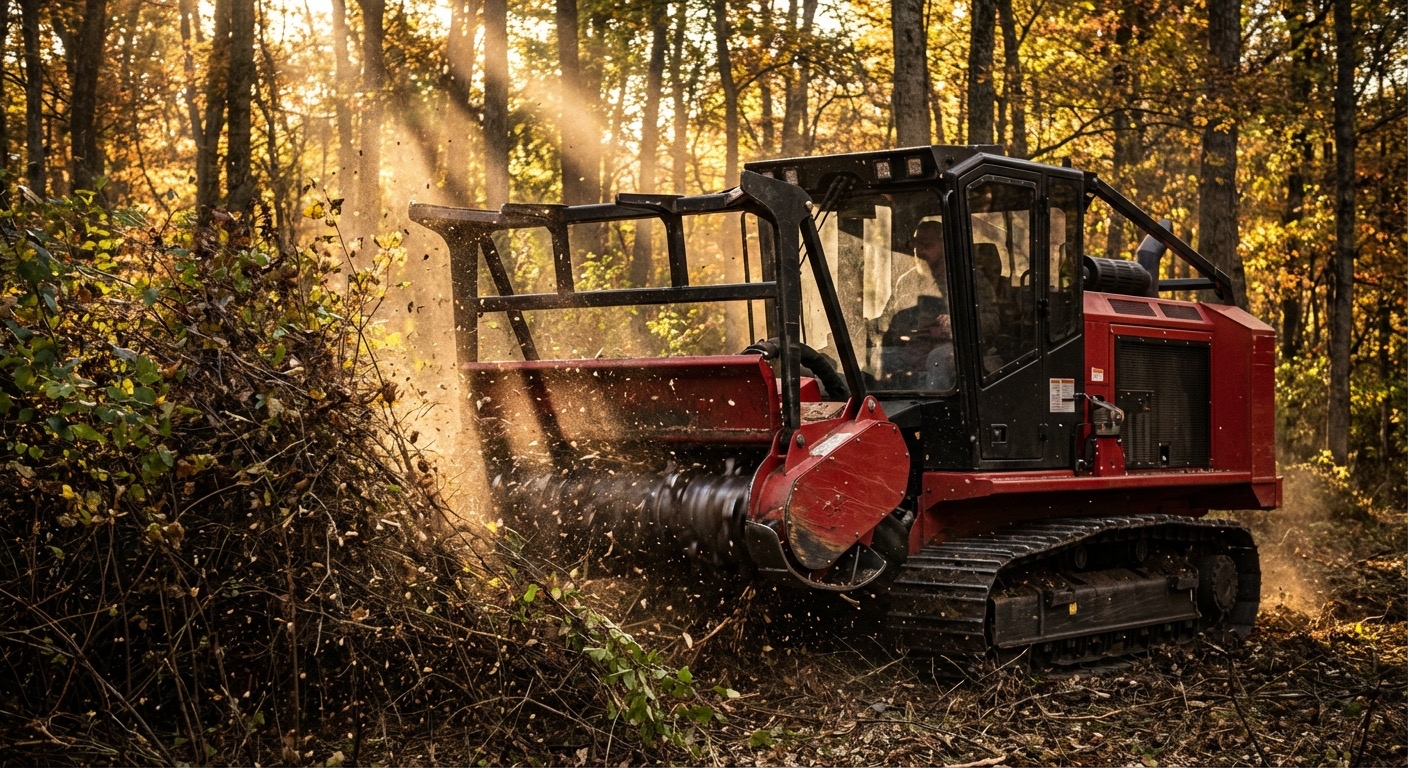
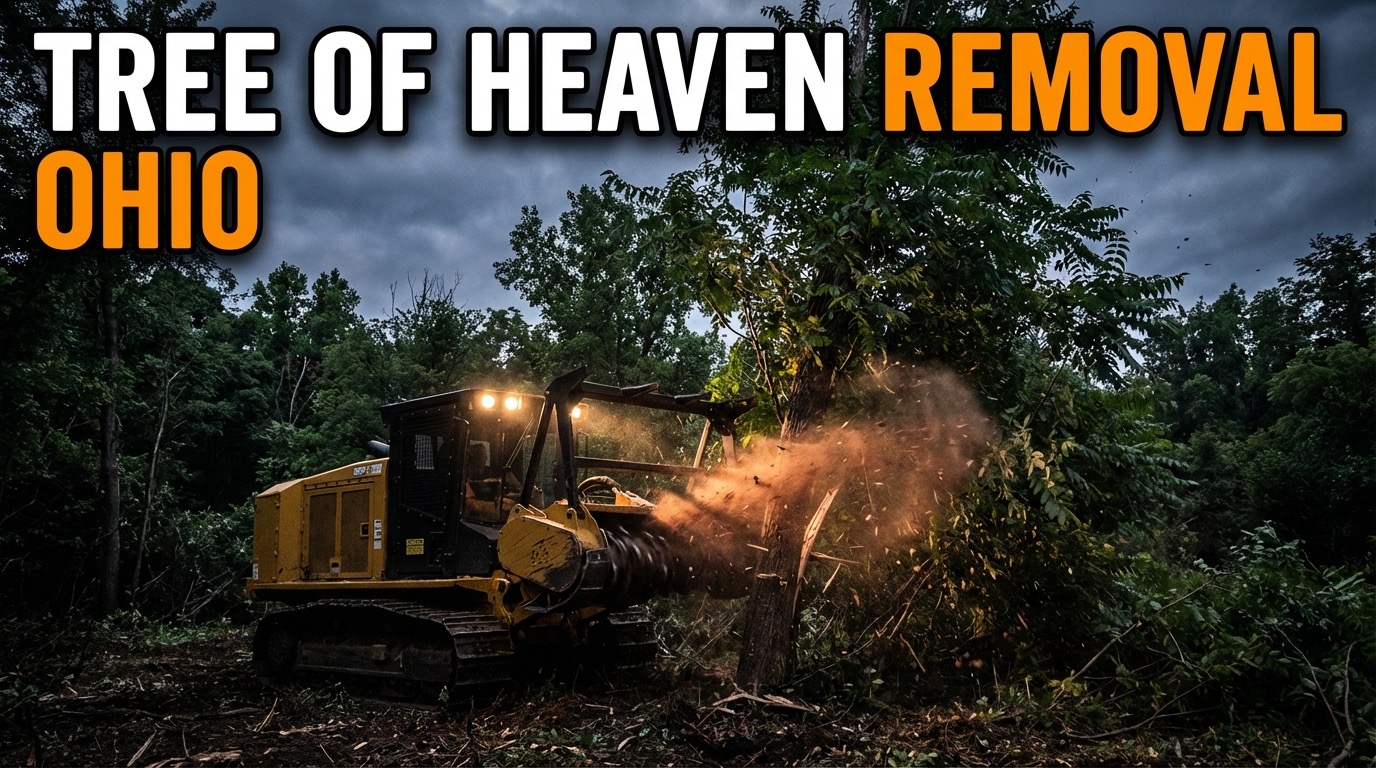
For properties with widespread tree of heaven stands covering a quarter acre or more, forestry mulching is the most efficient first step. A mulching head grinds the trees, trunks, branches, and understory into ground-level mulch in a single pass. This eliminates the above-ground vegetation and creates access for follow-up herbicide treatment.
After mulching, the root system will send up new sprouts within weeks. This is expected and actually helps. When those sprouts are 12 to 18 inches tall, a targeted foliar herbicide application kills them and the connected root system more effectively than treating full-sized trees.
This approach is how Brushworks handles tree of heaven removal across Greater Cincinnati. We mulch the infestation, then coordinate follow-up treatment to catch the regrowth. Most properties need 2 to 3 follow-up passes over 12 to 18 months to exhaust the root system.
4. Basal Bark Treatment (Hard-to-Reach Trees)
For trees growing in areas where cutting isn't practical, like steep slopes, fence rows, or near structures, basal bark treatment works without cutting. Mix a triclopyr-based herbicide with basal oil and spray or paint it onto the lower 12 to 18 inches of bark. The herbicide penetrates through the bark into the cambium layer.
This method works year-round on trees up to 6 inches in diameter. Larger trees need the hack-and-squirt approach.
What NOT to Do
Don't just cut it down. This is the most common mistake. Cutting without chemical treatment guarantees you'll have a bigger problem next year. The root system goes into overdrive and sends up sprouts everywhere.
Don't mow the sprouts repeatedly hoping they'll give up. Tree of heaven stores energy in its massive root system. It can keep producing sprouts for years. You'll run out of patience before it runs out of energy.
Don't burn it. Fire kills the above-ground growth but the root system survives. The heat also sterilizes the soil around the base, which reduces competition from other plants and gives tree of heaven an even bigger advantage when it resprouts.
Don't wait. A small tree of heaven problem becomes a big tree of heaven problem fast. Every year you delay, the root network expands and the seed bank in your soil grows. Early action saves money.
Need help with invasive tree removal? Contact Brushworks for a free property assessment.
Get a Free QuoteTree of Heaven Removal Costs in Ohio
Cost depends on how many trees you're dealing with, whether they're scattered individuals or dense stands, the terrain, and how accessible the property is.
Individual Tree Removal
For a few scattered trees, professional removal with stump treatment runs $300 to $800 per tree. This includes cutting, stump treatment, and basic cleanup. Larger trees or trees near structures cost more due to the care required.
Dense Stand Removal (Forestry Mulching)
For larger infestations, forestry mulching costs $2,500 to $5,000 per acre in Greater Cincinnati. This handles the initial removal of all above-ground vegetation. Steeper terrain or extremely dense growth pushes the cost toward the higher end.
Follow-Up Herbicide Treatment
Plan for 2 to 3 follow-up herbicide applications at $200 to $500 per visit depending on the size of the treatment area. These visits target regrowth sprouts and are spaced 4 to 6 months apart over an 18-month period.
Total Cost Estimate
For a typical half-acre tree of heaven infestation in Southwest Ohio, expect to spend $2,000 to $4,000 total including initial clearing and follow-up treatments. That sounds like a lot until you consider that tree of heaven reduces property values, damages foundations and pavement with its aggressive roots, and creates liability if it drops limbs on neighbors' property.
The Spotted Lanternfly Connection
The spotted lanternfly (Lycorma delicatula) is an invasive insect from Asia that feeds on plant sap. It attacks grapes, fruit trees, hardwoods, and ornamentals. It arrived in Pennsylvania in 2014 and has been spreading south and west ever since. Ohio confirmed its first spotted lanternfly detections in 2020, and the insect has now been found in multiple Ohio counties.
Tree of heaven is the spotted lanternfly's preferred host. The insect feeds on it, lays eggs on it, and uses it as a base to spread to nearby crops and ornamental plants. Removing tree of heaven from your property eliminates the insect's preferred food source and breeding habitat.
The Ohio Department of Agriculture recommends removing tree of heaven as part of spotted lanternfly management, with one important caveat: if you suspect spotted lanternfly is already on your property, treat the tree of heaven with herbicide before removing it. This kills any lanternfly egg masses on the trees as part of the removal process.
For property owners in Ohio, removing tree of heaven is now about more than just controlling an invasive tree. It's about protecting your fruit trees, your garden, and your neighbors from the spotted lanternfly.
After Removal: What to Plant Instead
Once you've eliminated tree of heaven, don't leave bare ground. Open soil is an invitation for more invasive species (including new tree of heaven seedlings from the seed bank). Plant native species that will compete for space and light.
For sunny areas: Black-eyed Susan, wild bergamot, little bluestem grass, and native warm-season grasses establish quickly and compete well against invasive seedlings.
For partially shaded areas: Spicebush, pawpaw, and native viburnums are strong competitors that fill in the understory quickly.
For reforestation: Red oak, white oak, tulip poplar, and sugar maple are excellent native replacements. They're slower growing than tree of heaven but they'll outlast it by centuries.
The key is establishing ground cover fast. Native seed mixes applied after forestry mulching germinate in the mulch layer and start competing with any tree of heaven seedlings within the first growing season.
Tree of Heaven in Cincinnati and Southwest Ohio
Tree of heaven is everywhere in the Cincinnati metro area. It grows along I-71, I-75, and I-275 corridors. It colonizes abandoned lots in Hamilton County, grows along creek banks in Warren County, and pops up in fence rows across Clermont County.
Southwest Ohio's mix of urban, suburban, and rural landscapes gives tree of heaven plenty of disturbed soil to colonize. Construction sites, utility corridors, and old farmsteads are especially vulnerable.
Brushworks has removed tree of heaven from properties across Greater Cincinnati, from small residential lots in Anderson Township to multi-acre stands in rural Clermont and Brown counties. Every property is different, but the process is the same: identify the extent of the infestation, remove the above-ground growth with forestry mulching, and follow up with targeted herbicide treatment until the root system is exhausted.
If you're seeing tree of heaven on your property, spring is when it's most obvious. The compound leaves unfurl in April and May and the tree grows visibly week over week. By midsummer, the seed clusters on female trees are unmistakable. Don't wait for it to spread.
Frequently Asked Questions
How do I identify tree of heaven in Ohio?
Tree of heaven has long compound leaves with 11 to 25 leaflets, each with 1-2 small notches (glandular teeth) at the base. Crush a leaf and you'll notice a strong, unpleasant smell often compared to rancid peanut butter or burnt rubber. Female trees produce large clusters of papery, twisted seed pods in reddish-brown bunches. It looks similar to native black walnut and staghorn sumac, but the smell test is a dead giveaway.
Will cutting down tree of heaven kill it?
No. Cutting without treating the stump will make the problem worse. The root system responds by sending up dozens of new shoots. A single cut tree can produce 50 or more new stems within one growing season. You need to combine physical removal with stump treatment or forestry mulching with follow-up herbicide.
What is the best time to remove tree of heaven in Ohio?
Late summer through early fall (July through September) is best for herbicide treatment. The tree is pulling nutrients toward the roots during this window, which carries herbicide deep into the root system. Physical removal with forestry mulching can happen any time of year.
How much does tree of heaven removal cost in Ohio?
Individual tree removal with stump treatment runs $300 to $800 per tree. For larger stands, forestry mulching costs $2,500 to $5,000 per acre. Follow-up herbicide treatment adds $200 to $500 per visit, with most properties needing 2-3 treatments over 18 months.
Is tree of heaven the same as the spotted lanternfly host tree?
Yes. Tree of heaven is the primary host plant for the spotted lanternfly, an invasive insect already present in Ohio. Removing tree of heaven reduces spotted lanternfly habitat and helps slow its spread. The Ohio Department of Agriculture encourages removal as part of lanternfly management.