
Tree Removal vs Forestry Mulching: Which Is Best for Your Property?
When you need to clear land in Cincinnati or anywhere in Ohio, two methods dominate the conversation: traditional tree removal and forestry mulching. Both get the job done, but they work very differently—and choosing the wrong one can cost you thousands of dollars and weeks of time. Here's your complete guide to making the right choice.
Understanding the Two Methods
Before comparing costs and timelines, let's understand what each method actually involves. The differences are fundamental—they're essentially two different approaches to the same problem.
🪓 Traditional Tree Removal
Traditional tree removal is the surgical approach. An arborist or tree service comes to your property and removes trees one at a time. Here's the typical process:
- Assess each tree individually
- Climb or use a bucket truck to access the canopy
- Section the tree, lowering limbs and trunk pieces
- Cut the trunk as low as possible
- Chip branches and haul away debris
- Grind the stump (often a separate service)
- Clean up the site
Timeline: 3-10 trees per day depending on size and access
🌲 Forestry Mulching
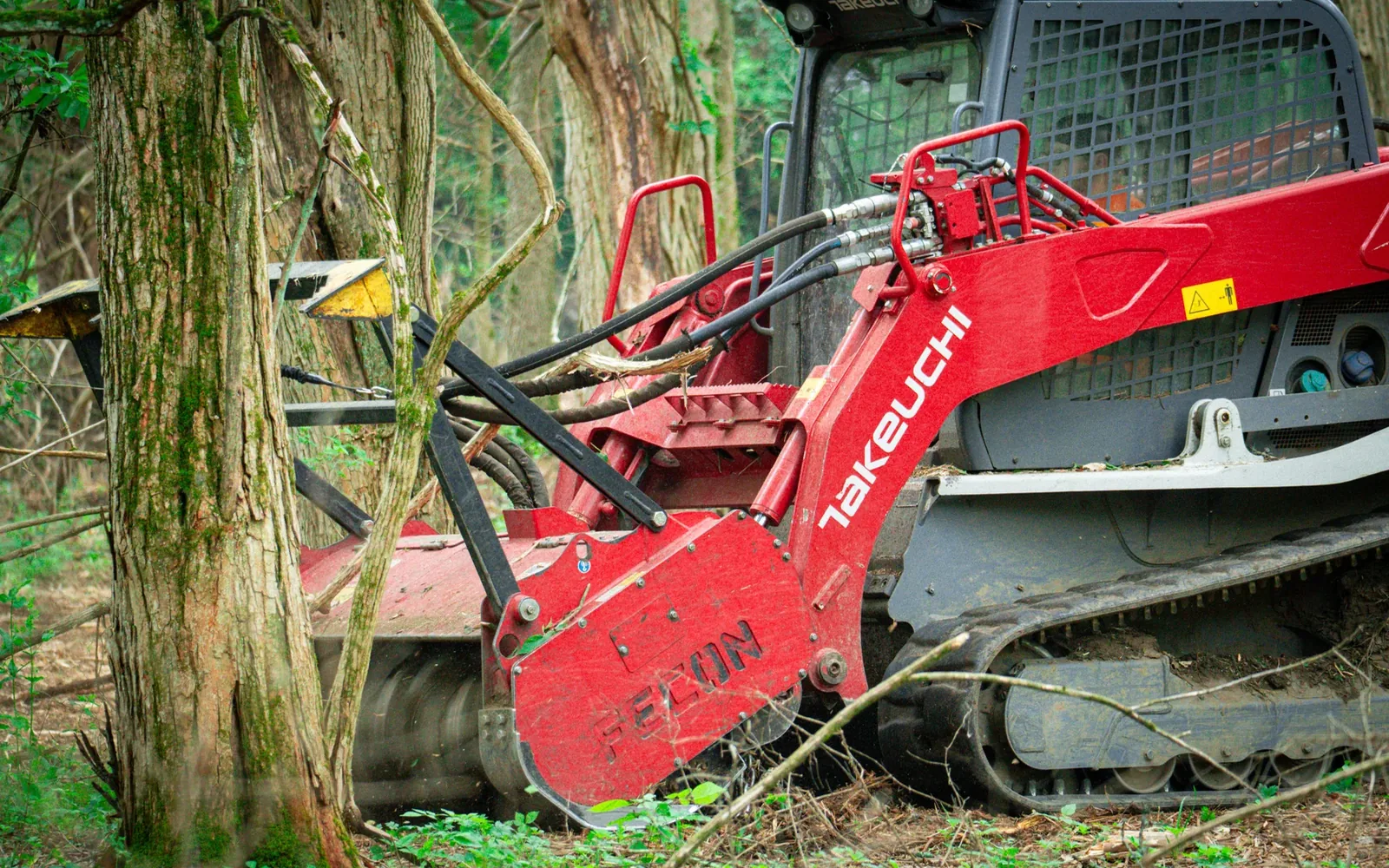
Forestry mulching is the area-clearing approach. A specialized machine drives through the vegetation and grinds everything in its path into mulch. The process:
- Assess the clearing area and mark boundaries
- Flag any trees or features to preserve
- Mulcher makes systematic passes through the area
- Trees, brush, and stumps are ground in place
- Mulch layer is left on ground (2-4" deep)
- Site is ready for immediate use
Timeline: 1-3 acres per day depending on vegetation density
The key distinction: Tree removal is about individual trees. Forestry mulching is about clearing areas. This fundamental difference drives every other comparison—cost, time, environmental impact, and end result.
Not sure which method is right for your property? Get an instant estimate to see what forestry mulching would cost for your project.
Get Your Instant EstimateCost Comparison: Where the Numbers Really Land
Let's talk money—because this is often the deciding factor. The cost structures are completely different, which means the "cheaper" option depends entirely on your situation.
Traditional Tree Removal Pricing
Tree services typically price per tree based on size, species, location, and complexity:
| Tree Size | Typical Cost | Stump Grinding (Extra) |
|---|---|---|
| Small (under 25 ft) | $200-$500 | $75-$150 |
| Medium (25-50 ft) | $500-$1,000 | $150-$300 |
| Large (50-75 ft) | $1,000-$1,800 | $300-$500 |
| Extra Large (75+ ft) | $1,800-$3,000+ | $500-$800+ |
Additional costs: Brush and debris hauling ($100-$300), crane rental for difficult trees ($500-$1,500/day), emergency or hazard premium (25-50% extra)
Forestry Mulching Pricing
Forestry mulching is priced by the acre or by the hour, regardless of tree count:
| Vegetation Density | Cost Per Acre | Typical Acreage/Day |
|---|---|---|
| Light (brush, small saplings) | $1,200-$1,800 | 2-3 acres |
| Moderate (mixed brush and trees to 6") | $1,800-$2,500 | 1.5-2 acres |
| Heavy (dense trees to 10") | $2,500-$3,500 | 1-1.5 acres |
| Very Heavy (large trees, thick growth) | $3,500-$4,500+ | 0.5-1 acre |
What's included: All clearing, grinding, and stump processing. No extra charges for debris hauling or stump grinding—it's all processed in place.
Real-World Cost Scenarios
Scenario 1: Clear 2 acres with 50 mixed trees (6-12" diameter)
- Traditional removal: 50 trees × $600-$1,200 avg = $30,000-$60,000 + stumps + hauling
- Forestry mulching: 2 acres × $2,500 = $5,000-$6,000 total
- Winner: Forestry mulching by 80-90%
Scenario 2: Remove 3 large oaks threatening a house
- Traditional removal: 3 trees × $1,500-$2,500 + stumps = $5,000-$9,000
- Forestry mulching: Can't safely work near structures; not applicable
- Winner: Traditional removal (only option)
Scenario 3: Clear 1/4 acre overgrown backyard
- Traditional removal: 15 trees × $400-$800 + stumps + hauling = $8,000-$15,000
- Forestry mulching: 0.25 acre × $2,000 = $500-$800 (minimum charge may apply: ~$1,500)
- Winner: Forestry mulching, even with minimum
Timeline Comparison: How Fast Can You Get It Done?
Time is money, especially if you have construction deadlines, listing dates, or seasonal constraints. The two methods operate on completely different timescales.
Traditional Tree Removal Timeline
- Scheduling: 1-4 weeks wait for most companies
- Small job (3-5 trees): 1 day
- Medium job (10-20 trees): 2-4 days
- Large clearing (50+ trees): 2-4 weeks
- Debris removal: Same day to 1 week after
- Stump grinding: Often scheduled separately, 1-2 weeks later
Total time from call to clean site: 2-8 weeks typical
Forestry Mulching Timeline
- Scheduling: 1-3 weeks wait (varies by season)
- Small job (under 1 acre): Half day to 1 day
- Medium job (1-3 acres): 1-2 days
- Large clearing (5-10 acres): 3-5 days
- Debris removal: None needed—mulched in place
- Stump processing: Done simultaneously
Total time from call to clean site: 1-4 weeks typical
The time multiplier: For a 5-acre clearing project with moderate vegetation, traditional tree removal might take 15-20 working days spread over 4-6 weeks. Forestry mulching handles the same job in 3-4 days. That's a 5x speed difference that matters when you have contractors waiting or sale deadlines approaching.
What Happens to Your Land: End Results Compared
The condition of your property after clearing varies dramatically between these two methods. Understanding the end result helps you plan next steps.
After Traditional Tree Removal
- Ground condition: Bare soil with stump holes or grinding debris
- Debris: None on site (hauled away)
- Erosion risk: Higher—exposed soil vulnerable to rain
- Soil compaction: Moderate to high from equipment
- Immediate use: Yes, with some cleanup
- Seeding/planting: Ready immediately
- Visual appearance: Clean but stark
After Forestry Mulching
- Ground condition: Covered with 2-4" of organic mulch
- Debris: Mulch remains on site (beneficial)
- Erosion risk: Low—mulch layer protects soil
- Soil compaction: Lower—mulchers often have better ground pressure
- Immediate use: Yes, including mowing
- Seeding/planting: May need to rake mulch or wait for decomposition in thick areas
- Visual appearance: Natural, park-like
The Mulch Layer: Asset or Obstacle?
The mulch left behind by forestry mulching is actually one of its biggest advantages—but it can also be a consideration:
✅ Benefits
- Prevents erosion immediately
- Suppresses weed growth
- Returns nutrients to soil as it decomposes
- Retains soil moisture
- Creates instant "finished" appearance
- No burning or hauling costs
⚠️ Considerations
- May need to rake for grass seeding
- Takes 6-18 months to fully decompose
- Can temporarily tie up nitrogen during decomposition
- Thick layers may need spreading
- Not ideal if you need bare soil immediately
Environmental Impact: Which Is Greener?
For environmentally-conscious property owners, the ecological impact of land clearing matters. Here's how the two methods compare:
| Factor | Tree Removal | Forestry Mulching |
|---|---|---|
| Soil Disturbance | High—stumps extracted, holes remain | Low—topsoil layer preserved |
| Erosion Risk | High—bare soil exposed | Low—mulch layer protects |
| Carbon Footprint | Higher—hauling, chipping, often burning | Lower—material stays on site |
| Nutrient Cycling | Nutrients removed from site | Nutrients returned to soil |
| Water Quality | Runoff risk from bare soil | Filtered by mulch layer |
| Wildlife Impact | Similar—habitat removed | Similar—habitat removed |
| Regrowth Prevention | Good with stump grinding | Excellent—ground below surface |
Environmental verdict: Forestry mulching is generally the more environmentally friendly option. By keeping organic material on site, preserving topsoil, and preventing erosion, it maintains land health better than traditional removal. The exception is when you're removing hazard trees near waterways, where professional arborist techniques minimize impact.
When to Choose Traditional Tree Removal
Despite forestry mulching's advantages for area clearing, traditional tree removal is the better choice in several situations:
🏠 Trees Near Structures
When trees are within 20-30 feet of homes, garages, or other buildings, you need the precision control of traditional removal. Forestry mulchers can't operate safely in tight quarters, and falling trees during mulching could cause damage. Professional arborists can section trees piece by piece, controlling exactly where every limb lands.
⚡ Trees Near Power Lines
Utility line work requires certified line-clearance arborists with specific training and equipment. Forestry mulching equipment can't discriminate between a tree limb and a power line. Call your utility company first—they often handle or subsidize line-clearance work.
🌳 Selective Removal Among Keepers
If you have a beautiful oak you want to keep but need to remove the three maples crowding it, traditional removal allows surgical precision. Mulchers work in swaths—they're not designed to thread between trees you want to preserve.
💰 Valuable Timber
If your trees include valuable hardwoods (black walnut, white oak, cherry), traditional removal preserves that value. A forestry mulcher turns a $2,000 walnut log into mulch. For significant timber value, hire a logger or sawyer before any clearing method.
🚗 Limited Access
Forestry mulchers are large machines that need access routes. If your property can only be reached through a narrow gate, residential neighborhood, or steep terrain, traditional tree removal crews with chainsaws and smaller equipment may be your only option.
🪨 Very Large Trees (18"+)
Most forestry mulchers top out at 12-18" diameter capacity. If your property has old-growth trees or very large specimens, they may need to be cut first with chainsaws before the mulcher can process them—or removed traditionally.
When to Choose Forestry Mulching
Forestry mulching excels in these situations—often dramatically outperforming traditional methods:
🏗️ Pre-Construction Site Clearing
Building a home, barn, or commercial structure? Forestry mulching clears your building pad and access routes in days, leaving a stable surface for construction equipment. No waiting for stump grinding or debris removal—contractors can start immediately.
🌾 Pasture and Field Restoration
Overgrown pastures with brush and young trees are perfect for mulching. The mulch layer decomposes and enriches the soil, and you can seed grass right through it. Traditional removal of 200 saplings would cost a fortune and leave bare, erosion-prone soil.
🦌 Hunting Land and Food Plots
Creating wildlife openings, shooting lanes, or food plots? Mulching creates the perfect canvas. The mulch suppresses weeds while you establish new plantings, and the work happens fast enough to complete before hunting season.
🚶 Trail and Path Clearing
Walking trails, ATV paths, or access roads through wooded areas are forestry mulching sweet spots. The machine creates a smooth, debris-free surface in a single pass—no grading, gravel, or construction required for recreational trails.
🌿 Invasive Species Removal
Honeysuckle, autumn olive, multiflora rose, and other invasives are no match for a forestry mulcher. It grinds the root crown below soil level, dramatically reducing regrowth. Traditional removal of dense invasive thickets is labor-intensive and expensive.
🏡 Lot Clearing for Real Estate
Selling wooded acreage? Clearing the building envelope and showing buyers a "ready to build" lot dramatically increases value and speeds sales. Mulching gives that manicured look faster and cheaper than any other method.
🔥 Fire Break and Defensible Space
Creating fire breaks or clearing defensible space around structures requires area clearing, not individual tree removal. Mulching creates the required clearance quickly while leaving a fire-resistant mulch layer rather than flammable debris.
The Hybrid Approach: Using Both Methods Together
Sometimes the best solution combines both methods. Smart property owners use each where it excels:
Example: 10-Acre Property Clearing
The property: 10 acres with a planned house site near existing driveway, 3 large oaks to preserve, and 8 acres of mixed brush and trees to clear for pasture.
The hybrid approach:
- Traditional removal ($4,500): Take down the 6 trees within 30 feet of the future house location—precision work near where you'll build.
- Mark preservation trees: Flag the 3 oaks you want to keep.
- Forestry mulching ($18,000): Clear the remaining 8 acres, working around the preserved oaks.
Total cost: ~$22,500
Pure traditional removal for same scope: ~$75,000+
Savings: $50,000+ while getting better results where each method excels
Pro tip: Coordinate the tree removal crew and mulching crew to work in sequence. Have trees near structures removed first, then bring in the mulcher to clear everything else including the debris from the tree removal.
Equipment Deep Dive: Understanding the Machines
Understanding the equipment helps you evaluate quotes and set realistic expectations:
Traditional Tree Removal Equipment
- Chainsaws: Primary cutting tool, various sizes for different tree diameters
- Bucket trucks: Lifts workers 40-80+ feet for canopy access
- Cranes: For extremely large or hazardous trees that can't be climbed
- Chippers: Process branches into chips (usually hauled off)
- Stump grinders: Separate machines to grind stumps below grade
- Dump trucks/trailers: Haul debris to disposal sites
Forestry Mulching Equipment
- Skid steer mulchers: Compact machines for smaller jobs and tighter access. Process trees up to 6-8" diameter. Lower hourly rate but slower on dense vegetation.
- Dedicated forestry mulchers: Purpose-built machines with 300-500+ HP. Handle trees up to 12-18" diameter efficiently. Higher productivity for large acreage.
- Excavator-mounted mulchers: Mulching head mounted on excavator. Excellent reach for steep terrain, ditch banks, and working around obstacles.
- Remote-controlled mulchers: For steep hillsides and hazardous terrain where operator safety is a concern.
Machine Capacity Guide
What different forestry mulchers can handle:
- Small skid steer (60-90 HP): Brush, saplings up to 4" diameter
- Large skid steer (90-120 HP): Mixed vegetation, trees up to 6-8" diameter
- Compact track loader: Similar to large skid steer with better ground pressure
- Dedicated mulcher (200-400 HP): Trees up to 12-15" diameter efficiently
- High-production mulcher (400+ HP): Trees up to 18-24" diameter, fastest production
Match the machine to the job: Sending a small skid steer to clear heavily wooded acreage wastes time and money. Similarly, mobilizing a high-production mulcher for a quarter-acre of light brush doesn't make economic sense.
Making Your Decision: A Practical Framework
Use these questions to determine which method—or combination—fits your project:
The Decision Tree
1. Are trees within 30 feet of structures or power lines?
→ Yes: Traditional removal for those specific trees
→ No: Continue to question 2
2. Are you removing fewer than 5 scattered trees?
→ Yes: Traditional removal is likely more economical
→ No: Continue to question 3
3. Do trees have significant timber value?
→ Yes: Harvest valuable timber first, then mulch remainder
→ No: Continue to question 4
4. Is clearing area 1/4 acre or larger?
→ Yes: Forestry mulching is almost certainly the better choice
→ No: Get quotes for both; mulching minimums may make traditional competitive
5. Do you need bare soil immediately?
→ Yes: Traditional removal OR mulching + raking/disking
→ No: Forestry mulching with mulch layer in place
Frequently Asked Questions
What is the main difference between tree removal and forestry mulching?
Tree removal involves cutting down individual trees, removing the trunk, and typically grinding the stump—leaving the site cleared but bare. Forestry mulching uses a specialized machine to grind standing trees, brush, and vegetation into mulch in a single pass, leaving a protective layer of organic material on the ground. Tree removal is selective and precise; forestry mulching is comprehensive and fast.
Is forestry mulching cheaper than traditional tree removal?
For clearing multiple trees or larger areas, forestry mulching is typically 30-50% cheaper than traditional tree removal. Tree removal costs $500-$2,000+ per tree depending on size and complexity. Forestry mulching costs $1,500-$3,500 per acre regardless of how many trees are present. For single valuable trees or surgical removal near structures, traditional removal may be more appropriate despite the higher per-tree cost.
Can forestry mulching handle large trees?
Most forestry mulchers efficiently process trees up to 8-12 inches in diameter. Larger, more powerful machines can handle trees up to 18-24 inches. For trees larger than what the mulcher can process (typically 12"+ for standard equipment), they can be cut first with a chainsaw and then mulched, or left standing if they're valuable specimen trees you want to preserve.
Does forestry mulching leave stumps?
Forestry mulching grinds trees and stumps down to 2-4 inches below ground level. This is sufficient for most purposes—you can mow over the area, seed grass, or build structures. However, some root mass remains underground. Traditional stump grinding goes deeper (6-12 inches) and removes more root material, which may be preferred if you're planting new trees in the exact same location.
Which method is better for the environment?
Forestry mulching is generally more environmentally friendly. It preserves topsoil, prevents erosion by leaving a protective mulch layer, returns nutrients to the soil as the mulch decomposes, doesn't require burning or hauling debris, and causes less soil compaction than heavy equipment like bulldozers. Traditional removal followed by hauling and burning has a larger carbon footprint and more site disturbance.
How long does each method take?
Forestry mulching is significantly faster for area clearing. A professional operator can typically clear 1-3 acres per day depending on vegetation density. Traditional tree removal might only process 3-10 trees per day depending on size and complexity, plus additional time for debris removal and stump grinding. For a 5-acre clearing project, forestry mulching might take 2-3 days versus 2-3 weeks for traditional removal.
Ready to Clear Your Property?
Whether you need precision tree removal or efficient area clearing, Brushworks helps Cincinnati and Ohio property owners find the right solution. Get an instant estimate for your forestry mulching project or contact us to discuss your specific needs.
