
What Is a Utility Easement?
A utility easement is a legal right that allows a utility company to use a strip of your property for their infrastructure. You still own the land. You still pay taxes on it. But the utility company has the right to access that strip for installation, maintenance, and repair of their equipment.
In Ohio, utility easements are recorded on your property deed. They were usually granted when the subdivision was platted or when the utility infrastructure was first installed, sometimes decades ago. The easement specifies the width of the corridor and what the utility company can do within it.
Common Utility Easements in Ohio
- Overhead power lines: Duke Energy, AEP Ohio, and local co-ops. These run through backyards, across fields, and along property boundaries throughout Southwest Ohio. Easements are typically 20-60 feet wide.
- Underground gas pipelines: Duke Energy Gas, Columbia Gas, and interstate transmission lines. Pipeline easements are usually 25-50 feet wide. You'll see yellow marker posts at regular intervals along the route.
- High-voltage transmission lines: The big metal towers carrying power across the state. These easements can be 100-150 feet wide and are maintained by the transmission company.
- Water and sewer lines: Municipal water and sewer easements, typically 15-30 feet wide. Common in suburban developments.
- Telecommunications: Fiber optic, cable, and phone line easements, usually 10-20 feet wide.
The practical problem: utility companies don't always keep up with vegetation management. They might clear an easement every 3-5 years, or only when something fails. In the meantime, Ohio's aggressive vegetation fills it in. Honeysuckle doesn't care about easement boundaries.
Why Easement Clearing Matters
Overgrown utility easements cause real problems for property owners:
- Power outages. Trees growing into overhead power lines are the number one cause of power outages in Ohio. Duke Energy reports that vegetation contact causes more than half of their outage events. If that overgrown easement behind your house takes out your power during a storm, the utility company will clear it. But wouldn't you rather it was cleared before the ice storm?
- Pipeline safety. The Pipeline and Hazardous Materials Safety Administration (PHMSA) requires vegetation management on pipeline rights-of-way. Root systems from large trees can damage pipe coatings and make it harder to detect leaks. Overgrown vegetation also prevents pipeline inspectors from doing visual surveys and aerial patrols.
- Property access. If a utility company needs to access their infrastructure for repairs, they'll clear whatever is in their way. They're not going to be gentle about it. A utility company clearing a neglected easement in an emergency will use whatever method gets them access fastest. If you maintain it yourself, you control how it looks.
- Property value. An overgrown easement running through your backyard looks bad. A clean, maintained easement with a mowed path or mulched corridor actually adds to your usable space.
- Fire risk. Dense, dry brush under power lines is a fire hazard. Ohio doesn't have California's wildfire problems, but brush fires under power lines happen every year, especially in the dry months.
Who Pays for Easement Clearing?
This is the question everyone asks first. The answer depends on the situation:
Utility Company Pays
Utility companies are responsible for maintaining their rights-of-way to protect their infrastructure. Duke Energy, AEP, and the pipeline companies all have vegetation management programs and budgets. They contract with tree service companies and right-of-way clearing crews to maintain their easements on a rotating cycle.
The catch: they work on their schedule, not yours. A utility company might clear your easement this year or three years from now. It depends on their maintenance cycle, their budget, and how high-risk your particular section is. High-voltage transmission lines get cleared more frequently than distribution lines.
Property Owner Pays
If you want the easement cleared on your timeline, you're paying for it yourself. Many property owners in Greater Cincinnati hire us to clear utility easements because they don't want to wait for the utility company's schedule. This is especially common when:
- The easement runs through a visible part of the property and the overgrowth looks terrible
- The property owner wants to use the easement corridor for a trail, mowed path, or access road
- A property sale is coming up and the owner wants the land to look its best
- The overgrowth is spreading invasive species into the rest of the property
Here's a tip: if a utility company does plan to clear the easement on your property, their crews will clear only what threatens their infrastructure. They'll top trees near the wires, cut a path wide enough for their trucks, and leave the rest. If you want the easement corridor fully cleared and looking good, you'll need to handle that yourself.
Need a price for clearing a utility easement on your property? Get a quick estimate in under a minute.
Instant Pricing ToolUtility Easement Clearing Costs in Ohio
Easement clearing is priced like any other land clearing job: by the complexity of the vegetation, the terrain, and the total area. But easements have a few factors that affect pricing differently than a standard lot clearing.
| Easement Type | Typical Width | Cost per 1,000 Linear Feet |
|---|---|---|
| Residential power line (light brush) | 30-40 ft | $1,200 - $2,500 |
| Residential power line (heavy brush/trees) | 30-40 ft | $2,500 - $4,500 |
| Gas pipeline ROW (moderate vegetation) | 30-50 ft | $1,500 - $3,500 |
| Transmission line corridor | 75-150 ft | $3,000 - $8,000 |
| Water/sewer easement | 15-30 ft | $800 - $2,000 |
What Drives Easement Clearing Costs Up
Terrain: Easements don't follow nice, flat paths. Power lines and pipelines run straight through whatever terrain is in the way. If the easement crosses a steep ravine or hillside, the clearing takes longer and may require specialized equipment like our remote-controlled mulcher.
Access: Some easements run through the middle of large properties with no road access. Getting equipment to the work site adds time and cost.
Tree size: If the easement has been neglected for 10+ years, you might have trees growing in it that are 8-12 inches in diameter. Those take longer to process than brush and saplings.
How We Clear Utility Easements
Forestry mulching is the go-to method for utility easement clearing. Here's why it works better than the alternatives:
No Ground Disturbance
This is the big one for pipeline easements. You cannot dig, grade, or disturb the soil over a buried pipeline without permission from the pipeline operator. Forestry mulching grinds vegetation at ground level and leaves the root systems in place. No digging, no grading, no risk to underground infrastructure. The mulch layer sits on top of the existing ground surface.
No Hauling
Everything gets processed on site. The mulcher grinds brush, saplings, and small trees into wood chips that stay on the ground. For long easement corridors that might be half a mile or more, not having to haul debris out saves a huge amount of time and money. Traditional cutting and hauling on a long easement can take three to four times as long as mulching.
Erosion Control
Easements often cross slopes, stream banks, and hillsides. The mulch layer left behind prevents erosion from rain runoff. If you clear an easement with a bulldozer or by hand-cutting and dragging the debris out, you expose bare soil that will wash away on the first hard rain. Mulching keeps the ground protected.
Regrowth Suppression
The 3-6 inch layer of wood chips left behind blocks sunlight from reaching the soil, which slows regrowth. A mulched easement stays cleaner longer than one that was hand-cleared or brush-hogged. For most easements in Ohio, mulching buys you 2-3 years before significant regrowth comes back.
Safety Around Power Lines
We don't work within striking distance of energized power lines. For overhead power line easements, we mulch the understory, brush, and any trees that won't reach the lines when they fall. Trees that are tall enough to contact the wires are the utility company's responsibility. Duke Energy and AEP both have tree trimming programs for vegetation that threatens their lines. We handle everything below that threshold.
Power Line Easement Clearing in Ohio
Power line easements are the most common type we clear for property owners in the Cincinnati area. Most of the residential easements in Hamilton, Clermont, Warren, and Butler counties carry Duke Energy distribution lines on wooden poles.
Here's what a typical power line easement clearing looks like:
- Call 811 first. Even if you're only clearing above-ground vegetation, underground utilities might share the same corridor. Gas lines, water lines, and fiber optic cables are often buried in or near power line easements. 811 is free, and the locate marks tell us exactly where underground infrastructure is buried.
- Walk the easement. We identify what needs to go and what can stay. If the property owner wants to keep specific trees that aren't threatening the lines, we mark them. We also look for obstacles like old fence posts, metal debris, or concrete that could damage equipment.
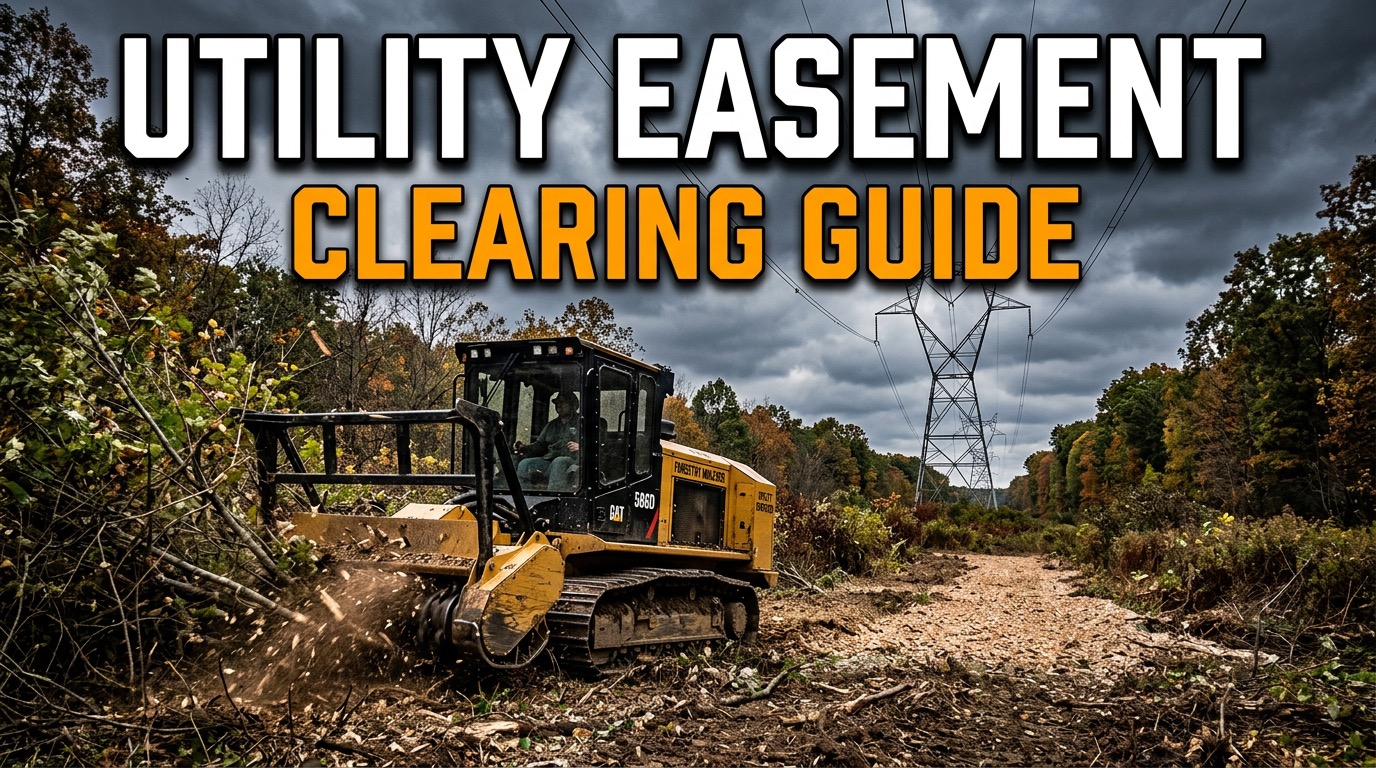
- Mulch the corridor. We run the tracked mulcher through the easement, processing everything within the corridor width. Brush, saplings, honeysuckle, multiflora rose, dead trees, standing deadwood. Everything gets ground into chips.
- Leave a clean corridor. When we're done, the easement looks like a park. Mulch on the ground, no standing brush, no piles of debris. You can walk through it, mow it, or just enjoy having an open sight line across your property.
Most residential power line easement clearings in the Cincinnati area take half a day to a full day, depending on length and vegetation density.
Pipeline Right-of-Way Clearing
Pipeline easements have stricter rules than power line easements. The pipeline companies take vegetation management seriously because overgrown rights-of-way create real safety and inspection problems.
Critical Rules for Pipeline Easement Work
- Always call 811. This is non-negotiable for pipeline easements. Underground pipeline locations must be marked before any work begins, even if you're just mulching above-ground vegetation.
- No deep ground disturbance. Don't dig, grade, or do anything that penetrates more than 12 inches below the surface within the easement. Forestry mulching doesn't go below ground level, so it's safe.
- No structures. Don't build fences, sheds, decks, or any structures on a pipeline easement. The pipeline company has the right to remove them.
- Keep it accessible. Pipeline companies need to drive trucks and equipment along their rights-of-way for inspections and maintenance. Don't block access with berms, ditches, or landscaping.
We've cleared pipeline easements for property owners throughout Southwest Ohio. The most common scenario: a homeowner bought a rural property with a gas pipeline running through it, and the pipeline company last cleared the easement five or six years ago. By now, it's a wall of honeysuckle and saplings. We mulch it back to a clean corridor in a day or two.
Some pipeline companies will actually reimburse property owners for vegetation management or will hire contractors directly to maintain their easements. It's worth calling the pipeline company's land department to ask before you spend your own money.
Transmission Line Corridor Clearing
High-voltage transmission corridors are the wide easements with the tall steel towers. These are maintained by the transmission owner (often AEP, American Transmission Systems, or Duke Energy Indiana/Kentucky) on a regular cycle, typically every 3-4 years.
Property owners with transmission easements usually don't need to hire their own clearing because the transmission companies maintain these corridors more aggressively. But there are situations where it makes sense:
- Between maintenance cycles. If the utility cleared the corridor two years ago and it's already growing back thick, you might want it maintained more frequently than the utility's schedule.
- Edge cleanup. Utility crews clear within the easement boundary but not an inch beyond it. If the vegetation on the edges is encroaching into your yard or fields, that's on you.
- Trail use. Some property owners with transmission easements use the cleared corridor for ATV trails, walking paths, or equipment access roads. Maintaining it for these purposes is the property owner's responsibility.
Clearing Easements on Steep Terrain
Southwest Ohio has plenty of hilly terrain, and utility easements go straight through it. Power lines and pipelines don't care about topography. They follow the most direct route from point A to point B, and that route often includes steep ravines, hillsides, and creek crossings.
For steep easement sections, we use the FAE RCU55 remote-controlled mulcher. This 12,000-pound machine handles slopes up to 60 degrees and is operated from a safe distance. It's the only way to safely clear some of the steeper easement sections without putting an operator at risk.
This comes up often in Clermont County, where pipeline and power line easements cross the deep ravines along the East Fork of the Little Miami River. It also comes up in Warren County and along the Ohio River corridor in Hamilton County. Standard tracked mulchers are fine for slopes up to about 30 degrees. Beyond that, you need the remote-controlled option.
Utility Easement Maintenance Schedule
If you're going to maintain a utility easement yourself, here's a reasonable schedule based on what we see in Ohio:
Initial Clearing
If the easement has been neglected for years, the first clearing is the most expensive. You're dealing with established trees, thick brush, and dense invasive species. After the initial clearing, maintenance is much cheaper and faster.
Annual Mowing
After mulching, the easement corridor can be maintained with annual mowing if the regrowth stays small. A brush hog or heavy-duty mower handles first-year regrowth well. This keeps the easement clean without needing a mulcher every year.
Re-Mulch Every 3-5 Years
Even with annual mowing, woody regrowth will eventually get too large for a mower. Plan on re-mulching the easement every 3-5 years. The re-mulch is faster and cheaper than the initial clearing because you're dealing with small regrowth instead of established vegetation.
Herbicide Follow-Up
For invasive species control, targeted herbicide application on regrowth 6-12 months after mulching gives the best long-term results. This is especially important for honeysuckle, which resprouts aggressively from root systems after cutting.
Ohio Utility Companies and Their ROW Programs
Here's a rundown of the major utility companies in Southwest Ohio and how they handle vegetation management on their easements:
Duke Energy Ohio (Electric)
Duke maintains distribution lines on a 4-year trim cycle. They hire tree trimming contractors who focus on "danger trees" (trees tall enough to fall into lines) and branches growing within 10 feet of conductors. Duke is responsible for clearing around their poles and lines. Property owners are responsible for brush and undergrowth that isn't directly threatening the lines. You can request an off-cycle trim by calling Duke Energy's vegetation management department.
Duke Energy Ohio (Gas)
Duke's gas division maintains pipeline rights-of-way on a regular cycle. They use a combination of mowing, herbicide application, and tree removal. If a pipeline easement on your property needs clearing, call Duke's pipeline ROW department. They may schedule it for their next maintenance cycle or hire a contractor to address it sooner.
AEP Ohio
AEP maintains their transmission and distribution lines on a rotating schedule. Their vegetation management program clears vegetation within the full width of the easement, not just near the wires. AEP is more aggressive than Duke about clearing the entire corridor. Contact AEP's forestry department if you want to know when your easement is scheduled for maintenance.
Interstate Pipeline Companies
Companies like Enbridge, TC Energy, and Marathon Pipe Line maintain their own rights-of-way. These are the larger-diameter pipelines carrying natural gas, petroleum products, or hazardous liquids across the state. They take ROW maintenance seriously and clear on regular cycles. If you have an interstate pipeline on your property, the pipeline company's contact information is usually listed on the yellow marker posts along the right-of-way.
Legal Considerations for Ohio Property Owners
A few legal points that come up regularly with utility easement clearing:
- You can clear your own easement. As the property owner, you have every right to clear brush and vegetation on a utility easement that crosses your property. The easement gives the utility company the right to use the land, but it doesn't prevent you from maintaining it. Just don't damage the utility infrastructure.
- You can't block utility access. If you install a fence across an easement, the utility company can require you to remove it or install a gate. Don't build permanent structures on easements.
- The utility company can clear without your permission. The easement agreement gives them this right. If trees are threatening their lines or a pipeline inspection is due, the utility company (or their contractor) will enter your property and do the work. They're supposed to notify you, but in emergencies, they may not.
- Damage claims. If a utility company or their contractor damages your property during easement maintenance (tears up your lawn, knocks down a fence, damages a driveway), you have the right to file a damage claim. Document everything with photos.
- Prescriptive easements. Some older properties in Ohio have utility infrastructure running through them without a recorded easement. If the utility has been using the route for more than 21 years, they may have a prescriptive easement. This is a legal gray area. Talk to a property attorney if you're dealing with this situation.
Real Easement Clearing Projects in Greater Cincinnati
Power Line Easement — Milford
A homeowner in Milford had a Duke Energy distribution line easement running through their 2-acre backyard. The easement was about 40 feet wide and 800 feet long. Ten years of neglect had turned it into a solid wall of honeysuckle and small trees up to 6 inches in diameter. The power company had trimmed the tops of trees near the wires a few years back but left the understory completely overgrown. We mulched the entire easement in 5 hours. The homeowner gained a clean corridor that connected their front yard to the back of the property, and they could finally see the tree line at the back of their lot.
Gas Pipeline ROW — Warren County
A farmer in Warren County had a 30-inch gas transmission pipeline running diagonally across 15 acres of his property. The pipeline company hadn't cleared it in about four years, and the 50-foot-wide corridor was full of saplings, autumn olive, and multiflora rose. We called 811, got the pipeline marked, and mulched the entire 2,500-foot corridor in two days. The farmer could finally drive his tractor along the pipeline route to access the back fields. The pipeline company's inspector came out the following month and was happy with the condition.
Transmission Corridor — Clermont County
A property owner had a 120-foot-wide AEP transmission corridor crossing 8 acres of hilly, wooded land. AEP had cleared under the lines two years ago, but the corridor edges were growing in fast with honeysuckle and Bradford pear seedlings. The owner wanted to use the corridor for ATV access to the back of his property. We mulched a 12-foot-wide trail through the center of the corridor and cleaned up the edges to push the tree line back to the full easement width. Day and a half of work. The property owner now has an all-weather access trail through the middle of his land.
Frequently Asked Questions
Who is responsible for clearing brush on a utility easement in Ohio?
Both the utility company and the property owner can clear vegetation. The utility company has the right and responsibility to maintain their infrastructure. Property owners can clear brush at any time as long as they don't damage utility equipment. Many property owners maintain easements themselves because utility companies only clear on their own schedule.
How much does it cost to clear a utility easement in Ohio?
Most residential utility easement clearings cost $1,000-$5,000. A typical 500-1,000 linear foot power line easement with moderate brush runs $1,500-$3,000. Longer pipeline corridors and transmission easements can run $2,000-$8,000 or more depending on width and vegetation.
Can I plant trees on a utility easement?
You can, but the utility company will remove anything that threatens their infrastructure. Tall trees under power lines will get cut. Deep-rooted trees over pipelines risk pipe damage. Stick to low-growing shrubs, grasses, and wildflowers.
How wide is a typical utility easement in Ohio?
Power line easements: 20-60 feet. Gas pipelines: 25-50 feet. Transmission lines: 100-150 feet. Water and sewer: 15-30 feet. The exact width is in the easement agreement on your property deed.
Do I need permission to clear brush on my easement?
For general brush clearing, most property owners can proceed without specific permission. But call 811 before any work near underground utilities, and contact the utility company before clearing near energized power lines. It's always smart to notify the utility company regardless.
What is the best method for clearing a utility easement?
Forestry mulching. It clears vegetation without disturbing the soil (critical for pipeline easements), leaves a mulch layer that suppresses regrowth and prevents erosion, and processes everything on site with no hauling required.
Get Your Utility Easement Cleared
Whether it's a power line corridor behind your house or a pipeline right-of-way cutting across your farm, we've cleared hundreds of utility easements across Greater Cincinnati and Southwest Ohio. We know the rules, we have the right equipment, and we'll leave you with a clean, maintained corridor instead of an overgrown mess.
Get an estimate for your easement clearing project.