The Short Answer
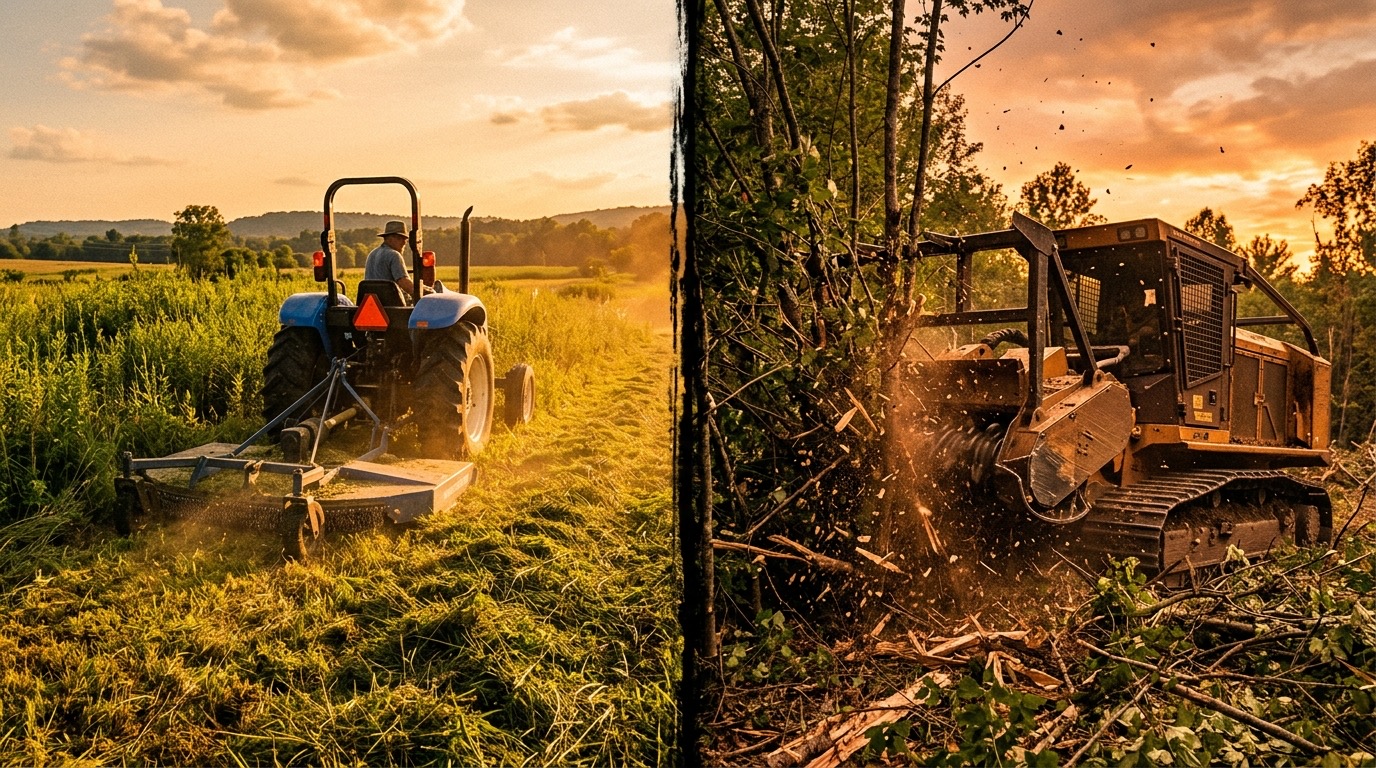
Brush hogging is mowing on steroids. A tractor-pulled rotary cutter chews through tall grass, weeds, and light brush. It keeps fields from getting overgrown. It costs $75 to $200 per acre. You need it regularly, like mowing a lawn you've neglected.
Forestry mulching is land clearing. A dedicated machine with a high-speed grinding drum turns trees, saplings, stumps, and dense brush into mulch chips right where they stand. It costs $1,500 to $5,000+ per acre. You do it once, and the land is transformed.
If you can walk through your overgrown area and push branches aside, you probably need brush hogging. If you need a machete to get through it, you need forestry mulching.
What Brush Hogging Is (And Isn't)
A brush hog is a rotary mower that attaches to the three-point hitch of a tractor. Heavy steel blades spin inside a reinforced deck and cut vegetation at or near ground level. Think of it as the aggressive cousin of your riding mower. Most brush hogs run 4 to 6 feet wide, and a standard 50+ HP tractor pulls them without issues.
What brush hogging handles well:
Tall grass and weeds. Fields that haven't been mowed in months or even a year or two. Goldenrod, ragweed, fescue that's gone to seed, Queen Anne's lace. This is bread and butter for a brush hog.
Light brush and small saplings. Woody stems up to about 2 inches in diameter. Young autumn olive, thin honeysuckle shoots, first-year tree seedlings. The blades knock them down but don't grind the stumps.
Routine maintenance. Keeping pastures, fence rows, utility easements, and field edges managed. Two to four passes per year keeps most Ohio properties under control.
What brush hogging can't do:
Trees and large saplings. Anything over 2 to 3 inches in diameter is going to damage the brush hog, bend the blades, or stall the tractor. We've seen people try to push a brush hog through 4-inch saplings and end up with a $2,000 repair bill on the mower.
Stumps. A brush hog rides on top of the ground. It doesn't touch stumps, root balls, or anything below the surface. After a brush hogging pass, you'll have a field of 2-inch stumps sticking up everywhere.
Dense woody brush. Thick stands of multiflora rose, mature honeysuckle, or blackberry thickets tangle in the blades and clog the deck. You'll spend more time unclogging than cutting.
Slopes. Tractors pulling brush hogs need relatively flat ground. Anything steeper than about 15 degrees gets dangerous. The tractor can slide sideways, and the brush hog digs into the uphill side of slopes.
What Forestry Mulching Is (And Why It Costs More)
Forestry mulching uses a purpose-built machine. Either a skid steer with a mulching head attachment, or a dedicated forestry mulching tractor (like our Takeuchi TL12 V2 or Bobcat T770s). The mulching head is a drum covered in steel teeth that spins at high RPM and grinds everything it contacts into chips.
What forestry mulching handles:
Trees up to 8-12 inches in diameter. Depending on the machine and the mulching head, a forestry mulcher chews through standing trees and turns them into a 2 to 4-inch layer of mulch on the ground. No hauling, no burning, no cleanup crew needed.
Stumps. The mulching head grinds stumps down to below grade. You don't need a separate stump grinder. The land comes out flat and plantable.
Dense brush and invasive species. Honeysuckle thickets, multiflora rose tangles, autumn olive stands, thick brambles. A mulching head doesn't care how tangled the vegetation is. It grinds through everything.
Slopes. Tracked machines like skid steers and compact track loaders handle slopes that would be impossible for a tractor. Our FAE RCU 55 remote-control mulcher works on grades up to 60 degrees for the really steep hillsides common in Hamilton and Clermont counties.
One-pass clearing. A forestry mulcher goes through an area once and leaves behind usable ground with a layer of natural mulch. No second pass. No debris piles. No burn permits. The mulch layer suppresses regrowth and protects the soil from erosion.
Why it costs more:
The equipment is expensive. A quality mulching head alone costs $15,000 to $40,000. The carrier machines run $50,000 to $150,000. Fuel consumption is high because you're grinding wood, not just cutting grass. Wear parts like teeth need replacing regularly. All that adds up in the per-acre rate.
But here's what people miss when comparing prices: forestry mulching is a one-time cost. You clear the land, and it's cleared. Brush hogging is recurring. At $150 per acre three times a year, you're spending $450 per acre annually. Over five years, that's $2,250 per acre in brush hogging. A single forestry mulching pass at $2,500 per acre followed by annual mowing at $75 per acre totals $2,800 over the same five years, and you get a dramatically better result from day one.
Not sure which service your property needs? Get a free estimate from our team.
Get Instant PricingSide-by-Side Comparison
Here's how the two methods stack up across every factor that matters when you're deciding which one to call for.
Vegetation Size
Brush hogging: Grass, weeds, and woody stems up to 2 inches. Anything bigger risks equipment damage.
Forestry mulching: Everything from grass to trees 8-12 inches in diameter. Some large forestry mulchers handle trees up to 18 inches.
Stump Removal
Brush hogging: No. Stumps remain. You walk the field afterward dodging 2-inch stumps.
Forestry mulching: Yes. Stumps get ground below grade in the same pass. Walk-ready ground when it's done.
Terrain
Brush hogging: Flat to gentle slopes only. Tractors get unstable on grades over 15 degrees. Hidden obstacles like rocks, stumps, and holes are a rollover risk.
Forestry mulching: Flat ground through steep slopes. Tracked machines handle rough terrain. Remote-control units work on hillsides too steep for any operator to ride.
Cost Per Acre
Brush hogging: $75 to $400 per acre depending on vegetation density and terrain.
Forestry mulching: $1,500 to $8,000 per acre depending on tree size, density, and access.
Frequency
Brush hogging: 2 to 4 times per year. Skip a year and you're likely past what a brush hog can handle.
Forestry mulching: Once. Follow up with regular mowing or brush hogging to maintain.
Cleanup Required
Brush hogging: Cut vegetation lies on the ground. Large stems and small trunks need to be collected or they'll damage mower equipment on future passes.
Forestry mulching: None. Everything gets processed into mulch in a single pass. No debris piles, no hauling, no burn permits.
Soil Disturbance
Brush hogging: Minimal. The mower rides on top of the ground. Existing root systems stay intact, which means woody plants grow back.
Forestry mulching: Moderate. Stumps get ground out, but the mulch layer protects the soil surface. Much less disturbance than bulldozing, which strips topsoil entirely.
Common Scenarios in the Cincinnati Area
Here's how real projects play out for Ohio property owners and which method fits each situation.
Overgrown Hay Field (2-3 Years Neglected)
What's there: Waist-high grass, goldenrod, some young tree seedlings poking through.
Right choice: Brush hogging. One or two passes and it looks like a field again. Budget $100 to $200 per acre.
Overgrown Field (5+ Years Neglected)
What's there: Saplings 3 to 6 inches thick, dense honeysuckle, multiflora rose, scattered larger trees.
Right choice: Forestry mulching. A brush hog can't get through 4-inch saplings without destroying itself. Forestry mulching resets the property to open ground. Budget $2,000 to $4,000 per acre.
Fence Row Maintenance
What's there: Growth encroaching from both sides of a fence line, mix of vines, brush, and young trees.
Right choice: Depends on how bad it is. If the fence is still visible and the growth is mostly vines and thin brush, brush hogging can knock it back. If trees are growing through the fence and you can't see the wire anymore, forestry mulching clears it completely and lets you repair or replace the fence.
Building Lot Prep
What's there: Wooded lot, mixed hardwoods, understory brush.
Right choice: Forestry mulching. No question. You need trees removed, stumps gone, and ground ready for construction. Brush hogging can't do any of that. Forestry mulching handles the entire process without the burn piles, hauling trucks, and stump grinders that traditional clearing requires.
Annual Pasture Maintenance
What's there: Managed pasture with seasonal weed growth and occasional woody sprouts.
Right choice: Brush hogging. This is exactly what brush hogging was designed for. Two to three passes per year keeps pastures productive and prevents woody growth from getting established. Most cattle, horse, and hay operations in Warren, Clinton, and Brown counties use brush hogging as their primary field management tool.
Invasive Species Removal
What's there: Thick honeysuckle, autumn olive, Bradford pear, or multiflora rose covering a hillside or wooded edge.
Right choice: Forestry mulching. Invasive woody plants have tough root systems and thick, tangled growth that jams brush hog blades. A mulching head grinds through the trunks and stumps in one pass. For honeysuckle in particular, grinding the stumps is critical because cut honeysuckle resprouts aggressively from the stump.
The "In Between" Problem
The most expensive mistake property owners make is waiting too long to act. There's a window when your overgrown property is perfect for brush hogging. That window closes faster than most people think.
Year one of neglect: tall grass and weeds. Easy brush hogging job, $100 to $200 per acre.
Year two: first tree seedlings and woody brush appear. Still manageable with a brush hog, but it takes longer. $150 to $300 per acre.
Year three: saplings are 1 to 3 inches thick. Brush hogging is borderline. Some operators will try it. Smart ones will tell you it's time for a different approach. $200 to $400 per acre, and you might damage the equipment.
Year four and beyond: you've got small trees, dense brush, and a canopy forming. Brush hogging is off the table. Forestry mulching is your only option short of a dozer. $2,000 to $5,000 per acre.
The takeaway: staying on top of brush hogging saves thousands. A $150 annual mowing prevents a $3,000 clearing job five years later. We tell every customer the same thing. Do the maintenance cut now while it's cheap.
Need help deciding? Send us a photo of your property and we'll tell you exactly which service fits.
Get a Free QuoteBrush Hogging Costs in Ohio
Brush hogging prices depend on the vegetation density, terrain, and total acreage. Here's what to expect in the Cincinnati market.
Light Growth (Regular Maintenance)
Grass and weeds under 2 feet tall. Flat, open ground with good access. $75 to $125 per acre. Most operators have a minimum charge of $200 to $300 regardless of acreage because mobilizing a tractor and brush hog to your property costs the same whether you have a quarter acre or two acres.
Moderate Growth (1-2 Years Overgrown)
Tall grass, thick weeds, scattered light brush. $125 to $250 per acre. Takes longer per acre because the mower needs slower passes and sometimes a second cut.
Heavy Growth (Pushing Brush Hog Limits)
Dense weeds mixed with young woody growth at the upper limit of what a brush hog can handle. $200 to $400 per acre. At this point, you're paying a premium because the operator is pushing equipment limits and risking blade damage.
Factors That Increase Cost
Terrain: Rolling or uneven ground adds 20 to 50% to the base rate. Slopes require more careful operation.
Obstacles: Rocks, hidden stumps, metal debris, and old fence wire slow the work and risk equipment damage. If the operator has to walk the field first, you're paying for that time.
Access: If the tractor can't drive directly to the mowing area, add hauling fees. Tight gate access or narrow lanes between buildings add time.
Small acreage: Most operators charge a minimum of $200 to $500 regardless of acreage. If you have a half-acre lot, you're paying the minimum, not a per-acre rate.
Forestry Mulching Costs in Ohio
Forestry mulching rates vary more than brush hogging because the vegetation range is much wider. Clearing scattered saplings is a different job than grinding through a dense hardwood stand.
Light Clearing (Saplings and Brush)
Young growth under 4 inches, scattered brush, no large trees. $1,500 to $2,500 per acre. This is the "just past brush hogging" stage where the vegetation is too woody for a brush hog but doesn't require grinding large trees.
Moderate Clearing (Mixed Brush and Small Trees)
Trees 4 to 8 inches mixed with dense understory brush. $2,500 to $4,000 per acre. Most residential land clearing projects in the Cincinnati area fall in this range. Honeysuckle removal, building lot prep, and overgrown property restoration.
Heavy Clearing (Dense Timber)
Mature trees 8 to 12+ inches, dense canopy, heavy understory. $4,000 to $8,000 per acre. Commercial lot clearing, utility right-of-way projects, and heavily wooded parcels.
What Drives Costs Higher
Tree diameter: Every inch of trunk diameter increases grinding time significantly. An 8-inch tree takes roughly four times as long to mulch as a 4-inch tree.
Density: Shoulder-to-shoulder saplings take longer per acre than scattered trees with open ground between them.
Steep terrain: Hillside work requires tracked machines and sometimes remote-control units. The equipment is more expensive to operate and slower on grades.
Access: If the machines can't drive to the work area, hauling costs and setup time add up. Tight residential lots where the mulcher needs to navigate between houses cost more than open rural parcels.
When to Use Both Methods Together
The smartest property management approach in Ohio combines both methods. Forestry mulching does the initial heavy clearing. Brush hogging or regular mowing handles the ongoing maintenance.
Here's a typical plan for a 5-acre property in Clermont County that's been neglected for 8 years:
Year 1: Forestry mulch the entire property. Remove all trees, saplings, brush, and stumps. Leave a clean, mulch-covered surface. Cost: $10,000 to $20,000 depending on vegetation density.
Year 1 (fall): Seed with a grass and wildflower mix suited to Ohio clay soils. Cost: $200 to $500 for seed.
Year 2 onward: Brush hog 2 to 3 times per year to keep regrowth managed. Cost: $375 to $750 per year for 5 acres.
Total five-year cost: roughly $12,000 to $23,000. And you have usable, maintained land from day one.
Compare that to brush hogging alone on a property that's already too overgrown. You can't brush hog it at all. So you either pay for forestry mulching anyway, or you hire a dozer crew for $15,000+ and deal with rutted soil, topsoil loss, and erosion problems for years afterward.
Ohio-Specific Considerations
A few things matter in Ohio that might not apply in other states.
Clay Soil and Wet Conditions
Ohio's clay soils hold water. In spring and after heavy rain, tractors pulling brush hogs can get stuck or leave deep ruts that take years to fill. Tracked machines used for forestry mulching distribute weight better and cause less ground damage in wet conditions. If your property has drainage issues or stays muddy into May, schedule brush hogging for dry periods in summer or fall.
Invasive Species Pressure
Southern Ohio has aggressive invasive plant species that change the calculus. Honeysuckle, autumn olive, multiflora rose, Bradford pear, and tree of heaven all resprout from stumps after cutting. Brush hogging cuts them down but leaves the stumps intact to resprout within weeks. Forestry mulching grinds the stumps below grade, which significantly reduces regrowth. For properties with heavy invasive species, forestry mulching paired with targeted herbicide on regrowth is the most effective approach.
Growing Season Length
Ohio's growing season runs roughly April through October. That's 7 months of active growth, which means a field brush hogged in May is chest-high again by August. Properties in the southern part of the state (Hamilton, Clermont, Brown counties) have slightly longer growing seasons than properties in northern Ohio, so plan for an extra maintenance cut per year compared to state averages.
County and Township Weed Ordinances
Many Ohio townships have vegetation height ordinances, typically limiting growth to 8 to 12 inches on residential properties. If you get a notice, brush hogging is usually the fastest response. But if the property is so overgrown that a brush hog can't handle it, you'll need forestry mulching to reset to a maintainable state before regular mowing can keep you in compliance.
How to Choose: A Simple Decision Guide
Answer these three questions and you'll know which service to call.
1. How thick is the thickest stem?
Grab the thickest stem in the area. If it's thinner than your thumb (under 1 inch), brush hogging. If it's thicker than your wrist (over 3 inches), forestry mulching. Between 1 and 3 inches is the gray area where either might work, but forestry mulching will do a cleaner job.
2. Is this a one-time project or ongoing maintenance?
If you want to clear overgrown land and start fresh, forestry mulching. If you need regular upkeep on land that's already open, brush hogging.
3. Do you need the stumps gone?
If you plan to mow, plant, build, or use the cleared area for anything that requires flat ground, you need stumps removed. That means forestry mulching. If you're just knocking down growth to maintain visibility or reduce fire risk and don't care about stumps, brush hogging works.
Still not sure? Send us a few photos of your property and we'll tell you exactly what it needs. No charge for that advice. Contact us here.
Frequently Asked Questions
What is the difference between brush hogging and forestry mulching?
Brush hogging uses a rotary mower to cut grass, weeds, and light brush at ground level. It handles vegetation up to about 2 inches thick. Forestry mulching uses a high-speed grinding drum to process trees, saplings, and brush up to 8-12 inches in diameter into mulch, including stumps. Brush hogging is maintenance. Forestry mulching is land clearing.
How much does brush hogging cost per acre in Ohio?
$75 to $200 per acre for light to moderate growth. Overgrown fields with heavier brush can run $200 to $400 per acre. Most operators charge a $200 to $500 minimum per visit regardless of acreage.
How much does forestry mulching cost per acre in Ohio?
$1,500 to $3,500 per acre for light vegetation. Medium density with small trees runs $2,500 to $5,000 per acre. Heavy timber clearing costs $4,000 to $8,000+ per acre.
Can a brush hog cut down small trees?
It can knock down saplings up to about 2 inches in diameter, but it doesn't grind them. Stumps remain, trunks get scattered, and anything over 2-3 inches risks damaging the equipment.
Do I need forestry mulching or just brush hogging for my overgrown property?
If you can walk through it pushing branches aside, brush hogging probably works. If you need a machete to get through it, you need forestry mulching. The thickness test: anything with stems over 3 inches needs a mulcher.
How often should I brush hog my property in Ohio?
2 to 4 times per year. Spring and fall are the most common cuts. Properties near wooded areas or with invasive species may need a mid-summer pass. Skip a year and the growth may become too woody for brush hogging.