
Why Septic Site Clearing Is Different from Standard Land Clearing
When you clear land for a barn or a garage, the goal is simple: remove everything and leave a flat, clean surface. Septic clearing is different. The soil under your leach field is doing the actual work of treating wastewater, so you cannot disturb it the way you would on a construction site.
Bulldozing a septic area is a bad idea. Tracked equipment pushing soil around compacts the ground, destroys the natural soil layers, and changes how water drains through the profile. That compaction can turn a passing perc test into a failing one.
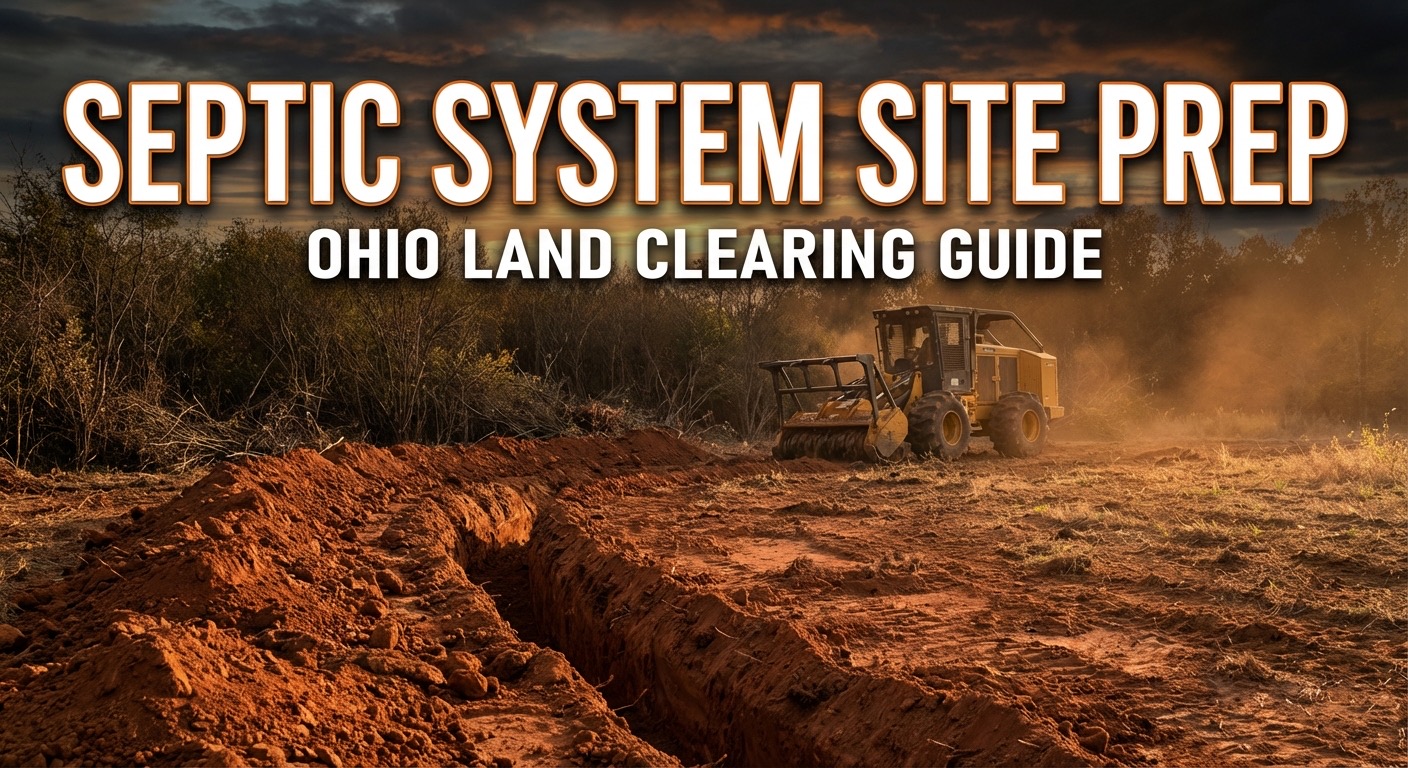
Forestry mulching is the right method for septic prep because the mulcher head cuts vegetation at or above ground level. Stumps get ground down. Roots stay in place. The soil structure stays intact. Your excavator shows up to a clean, accessible site with undisturbed ground ready for trenching.
This distinction matters most on Ohio clay soils. Hamilton County, Clermont County, Warren County, and most of southwest Ohio sit on heavy clay that compacts easily when wet. One pass with a dozer blade on saturated clay can compress the soil enough to fail a perc test that would have passed on undisturbed ground.
What Gets Cleared for a Septic System
A septic installation has several components, and each one needs cleared space. Most property owners underestimate the total footprint.
The Tank Location
The septic tank itself sits between the house and the leach field. It is usually a concrete or fiberglass box buried four to six feet deep. The cleared area around the tank needs to be large enough for the excavator to dig the hole and set the tank. Plan on at least a 20 by 20 foot cleared area around the tank location.
The Leach Field (Drain Field)
This is the biggest piece. A standard leach field for a three-bedroom house in Ohio is roughly 900 to 1,500 square feet. But Ohio code requires a designated replacement area of equal size, so the total footprint doubles. That is 1,800 to 3,000 square feet just for the leach field system, and you need buffer space around the edges for equipment access.
In practice, plan on clearing 4,000 to 6,000 square feet to cover the primary field, replacement area, and working room for the installation crew.
Equipment Access Lanes
An excavator needs to get from the road to the septic site. That means a cleared path at least 12 feet wide, and 14 to 16 feet is better. The access lane also needs to handle delivery trucks bringing the tank, gravel, and distribution boxes. If your septic site is 200 feet from the road through woods, that access lane alone could be a third of the total clearing cost.
The Connection Run
A sewer line runs from the house to the septic tank. This trench is usually three to four feet wide and however long the distance is between the building and the tank. If there is brush or trees in the path, it needs to be cleared.
Total Clearing Estimate
For a typical rural Ohio new-build with the septic system 100 to 200 feet from the house, expect to clear roughly 5,000 to 8,000 square feet total. That includes the tank pad, primary leach field, replacement area, access lane, and connection trench path. Larger homes or challenging terrain can push this to a quarter acre or more.
Ohio Septic Regulations You Need to Know Before Clearing
Ohio septic regulations are administered at the county level through local health departments. The rules are based on Ohio Administrative Code Chapter 3701-29, but each county health department handles permits, inspections, and soil evaluations.
Soil Evaluation Comes First
Before you clear anything, get your soil evaluation done. A registered sanitarian from your county health department will dig test pits, evaluate the soil profile, and determine what type of septic system your site can support. This test has to happen on undisturbed ground.
In southwest Ohio, the most common soil types are Clermont silt loam, Rossmoyne silt loam, and Cincinnati clay loam. All three have a fragipan layer (a dense, compacted subsoil) that affects drainage. The depth to that fragipan determines whether you can use a standard gravity system or need an alternative like a mound system or sand filter.
Setback Distances
Ohio requires minimum distances between septic components and other features on your property:
From a private water well: 50 feet minimum from the septic tank, 50 feet from the leach field. Some counties require 75 or 100 feet.
From property lines: 10 feet minimum from the tank, 10 feet from the leach field in most counties. Check your local code because some townships require more.
From surface water: 50 feet from streams, ponds, or drainage ditches.
From the house foundation: 10 feet minimum from the tank.
From driveways and parking areas: Leach fields cannot be under paved or compacted surfaces. Keep vehicle traffic off the field area permanently.
These setback distances directly affect where you can place the system and how much land you need to clear. On smaller lots, the setbacks leave very few options for placement.
Permit Timeline
In most Ohio counties, the process goes like this: apply for a soil evaluation, wait for the sanitarian visit (two to six weeks depending on season), get results and system design, submit for an installation permit, get the permit, then start work. The clearing should happen after the soil evaluation identifies the best site but before the installation crew arrives.
Do not clear the entire property and then figure out where the septic goes. Clear only the area the soil evaluation and site plan identify as the septic location.
Costs for Septic Site Clearing in Ohio
Clearing costs for septic work are usually a fraction of the total septic installation budget, but they are not insignificant. Here is what property owners in the Cincinnati area typically pay:
Light Brush and Saplings
If the septic site is covered in honeysuckle, saplings under four inches, and tall weeds, clearing runs $1,200 to $2,000 for the full septic footprint including access lane. This is the most common scenario on properties that have been field or pasture within the last 10 to 15 years.
Moderate Vegetation with Small Trees
Properties with mixed brush and trees in the 4 to 10 inch diameter range typically cost $2,000 to $3,000 to clear for septic. The mulcher handles these efficiently, but the work takes longer and the access lane through wooded areas adds cost.
Heavy Woods with Large Trees
If the septic site is in mature woods with 12-plus inch hardwoods, costs can run $3,000 to $4,500 or more. Large trees may need to be felled and removed before the mulcher can process the remaining brush and stumps. Depending on the number and size of trees, this might involve a separate tree service or chainsaw work before the mulching crew arrives.
Hillside Sites
Septic systems on sloped terrain cost more to clear because of equipment access challenges and the need for careful soil preservation. Hillside clearing for septic prep in the Cincinnati area runs 20 to 40 percent more than flat-ground work. If the slope requires remote-controlled equipment, add more.
Get a Free Estimate
Send us photos of your property and the soil evaluation report. We will give you an exact quote for the clearing work and coordinate timing with your septic installer. Request a quote here or call (513) 790-4150.
The Right Order of Operations
Getting the sequence right saves weeks of delays and thousands of dollars in rework. Here is how the timeline should look:
Step 1: Contact your county health department. Apply for a soil evaluation. In Hamilton, Clermont, Warren, and Butler counties, this is through the county environmental health division. Expect a two to six week wait for the evaluation, longer in spring.
Step 2: Get the soil evaluation done. The sanitarian digs test pits and evaluates the soil profile. They will identify the best location for the system and tell you what type of system your site can support. Do not clear anything before this step.
Step 3: Get a system design. Based on the soil evaluation, an engineer or the health department designs the septic system. This gives you exact dimensions and placement for the tank, leach field, and replacement area.
Step 4: Clear the site. Now you know exactly where the system goes. Clear the tank location, leach field area, replacement area, access lane, and connection run. Mark the cleared boundaries according to the site plan.
Step 5: Get the installation permit. Submit the system design and site plan to the health department. Once permitted, your excavator can start.
Step 6: Install the system. The excavation crew shows up to a cleared, accessible site and can start digging immediately.
The most common mistake is reversing steps two and four. Property owners clear an area they think will work, then the soil evaluation comes back showing that location has unsuitable soil or does not meet setback requirements. Now you have cleared the wrong spot and still need to clear the right one.
Why Forestry Mulching Is the Best Method for Septic Prep
We keep coming back to this because it matters. The method you use to clear the septic area directly affects whether the system works properly for the next 25 to 30 years.
No soil compaction. A forestry mulcher on a skid steer has a ground pressure of about 4 to 6 PSI. A bulldozer puts 8 to 12 PSI on the ground. On Ohio clay soils, that difference determines whether your leach field drains properly or backs up within five years.
No grading needed. Mulching removes vegetation and leaves the natural grade intact. The excavation crew sets their own grades when they trench for the leach field. Pre-grading the site with a dozer just adds cost and disrupts soil that needs to stay undisturbed.
Mulch protects exposed soil. After clearing, the ground is covered in a layer of processed wood chips. This prevents erosion between the clearing and the installation, which can be weeks or months apart. Bare soil on Ohio hillsides will wash away in the first heavy rain.
Faster turnaround. Most septic site clearing jobs take half a day to a full day. You can schedule the clearing to happen a few days before the excavation crew arrives, minimizing the gap between clearing and installation.
Stumps are not a problem. The mulcher grinds stumps below grade. The excavation crew does not have to work around or remove stumps when they are trenching for distribution lines.
Common Mistakes That Delay Septic Projects
We have seen every one of these on real projects in the Cincinnati area.
Clearing before the soil test. Already covered this, but it happens constantly. The property owner gets excited, clears two acres, then the health department says the septic has to go in the only spot that was not cleared. Or worse, equipment compacted the soil where the leach field needs to go.
Not clearing enough. Clearing just the leach field footprint without accounting for the access lane, tank location, replacement area, and equipment maneuvering space. The excavation crew shows up and cannot get their machine to the work area.
Clearing too close to the well. If you have a private well, the septic system has mandated setback distances. Clearing up to the well and then discovering the setback pushes the system further away means more clearing and potentially a redesign.
Ignoring the replacement area. Ohio code requires a designated replacement leach field area. This area has to remain unbuilt, uncompacted, and available for future use. It needs to be cleared and maintained but never driven on with heavy equipment.
Timing the clearing wrong. Clearing in March on wet Ohio clay turns the site into a mud pit. The excavation crew cannot work, the soil evaluation may need to be redone, and the project gets pushed back months. Schedule clearing for dry conditions.
Septic Systems on Ohio Hillsides
A lot of buildable land in southwest Ohio is hilly. The Ohio River valley, the Little Miami River corridor, and most of Clermont and Hamilton counties have significant slopes. Installing a septic system on a hillside adds complexity to both the clearing and the installation.
Gravity matters. A standard gravity-fed septic system needs relatively flat ground for the leach field. On slopes greater than 15 percent, you are usually looking at an alternative system: mound, drip distribution, or a pump-to-distribution setup. These systems have different footprints and clearing requirements.
Erosion control is critical. Clearing a hillside and leaving it exposed invites erosion. Forestry mulching leaves a natural mulch layer that holds soil in place. If there is a gap between clearing and installation, the mulch layer prevents the site from washing out.
Equipment access is harder. Getting a mulcher up a steep hillside requires specialized equipment. Standard skid steers lose traction on slopes over 20 degrees. Brushworks runs tracked machines and remote-controlled mulchers that handle slopes other contractors cannot reach.
Downhill drainage. The leach field cannot be directly uphill from the house or any occupied structure. Effluent flows downhill through the soil, and the health department will reject any design that puts treated wastewater flowing toward a building foundation.
Working with Your Septic Installer
The best results happen when the clearing crew and the septic installer communicate directly. Here is what we coordinate on every septic clearing job:
Exact boundaries. The installer marks or maps the tank location, leach field boundaries, replacement area, and connection route. We clear to those marks with a buffer for equipment access.
Access requirements. Different installers use different equipment. Some run mini excavators that fit through a 10-foot gap. Others use full-size excavators that need 16 feet of clearance. We match the access lane width to the installer's equipment.
Timing. Ideally, the clearing happens one to two weeks before installation. This gives the mulch time to settle, allows the health department to do their pre-installation inspection of the cleared site, and minimizes the window for erosion or regrowth.
Stump depth. Most installers want stumps ground to 6 inches below grade in the leach field area and at least 12 inches below in the tank excavation area. We adjust the mulching depth based on where the digging will happen.
County-Specific Notes for Southwest Ohio
Hamilton County
Hamilton County Health Department is one of the stricter departments in the region. They require a registered soil scientist for evaluations on properties with challenging soil conditions. Turnaround on soil evaluations is typically three to four weeks. The eastern townships (Anderson, Newtown, Indian Hill) have the most septic installations due to lower housing density and lack of sewer access.
Clermont County
Clermont County has the highest density of septic systems in the Cincinnati metro area. The county health department has a dedicated sewage program and processes more soil evaluations than any neighboring county. Clermont soils are predominantly silt loam with shallow fragipan, so mound systems and sand filters are common. Clearing for mound systems requires a larger footprint than standard gravity systems.
Warren County
Warren County is where we are based (Loveland), so we know this area best. The eastern half of the county has better-draining soils than the western half. Properties along the Little Miami River corridor often have well-drained alluvial soils that support standard gravity systems. The hilly areas around Oregonia and Waynesville tend to need alternative systems due to steep slopes and clay subsoils.
Butler County
Butler County has been expanding rapidly, and new subdivisions in Liberty Township, West Chester, and Fairfield Township are mostly on sewer. But the more rural areas of Ross Township, Hanover Township, and Oxford still rely heavily on septic. Soil conditions are variable, and the county health department requires a site-specific evaluation for every new installation.
How to Get Started
If you are building on rural property in Ohio and need septic site clearing, here is the fastest path forward:
1. Contact your county health department and apply for a soil evaluation. Do this as early as possible because wait times vary by season.
2. Get your soil evaluation and system design. Once you know where the septic goes and what type of system you need, you have the information we need to quote the clearing.
3. Send us the site plan along with photos of the property. We will give you an exact price for clearing the septic area, access lane, and any additional areas you want opened up. Use our instant pricing tool for a quick ballpark, or request a detailed quote.
4. We clear the site and coordinate timing with your septic installer so the installation can follow immediately.
We have cleared septic sites across Hamilton, Clermont, Warren, Butler, and Brown counties. We know the local soils, the county health department requirements, and the septic installers working in this area. That experience means fewer surprises and a faster path from overgrown lot to working septic system.
Call (513) 790-4150 or request a quote online.
Related Articles
Land Clearing for Home Building in Ohio
Complete guide to clearing land for residential construction in Ohio.
Do You Need Permits for Land Clearing in Ohio?
When permits are required and how to navigate Ohio regulations.
Land Clearing Clermont County Ohio
Costs, permits, and what to expect for Clermont County property owners.