
Ohio's Storm Reality: Why You Need a Plan
Ohio sits in a dangerous weather zone. We get it all: severe thunderstorms in spring and summer, tornadoes during peak season (April through July), ice storms in winter, and wind events year-round. The Ohio Valley's topography funnels weather systems right through Greater Cincinnati.
Ohio Severe Weather Facts
- • Average 19 tornadoes per year in Ohio
- • Derecho events (straight-line winds 60+ mph) hit the region every few years
- • Ice storms cause more cumulative damage than tornadoes in Ohio
- • Peak storm season: April through August
- • Average damage per severe storm: $50,000-$500,000+ in affected neighborhoods
When storms hit, they don't discriminate. A single microburst can level trees across a two-mile swath. A tornado can hopscotch through a subdivision, destroying one house while leaving the neighbor untouched. Ice accumulation can snap thousands of branches in a single night.
Common Storm Damage
- ✗ Uprooted trees on structures
- ✗ Broken limbs on roofs/cars
- ✗ Blocked driveways and roads
- ✗ Downed fences
- ✗ Power lines tangled with debris
- ✗ Scattered branches across yards
- ✗ Leaning "widow-makers"
What We Handle
- → Emergency tree removal
- → Debris clearing and hauling
- → Access restoration (driveways)
- → Hazard tree removal
- → Full property cleanup
- → Stump grinding (if needed)
- → Site restoration
What to Do Immediately After Storm Damage
The first 24-48 hours after a storm are critical. What you do (and don't do) affects your safety, your insurance claim, and your cleanup costs.
⚠️ Critical Safety Rules
- Stay away from downed power lines. Assume ALL downed lines are live and deadly. Stay at least 35 feet away. Call Duke Energy or your utility immediately.
- Don't go under damaged trees. Partially fallen trees can shift without warning. A hung-up tree is under tremendous tension.
- Don't use chainsaws on tensioned wood. Stressed limbs can spring violently. This kills people every year.
- Watch for structural damage. If a tree hit your house, don't enter until you're sure it's safe.
Your Post-Storm Checklist
Within 1 Hour
- ☐ Account for family members
- ☐ Check for gas leaks (smell)
- ☐ Report downed power lines
- ☐ Stay inside if storm is ongoing
- ☐ Turn off main breaker if flooding
Within 24 Hours
- ☐ Document ALL damage (photos/video)
- ☐ Contact insurance company
- ☐ Cover exposed openings (tarps)
- ☐ Call for professional assessment
- ☐ Keep receipts for everything
📸 Document Everything First
Before touching anything, take extensive photos and video:
- • Wide shots showing overall damage
- • Close-ups of where trees/branches hit structures
- • Damage to fences, vehicles, sheds
- • Location of fallen trees relative to property lines
- • Any pre-existing conditions the storm worsened
This documentation is essential for insurance claims. Adjusters need to see the original damage, not the post-cleanup state.
Emergency Storm Damage Clearing: What to Expect
Professional storm cleanup is different from regular tree service or land clearing. It's faster-paced, often more complex, and requires specialized skills for safely handling damaged, tensioned trees.
Our Emergency Response Process
Step 1: Triage Call
When you call, we gather key information: Is anyone injured? Are power lines involved? Is access blocked? Are structures damaged? This helps us prioritize and dispatch appropriately.
Step 2: On-Site Assessment
We assess the situation in person—you can't quote storm work accurately from photos. We identify hazards, determine equipment needs, and provide an honest estimate. No pressure, no games.
Step 3: Priority Work
We handle the urgent stuff first: clear blocked driveways, remove trees from structures, eliminate immediate hazards. This gets your life functional again quickly.
Step 4: Full Cleanup
Once urgent issues are addressed, we complete the full scope—removing remaining debris, processing brush, and restoring your property to pre-storm condition (or better).
Step 5: Documentation
We provide detailed invoices showing work performed, which you need for insurance reimbursement. We can also provide before/during/after photos if needed.
Response Times After Major Storms
Be realistic about timing after regional storm events. When a derecho or tornado hits the area, every tree service within 50 miles gets flooded with calls simultaneously.
Typical response times:
- • Isolated storm (your property only): Same day or next day
- • Neighborhood event: 24-48 hours
- • Regional disaster: 3-7 days for non-emergencies
We prioritize by urgency: blocked emergency access, trees on structures, and safety hazards get addressed first.
Storm Damage Clearing Costs in Cincinnati
Storm cleanup costs vary widely based on the complexity of the work. A single fallen tree in an open yard is straightforward. A tree tangled in power lines on your roof is a complex operation.
| Scenario | Typical Cost | Time |
|---|---|---|
| Single fallen tree (clear access) | $300 - $800 | 1-2 hours |
| Large tree on driveway | $500 - $1,500 | 2-4 hours |
| Tree on fence/shed | $600 - $2,000 | 2-4 hours |
| Tree on roof (careful removal) | $1,000 - $3,500 | 3-6 hours |
| Multiple trees (5-10) | $2,000 - $5,000 | 1 day |
| Full property cleanup (major storm) | $3,000 - $8,000+ | 1-3 days |
| Commercial property cleanup | $5,000 - $25,000+ | 2-7 days |
We Don't Price Gouge
After major storms, some contractors triple their rates to exploit desperate homeowners. That's not us.
Our storm cleanup pricing is based on actual work involved—time, equipment, and disposal. We charge fair rates whether it's a random Tuesday or the day after a tornado. We live in this community too.
Get multiple quotes if you can. But be wary of anyone quoting over the phone without seeing the job, or demanding cash upfront.
What Affects Storm Cleanup Cost
Increases Cost
- • Tree on structure (careful removal)
- • Near power lines (utility coordination)
- • Large diameter trees (24"+)
- • Poor access for equipment
- • Tangled/hung-up trees
- • Hauling required (no mulching)
Decreases Cost
- • Clear, open access
- • Trees on ground (not structures)
- • Mulch-in-place option
- • Multiple items (volume discount)
- • Flexible scheduling
- • Good staging area for equipment
Insurance and Storm Damage: What's Covered
Most homeowner's insurance policies cover storm damage, but coverage for tree removal is often misunderstood. Knowing what's covered—and what's not—helps you make smart decisions.
Typical Insurance Coverage
✓ Usually Covered
- • Tree removal when tree damages a covered structure (house, garage, shed)
- • Tree removal when tree blocks driveway/access
- • Damage repair to structures
- • Temporary living expenses if home is uninhabitable
⚠️ Sometimes Covered
- • Tree removal limits (often $500-$1,000 per tree)
- • Debris removal (may have separate limit)
- • Fence damage (check your policy)
- • Landscaping damage (usually limited)
✗ Typically NOT Covered
- • Tree fell but damaged nothing
- • Preventive removal of damaged/leaning trees
- • Neighbor's tree fell on your property (usually your responsibility)
- • Trees that fell due to disease/neglect
Working With Your Insurance
We make the insurance process easier:
- • Detailed invoices with itemized work descriptions
- • Photo documentation of damage and work performed
- • Direct communication with adjusters if needed
- • Separate line items for structure-related vs. general cleanup
Tip: File your claim BEFORE cleanup if possible. Some insurers want to send an adjuster to see the original damage.
The Neighbor's Tree Question
One of the most common questions: "My neighbor's tree fell on my property. Aren't they responsible?"
Generally, no. In Ohio, if a healthy tree falls due to a storm (act of God), the property where it lands is responsible for removal. Your neighbor isn't liable unless:
- • The tree was obviously dead/diseased and they ignored it
- • You notified them in writing about a hazardous tree
- • They were negligent in maintaining their property
This feels unfair, but it's how Ohio law works. Your homeowner's insurance should cover removal if the tree damaged your property.
Types of Storm Damage We Handle
Storm damage comes in many forms. Each requires different equipment, techniques, and safety considerations.
Uprooted Trees
Complete root ball failures, typically from saturated soil + high winds. These are often the easiest to remove because there's no tension in the trunk. We cut into manageable sections, chip the brush, and can grind the stump if desired.
Special consideration: Large root balls leave significant holes that need filling.
Snapped Trunks
Wind or ice load snaps the trunk partway up, leaving a jagged stump and the crown on the ground (or on your roof). The remaining stump may need to be removed if it's a hazard or eyesore.
Special consideration: Sharp, splintered wood is dangerous. Watch for "barber chairs" (vertical splits).
Hung-Up Trees (Widow Makers)
A tree that's partially fallen but caught in another tree. These are among the most dangerous situations in tree work. The tree is under tremendous tension and can drop or swing unpredictably.
Special consideration: Never attempt to remove a hung-up tree yourself. Professional equipment and techniques are essential.
Trees on Structures
Tree fell on your house, garage, shed, or vehicle. Requires careful removal to avoid additional damage. We often work with roofing contractors to ensure structural integrity before and after.
Special consideration: May need to section the tree while it's still on the structure, rather than pulling it off whole.
Multiple Tree Blowdowns
Severe storms can level a dozen or more trees on a single property. This is where forestry mulching equipment shines—we can process huge volumes of debris efficiently, turning it into mulch rather than hauling it away.
Special consideration: May require phased approach: clear access first, then systematic cleanup.
Ice Storm Damage
Ice accumulation breaks branches throughout the canopy, leaving trees looking like they were hit by artillery. Cleanup is often more labor-intensive because damage is scattered rather than concentrated.
Special consideration: Some trees can recover from ice damage; assessment helps determine which to remove vs. prune.
Why Forestry Mulching for Storm Cleanup
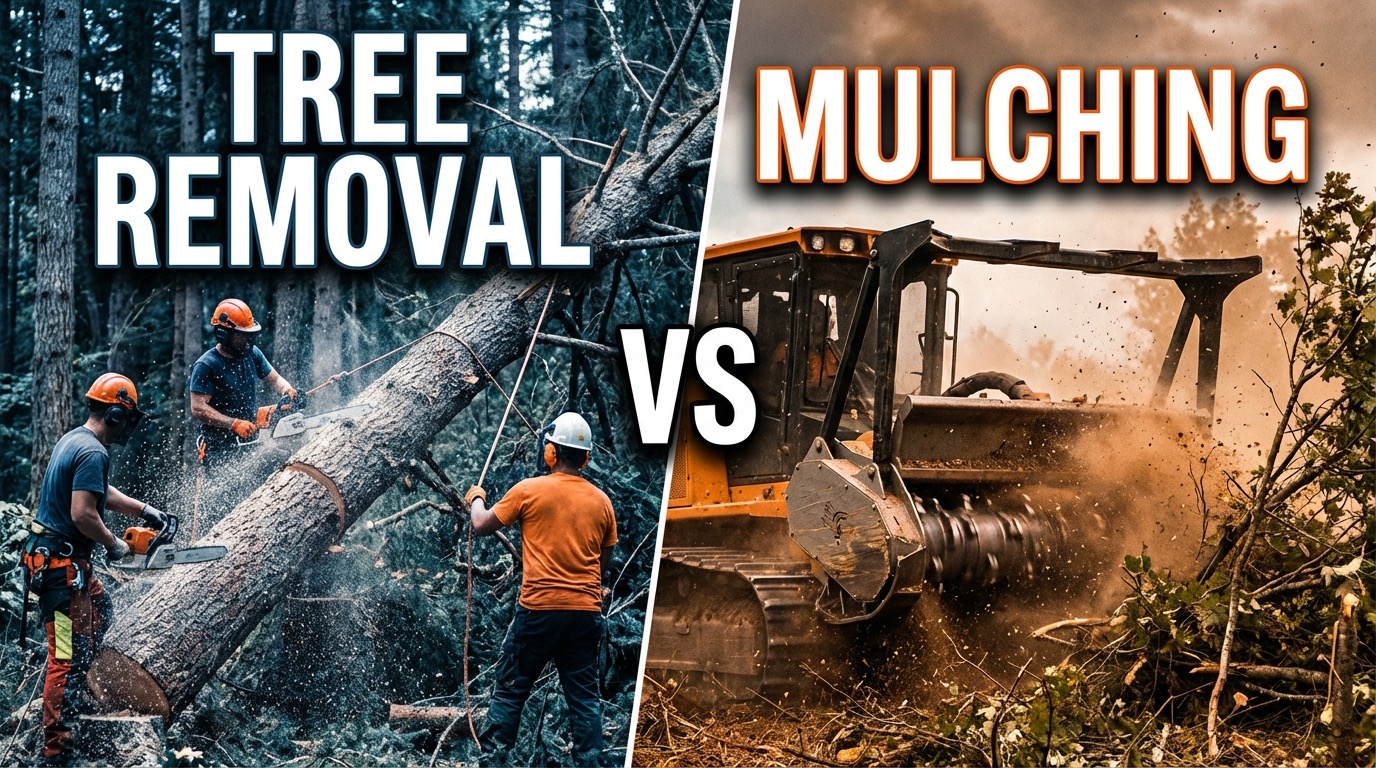
Traditional storm cleanup means chainsaws, chippers, trucks, and multiple trips to the dump. It's slow, expensive, and leaves your property a mess during the process. Forestry mulching offers a better approach for many storm situations.
Traditional Storm Cleanup
- • Cut with chainsaws
- • Feed into chipper
- • Load trucks with chips
- • Haul to disposal site
- • Repeat... multiple times
- • Rake and cleanup debris
Result: 2-3x longer, higher cost, more property disruption
Forestry Mulching Approach
- • Mulcher processes debris in place
- • No chipping, no hauling
- • One machine, one pass
- • Mulch stays as ground cover
- • Finished when we leave
- • Property looks better, not worse
Result: Faster completion, lower cost, minimal disruption
When Mulching Works Best
- • Multiple downed trees: Volume makes mulching efficient
- • Trees in yard/woods: No need to preserve lawn for hauling
- • Want mulch left behind: Great for wooded areas, gardens
- • Speed is priority: Get your property functional fast
When hauling is better: Trees on structures (need careful dismantling), limited space, or homeowner wants all debris removed.
Service Areas for Emergency Storm Response
We provide emergency storm damage clearing throughout Greater Cincinnati and surrounding Ohio counties.
Hamilton County
- • Cincinnati
- • Anderson Township
- • Indian Hill
- • Symmes Township
- • Mt. Washington
- • Madeira
- • Montgomery
- • Blue Ash
Clermont County
- • Loveland
- • Milford
- • Goshen
- • Batavia
- • Williamsburg
- • Bethel
- • New Richmond
- • Amelia
Warren & Butler
- • Mason
- • Lebanon
- • Maineville
- • Morrow
- • West Chester
- • Liberty Township
- • Fairfield
- • Hamilton
We also serve Northern Kentucky (Boone, Kenton, Campbell counties) and Eastern Indiana for storm emergencies. For major events, we can mobilize additional equipment and crews.
Be Prepared: Before the Next Storm
The best time to address storm risks is before disaster strikes. A few preventive steps can dramatically reduce your exposure.
Storm Preparation Checklist
Property Assessment
- ☐ Identify dead/dying trees
- ☐ Note trees leaning toward structures
- ☐ Check for dead branches (hangers)
- ☐ Assess trees with split trunks
- ☐ Look for root problems (heaving)
Preventive Action
- ☐ Remove obvious hazard trees
- ☐ Prune dead branches
- ☐ Thin dense canopies (reduce wind load)
- ☐ Document current tree conditions
- ☐ Review insurance coverage
Hazard Tree Assessment
We offer pre-storm hazard assessments to identify trees likely to fail. Signs of concern:
- • Dead or dying trees: Obvious candidates for failure
- • Leaning trees: Especially those that have recently started leaning
- • Co-dominant stems: V-shaped forks with included bark
- • Cavities and decay: Holes, mushrooms, soft wood
- • Root problems: Construction damage, soil heaving, circling roots
- • Previous damage: Old lightning strikes, past storm damage
Removing a hazard tree in controlled conditions costs a fraction of emergency removal after it falls on your house.
Get Help Now
If you're dealing with storm damage right now, we're ready to help. Fast response, fair pricing, professional results.
Emergency Contact
Call us directly for fastest response:
(513) 790-4150When you call, have ready:
- • Your address
- • Description of damage
- • Whether access is blocked
- • Any power line involvement
- • Whether structures are damaged
Frequently Asked Questions
How quickly can you respond to storm damage in Cincinnati?
We typically respond within 24-48 hours for emergency calls, often same-day for urgent situations. Response times depend on storm severity and call volume. After major regional storms, we prioritize by urgency—blocked driveways and structural threats first.
How much does emergency storm damage clearing cost?
Emergency storm clearing typically costs $500-$3,000 for residential properties, depending on debris volume and tree sizes. Single fallen trees run $300-$1,500. Full property cleanup after major storms ranges $2,000-$8,000+. We provide quick assessments and honest pricing—no gouging during emergencies.
Will my insurance cover storm damage clearing?
Most homeowner's insurance covers storm damage tree removal when trees damage structures or block access. Coverage varies by policy—tree removal limits typically range $500-$1,000 per tree. We provide detailed invoices and can work directly with insurance adjusters. Always document damage with photos before cleanup.
Can you remove trees that fell on structures?
Yes, we regularly remove trees from roofs, fences, sheds, and vehicles. We work carefully to minimize additional damage during removal. For trees on homes, we often coordinate with roofing contractors to ensure proper structural assessment before and after removal.
What should I do immediately after storm damage?
First, stay away from downed power lines—assume all are live. Document damage with photos for insurance. Avoid going under damaged trees. Cover any structural openings with tarps if safe. Then call for professional assessment. Don't attempt chainsaw work on tensioned trees—they can spring unpredictably.
Do you handle commercial storm damage cleanup?
Yes, we serve commercial properties, HOAs, municipalities, and property management companies. For large-scale storm cleanup, we can deploy multiple crews and heavy equipment. We've handled post-storm clearing for shopping centers, apartment complexes, and industrial sites throughout Greater Cincinnati.
Related Articles
Tree Removal vs Forestry Mulching
Compare methods for clearing trees from your property.
Read Article →Land Clearing Cost Per Acre Ohio
Complete pricing guide for all types of land clearing.
Read Article →