
Common Farm Clearing Challenges in Ohio
Ohio's climate and fertile soil mean vegetation grows aggressively. Left unmanaged for even a few years, productive farmland can become overgrown and unusable. Here are the most common challenges we see on Ohio farms:
- Pastures lost to brush: A pasture that's not actively grazed or mowed can be overtaken by brush, honeysuckle, and small trees in just 3-5 years. What was once productive grazing land becomes impenetrable thicket.
- Overgrown fence lines: Fence lines are vegetation magnets. Birds perch on fences and deposit seeds, brush grows up through the wire, and suddenly you can't see—or maintain—your fencing.
- Invasive species takeover: Bush honeysuckle, multiflora rose, and autumn olive spread aggressively across Ohio farmland, crowding out native species and reducing land productivity.
- Woodland edge encroachment: Woods slowly expand into adjacent fields as seedlings establish along the edges. Each year, you lose a little more productive ground.
- Neglected timber stands: Woodlots that haven't been managed in decades become choked with understory, reducing timber quality and wildlife habitat value.
The Cost of Waiting
Every year you wait, the problem gets worse—and more expensive to fix. A fence line that could be cleared in a few hours today might take a full day in 3 years. A 5-acre overgrown pasture becomes a 7-acre problem as brush continues to spread.
Farm Applications for Forestry Mulching
Pasture Reclamation
Reclaiming overgrown pasture is one of our most common farm projects. Forestry mulching can transform brush-covered land back into usable grazing area in a single day.
What we handle:
- • Dense honeysuckle thickets up to 20 feet tall
- • Multiflora rose and thorny brush
- • Small trees (up to 8" diameter) that have established in former pasture
- • Mixed brush and vegetation of any density
The result: Clean, mulched ground ready for reseeding. The mulch layer suppresses regrowth while decomposing and adding organic matter to the soil. Most farmers see grass establishing within one growing season.
Typical timeline: 1-3 acres per day depending on vegetation density. A 5-acre pasture reclamation usually takes 2-3 days.
Fence Line Clearing
Overgrown fence lines are more than an eyesore—they make fence maintenance impossible, harbor pests, and create fire hazards. We clear fence lines efficiently so you can see, access, and maintain your fencing.
Clearing options:
- • Both sides clearing: For internal fences where you own both sides
- • One-side clearing: For boundary fences where you're only clearing your side
- • Pre-fence clearing: Clear the line before installing new fencing
- • Existing fence work: Clear around existing fences without damaging wire or posts
Our operators are experienced at working close to existing fences. We can clear right up to the fence line on your side without tangling wire or damaging posts. For more on this service, see our fence line clearing page.
Timber Stand Improvement (TSI)
Healthy timber stands need periodic management. Forestry mulching removes undesirable understory vegetation, allowing quality timber trees to thrive.
TSI benefits:
- • Improved timber growth: Removing competition allows valuable trees to grow faster
- • Better access: Walk through your woods without fighting brush
- • Enhanced wildlife habitat: Edge habitat and browse for deer and turkey
- • Reduced fire risk: Less understory fuel means lower wildfire danger
- • Aesthetic improvement: Woods you can actually enjoy
We work selectively—removing invasive brush and undesirable species while preserving quality timber trees. Tell us what you want to keep and what should go, and we'll clear accordingly.
Woodland Edge Management
The edge between woods and fields is prime real estate for brush encroachment. Maintaining clean woodland edges keeps your field boundaries defined and prevents annual loss of productive ground.
- • Push back encroaching saplings and brush
- • Define clean edges between woods and fields
- • Create firebreaks between wooded areas and structures
- • Improve sight lines for hunting and property management
Ditch Bank and Waterway Clearing
Drainage ditches and waterways need periodic clearing to function properly. We can clear vegetation from ditch banks and around farm ponds without the erosion and disturbance that traditional methods cause.
- • Clear brush from drainage ditch banks
- • Open up overgrown waterways
- • Clear around farm ponds and water features
- • Maintain buffer strips and filter areas
Why Forestry Mulching Beats Traditional Farm Clearing
Farmers have cleared land for generations using bulldozers, burn piles, and manual labor. Forestry mulching is a better approach for most farm applications:
Traditional Methods
- ❌ Bulldozing disturbs topsoil
- ❌ Burn piles take weeks to manage
- ❌ Debris hauling is expensive
- ❌ Stumps remain and regrow
- ❌ Erosion starts immediately
- ❌ Manual cutting is slow and dangerous
Forestry Mulching
- ✅ Leaves topsoil intact
- ✅ No burn piles—everything processed in place
- ✅ No debris hauling costs
- ✅ Grinds at root level to reduce regrowth
- ✅ Mulch layer prevents erosion
- ✅ Fast, efficient, one-pass clearing
For farmers, the soil preservation alone makes forestry mulching worth considering. When you push topsoil around with a dozer, you lose the organic matter and soil structure that took decades to develop. Mulching leaves soil in place and actually adds organic matter as the mulch decomposes.
No Fire Permits, No Waiting
Burn bans, fire permits, weather delays—burning debris is increasingly difficult in Ohio. Forestry mulching eliminates the burn pile entirely. The material is processed in place, ready to decompose naturally. No waiting for burn conditions, no neighbor complaints about smoke, no fire risk.
Costs for Farm Forestry Mulching
Farm clearing costs depend on the type of work, vegetation density, and acreage. Here are typical ranges for Ohio farm projects:
Pasture Reclamation
$1,400–$2,500 per acre
Light to moderate brush. Dense honeysuckle walls may be higher. Volume discounts available for larger projects.
Fence Line Clearing
$2–$5 per linear foot
Varies with vegetation density and width. Minimum project size applies.
Timber Stand Improvement
$1,200–$2,000 per acre
Selective understory removal. Lower cost than full clearing since we're working around trees.
Minimum Project
$850
Covers mobilization for smaller projects. Most farm projects exceed this easily.
Volume discounts: Larger projects (10+ acres) typically receive per-acre discounts. If you have multiple areas to clear, combining them into one project reduces overall cost.
Get Accurate Pricing
Every farm is different. For accurate pricing, we need to see the property—either in person or via detailed photos and aerial imagery. Use our instant pricing calculator for a quick estimate, or contact us with details about your project.
Equipment for Farm Applications
Different farm clearing tasks call for different equipment. Brushworks operates multiple machines to handle any farm application:
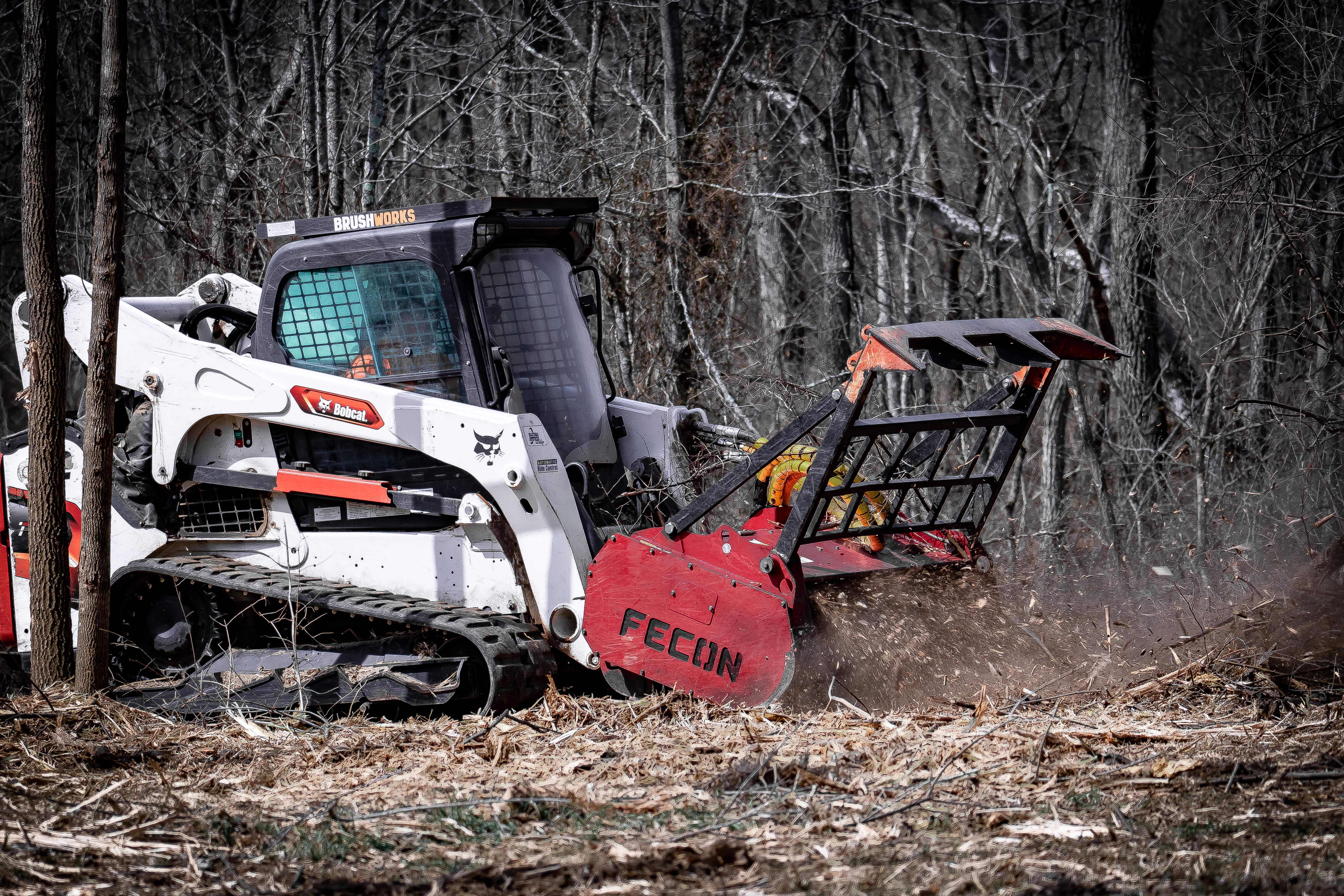
Track Loaders with Mulching Heads
Our primary equipment for flat to moderate terrain. High-flow hydraulics power professional FAE mulching heads that process brush and trees up to 8" diameter. Track loaders are stable, efficient, and cause minimal ground disturbance.
FAE RCU-55 Remote-Controlled Mulcher
For steep hillsides, pond banks, and areas where traditional equipment can't safely operate. The RCU-55 works on slopes up to 50° with no operator on the slope. Perfect for clearing steep pastures, eroded banks, and difficult terrain. Learn more on our hillside mulching page.
Brush Hog / Rotary Cutter
For lighter maintenance work—tall grass, weeds, and light brush. Not suitable for woody vegetation or anything over a few inches diameter, but cost-effective for basic field maintenance. See our brush hogging page for details.
We'll recommend the right equipment for your project during the quote process. Sometimes a combination of equipment provides the best results—mulching the heavy stuff and brush hogging the lighter areas.
Best Time of Year for Farm Clearing
Ohio farmers can benefit from clearing work any time of year, but certain seasons offer advantages:
Late Fall / Winter (Nov–Mar)
- ✅ Ground is firm—less rutting
- ✅ No leaves—easier to see what you're clearing
- ✅ Less sap—cleaner processing
- ✅ Fits farm schedule between harvest and planting
- ✅ Pasture ready to seed in spring
Spring / Summer (Apr–Oct)
- ✅ Can identify invasive species by leaves
- ✅ Immediate regrowth control visibility
- ✅ Mulch breaks down faster in warm weather
- ⚠️ Wet ground can cause access issues
- ⚠️ Active growing season—regrowth more aggressive
For pasture reclamation, late fall/winter clearing followed by spring seeding typically produces the best results. The mulch has time to settle over winter, and you can seed directly into it in spring.
Service Area for Farm Clearing
Brushworks provides forestry mulching for farms throughout Southwest Ohio and Northern Kentucky:
Warren County
Clermont County
Brown County
Clinton County
Highland County
Adams County
Butler County
Hamilton County
We're based in Loveland and regularly work throughout the rural areas of Southwest Ohio. For farms outside our core service area, contact us to discuss—we'll consider larger projects anywhere in Ohio.
Ready to Reclaim Your Farm Land?
Whether you're reclaiming lost pasture, clearing fence lines for new fencing, or managing your timber stands, Brushworks can help you get more from your farm property.
Send us information about your project—what you want to clear, approximate acreage, and your goals for the land—and we'll provide a clear quote. For larger farm projects, we're happy to meet on-site to walk the property together.
Get Started
Use our instant pricing calculator for a quick estimate, or request a quote with your project details.
Questions? Call us at (513) 790-4150. We're farmers ourselves and understand what you're dealing with.