
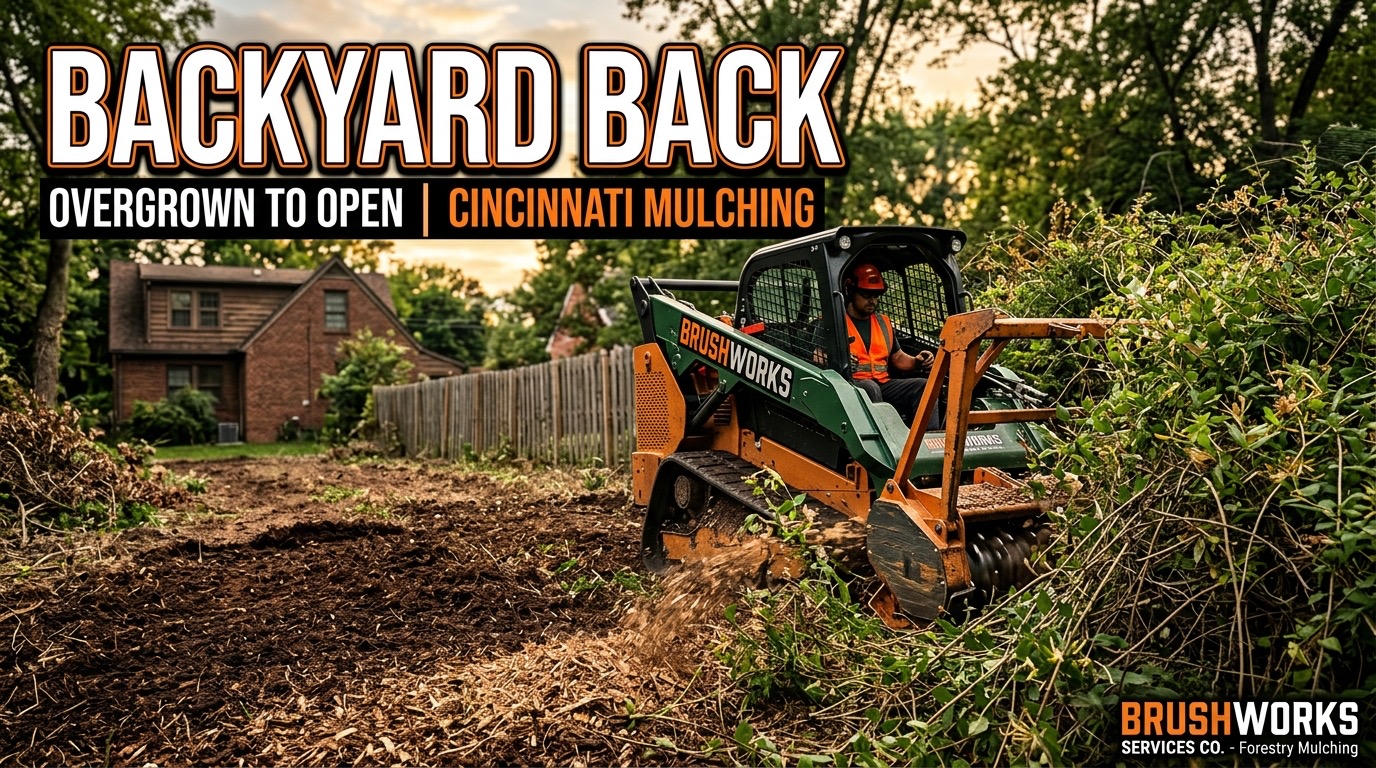
Start by deciding what the backyard needs to become
Before anyone cuts a stem, decide what you want back. A mowable lawn edge is different from a kids' play area. A future fence line is different from a garden, a shed pad, a trail to the creek, or a privacy buffer along the neighbor's property. The final use controls how much gets cleared, how wide access needs to be, and how clean the finish should be.
A lot of backyard clearing mistakes happen because the goal is too vague. "Clean it up" sounds simple, but it can mean ten different things. One homeowner wants every sapling gone. Another wants the brush opened while keeping the mature shade trees. One property needs a machine path for a fence crew. Another just needs the invasive wall pushed back so the mower can keep it under control.
For Cincinnati properties, the best answer is usually selective. Remove the junk growth, keep the useful trees, open the ground, and leave the yard in a condition that can be maintained. Stripping everything bare often creates more heat, more mud, more erosion, and less privacy than the owner expected.
Plain rule
Do not clear to make the backyard look empty. Clear to make it usable. There is a big difference.
What usually takes over Cincinnati backyards
Around Cincinnati, the usual troublemakers are bush honeysuckle, multiflora rose, wild grapevine, poison ivy, tree of heaven, autumn olive, brambles, locust sprouts, boxelder, dead ash, and volunteer maples. Add wet clay soil, creek edges, steep little hillsides, and old fence rows, and a backyard can turn into a thicket faster than people expect.
Honeysuckle is the big one. It leafs out early, holds green late, blocks light, and creates a wall that hides everything behind it. Once honeysuckle owns the understory, grass disappears and the yard starts feeling smaller. Vines make it worse by climbing good trees and pulling down branches. Briars and multiflora rose make the area unpleasant to walk. Poison ivy turns a cleanup project into a skin problem.
The brush is rarely the only issue. Overgrown backyards often hide dumped concrete, old landscape timbers, steel posts, wire fence, kids' toys, rotten firewood, groundhog holes, septic lids, drainage outlets, and private utility lines. That hidden layer is why a careful walk-through matters before equipment starts working.
Common growth we see
- • Honeysuckle and invasive shrubs
- • Briars, rose canes, and thorn patches
- • Wild grape and poison ivy vines
- • Saplings and small volunteer trees
- • Dead ash limbs and storm debris
Common hidden problems
- • Old fence wire and steel posts
- • Septic lids, drains, and private lines
- • Concrete, rocks, tires, and trash
- • Soft spots and wet clay
- • Property corners nobody can see
Walk it before you price it
If you can walk the backyard safely, do it before calling for a quote. Take photos from the house looking out, from the far edge looking back, and from any gate or driveway where equipment might enter. A short video helps too. Show the thickness of the brush, the access point, the slope, and anything that needs to stay.
If you cannot walk it safely because of thorns, poison ivy, bees, steep ground, or debris, say that. A good contractor can still start with aerial imagery and outside photos, but they need to know the limits. Pretending the property is easy to access only creates surprises later.
Marking matters. Tie ribbon on trees you want to keep. Use paint or flags for the edge of the work. If the clearing line is near a neighbor, fence, creek, drainage swale, shed, pool, or garden, make it obvious. Guessing from a conversation is how the wrong thing gets cut.
Check utilities, septic, and private lines
Public utility locates are important, but they do not mark everything. Many backyard problems involve private lines: electric to a detached garage, low-voltage lighting, invisible dog fence, irrigation, water to a barn, septic lines, old drain tile, or a downspout line that disappears into the ground. The owner usually has to identify those.
Septic systems deserve extra caution. Tanks, distribution boxes, leach fields, and cleanouts do not like heavy equipment. If the backyard has a septic system, mark it clearly and tell the clearing crew before they unload. The same goes for wells, cisterns, buried propane lines, and any old outbuilding utilities.
Cincinnati yards also have plenty of drainage surprises. If water already runs through the backyard during storms, clearing can change how visible that water path is. It should not be ignored. Keep buffers where they help slow water, avoid chewing up wet channels, and plan seed or ground cover where bare soil could wash.
Mark this before work starts
- • Property lines, corners, and neighbor boundaries
- • Septic tanks, leach fields, wells, drains, and culverts
- • Private electric, water, lighting, irrigation, or invisible fence lines
- • Trees, shrubs, screens, and buffers that should stay
- • Soft ground, creek banks, steep slopes, and no-go areas
When forestry mulching fits a backyard
Forestry mulching is a strong option when the backyard is full of woody brush, invasive shrubs, vines, saplings, and small trees. The machine cuts and grinds the material in place, leaving a mulch layer instead of piles. For many overgrown Cincinnati backyards, that is cleaner and faster than cutting everything by hand and dragging it out one limb at a time.
Access decides a lot. The machine needs a safe way to unload and reach the work without wrecking the front yard, driveway, fence, landscaping, septic area, or neighbor's property. Some backyards have a wide side gate and easy access. Others need fence panels removed, a temporary path opened, or a smaller machine.
Mulching is not the answer for every detail. It does not remove stumps below grade. It does not grade a yard, install drainage, or create a finished lawn. It also is not ideal right next to fragile fences, windows, pools, or tight ornamental areas. But for the rough overgrown section behind the maintained yard, it can be exactly the right first pass.
Good fit for mulching
- ✓ Honeysuckle walls
- ✓ Briars and invasive shrubs
- ✓ Saplings and small trees
- ✓ Overgrown edges and back lots
- ✓ Access paths and rough yard expansion
May need another method
- • Finish grading for lawn
- • Large tree removal near structures
- • Stump grinding below grade
- • Hauling trash or concrete
- • Tight hand work around delicate features
Hand clearing, brush hogging, and machine clearing
Hand clearing has its place. It is good around fences, sheds, pools, landscape beds, utilities, and tight corners. It is also slow and expensive when the whole back half of the property is woody brush. If the material is thick enough to fight back, hand crews spend a lot of time cutting, dragging, stacking, and loading.
Brush hogging works when the growth is grass, weeds, and light brush that can be mowed. It is not the same as clearing a woody thicket. A brush hog can beat down rough vegetation, but heavy honeysuckle, locust sprouts, rose canes, and vines often need more horsepower and a different head. If the area has hidden wire, rocks, stumps, or debris, mowing can get ugly fast.
Machine clearing makes sense when the problem is bigger than maintenance. A forestry mulcher, skid steer attachment, compact track loader, or remote machine can open ground quickly. The tradeoff is access and site protection. You want enough machine to do the work, but not so much that the route to the backyard becomes the damage.
Do not ignore drainage and slopes
Many Greater Cincinnati backyards fall toward a creek, ravine, swale, or wooded edge. That is part of why they overgrow. The mower stops going there, the ground stays damp, and brush takes over. Clearing those areas without thinking about water can create a new problem.
On slopes, keep root structure where it helps hold soil. Remove invasive understory and deadfall, but be careful about scraping everything down to bare dirt. A mulch layer can help soften rainfall impact, but steep ground may still need seed, straw, erosion blanket, or a no-mow plan after clearing. Creek edges may need selective work rather than a full cut to the bank.
The goal is a backyard you can use, not a muddy slide. If the area has standing water, storm flow, or erosion cuts, mention that during quoting. Sometimes clearing is step one, then drainage repair, grading, or stabilization comes after.
What an overgrown backyard clearing plan looks like
A good plan is simple enough to explain. First, identify the work limits and what stays. Second, open safe access. Third, clear the heavy brush and small woody growth. Fourth, clean up the edges around fences, structures, and trees. Fifth, decide what happens next so the backyard does not close back in.
On a typical Cincinnati job, that might mean removing honeysuckle and saplings along the back fence, keeping two good shade trees, opening a ten-foot path to the shed, mulching the brush in place, hand trimming around the chain-link fence, and leaving enough room for the owner to mow the edge. On a larger property, it might mean opening trails, reclaiming a creek view, or making room for a future detached garage or garden.
The important part is sequencing. If a fence contractor, landscaper, drain contractor, or shed installer is coming next, clear what they actually need. If the owner wants grass, plan for seed timing. If the area will stay natural, plan maintenance paths and brush control.
How to keep it from growing back
Clearing is the reset, not the finish line. Cincinnati growth comes back fast, especially honeysuckle, locust, briars, and vines. If sunlight reaches the ground for the first time in years, weeds and sprouts will respond. That is normal. The question is whether you have a follow-up plan.
The easiest long-term answer is mowing, but only if the cleared area can actually be mowed. That means the ground needs to be reasonably smooth, dry enough, and free of stumps or debris that will beat up equipment. If mowing is not realistic, selective herbicide, periodic brush cutting, seeding, native plantings, or a maintenance trail may make more sense.
Do not wait five years and pay to reclaim the same backyard again. A small follow-up pass after the first growing season is usually cheaper than letting saplings turn into trees.
After-clearing options
- • Mow the edge every few weeks during growing season
- • Seed disturbed areas before weeds own the bare soil
- • Treat invasive resprouts while they are small
- • Keep a walking or equipment path open
- • Schedule a light maintenance pass before brush gets woody again
What affects backyard clearing cost
Backyard clearing cost depends less on the word "backyard" and more on the real conditions. A quarter acre of weeds behind a ranch house is one job. A quarter acre of thorny brush down a slope behind a tight fence is another. Access, density, slope, hidden debris, tree size, and finish level all matter.
Small jobs also carry mobilization cost. Even if the area is not huge, the crew still has to load equipment, haul it to the site, unload safely, protect access, perform the work, and clean up. That is why tiny projects can feel expensive per square foot compared with larger acreage work.
Photos help, but good photos matter. Stand back far enough to show scale. Include the access route. Show the thickest brush. Point out fences, gates, slopes, and structures. If there is debris or wire, say so up front. Nobody wins when a mulching head finds steel the hard way.
How Brushworks handles overgrown backyard clearing
Brushworks looks at the backyard the way a property owner does: what can you use now, what is blocked, what is worth keeping, and what will be a problem after clearing? We are not trying to make every yard look like a construction site. Most homeowners want usable ground, better access, cleaner edges, and a plan they can maintain.
For many Cincinnati-area backyards, forestry mulching is the right tool for the rough overgrown section. For tight edges, fences, utilities, and structures, the plan may include hand work or a different approach. The point is to match the work to the property instead of forcing one method everywhere.
We work across Greater Cincinnati and southwest Ohio, including Hamilton County, Clermont County, Warren County, Butler County, Loveland, Milford, Mason, Lebanon, Batavia, Goshen, and nearby communities. If the back half of your yard has disappeared, we can help you get it back.
Need your backyard back?
Send the address, photos, and what you want the area to become. We can help figure out whether the job needs forestry mulching, selective clearing, hand work, or a staged cleanup plan.
Frequently asked questions
What is the best way to clear an overgrown backyard in Cincinnati?
The best method depends on access, slope, brush density, utilities, and what you want the yard to become. Light growth may only need cutting and cleanup. Heavy honeysuckle, briars, vines, saplings, and small trees are often better handled with forestry mulching or selective machine clearing.
Can forestry mulching be used in a backyard?
Yes, if there is enough access for the machine and the ground can support it. Forestry mulching works well for thick brush, invasive shrubs, saplings, and vines. Tight gates, soft lawns, septic areas, and nearby structures may require a smaller machine or a different plan.
Do I need to remove all the trees in an overgrown backyard?
No. Most backyards look and function better when good shade trees stay. The smart approach is usually to remove brush, dead trees, invasive growth, and problem saplings while keeping healthy trees, privacy buffers, and creek or slope protection.
How do I keep brush from growing back after clearing?
Plan the follow-up before the first clearing pass. Mowing, selective herbicide, seeding, mulch management, fence repair, drainage fixes, and periodic maintenance all help. Cincinnati brush grows fast, so doing nothing after clearing usually means the yard starts closing back in.
What should I mark before a backyard clearing crew arrives?
Mark property lines, utilities, septic components, wells, drains, irrigation, invisible fence wires, trees to keep, work limits, and any areas that are too soft or sensitive for equipment. Private lines are often not marked by public utility locate services.
How much does overgrown backyard clearing cost near Cincinnati?
Cost depends on size, access, density, slope, debris, tree size, finish level, and whether material is mulched, piled, or hauled away. Photos, a short video, and the property address usually help narrow the range before a visit.
Related articles
Briar Patch Removal Cincinnati
How to clear thorny brush without turning the job into a bloodbath.
Poison Ivy Removal Cincinnati
What to know before cutting, pulling, or mulching poison ivy on your property.
Lot Clearing Near Me Cincinnati
A broader guide to local lot clearing, access, permits, and hiring.
Ready to clear the part of the yard you stopped using?
Use instant pricing for a quick starting point, or send photos if the backyard has thick brush, tight access, slope, utilities, septic, or debris.