
How to Hire a Land Clearing Company in Ohio: What to Ask, What to Avoid

The wrong company can cost you double. Here's how to get it right the first time.

ยท 14 min read

Spring is here. You've got a property that needs clearing. Maybe it's a building lot, an overgrown backyard, or 10 acres of honeysuckle that's been winning the war for a decade. You Google "land clearing near me" and get 15 results. Now what?

Hiring the wrong land clearing company is one of those mistakes that costs you twice. Once for the bad work, and again to fix it. We've been called in to clean up after other crews more times than we'd like to count. Ruts through the yard. Trees pushed into piles and left. Stumps sticking up everywhere. Property lines ignored.

This guide covers everything you need to know to hire the right company, ask the right questions, and avoid the guys who'll make your project harder than it needs to be.

Start with the Right Clearing Method

Before you call anyone, understand what you're buying. There are two main approaches to land clearing in Ohio, and they produce very different results.

Forestry Mulching

A single machine grinds trees, brush, and stumps into mulch right where they stand. The mulch stays on the ground. No hauling. No burning. No piles of debris. The finished product is a clean, walkable surface with a layer of organic material protecting the soil.

Best for: residential lots, properties where you want to keep the topsoil, slopes, areas near waterways, and anywhere you want a finished-looking result the same day.

Traditional Clearing (Bulldozer/Excavator)

A dozer pushes trees and brush into piles. Those piles then need to be burned (if your county allows it), buried on-site, or loaded onto trucks and hauled to a dump. This method also scrapes topsoil and disrupts the ground surface.

Best for: large commercial sites where grading is needed anyway, properties where every stump needs to come out for construction, and situations where the lowest per-hour rate matters more than the finished product.

Most residential and small commercial projects in Ohio are better served by forestry mulching. It costs more per hour but less total because there's no cleanup phase. And you don't end up with a moonscape that needs thousands in erosion control.

The 8 Questions You Need to Ask Every Company

Before you sign anything or shake hands, ask these questions. The answers will tell you whether you're dealing with a professional operation or a guy with a machine and a prayer.

1. "Can I see your insurance certificate?"

This is the single most important question. If a worker gets hurt on your property and the company has no workers' comp, you could be liable. If their machine throws a rock through your window and they have no general liability, you're paying for it.

What to look for:

  • General liability insurance: Minimum $1 million per occurrence
  • Workers' compensation: Required in Ohio if they have employees
  • The certificate should name you as a certificate holder so you know it's current and real

Any company that hesitates, says "I'll get that to you," and never does, or tells you insurance "isn't necessary for this kind of work" is a company you don't hire. Full stop.

2. "What equipment do you run?"

Equipment tells you a lot about capability. A skid steer with a brush cutter attachment is fine for light brush and small trees. But if you've got 8-inch hardwoods and heavy growth, you need a dedicated forestry mulcher on a tracked carrier or an excavator-mounted mulching head.

Ask specifically:

  • What's the biggest tree diameter your machine can handle?
  • Is your equipment tracked or wheeled? (Tracked is better for soft ground and slopes)
  • Do you have machines rated for steep terrain?

A company with the right iron for your job will finish faster and do cleaner work. A company trying to clear 12-inch trees with a machine rated for 6-inch material will take twice as long and charge you for every extra hour.

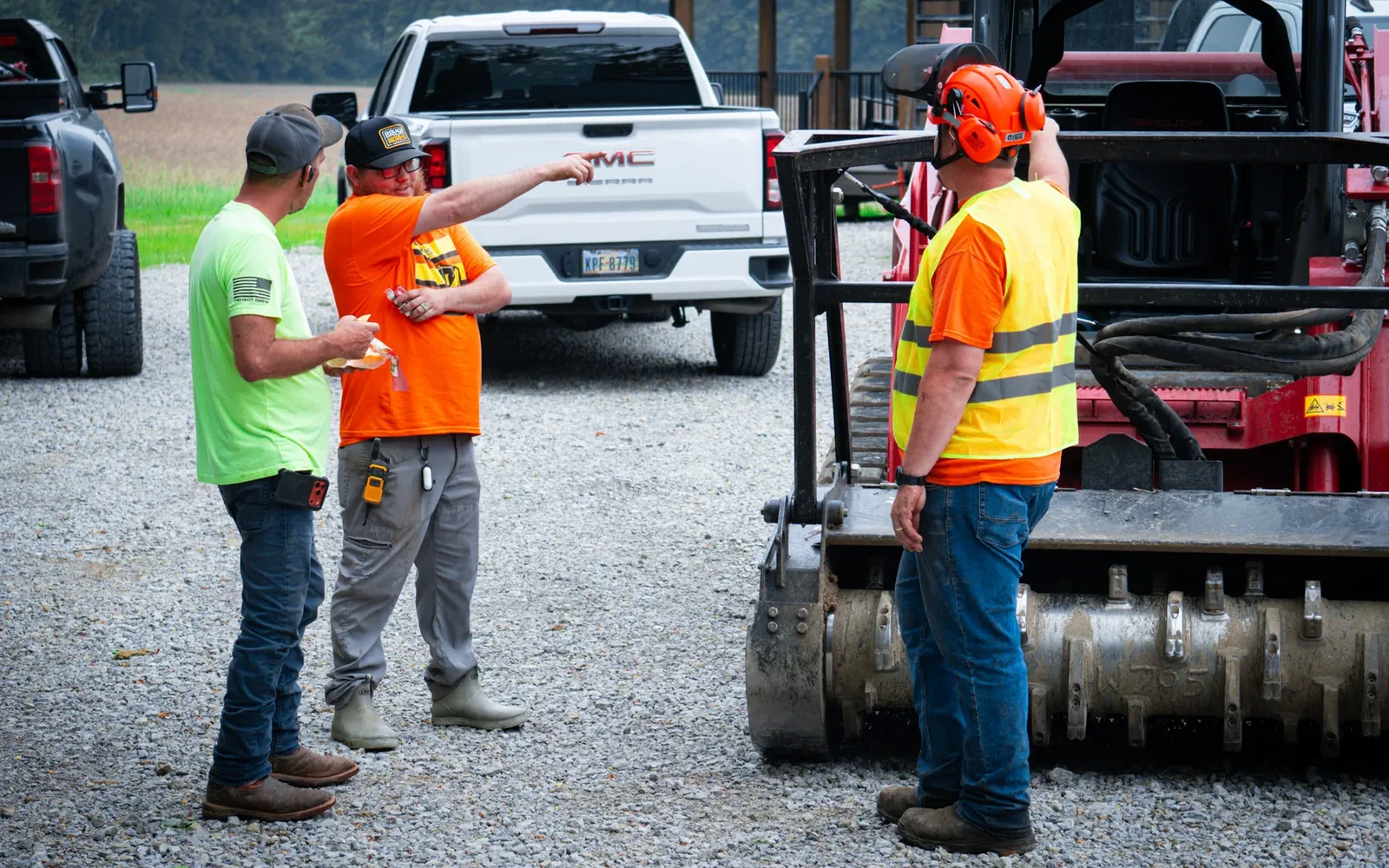
3. "Will you walk the property with me before quoting?"

If a company quotes your job based on a Google Maps satellite image alone, you're rolling the dice. Satellite images don't show understory density, ground conditions, hidden obstacles (old fencing, concrete, metal), or slope severity.

A professional company walks your property before giving you a number. They'll mark what stays, what goes, identify access points for equipment, and flag potential problems before they become expensive surprises.

Phone quotes and sight-unseen estimates are fine for getting a ballpark. But before you commit, insist on a site visit. It protects both of you.

4. "Is your quote per hour or a flat rate?"

Flat-rate quotes protect you. Hourly quotes protect the company.

If a machine breaks down for two hours, an hourly company might still charge you for that time (or at least the mobilization delay). If the terrain is worse than expected, hourly billing means your budget grows with every passing hour.

Good companies that have cleared enough properties can walk your site and give you a fixed price. They know what it takes. They'll absorb the risk of hidden complications because they've built that margin into their pricing.

If a company will only quote hourly, ask for a "not to exceed" cap. If they won't give you one, that tells you something about either their experience or their business model.

5. "What happens to the debris?"

This question separates forestry mulching companies from traditional clearing crews, and it has a huge impact on your final cost.

With forestry mulching, the answer is simple: everything gets ground into mulch on-site. No debris to deal with. No burn piles. No hauling fees.

With traditional clearing, debris disposal can be a project unto itself. Burning requires a permit in most Ohio counties and isn't allowed in many municipalities. Hauling to a landfill or wood recycler adds $500-2,000+ depending on volume. Burying on-site is an option on large rural properties but creates problems if you ever want to build where the debris is buried.

Make sure the quote includes debris disposal. "We'll push it into a pile and you can burn it later" is not a plan. That's a problem you're inheriting.

6. "How do you handle stumps?"

Stumps are where a lot of land clearing arguments start. What counts as "cleared" varies wildly between companies.

Forestry mulchers grind stumps flush with or slightly below ground level as part of the clearing process. No extra charge, no stump grinding crew needed afterward.

Bulldozer operators may push stumps out of the ground (leaving holes), cut them off at ground level, or ignore them entirely. If your plan is to build, grade, or seed the area, stumps sticking up 6 inches above grade are going to be a problem.

Get it in writing: are stumps ground flush, removed, or left? And is stump work included in the quote?

7. "Can you show me photos of similar projects?"

Every company says they do great work. Photos prove it. Look for before-and-after shots of properties similar to yours. Same terrain, same density, same type of vegetation.

Better yet, ask for a reference you can call. Talk to a past customer. Ask if the crew showed up on time, finished when they said they would, and left the property the way they described.

Google reviews help but they're easy to game. A direct conversation with someone whose property was cleared last month tells you more than 50 five-star reviews.

8. "What's your timeline?"

April through October is peak season for land clearing in Ohio. Good crews book 2-4 weeks out during spring and summer. If someone can show up tomorrow during peak season, ask yourself why their schedule is that open.

Get a start date and an estimated completion date in writing. Ask what happens if weather delays the project. A professional company will communicate proactively about delays, not ghost you for a week and then show up unannounced.

Want a straight answer on your project?

Use our instant pricing calculator for a ballpark estimate, or request a free on-site quote. We walk every property before giving you a number.

Get Instant Pricing

Red Flags That Should Kill the Deal

We're not going to trash-talk competitors. But we've been in this industry long enough to know the warning signs. If you see any of these, keep looking.

No insurance certificate. Already covered this. Non-negotiable.

No written quote. A handshake and a verbal number isn't a contract. When something goes wrong, and something always goes wrong on clearing jobs, you want paper. Even a simple email with scope, price, and payment terms is better than nothing.

Massive deposit requirement. A reasonable deposit is 10-25% to reserve your spot on the schedule. If someone wants 50% up front before any work happens, that's a red flag. Too many property owners in Ohio have been burned by paying big deposits to companies that never showed up.

"We'll figure it out when we get there." Vague scope means vague results. If a company can't tell you exactly what they'll clear, what they'll leave, and what the property will look like when they're done, they haven't done this enough.

No online presence. No website, no Google Business listing, no reviews, no photos of past work. In 2026, every legitimate business has some kind of online presence. If they don't, they're either brand new (which means you're their test subject) or they've burned through enough bad reviews that they started over.

Lowball pricing that's 40%+ below everyone else. If three companies quote $4,000-5,000 and one quotes $2,000, that fourth company is either cutting corners (no insurance, no stumps, debris left on-site) or underbidding to win the job and then hitting you with change orders. The cheapest quote almost never delivers the best result.

How to Compare Land Clearing Quotes in Ohio

You've got three quotes on your desk. They all have different formats and different numbers. Here's how to do an apples-to-apples comparison.

Build a simple comparison grid:

Factor Company A Company B Company C
Total price $____ $____ $____
Pricing model (flat vs hourly)
Insurance verified?
Stumps included?
Debris removal included?
Clearing method
Site visit completed?
Google reviews (# and rating)
Start date
Payment terms

When you fill this in, the right choice usually becomes obvious. The company with verified insurance, a flat-rate quote, stumps and debris included, a completed site visit, and solid reviews is almost always worth a few hundred dollars more than the unknown with an hourly rate and no proof of insurance.

What to Put in Your Contract

Even for small residential jobs, get the basics in writing. It doesn't need to be a 10-page legal document. A one-page agreement or detailed email that covers these points is enough:

  • Scope of work: What gets cleared, what stays. Include a property map or photo with areas marked if possible.
  • Total price: Fixed amount. Include what triggers additional charges (buried concrete, underground utilities, etc.).
  • Payment schedule: Deposit amount, when the balance is due (completion, not start).
  • Timeline: Estimated start and completion dates.
  • Stump handling: Ground flush, removed, or left.
  • Debris disposal: Who handles it and how.
  • Access and staging: Where equipment enters, where machines park.
  • Damage responsibility: Who pays if a driveway, fence, or utility line gets hit.

This protects both sides. Good companies welcome a written agreement because it prevents the "I thought you were going to..." conversations that ruin business relationships.

Ohio-Specific Things to Know

Land clearing in Ohio comes with a few wrinkles that don't exist in every state.

Burn permits. Most Ohio counties require a burn permit for open burning. Some municipalities ban it entirely. If your clearing company plans to burn debris, confirm they're handling the permit. If they say "we'll just burn it," ask if they've checked with the local fire department. Open burning violations carry fines of $250-1,000 per incident.

Utility locates. Ohio law requires calling 811 (OUPS - Ohio Utility Protection Service) before any excavation. Forestry mulching on the surface doesn't always trigger this requirement, but any stump removal, grading, or grubbing does. A good company calls 811 automatically. Ask to confirm.

Wetland and stream buffers. Ohio EPA regulates clearing near streams and wetlands. If your property has a creek, drainage ditch, or low-lying wet area, your clearing company should know the buffer requirements. In some counties, you can't clear within 50-120 feet of a regulated waterway without permits.

Endangered species. Indiana bats and other protected species can shut down a clearing project between April and September if roosting habitat is found. This is rare for residential projects but comes up on larger rural tracts. A company that's cleared a lot of Ohio properties will know whether this applies to your situation.

HOA restrictions. If you're in a development or neighborhood with an HOA, check your covenants before hiring anyone. Some HOAs require approval for tree removal, have setback requirements, or restrict certain types of equipment on neighborhood roads.

What Good Companies Do Differently

After clearing hundreds of properties across Greater Cincinnati, Hamilton County, Warren County, Clermont County, and Butler County, here's what separates the professionals from the rest:

They show up when they say they will. Sounds basic. It's not. The number one complaint about contractors in any trade is reliability. A company that communicates schedule changes proactively and doesn't leave you waiting around is worth more than the cheapest quote.

They protect what shouldn't be cleared. Good operators mark trees that stay with flagging tape before starting. They know where your property line is. They pay attention to landscaping, fences, and structures near the clearing zone.

They leave the site clean. No trash. No hydraulic fluid spills. No ruts through your lawn from the access route. The property should look better when they leave, not just different.

They give you a walk-through when the job is done. A final walk-through with the property owner catches any missed spots and confirms the scope was completed. If something was missed, a good company fixes it on the spot, not after three follow-up calls.

They answer the phone. Or call back the same day. If you can't get a response before they have your money, imagine what communication looks like after.

Ready to get started?

We walk every property, give flat-rate quotes, carry full insurance, and answer the phone. Tell us about your project.

Get a Free Quote

How Much to Budget

Here are real-world ranges for land clearing in Ohio as of spring 2026:

Project Type Typical Cost Includes
Small lot clearing (1/4 to 1/2 acre, light brush) $1,500-3,000 Mulching, stumps ground flush
Residential lot (1 acre, moderate growth) $3,000-5,000 Full clearing, stumps, mulch left on site
Heavy timber (1 acre, 8"+ trees) $4,500-7,000 Large tree mulching, stumps, rough grade
Hillside/steep terrain (per acre) $5,000-8,000 Specialized equipment, steep-slope premium
Large acreage (5+ acres) $2,000-4,000/acre Volume pricing, mobilization spread across acreage

These numbers are for forestry mulching. Traditional bulldozer clearing can be 20-30% less per acre, but add debris hauling and erosion control costs and the total usually comes out higher.

Frequently Asked Questions

How much does land clearing cost in Ohio?

Most residential land clearing runs $2,000 to $6,000 per acre for forestry mulching. Light brush on flat ground is on the low end. Heavy timber on steep terrain is on the high end. Bulldozing can be cheaper per acre but requires hauling, burning, or burying debris, which adds cost. Always get an all-in price, not just a per-hour rate.

Should I hire a company that charges by the hour or by the acre?

Per-acre or flat-rate pricing protects you from surprises. Hourly billing means a breakdown, slow operator, or unexpected conditions can blow up your budget. Good companies will walk your property and give you a fixed price. If someone refuses to quote a flat rate, that's a yellow flag.

Do land clearing companies need to be licensed in Ohio?

Ohio doesn't require a specific land clearing license. But reputable companies carry general liability insurance (at least $1 million), workers' comp, and operate as an LLC or similar business structure. Always ask for a certificate of insurance before work starts.

What's the difference between forestry mulching and traditional land clearing?

Forestry mulching uses a single machine to grind trees and brush into mulch on-site. No hauling, no burning, no open dirt. Traditional clearing uses a bulldozer to push trees into piles, then burns, buries, or hauls the debris. Forestry mulching costs more per hour but is often cheaper total because there's no cleanup phase.

How do I compare quotes from different land clearing companies?

Make sure every quote covers the same scope: What gets cleared? What stays? Who handles stumps? Is debris removal included? Are there extra charges for slopes, access issues, or hidden obstacles? Compare total project cost, not hourly rates.

When is the best time to schedule land clearing in Ohio?

Late fall through early spring (November to March) is the cheapest time because demand drops and frozen ground supports heavy equipment better. Spring and summer are peak season. Book 2-4 weeks ahead during busy season. Winter clearing can save you 10-20% if your project is flexible on timing.

Bottom Line

Hiring a land clearing company comes down to three things: Can they do the work? Will they show up? And will the final product match what they promised?

Check insurance. Get a flat-rate quote. Insist on a site visit. Look at their past work. Put the scope in writing. If all of that checks out, you've found your company.

If any of it falls short, keep looking. Ohio has plenty of good land clearing operators. You don't have to settle for the one who can't produce an insurance certificate or won't give you a straight answer on price.