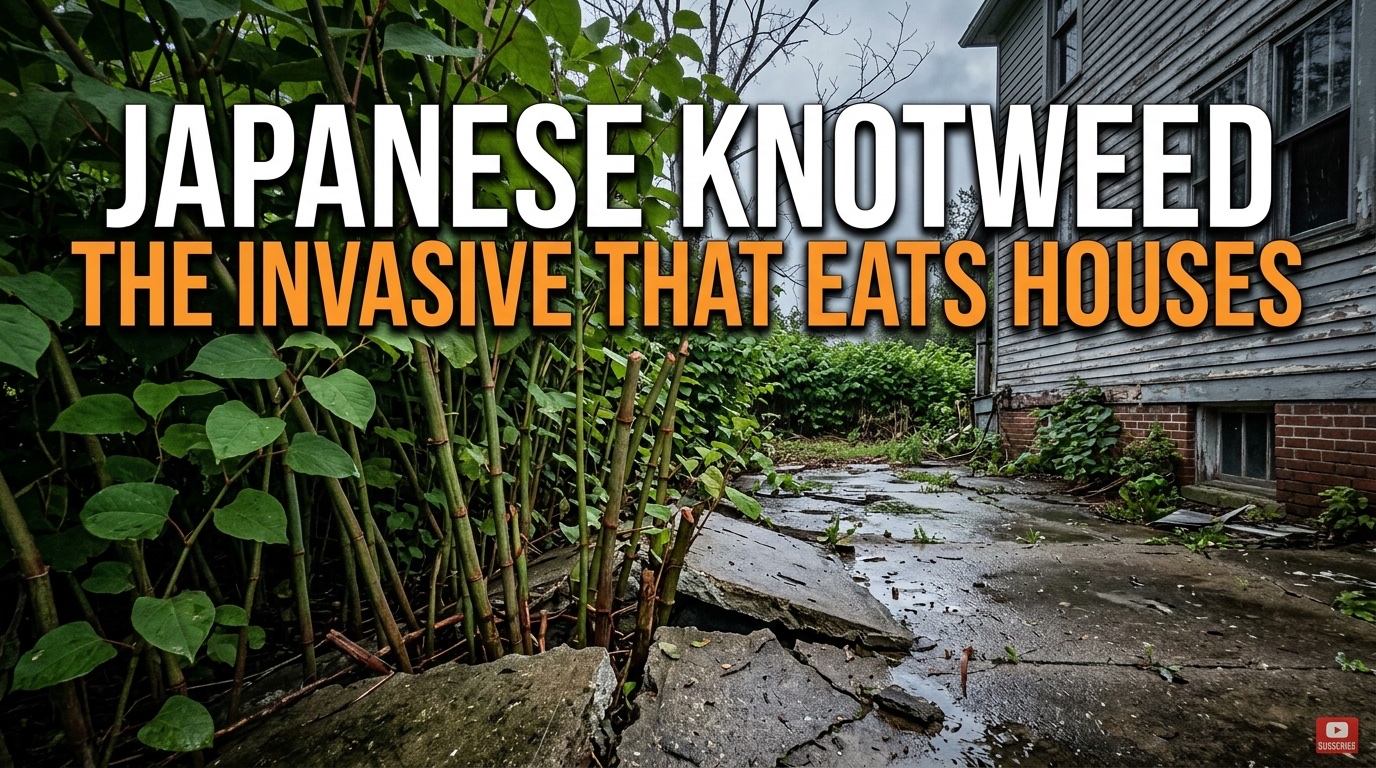
What Is Japanese Knotweed and Why Should Ohio Property Owners Care?
Japanese knotweed (Fallopia japonica) is a perennial plant from East Asia that was brought to the US in the late 1800s as an ornamental garden plant. That was a mistake. It's now classified as one of the world's 100 worst invasive species by the International Union for Conservation of Nature, and it grows in every county in Ohio.
The plant looks harmless enough at first. Green bamboo-like canes, heart-shaped leaves, pretty white flower clusters in late summer. But underground is where the real problem lives. Japanese knotweed has a rhizome (root) system that can extend 10 feet deep and spread 20 feet in every direction from the visible plant. Those rhizomes grow with enough force to crack foundation walls, push through asphalt, and break apart retaining walls.
In the UK, having knotweed within 7 meters of a building can make a property unmortgageable. Lenders just won't touch it. The US hasn't caught up to that level of regulatory concern yet, but the structural damage is the same on this side of the Atlantic.
For Cincinnati-area property owners, knotweed is a growing problem along the Little Miami River corridor, throughout Hamilton County's urban creek banks, and in older neighborhoods where it was originally planted as a garden ornamental decades ago. We're seeing more of it every year in Clermont, Warren, and Butler counties too.
How to Identify Japanese Knotweed in Ohio
Knotweed changes appearance dramatically with the seasons. Knowing what it looks like in each stage prevents you from missing it.
Spring (March through May)
Red or purple asparagus-like shoots push up from the ground in early spring. They grow fast. We're talking 3 to 4 inches per day in warm weather. By late May, canes are already 6 to 8 feet tall. The shoots are the easiest stage to identify because nothing else in Ohio looks like red bamboo shoots erupting from the soil in March.
Summer (June through August)
Full-grown canes reach 10 to 13 feet tall with a distinct bamboo-like appearance. Hollow green stems with visible nodes (joints). Leaves are large, 4 to 6 inches wide, shaped like a flat-bottomed heart or shield with a pointed tip. The leaf base is cut straight across, which is the key feature that separates it from similar plants. Creamy white flower clusters appear in August and September at the leaf joints near the top of the plant.
Fall and Winter
Leaves yellow and drop in October. The canes die back to brown, woody stalks that stay standing through winter. Dead knotweed canes are hollow and snap easily. They look like dried bamboo. The dried flower clusters sometimes persist through early winter. The dead canes are a useful winter ID feature because they mark where the rhizomes are underground and where new growth will appear in spring.
Plants That Look Similar
Giant knotweed (Fallopia sachalinensis) is a close relative with larger, more rounded leaves up to 12 inches wide. It's also invasive and treated the same way. Himalayan knotweed has narrower lance-shaped leaves. Bamboo has evergreen leaves and doesn't die back in winter. Pokeweed has similar height but has purple stems, large berries, and alternate leaf arrangement.
If you're not sure, snap a photo and contact your county's OSU Extension office. Hamilton County's office in Cincinnati and Clermont County's office in Owensville both handle plant ID questions regularly.
Why Japanese Knotweed Is So Hard to Kill
Most invasive plants are annoying. Knotweed is in a different category. Here's why it beats almost every removal attempt.
The Root System Is Massive
A single knotweed plant can have a rhizome network weighing several tons. Rhizomes extend 6 to 10 feet deep in typical Ohio clay soils and spread 15 to 20 feet laterally. Even small root fragments, pieces as small as half an inch, can grow into new plants. Every time you dig, rototill, or disturb the soil, you're potentially creating dozens of new knotweed plants from broken root pieces.
It Grows Insanely Fast
During peak growing season (May through July), knotweed canes grow 3 to 4 inches per day. Cut it down on Monday and it's knee-high again by Friday. This growth rate exhausts property owners who try to keep it mowed. You'd need to cut it every single week for multiple growing seasons to even start weakening the root system through energy depletion.
It Spreads Without Seeds
In North America, most Japanese knotweed spreads vegetatively, not through seeds. Root fragments get moved by flooding, soil disturbance, contaminated fill dirt, and construction equipment. A single piece of rhizome carried downstream during a spring flood can establish a new colony. This is why knotweed is so common along Ohio's rivers and creeks. The Little Miami, Great Miami, and Scioto river corridors are all heavily infested.
It Damages Structures
Knotweed rhizomes exploit any weakness in hardscape. Cracks in foundations, gaps in retaining walls, joints in concrete driveways, seams in drainage pipes. The rhizomes don't drill through solid concrete, but they find existing weak points and widen them with sustained pressure. We've seen knotweed push through 2-inch cracks in poured concrete foundations in Anderson Township and split apart block retaining walls in Milford. If you have knotweed within 15 feet of a structure, the structural risk is real.
Got Japanese knotweed threatening your property? Get an instant estimate for professional clearing.
Get Instant PricingDIY Japanese Knotweed Removal: What Works and What Doesn't
Let's be straight: DIY knotweed removal is possible for small patches, but it takes years of consistent effort. Most people give up after one season. If you're going to try it yourself, go in with realistic expectations.
Repeated Cutting (Slow but Free)
Cut the canes to ground level every 7 to 10 days throughout the growing season (May through October). Bag and trash all cut material. Don't compost it. Don't leave cuttings on the ground. Every piece of stem that touches moist soil can root.
This works by starving the root system. The plant uses stored energy to push new shoots, and if you keep cutting before the leaves can photosynthesize and replenish that energy, the roots gradually weaken. The problem is "gradually" means 3 to 5 years of cutting every single week during the growing season. Miss a few weeks and the plant recovers most of its lost energy.
Herbicide Treatment (Most Effective DIY Option)
Glyphosate-based herbicides (Roundup Pro, Rodeo for near water) applied in late August through October give the best results. This timing matters. In late summer and fall, the plant moves sugars down to the roots for winter storage, and the herbicide travels with them deep into the rhizome system.
Two application methods work best:
Stem injection: Cut each cane and inject glyphosate concentrate directly into the hollow stem. This delivers the chemical straight to the root system with zero drift to surrounding plants. It's labor-intensive but precise. You can buy stem injector tools online for $30 to $50.
Foliar spray: Spray a 2 to 3% glyphosate solution on the leaves in September. The leaves absorb the chemical and transport it to the roots. This is faster than injection but affects any plants the spray contacts. Best for large stands where you don't care about surrounding vegetation.
Expect to repeat herbicide treatment for a minimum of 3 years. Monitor for regrowth for at least 2 years after the last visible cane dies.
What Doesn't Work
Digging it out: Unless you can excavate 10 feet deep and 20 feet wide around every cane, you'll leave root fragments that regrow. Most homeowners dig out the visible roots in the top 2 feet of soil and declare victory, then watch new shoots pop up from the deeper rhizomes within weeks. Professional excavation with disposal can work but costs $10,000 or more for even a small patch.
Covering with tarps or landscape fabric: Knotweed pushes through standard landscape fabric like it's not there. Heavy-duty root barrier membranes (40-mil HDPE) can contain it, but the plant just grows sideways until it finds the edge. Tarping works better than fabric, but you need to leave it in place for at least 3 to 5 years, the tarp will degrade before then unless you use commercial-grade material, and any gap or tear becomes an exit point.
Vinegar, salt, or boiling water: Burns the leaves temporarily. Does nothing to the root system 6 feet underground. The plant regrows within weeks.
Mowing once in a while: Occasional mowing actually makes knotweed spread faster by scattering stem fragments across your lawn. If you're going to mow, it needs to be weekly and you need to collect all clippings. But even then, mowing alone won't reach the root system.
Professional Japanese Knotweed Removal in Cincinnati
Professional treatment combines mechanical clearing with systematic herbicide programs. The goal is to knock back the above-ground growth quickly, then attack the root system over multiple seasons.
Forestry Mulching + Herbicide Program
A forestry mulching head on a skid steer grinds the above-ground canes into mulch in a single pass. This is the fastest way to clear a large knotweed stand. We can take a 10-foot-tall wall of knotweed down to ground level in hours, not days.
Mulching alone won't kill knotweed. The roots are too deep. But it removes the canopy and forces the plant to use stored energy to push new growth. When that regrowth reaches 3 to 4 feet tall (usually 4 to 6 weeks after mulching), we apply targeted herbicide to the fresh leaves. Young regrowth absorbs herbicide much more effectively than the original mature canes with their thick waxy leaf coating.
The best timing: mulch in June or July, let regrowth come back, then hit it with glyphosate or imazapyr in September. Follow up with a second application the next September. By year three, most infestations are down to scattered shoots that can be spot-treated.
Stem Injection Programs
For knotweed growing near water, wetlands, or sensitive areas where broadcast spraying isn't an option, stem injection is the go-to method. Each cane gets cut and injected individually with concentrated glyphosate. It takes more labor but keeps the chemical out of waterways and non-target plants.
This matters in the Cincinnati area because so much knotweed grows along creek banks and river corridors. Properties along the Little Miami River, East Fork, and Indian Creek often need injection treatment to comply with Ohio EPA buffer zone requirements.
Excavation and Disposal
For situations where knotweed threatens a foundation or where construction requires complete removal, excavation is the nuclear option. This means digging out all soil containing rhizomes to a depth of 8 to 10 feet and hauling it to a landfill that accepts invasive plant material. It's expensive, disruptive, and usually only makes sense for commercial development sites where the timeline doesn't allow for a multi-year herbicide program. For residential properties, the mulch-and-treat approach costs a fraction of excavation and gets the same result over 2 to 3 years.
Japanese Knotweed Removal Costs in Ohio
Costs depend on the size of the infestation, proximity to structures or water, and how many years of follow-up treatment are needed.
Small Patches (Under 500 Square Feet)
Initial clearing and first-year herbicide treatment costs $500 to $1,500. Follow-up treatment in years two and three adds $300 to $800 per year. Total cost over a 3-year program: $1,100 to $3,100. This covers typical residential patches in backyards, along fence lines, or near garden beds in suburban Cincinnati neighborhoods.
Medium Infestations (Quarter to Half Acre)
Mechanical clearing plus a full season of follow-up herbicide treatments runs $2,000 to $5,000 for year one. Subsequent years add $800 to $2,000 annually. Common on larger residential properties and rural parcels in Clermont County, Warren County, and along creek corridors throughout the Tri-State area.
Large Stands (Half Acre or More)
Full forestry mulching plus multi-year herbicide management costs $5,000 to $15,000 or more for the initial clearing and first year. Large infestations on commercial properties, along road right-of-ways, and on undeveloped parcels fall in this range. Properties with steep terrain or limited equipment access run higher.
Full Excavation
$10,000 to $50,000 or more depending on depth and volume of contaminated soil. Only used when complete removal is required immediately, typically for commercial construction or properties where the knotweed is actively damaging a building foundation. Not cost-effective for most residential situations.
Ready to deal with your knotweed problem? Contact Brushworks for a free property assessment.
Get a Free QuoteWhere Japanese Knotweed Grows in the Cincinnati Area
Knotweed follows water and disturbed ground. Knowing the hot spots helps you catch it early on your own property.
River and Creek Banks
The most common location by far. Knotweed lines creek banks throughout the Cincinnati metro area. The Little Miami River valley from Milford through Loveland and up to South Lebanon has heavy infestations. East Fork of the Little Miami, Indian Creek, and the Mill Creek corridor through northern Hamilton County are all problem areas. Flooding carries root fragments downstream, establishing new colonies every spring.
Road Shoulders and Right-of-Ways
ODOT mowing crews spread knotweed along state routes by running mowers through established stands and carrying stem fragments to the next patch of bare soil. Routes 32, 50, and 28 through Clermont County all have knotweed along the shoulders. It also grows along railroad corridors, which is how it spread across Ohio in the first place.
Older Residential Properties
Japanese knotweed was sold in nurseries as a garden plant through the 1960s. Properties in older Cincinnati neighborhoods like Clifton, Hyde Park, Mt. Lookout, and Mariemont sometimes have established patches that were intentionally planted 50 or 60 years ago. By now they've spread well beyond the original planting site.
Construction Sites and Fill Areas
Contaminated fill dirt is a major knotweed vector. A developer brings in fill from a site with knotweed, and the rhizome fragments in the dirt establish new colonies. We've seen this happen on new residential developments in Liberty Township and West Chester where the fill material came from a knotweed-infested site. If you're buying a new-construction home on filled ground, check for knotweed shoots in the first two springs after construction.
Japanese Knotweed and Property Values in Ohio
Ohio doesn't have knotweed-specific property disclosure laws like the UK does. But that doesn't mean it won't affect your home sale.
Informed buyers and their inspectors increasingly recognize knotweed. If a home inspector flags it, expect buyers to either demand treatment as a condition of sale or reduce their offer by the cost of professional removal. On a typical residential property, that's $3,000 to $10,000 off the sale price.
Ohio's property disclosure form requires sellers to disclose known "material defects" that affect the property's value or desirability. An established knotweed infestation that's damaging structures or threatening to spread to neighboring properties arguably falls under that requirement. Getting ahead of it with documented treatment is better than dealing with it during a sale negotiation.
The real cost isn't the treatment itself. It's the structural damage if you ignore it. Foundation repairs caused by knotweed damage can run $10,000 to $50,000 depending on the severity. Compared to that, a $3,000 to $5,000 multi-year treatment program is cheap insurance.
Preventing Knotweed from Coming Back
Knotweed treatment isn't a one-and-done job. Even after the visible plants are gone, the rhizome system can hold dormant buds for years. Prevention means ongoing vigilance.
Monitor for 5 Years After Treatment
Walk the treated area monthly during the growing season for at least 5 years after the last visible shoot. New growth from deep rhizome fragments can appear years after you think the problem is solved. Catching and treating a single new shoot is easy. Letting it grow for a full season means you're back to square one.
Establish Competing Vegetation
Dense ground cover makes it harder for knotweed shoots to establish. After treatment, seed the area with an aggressive grass mix or plant native shrubs that will shade the ground. In riparian areas along creeks, native species like silky dogwood, elderberry, and Joe-Pye weed establish well and provide competition.
Control the Source
If knotweed is growing on neighboring property or along a creek upstream from your land, treating your patch without addressing the source means reinfection. Talk to your neighbors. Contact your local soil and water conservation district. Hamilton County SWCD and Clermont County SWCD both have resources for coordinated knotweed control efforts.
Watch Fill Dirt and Landscaping Materials
If you're bringing in fill dirt, topsoil, or mulch, ask the supplier where it came from and whether the source site had knotweed. This sounds paranoid, but contaminated fill is one of the top ways knotweed shows up on properties that never had it before.
Legal Considerations for Knotweed in Ohio
Ohio does not currently have a state law requiring property owners to remove Japanese knotweed. But that doesn't mean you're off the hook.
Neighbor liability: If knotweed on your property spreads to a neighbor's property and causes damage, such as cracking their foundation or damaging their retaining wall, you could face a civil claim. Ohio courts haven't set clear precedent on knotweed specifically, but general nuisance law applies. If you know the plant is there and take no action while it damages someone else's property, you're exposed.
Property disclosure: Sellers in Ohio must disclose known material defects on the residential property disclosure form. A documented knotweed infestation that affects structural integrity or property usability could be considered a material defect. Not disclosing it opens you up to post-sale legal action from the buyer.
Municipal codes: Some Ohio municipalities have nuisance vegetation ordinances that can apply to knotweed. Check with your local code enforcement office if you're unsure about local requirements.
Frequently Asked Questions
How do I get rid of Japanese knotweed in Ohio?
The best approach combines cutting or mulching the canes with targeted herbicide on the regrowth. Cut in mid-summer, then spray glyphosate or imazapyr on the fresh regrowth in late August through October. Plan for at least 3 years of treatment. Digging out the roots rarely works because the rhizome system can go 10 feet deep.
How much does professional Japanese knotweed removal cost in Ohio?
Small patches cost $500 to $1,500 for initial clearing and first-year treatment. Medium infestations run $2,000 to $5,000. Large stands cost $5,000 to $15,000 or more. Most properties need 2 to 3 years of follow-up treatment, adding $500 to $2,000 per year.
Can Japanese knotweed damage my house foundation?
Yes. Knotweed rhizomes exploit existing cracks and weak points in foundations, retaining walls, drainage pipes, and paved surfaces. The roots grow with enough force to widen small cracks into structural problems. If you have knotweed within 15 feet of a structure, get it assessed.
Is it illegal to have Japanese knotweed on your property in Ohio?
No Ohio state law requires removal. But you can be held liable if it spreads to a neighbor's property and causes damage. Property sellers should disclose known infestations on the residential disclosure form.
When is the best time to treat Japanese knotweed in Ohio?
Late August through October is the best window for herbicide treatment. The plant is moving energy down to its roots for winter, so herbicide gets transported deep into the rhizomes. Cut the canes in June or July, let regrowth reach 3 to 4 feet, then treat in September.
How deep do Japanese knotweed roots go?
Rhizomes typically grow 6 to 10 feet deep, with documented cases beyond 15 feet. Lateral spread can reach 20 feet or more from the visible canes. A 200-square-foot patch above ground might have a root network covering 2,000 square feet underground.