
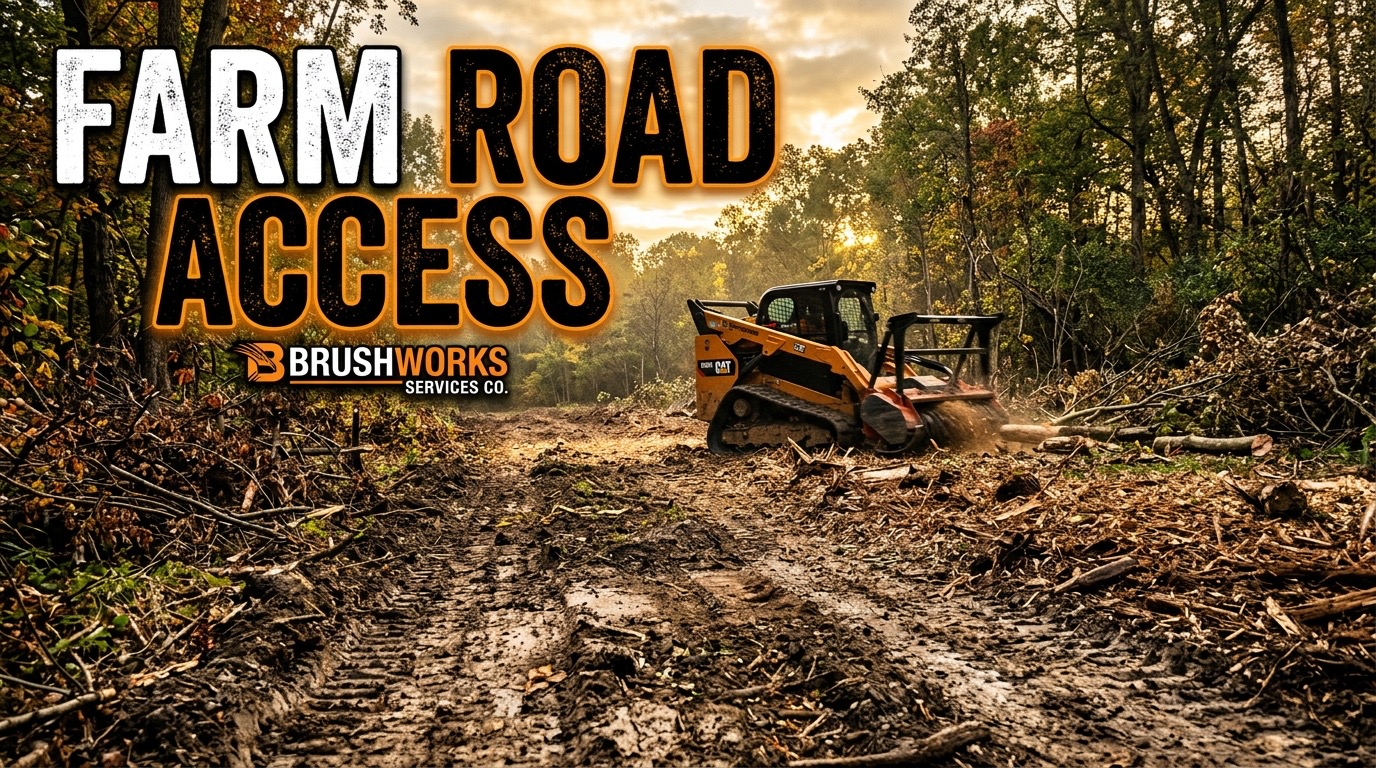
A farm road is not just a path through the brush
A good farm access road does boring work every day. It lets you get a tractor to the back field, haul hay without dragging mirrors through limbs, reach a creek crossing, check fence, move firewood, or bring a contractor to the right place without walking him through waist-high honeysuckle. When the road is right, nobody thinks about it. When it is wrong, it eats time every week.
Most problem farm roads in Ohio start the same way. There was an old lane at some point. Maybe it followed a fence row, wrapped around a field edge, or ran to a barn pad that is not there anymore. Then the property sat for a few years. Honeysuckle filled the shoulders. Locust and maple saplings came up in the center. The low spot turned into a rut. Vines pulled trees over the lane. Now the road still exists on the deed or in your memory, but you cannot drive it without scratching up a truck or burying a trailer.
Land clearing is the first step toward making that route usable again. It is not the same as building the whole road. Clearing opens the corridor, exposes the grade, finds the wet spots, and gives gravel, drainage, fencing, or excavation crews room to work. Skip that step and you end up guessing where the road should go while fighting brush with every decision.
Start with the job the road needs to do
Do not clear a farm access road until you know what has to use it. A lane for a side-by-side is different from a lane for a loaded hay wagon. A driveway to a future pole barn is different from a seasonal path to a back food plot. Width, turning radius, overhead clearance, drainage, and surface all depend on the heaviest, widest, and most awkward thing that needs to travel that route.
Around Cincinnati and southern Ohio, we see owners underestimate this all the time. They ask for a ten-foot opening, then realize the gravel truck needs room to dump. They clear a straight shot through brush, then learn a gooseneck trailer cannot make the bend. They open a path along a field edge, then find out water naturally crosses the route in three places.
Plan the road around real use
- • Pickup trucks, service trucks, and dump trucks
- • Tractors, skid steers, hay wagons, and implements
- • Livestock trailers, equipment trailers, and delivery drivers
- • Emergency access for fire, EMS, or utility crews
- • Gates, fence corners, culverts, and creek crossings
- • Turnarounds so nobody has to back a trailer through the woods
If the route may serve future buildings, septic work, pond maintenance, timber work, or pasture improvements, clear it for that future use now. It is cheaper to make the corridor practical the first time than to call everyone back because a truck cannot swing into the site.
Reopening an old farm lane versus cutting a new one
Old lanes are often the best place to start because they usually follow ground that worked once. The grade may already be flatter. There may be remnants of stone under the leaves. Field entrances, gates, and creek approaches may already line up. But old does not always mean good. Some lanes were built for horses, small tractors, or a different property layout. Some follow fence rows because that was convenient, not because the drainage is good.
When reopening an old lane, clearing should expose what is there before anyone commits to gravel. Mulching brush and saplings lets you see the crown, ruts, ditches, rocks, buried junk, tile outlets, and wet pockets. Once the brush is gone, the next move becomes obvious. Maybe the road only needs grading and stone. Maybe it needs a culvert. Maybe one section should be abandoned and rerouted ten yards uphill.
A new road gives you more control, but it also requires more thought. The shortest route across a farm is rarely the cheapest route after you account for slopes, wet areas, tree removal, drainage, and turns. A slightly longer route along a contour or field edge can be easier to build, easier to maintain, and less likely to wash out.
How wide should you clear?
The travel surface is only part of the road. If you want a 10-foot driving lane, you usually need more than 10 feet cleared. Brush grows inward. Limbs hang over. Ditches and soft shoulders need space. Trucks need mirrors. Trailers need room on turns. Gravel crews need room to work without scraping trees every pass.
For light UTV access, an 8 to 10-foot corridor may be enough. For pickup access, 12 feet of clear travel width is a better minimum. For farm equipment, trailers, or contractor access, clearing 16 to 20 feet often makes more sense, especially on curves and approaches. Wider does not mean you need a highway through the farm. It means the road can be used without beating up equipment or constantly trimming branches.
| Use | Practical clearing width | Watch for |
|---|---|---|
| UTV or walking access | 8 to 10 feet | Low limbs, briars, and quick regrowth |
| Pickup or small tractor | 12 to 16 feet | Mirrors, ditch edges, and wet shoulders |
| Trailers and hay equipment | 16 to 20 feet or more at turns | Swing room, gates, and turnarounds |
| Construction or gravel access | 20 feet where possible | Dump truck clearance and overhead limbs |
Overhead clearance matters too. A lane that looks fine from a pickup may still be useless for a dump truck, mini excavator, hay wagon, or equipment trailer. Trim or remove the trees that will become a problem before the first load of stone arrives.
Drainage decides whether the road lasts
Water is the part of the job you cannot ignore. Ohio farms have clay, springs, field tile, creek bottoms, rolling hills, and heavy rain. If water wants to cross the access road, it will. You can give it a culvert, ditch, water bar, broad crossing, or gravel base. Or you can let it cut ruts until the road turns into a mess.
Clearing helps because it reveals the drainage. Before brush comes down, a low spot may just look like more weeds. After clearing, you can see the dip, the wet soil, the old rut, the buried pipe, or the place where runoff leaves the field. That is when you decide whether the road needs stone, a culvert, ditch cleaning, fabric, or a small reroute.
Do not build a farm road by scraping everything flat and hoping gravel fixes it. Gravel over mud becomes expensive mud. A good access route sheds water before it gets under the driving surface. That might mean cutting back brush along the sunny side so the road dries faster. It might mean opening ditch lines. It might mean moving the road slightly upslope instead of fighting a wet draw forever.
Where forestry mulching fits in road prep
Forestry mulching is one of the cleanest ways to open a farm access road corridor. It handles honeysuckle, autumn olive, multiflora rose, grapevine, briars, saplings, and smaller trees without leaving brush piles along the lane. The material is processed where it stands and left as mulch on the ground. That gives you visibility and access without hauling every limb away.
Mulching is especially useful on old lanes, field edges, wooded approaches, and overgrown fence rows. It can open the route for surveyors, excavators, gravel crews, fencing contractors, and farm equipment. It also leaves less exposed soil than grubbing everything out with a dozer, which helps on slopes and around fields where erosion matters.
Mulching is good for
- • Opening old farm lanes
- • Clearing brushy fence rows beside a route
- • Removing saplings and invasive shrubs
- • Creating equipment access before gravel work
- • Improving visibility around gates and turns
It does not replace
- • Culverts and drainage correction
- • Grading, crowning, or ditch work
- • Gravel, geotextile fabric, or base stone
- • Large stump removal where excavation is needed
- • Engineering for heavy commercial access
That distinction matters. Clearing makes the road possible. Road building makes it durable. If you need both, the right order is usually clear first, inspect the route, then grade and stone with full visibility.
Watch the entrances, gates, and turns
Most farm road headaches happen at tight spots. The field entrance is too narrow. The gate is set at a bad angle. The turn around the barn is pinched by trees. The trailer makes the first bend but drops a tire in the ditch on the second. These are small problems until you are blocking traffic with a loaded trailer.
When clearing, give extra room at entrances and turns. Cut back brush far enough that drivers can see both ways. Open the inside and outside of curves where trailers track differently than trucks. Leave room to swing wide at gates. If a gate needs moved, widened, or reset, it is better to learn that during clearing than after stone is down.
Turnarounds are worth planning. A simple bulb, hammerhead, or widened pad near the end of the lane can save a lot of frustration. If contractors, delivery drivers, or emergency crews may use the road, do not assume they will enjoy backing half a mile through trees. They will not.
Trees to keep, trees to remove
Not every tree beside a farm road needs to go. Some give shade, protect a bank, mark a boundary, or simply look good. The trees to remove are the ones that narrow the road, lean over the travel path, drop limbs, interfere with drainage, grow in the roadbed, or sit where equipment needs to turn.
Locust, boxelder, silver maple, honeysuckle, autumn olive, and grapevine often cause trouble along old lanes in southwest Ohio. Thorn trees scratch trucks and snag clothing. Vines pull limbs down into the lane. Honeysuckle blocks sight lines and keeps the road wet by trapping shade and leaves. Dead ash trees deserve special attention because emerald ash borer has left a lot of brittle standing timber across Ohio.
Large tree removal is a separate decision from brush clearing. If the tree is big enough to leave a stump, affect grade, or threaten a fence, building, or power line, plan it instead of treating it like another shrub. A farm road is supposed to make access easier, not create a stump field that catches every blade, tire, and implement.
Cost factors for clearing farm access roads in Ohio
Access road clearing is usually priced by the job because the variables matter more than the distance on a map. A straight 400-foot lane through light honeysuckle is different from a 400-foot route with creek crossings, steep side slope, dead trees, hidden fence, and wet clay. The work may be simple clearing, or it may be the first phase of a bigger road build.
The biggest cost factors are length, width, brush density, tree size, slope, wet ground, overhead trimming, debris handling, and whether the route is easy to reach with equipment. If the lane needs gravel, culverts, grading, or ditch work afterward, those are separate costs. Clearing first often saves money on the rest because everyone can see what they are working with.
Need a farm road opened up?
Send the address, where the road should start and end, and what equipment needs to use it. We can help you decide how wide to clear, where drainage may be an issue, and what should happen before gravel goes down.
What to mark before the crew arrives
A little marking saves a lot of confusion. Flag the start and end of the road, preferred route, trees to save, wet crossings, culverts, buried utilities, septic areas, fence corners, property lines, and any old tile outlets you know about. If there is a neighbor line nearby, get that settled before clearing. A mulcher can make a lot of progress in a day, including progress you did not mean to make.
Photos help too. If you are sending a quote request, take pictures from the entrance, the middle of the route, the worst brush, the wettest spot, and the destination. Satellite pins are useful, but ground photos tell the real story. They show slope, density, access, and whether the job is mostly brush or actual trees.
If you are planning future gravel or construction access, tell the clearing crew. They may widen certain areas, open a staging spot, remove overhead limbs, or clear a better route for dump trucks. The more the crew knows about the next step, the less likely you are to pay twice.
How Brushworks approaches farm access road clearing
Brushworks clears overgrown farm lanes, field roads, equipment access routes, fence rows, and wooded corridors across Greater Cincinnati and southern Ohio. We look at more than the brush in front of the machine. We look at how the road will be used, where water is moving, how wide the route needs to be, what trees should stay, and where contractors or farm equipment will need room.
Sometimes the right answer is reopening the old lane. Sometimes it is cutting a cleaner route that avoids a wet spot. Sometimes it is clearing the corridor now and letting an excavator or gravel contractor handle the roadbed once the site is open. The goal is simple: make the property easier to use without creating a maintenance problem you have to fight every season.
If you have a road that used to be there, or a route you need across a farm, start with clearing. Once the brush is gone, the rest of the plan gets a lot clearer.
Frequently asked questions
How wide should a farm access road be in Ohio?
Most farm access roads need at least 10 to 12 feet of clear travel width, with more room on curves, gates, ditches, turnarounds, and anywhere trailers or service trucks need to pass. Clearing 16 to 20 feet often makes sense before gravel work because limbs, brush, and soft shoulders shrink the usable road fast.
Can forestry mulching clear a farm road route?
Yes. Forestry mulching is a good fit for opening old lanes, cutting through brush, removing honeysuckle and saplings, and clearing shoulders before road construction. It does not replace grading, stone, culverts, or drainage work, but it gives the excavator or gravel contractor a clean corridor to work in.
Do I need gravel right after clearing an access road?
Not always. If the road is only for light seasonal use and the ground is firm, clearing and mowing may be enough for a while. If you plan to run trucks, trailers, hay equipment, or heavy machinery, gravel and drainage are usually worth doing before the route gets rutted.
What is the best time to clear a farm access road in Ohio?
Late fall, winter, and dry summer windows are often best. Leaves are down in winter, visibility is better, and frozen or dry ground protects fields from rutting. Spring can work, but Ohio clay and wet low spots can make road work messy.
What should be cleared before installing culverts or gravel?
Clear the road corridor, shoulders, ditch lines, turnaround areas, gate approaches, and enough overhead room for dump trucks and equipment. Mark wet crossings, utilities, property lines, tile outlets, and trees that should stay before the crew starts cutting.
Related articles
Ready to open the road?
Send us the route, a few photos, and what needs to drive it. We will help you clear a practical farm access road that works after the first rain.