
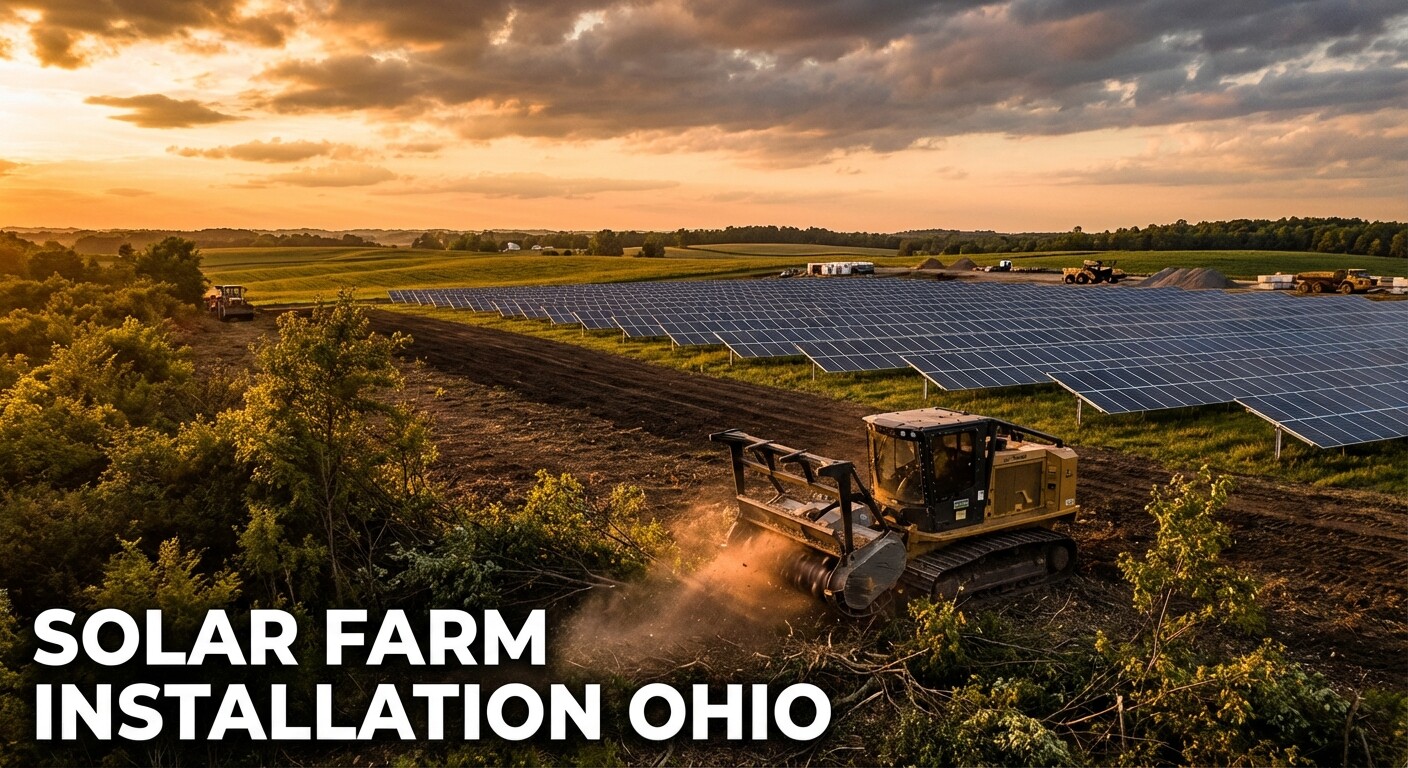
Ohio's Solar Boom: What's Driving Demand
Ohio has emerged as a surprising leader in solar development. The state's relatively flat terrain, available agricultural land, and proximity to major population centers make it attractive for solar developers. Add in supportive policy frameworks and competitive electricity markets, and you've got a recipe for rapid growth.
Ohio Solar by the Numbers
- • 1,200+ MW of utility-scale solar in development pipeline
- • 100+ proposed solar projects across 40+ counties
- • Average project size: 75-300 MW (500-2,000+ acres)
- • Investment: $1+ billion in solar construction annually
- • Timeline: Most projects need site prep completed within 6-12 months
The majority of Ohio solar development is happening in rural agricultural areas—former cropland, pastures, and mixed-use properties. These sites often require significant vegetation management before construction can begin.
Utility-Scale Solar (50+ MW)
- → 500-3,000+ acres per project
- → OPSB certification required
- → Multi-year development timeline
- → Major EPC contractors involved
- → Extensive environmental review
Community Solar (2-20 MW)
- → 15-150 acres per project
- → County zoning approval
- → Faster development cycle
- → Regional contractors
- → Streamlined permitting
What Solar Farm Site Prep Actually Involves
Solar farm land clearing goes well beyond just removing trees. It's a multi-phase process that prepares the site for construction while meeting strict environmental and engineering requirements.
Phase 1: Site Assessment & Planning
Before any equipment touches the ground, the site needs thorough evaluation:
- • Vegetation inventory: Tree species, sizes, densities, and locations
- • Wetland delineation: Identify and flag protected areas
- • Topographic survey: Understand grades and drainage patterns
- • Access evaluation: Equipment ingress/egress routes
- • Utilities: Locate underground lines and overhead hazards
- • Environmental constraints: Endangered species, cultural resources
Phase 2: Vegetation Removal
The core clearing work includes:
- • Brush and understory clearing: Removing all vegetation within panel areas
- • Tree removal: Felling, processing, or mulching standing timber
- • Stump treatment: Grinding, removal, or herbicide application
- • Debris management: On-site processing or removal
- • Buffer zones: Maintaining setbacks around wetlands, property lines
Phase 3: Site Stabilization
After clearing, the site needs preparation for construction:
- • Erosion control: Silt fencing, mulch berms, sediment basins
- • Access roads: Temporary construction roads for equipment
- • Staging areas: Clear zones for material storage
- • Drainage management: Temporary ditching and culverts
- • Seeding: Temporary or permanent cover crop establishment
Why Forestry Mulching Works for Solar Sites
Traditional clearing methods—bulldozing, excavation, and hauling—work, but they're often not the most efficient or cost-effective approach for solar farm sites. Forestry mulching offers significant advantages.
Traditional Clearing
- ✗ Disturbs soil structure
- ✗ Creates erosion issues
- ✗ Requires extensive hauling
- ✗ Higher disposal costs
- ✗ More grading needed later
- ✗ Longer site stabilization
Forestry Mulching
- ✓ Preserves soil structure
- ✓ Mulch prevents erosion
- ✓ Single-pass operation
- ✓ No hauling costs
- ✓ Minimal grading required
- ✓ Immediate stabilization
The Mulch Advantage for Solar
When forestry mulching equipment processes vegetation, it creates a layer of organic material that:
- • Prevents erosion during the gap between clearing and panel installation
- • Suppresses weed growth that could interfere with construction
- • Improves soil biology as it decomposes
- • Reduces stormwater runoff by increasing infiltration
- • Eliminates disposal logistics for thousands of tons of debris
For a 500-acre solar site, the disposal cost savings alone can exceed $100,000.
When Mulching Works Best
Forestry mulching is ideal for solar sites that are:
- • Former agricultural land with brush encroachment
- • Sites with trees under 12-14" diameter
- • Properties where soil preservation matters
- • Projects with tight timelines
- • Sites requiring ongoing vegetation management
For sites with large timber or where complete removal is required (e.g., for grading), combination approaches work best.
Solar Farm Clearing Costs in Ohio
Land clearing is typically 5-15% of total solar project development costs, but it's often where delays occur. Understanding realistic pricing helps with project budgeting and contractor selection.
| Site Condition | Cost Per Acre | Timeline |
|---|---|---|
| Open farmland (minimal brush) | $500 - $1,500 | 1-2 acres/day |
| Light brush / field edges | $1,500 - $2,500 | 0.75-1.5 acres/day |
| Moderate brush / small trees | $2,500 - $4,000 | 0.5-1 acre/day |
| Heavy brush / mixed forest | $3,500 - $5,500 | 0.25-0.5 acres/day |
| Mature timber (requires logging) | $4,500 - $8,000+ | Variable |
Volume Pricing for Large Projects
Solar farm scale creates significant cost efficiencies:
- • 50-100 acres: 10-15% volume discount
- • 100-250 acres: 15-20% volume discount
- • 250+ acres: 20-25% volume discount
For a 200-acre project at $3,000/acre base rate, volume pricing could save $90,000-$120,000.
Factors That Affect Solar Clearing Costs
Increases Cost
- • Large diameter trees (18"+)
- • Rocky or wet soil conditions
- • Environmental restrictions
- • Remote site access
- • Accelerated timeline demands
- • Complete debris removal required
Decreases Cost
- • Former agricultural land
- • Good site access
- • Flexible scheduling
- • Mulch-in-place acceptable
- • Larger contiguous areas
- • Multiple phases (relationship)
Environmental Compliance for Solar Clearing
Solar developers face significant environmental scrutiny. Land clearing contractors must understand and comply with multiple regulatory frameworks.
⚠️ Critical Compliance Areas
- Wetlands: No disturbance within delineated wetlands without Army Corps permits. Violations can halt projects and cost millions.
- Streams & Waterways: Buffer requirements (typically 50-100') and crossing permits required.
- Endangered Species: Pre-clearing surveys may be required. Seasonal restrictions for bat habitat, bird nesting.
- Cultural Resources: Archaeological surveys required for large projects. Stop work if artifacts discovered.
- Stormwater: NPDES permits required for sites over 1 acre. Erosion control plans must be in place before clearing.
Seasonal Timing Considerations
Indiana Bat & Northern Long-Eared Bat
Tree clearing restrictions typically April 1 - September 30 in areas with documented bat presence. Clearing outside this window avoids costly surveys and mitigation.
Migratory Bird Nesting
Avoid clearing during peak nesting (April - August) when possible. If clearing is necessary, pre-clearing nest surveys may be required.
Wetland & Stream Work
Low-water conditions (late summer/early fall) often preferred for any work near waterways. Frozen ground (winter) can also reduce impacts.
Working With EPC Contractors
Solar projects typically involve multiple contractors. Land clearing contractors interface with:
- • EPC (Engineering, Procurement, Construction): Overall project management
- • Environmental Consultants: Wetland delineation, species surveys
- • Civil Engineers: Grading plans, drainage design
- • Surveyors: Property boundaries, panel layout
Clear communication and coordination prevents costly conflicts and delays.
The Solar Farm Clearing Process: Step by Step
Here's what a typical solar farm clearing project looks like from initial contact to final acceptance.
Step 1: Project Briefing & Site Visit
Developer or EPC provides project scope, timeline, and environmental constraints. We conduct a thorough site assessment covering:
- • Vegetation density and types across the site
- • Access points and potential haul routes
- • Wetland/stream locations and required buffers
- • Soil conditions and potential challenges
- • Utility locations (underground and overhead)
Step 2: Proposal & Contracting
Detailed proposal includes:
- • Phased pricing by vegetation type/area
- • Mobilization and demobilization costs
- • Projected timeline and crew requirements
- • Environmental compliance responsibilities
- • Insurance certificates and safety documentation
Step 3: Pre-Clearing Preparation
Before equipment arrives:
- • Environmental consultant flags wetlands, streams, tree protection zones
- • Surveyor marks property boundaries and clearing limits
- • Utilities are located and marked
- • Erosion control measures installed (silt fence, etc.)
- • Access roads established if needed
Step 4: Clearing Operations
The actual clearing typically proceeds in phases:
- • Start from site access points, work outward
- • Clear in sections to maintain erosion control
- • Process vegetation with mulching heads or chip/haul
- • Maintain buffers around flagged sensitive areas
- • Daily progress documentation and reporting
Step 5: Site Stabilization & Handoff
After clearing completion:
- • Final erosion control installation/repair
- • Temporary or permanent seeding as specified
- • Access road stabilization
- • Documentation and as-built reporting
- • Walk-through with EPC/developer for acceptance
Ongoing Vegetation Management for Solar Farms
Land clearing is just the beginning. Solar farms require ongoing vegetation management throughout their 25-40 year operational life.
Post-Construction Vegetation Needs
- • Panel area maintenance: Keep vegetation below panel height (typically 18-24")
- • Perimeter clearing: Maintain buffer zones and property lines
- • Access road maintenance: Keep service roads clear
- • Invasive species control: Prevent establishment of problem plants
- • Pollinator habitat: Many projects now establish native plantings
Maintenance Contract Opportunities
Solar operators increasingly seek long-term vegetation management partners:
- • Annual brush hogging: 2-4x per season under panels
- • Perimeter clearing: Annual or biannual forestry mulching
- • Emergency response: Storm damage, fire break maintenance
Multi-year maintenance contracts provide predictable revenue and build relationships for future development projects.
Service Areas for Solar Farm Clearing
While based in Greater Cincinnati, we serve solar projects throughout Ohio and surrounding states.
Southwest Ohio
- • Hamilton County
- • Butler County
- • Warren County
- • Clermont County
- • Clinton County
- • Brown County
- • Adams County
Central & Southeast Ohio
- • Madison County
- • Pickaway County
- • Fayette County
- • Highland County
- • Ross County
- • Pike County
- • Scioto County
Regional Coverage
- • Northern Kentucky
- • Southeast Indiana
- • Projects throughout Ohio
- • Multi-state deployment capable
For utility-scale projects, we can mobilize crews and equipment to locations throughout the Midwest. Contact us to discuss your specific project location.
Get Your Solar Site Cleared
Whether you're an EPC contractor, solar developer, or landowner preparing for a lease, we're ready to help with professional site preparation.
Contact Us
Call to discuss your project:
(513) 790-4150When you call, have ready:
- • Project location (county, nearest town)
- • Approximate acreage
- • Current site conditions (farmland, wooded, mixed)
- • Target timeline
- • Any known environmental constraints
Frequently Asked Questions
How much does land clearing cost for a solar farm in Ohio?
Solar farm land clearing typically costs $2,000-$5,000 per acre depending on vegetation density, terrain, and site access. Heavily wooded sites with large trees cost more. Open farmland with brush and small trees is on the lower end. Volume discounts apply for larger projects—50+ acre sites often see 15-25% cost reductions.
What's the best time of year to clear land for solar installation?
Late fall through early spring (October-March) is ideal for solar farm clearing in Ohio. Ground conditions are typically stable, environmental restrictions are minimal, and cleared sites have time to stabilize before construction. Avoid clearing during bird nesting season (April-August) if possible to minimize permitting complications.
Do I need permits to clear land for a solar farm in Ohio?
Yes, solar projects typically require multiple permits. Most Ohio solar farms need county zoning approval, OPSB certification (for projects over 50 MW), and may require wetland permits, stormwater plans, and erosion control permits. Your EPC contractor usually handles permitting, but clearing contractors should be aware of any environmental constraints.
Can forestry mulching be used for solar farm site prep?
Absolutely. Forestry mulching is often the preferred method for solar farm clearing because it's fast, cost-effective, and leaves organic material on-site to prevent erosion. Unlike bulldozing, mulching doesn't disturb the soil structure, which reduces grading requirements and stormwater issues. It's especially effective for sites converting from farmland or light brush.
How long does it take to clear land for a solar farm?
Timeline depends on site size and conditions. A 50-acre site with moderate brush typically takes 2-3 weeks to clear. A 200-acre heavily wooded site might take 6-8 weeks. With multiple crews and equipment, larger projects can be accelerated. Weather, especially wet conditions, can impact schedules significantly.
What happens to trees removed during solar farm clearing?
With forestry mulching, trees are processed into mulch on-site. This material helps with erosion control and can be incorporated into the site or redistributed. For sites requiring complete removal, timber can be sold (if merchantable), chipped for biomass, or hauled for disposal. We work with developers to determine the most cost-effective approach.
Related Articles
Commercial Land Clearing Cincinnati
Guide for businesses, developers, and large-scale projects.
Read Article →Land Clearing Permits Ohio
When permits are required and how to navigate regulations.
Read Article →