
Small Acreage Land Clearing Ohio
A few acres can feel like a whole different property once the brush, vines, and volunteer trees are brought back under control.
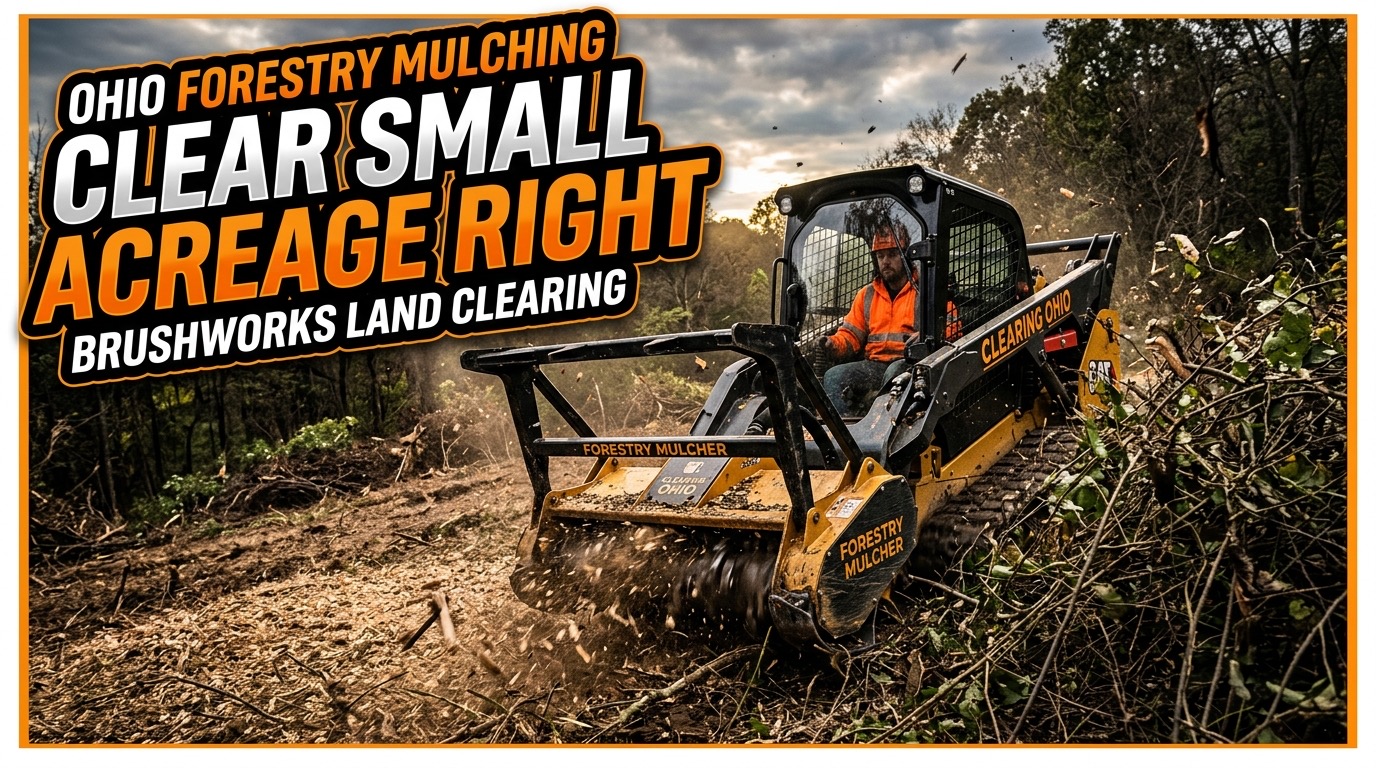
Small acreage can be harder to plan than a big clearing job. On a large tract, the work may be obvious: open a field, cut an access road, clear a building pad, or prepare a long fence line. On three, five, or ten acres, every decision feels closer to the house, driveway, neighbors, drainage, shade, and the parts of the property you still want to feel wooded.
That is why small acreage land clearing in Ohio should start with how the land will actually be used. Do you need room for a detached garage, garden, pasture, trails, firewood access, a pole barn, a wider yard, or a path to the back line? Are you trying to reclaim an old field from honeysuckle and briars? Are you preparing a rural homesite around Cincinnati, Dayton, Warren County, Clermont County, Butler County, or a nearby township?
Good clearing does not mean flattening everything. Often the best result is selective: open the entrance, clear the edges, remove invasive brush, keep the better trees, create room for maintenance, and leave the property easier to manage after the machine leaves. That takes more thought than just cutting the thickest patch first.
Brushworks works on small acreage projects throughout Greater Cincinnati and nearby Ohio communities. The goal is simple: turn ground you avoid into ground you can use, while keeping the parts of the property that still make it worth owning.
Need a few acres opened up?
Send the address, a few photos, and a simple note about what you want the land to do. Brushworks can help you clear access, trails, brush, field edges, and usable space without guessing at the scope.
Start with the problem, not the acreage
Property owners often ask what it costs to clear a certain number of acres. Acreage matters, but it is only part of the story. One acre of waist-high weeds is not the same as one acre of honeysuckle, locust saplings, grapevine, dead ash, old fence wire, dumped debris, and wet clay. A narrow trail through woods is not the same as opening a building site for equipment access.
Before pricing or planning, name the problem. Maybe you cannot get a mower to the back field. Maybe the driveway entrance is too tight for a trailer. Maybe the kids have nowhere to play because the yard edge turned into a wall of briars. Maybe you bought five wooded acres and need to see where a small barn or cabin could go.
Once the problem is clear, the clearing plan gets smaller and smarter. You may not need to clear every acre. You may need a lane, a turn-around, a work pocket, a trail loop, a fence row, or a clean edge between lawn and woods. On small acreage, targeted clearing often gives more value than opening the whole property at once.
Walk the property before you decide what stays
A good walk-through will save you from removing the wrong things. Ohio small acreage is full of mixed growth. You may have a few good oaks, maples, walnuts, hickories, or sycamores buried behind lower-value brush. You may also have invasive honeysuckle, autumn olive, multiflora rose, Bradford pear, tree of heaven, grapevine, and thorny locust stealing light from the trees worth keeping.
Walk the property with the future use in mind. Mark healthy shade trees near the house. Mark trees that frame a driveway or give privacy from the road. Mark old fence corners, wells, drain tile, culverts, utilities, septic areas, landscape stones, and any structure remains. If the property has steep spots, wet spots, or drainage swales, treat them carefully instead of cutting first and discovering the issue later.
Do this before leaves are fully out if you can. Winter and early spring make it easier to see trunks, grade changes, hidden debris, and old lanes. Summer still works, but dense growth can hide the shape of the ground. Photos from different seasons can help if you have them.
Common small acreage clearing goals
Most small acreage projects fall into a few practical categories. Some owners need access: a clearer driveway, a lane to the back of the property, a trail wide enough for a UTV, or room for a truck and trailer to turn around. Others need usable space: a yard expansion, garden area, pasture edge, detached garage site, small barn pad, firewood area, or equipment storage spot.
Some projects are about maintenance. A property may not need a new use yet, but it needs to stop getting worse. Clearing brush off fence lines, around outbuildings, along a creek edge, near a pond, or beside a driveway can make mowing and inspection possible again.
Other projects are about visibility and safety. Overgrown land can hide dead trees, holes, dumped material, old wire, poison ivy, ticks, and trip hazards. Opening the right areas makes it easier to see what you own and decide what the next step should be.
Forestry mulching works well for selective clearing
Forestry mulching is often a good tool for small acreage because it handles woody brush and small trees in place. Instead of cutting, dragging, burning, or hauling piles, the machine grinds material into mulch and leaves it on the ground. That can be useful on Ohio properties where access is tight, brush is tangled, and the owner wants a cleaner finish without tearing the whole area apart.
Mulching can help clear honeysuckle walls, briar patches, autumn olive, saplings, field edges, trail routes, wooded understory, and old fence row growth. It can create enough visibility to plan the next phase, whether that is gravel, fencing, mowing, seeding, grading, or building.
It is not the right tool for every job. Large hazardous trees may need a tree service. Final grade work may need excavation. Stumps that must be fully removed need a different process. Wet ground may need a drier window. Known utilities, old metal, woven wire, and hidden debris need to be marked or avoided. The best small-acreage projects use mulching where it fits and bring in other trades when the work moves beyond vegetation.
Clear access first
Access is usually the best first phase. If equipment, contractors, family, emergency vehicles, or maintenance crews cannot reach the work area, everything else costs more. A clear entrance, a dependable lane, and enough turn-around space can change the whole project.
For a small Ohio property, access might mean widening a brushy driveway edge, reopening an old farm lane, cutting a UTV trail, clearing low limbs for delivery trucks, or creating a path to a back corner. This work does not have to be fancy. It needs to be usable, visible, and maintainable.
Access clearing also reveals the property. Once you can drive or walk the land without fighting vines and saplings, you can make better decisions about building sites, drainage, trails, garden space, and privacy. Many owners think they need a full-acre clearing when what they really need first is a clean route through the property.
Be careful around drainage
Ohio clay does not forgive sloppy drainage work. Small acreage often has shallow swales, roadside ditches, seasonal wet spots, culverts, pond edges, creek banks, and low pockets that hold water after storms. Brush may be annoying, but it may also be holding soil on a slope or hiding a drainage path.
Clearing should make drainage easier to see and maintain, not worse. Avoid stripping steep banks bare. Do not push mulch into ditches or channels where water needs to move. Be cautious around creek edges and wetland-adjacent areas. If the goal is a building site, gravel drive, or barn pad, drainage needs to be part of the plan before clearing turns into grading.
For many properties, the first clearing pass exposes the ditch, culvert, or swale so an excavator, driveway contractor, or builder can make informed decisions. That is better than burying a drainage problem under new stone or building materials.
Keep privacy where it helps
On a small parcel, privacy can disappear fast. A few trees and shrubs may be the difference between a comfortable homesite and a clear view of the road or neighbor. That does not mean leaving invasive brush everywhere. It means thinking before you open every edge.
Sometimes the right move is to clear low invasive growth while keeping better canopy trees. Sometimes a screen of native trees should stay, but the vines and deadfall underneath should go. Sometimes the view from the house needs to open, while the view from the road should stay softened.
Mark privacy areas before work starts. If there is a road, driveway, neighboring house, barn, or future patio involved, stand in those places and look both directions. Small acreage clearing is close enough that one careless opening can change how the whole property feels.
Plan for mowing and follow-up
Clearing is not the end of small acreage maintenance. It is the reset. After sunlight reaches the ground, Ohio regrowth will try to move in. Honeysuckle can resprout. Briars can come back along edges. Locust, maple, elm, and box elder sprouts can show up quickly. Grass and weeds will respond too.
The best clearing plan leaves the property in a shape you can maintain. That may mean leaving wide enough edges for a mower, making trail turns practical, clearing around obstacles instead of trapping them in islands, and avoiding awkward strips that no one can mow or trim.
If invasive brush is heavy, mechanical clearing may need follow-up cutting, mowing, or treatment by a qualified applicator. A one-time clearing can look good for a season and still fail if no one has a plan for year two. Ask what maintenance will look like before deciding how far to clear.
Know what to mark before equipment arrives
Small acreage is where hidden items show up often. Old rural lots may contain wire fence, T-posts, concrete chunks, glass, culvert ends, drain pipe, scrap metal, buried landscape edging, abandoned wells, old foundations, dog fence wire, private electric lines, and leftover farm debris.
Mark anything known before the clearing crew arrives. Public utility locates are important before digging, trenching, post work, stump removal, or grading, but they may not identify every private line. If you know where a water line, electric feed, invisible fence, propane line, septic component, or drainage pipe runs, flag it.
Also mark the keepers. A contractor should not have to guess which trees matter to you. Use ribbon or paint for trees to save, trees to remove, trail centerlines, proposed building corners, and property limits. Clear communication protects the land and the budget.
Permits and local rules can still matter
Small acreage does not mean rule-free. Many basic vegetation clearing projects on private upland property are straightforward, but the details matter. Work near streams, wetlands, road rights-of-way, steep slopes, floodplain areas, and drainage channels can involve local, county, state, or federal rules.
If clearing is tied to a home build, barn, driveway, septic system, pond, commercial use, or major grading, check requirements early. Townships and counties around Cincinnati can have different expectations. Road authorities may care about driveway entrances, culverts, ditch flow, and sight lines. Building departments may care about erosion control once soil disturbance begins.
Vegetation clearing and earthwork are not the same thing, but they often happen near each other. If the next step after clearing is construction, bring the builder, excavator, surveyor, or county office into the conversation before the work gets too far ahead.
How to phase a small acreage project
Phasing keeps the job practical. Phase one might be access and inspection: open the entrance, clear a lane, expose the back corner, and make the site walkable. Phase two might be usable space: clear the garden, barn area, trail loop, firewood pad, or pasture edge. Phase three might be maintenance: mowing paths, invasive follow-up, seeding, gravel, fencing, or drainage work.
This approach helps with budget and decision-making. It also prevents over-clearing. Once the first phase is complete, the property will look different. You may realize that a certain tree should stay, a trail should turn, a barn should shift, or an area you planned to open is better left as a buffer.
Small acreage benefits from that patience. You are not just clearing land. You are shaping the property you will see every day.
Photos that help with an estimate
Good photos help a lot. Take pictures of the driveway entrance, the thickest brush, the ground surface, the intended clearing area, any trails or lanes, nearby structures, wet spots, fences, and trees you want to keep. Wide photos are more useful than close-ups alone because they show access and scale.
A marked screenshot from Google Maps, county GIS, or a survey can help show property boundaries and work areas. If you know the acreage but only want part of it cleared, draw the rough zone. If you want a trail, mark the start and finish. If you want a building pocket, mark the desired location and mention whether utilities, septic, or driveway changes are planned.
When you ask for a quote, explain what problem you want solved. "Clear two acres" is less useful than "open a lane to the back field, clear around the old shed, and knock back honeysuckle so we can mow the edges." The clearer the goal, the better the plan.
What Brushworks looks for on small acreage jobs
Brushworks looks at access, slope, wet ground, brush type, tree size, hidden debris risk, nearby structures, utilities, keep trees, drainage, and what the property owner wants to do after clearing. That last part matters. A clearing plan for a future garden is different from a plan for a trail loop, pasture edge, driveway, or pole barn.
We also look for ways to leave the property easier to maintain. That may mean opening a clean edge a mower can follow, leaving mulch where it helps protect soil, avoiding damage to better trees, and keeping the work focused on areas that actually improve how the land functions.
If you own a few acres in Ohio and the property feels smaller every year because brush keeps closing in, start with a practical goal. Open access. Reclaim the edges. Save the good trees. Make room for the next use. A small acreage project done well should feel less like a clear-cut and more like getting your land back.
Frequently asked questions
What counts as small acreage land clearing in Ohio?
Small acreage clearing usually means reclaiming a few acres or less for access, trails, yard expansion, pasture edges, fence lines, gardens, building sites, or usable open space. The exact size matters less than the goal and the amount of brush, saplings, vines, and small trees in the way.
Is forestry mulching a good fit for small acreage?
Forestry mulching is often a strong fit for small acreage because it can clear woody brush, invasive shrubs, saplings, and tangled understory without hauling piles of debris away. It is not a replacement for finish grading, excavation, stump grinding, gravel work, or tree removal for large hazardous trees.
How much of a small property should I clear at once?
Clear the areas that solve real access, visibility, safety, drainage, or use problems first. Many Ohio property owners get better results by clearing lanes, edges, building pockets, trails, and maintenance access before deciding whether more acreage needs to be opened.
Will cleared small acreage grow back?
Yes, Ohio brush will regrow if the property is not maintained. Honeysuckle, briars, autumn olive, locust sprouts, grapevine, and volunteer trees can come back quickly where sunlight reaches the ground. A mowing, trimming, or follow-up treatment plan helps keep the cleared area usable.
Do I need permits to clear small acreage in Ohio?
Permit needs depend on the location and scope. Clearing upland brush on private property is different from changing drainage, working near streams or wetlands, disturbing steep slopes, clearing in a road right-of-way, or preparing a building site. Check local township, county, and state requirements before major site changes.
Related articles
Overgrown Field Reclamation Ohio
How to turn brushy acres back into usable ground without losing control of the next season.
Driveway Access Clearing Ohio
What to know before opening access through wooded or overgrown Ohio property.
Best Time to Clear Land in Ohio
Seasonal timing, ground conditions, and planning notes for Ohio clearing projects.
Ready to clear the right parts of your acreage?
Use instant pricing for a starting point, or send photos and a short description of what you want the land to do.