
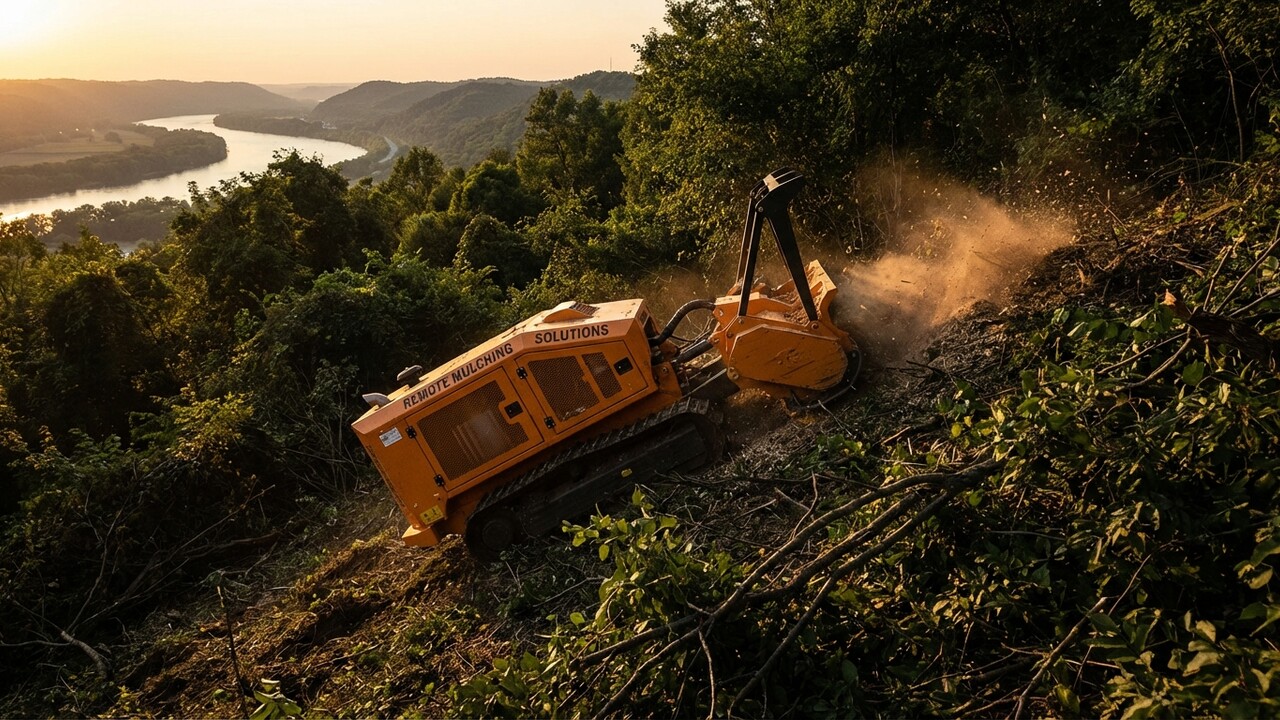
Why Cincinnati Has So Many Problem Hillsides
If you've lived in Greater Cincinnati for any time, you know the terrain. The Ohio River carved deep valleys into southern Ohio over millions of years, leaving behind dramatic elevation changes that make our region beautiful—and challenging for property owners.
Cincinnati's Terrain Challenge
The Greater Cincinnati area features:
- • 300+ feet of elevation change between river bottoms and hilltops
- • Shale and limestone bedrock that creates unstable slopes
- • Clay-heavy soils prone to sliding when disturbed
- • Steep creek banks throughout Hamilton, Clermont, Warren, and Butler counties
- • Retention pond slopes in nearly every HOA and commercial property
- • Historic landslide zones that require careful management
This terrain creates incredible hillside properties with stunning views—but it also means almost every homeowner eventually faces an overgrown slope they can't maintain. And when honeysuckle, Bradford pears, and other invasives take over, the problem compounds every year.
Common Hillside Problems
- ✗ Overgrown with invasive species
- ✗ Can't see through to neighbors/views
- ✗ Erosion eating away at yard
- ✗ Dead trees threatening to fall
- ✗ Fire hazard from dry brush
- ✗ Pest and wildlife habitat
- ✗ Property value declining
Where We See This Most
- → Mt. Adams, Price Hill, Clifton Heights
- → Anderson Township backyards
- → Indian Hill estates
- → Loveland creek properties
- → Mason/West Chester retention areas
- → Northern Kentucky hillsides
- → I-71/I-75 corridor embankments
Why Regular Contractors Can't Clear Steep Slopes
When landscapers and general land clearing companies turn down your hillside project, they're not being lazy—they're being honest about their equipment limitations and safety concerns.
The Problem with Standard Equipment
Typical land clearing equipment—skid steers, compact track loaders, and forestry mulchers on standard carriers—has serious limitations on slopes:
| Equipment Type | Safe Slope Limit | Real-World Issue |
|---|---|---|
| Skid Steer | ~15 degrees | Tips easily, no operator protection |
| Compact Track Loader | ~20-25 degrees | Better but still unstable with attachments |
| Standard Mulcher | ~20-25 degrees | High center of gravity, rollover risk |
| Excavator | ~25-30 degrees | Destroys terrain, causes erosion |
| Remote-Controlled Mulcher | Up to 55 degrees | Purpose-built for steep terrain |
The Real Danger
Equipment rollovers are one of the leading causes of death in the land clearing industry. When a 10,000+ pound machine tips over on a hillside, the operator is trapped in the cab with no escape route. This is why responsible contractors refuse jobs beyond their equipment's safe operating limits.
The solution isn't to push unsafe limits—it's to use equipment specifically designed for steep terrain.
A 30-degree slope might not look that steep when you're standing at the bottom, but put a 5-ton machine on it and physics takes over quickly. Most Cincinnati hillsides behind homes are 25-45 degrees—well beyond what standard equipment can safely handle.
The Remote-Controlled Solution for Cincinnati Hillsides
Specialized remote-controlled mulching equipment changes everything for steep terrain. These purpose-built machines operate on slopes up to 55 degrees—terrain that would be suicidal for conventional equipment.
How Remote-Controlled Mulchers Work
Design Features
- • Ultra-low center of gravity
- • Wide steel track footprint
- • No cab = no rollover injury risk
- • Wireless control from safe distance
- • Purpose-built for extreme angles
Operator Safety
- • Controller operates from flat ground
- • 360-degree visibility of work area
- • Instant stop if needed
- • No exposure to debris/dust
- • Can work inaccessible areas
What We Use: FAE RCU55
Brushworks operates an FAE RCU55 remote-controlled tracked carrier—one of only a handful in Ohio. This Italian-engineered machine is specifically designed for the slopes and terrain that defeat conventional equipment.
- • 55-degree slope rating — handles nearly any Cincinnati hillside
- • Steel tracks — minimal ground disturbance, better traction than rubber
- • High-flow mulching head — processes trees up to 8" diameter
- • Compact size — accesses tight areas standard equipment can't reach
The operator controls the machine from a safe distance using a wireless controller with joysticks. This means the expensive equipment can go into dangerous terrain while the operator stays on stable ground. If something goes wrong, there's no person in harm's way.
What Steep Hillside Clearing Costs in Cincinnati
Steep terrain clearing costs more than flat land for obvious reasons—specialized equipment, higher risk, and slower production. But the premium is often less than property owners expect, especially compared to alternatives.
| Project Type | Typical Cost | What's Included |
|---|---|---|
| Residential Hillside (1/4 acre) | $2,500 - $4,000 | Full clearing, mulch finish, no hauling |
| Residential Hillside (1/2 acre) | $4,000 - $6,500 | Medium density brush and trees |
| Large Hillside (1+ acre) | $3,500 - $6,000/acre | Volume pricing applies |
| Creek Bank Clearing | $3.00 - $6.00/linear ft | Both sides of creek, varies by density |
| Retention Pond Slopes | $3,000 - $8,000 | Typical HOA pond perimeter |
| Severe Slope (45°+) | Add 25-40% | Extreme terrain premium |
Compare to Alternatives
When evaluating cost, consider what else you might try:
- • Hand clearing with chainsaws: $8,000-$15,000+ for same area, weeks of labor, haul-off costs
- • Letting it grow: Property value decreases, erosion worsens, liability increases
- • Burning (where legal): Permit hassles, fire risk, incomplete results, ash cleanup
- • Goats: Temporary, expensive rental, doesn't remove trees, takes months
Forestry mulching completes in 1-2 days, leaves a finished mulch surface, prevents erosion, and requires no debris disposal.
Free On-Site Estimates
Every hillside is different—slope angle, vegetation type, access, and terrain all affect pricing. We provide free on-site estimates where we walk the property with you, assess the terrain, and provide an exact project price. No hourly rate surprises, no change orders.
Common Cincinnati Hillside Clearing Projects
We've cleared hundreds of steep slopes throughout Greater Cincinnati. Here are the most common scenarios we encounter:
Backyard Hillsides
The classic Cincinnati problem: your backyard ends at a steep slope that drops 50-100 feet to a creek, road, or neighbor's property. Over the years, honeysuckle and brush have taken over completely. You can't see through it, can't maintain it, and it's slowly encroaching on your usable yard.
Typical project: 1/4 to 1/2 acre, 1 day, $3,000-$5,000
HOA Retention Ponds & Common Areas
Every Cincinnati-area subdivision has them: retention ponds and common area slopes that HOAs are responsible for maintaining. These often go unmaintained for years until residents complain about appearance, wildlife, or erosion threatening stormwater infrastructure.
Typical project: Multiple pond banks + slopes, 2-5 days, $8,000-$25,000
Creek Bank Reclamation
Properties along creeks (Little Miami, Todd's Fork, Muddy Creek, etc.) often have steep, eroding banks covered in invasive vegetation. Left alone, the erosion accelerates; traditional clearing causes more erosion. Mulching is the only method that clears AND protects the bank.
Typical project: 200-1,000 linear feet, 1-2 days, $2,000-$6,000
View Restoration
Many Cincinnati hillside homes were built for their views—of the river, downtown, or the valley below. After 10-20 years of tree growth, those views are blocked. Selective clearing on steep slopes restores views without removing all vegetation.
Typical project: Strategic clearing, 4-8 hours, $2,000-$4,000
Commercial & Municipal Slopes
Highway embankments, industrial site perimeters, school properties, and municipal land often have steep slopes that need periodic clearing for safety, sightlines, and maintenance access. We work with ODOT, cities, and commercial property managers throughout the region.
Typical project: Multi-acre, 3-10 days, $15,000-$50,000+
The Hillside Clearing Process
Here's what to expect when you hire professionals for steep hillside clearing in Cincinnati:
Step 1: Site Assessment
We walk the property with you to evaluate:
- • Slope angle: How steep is the terrain? (We can handle up to 55 degrees)
- • Vegetation density: Brush only, small trees, or mature timber?
- • Access: How do we get equipment to the site?
- • Boundaries: What stays, what goes?
- • Special concerns: Erosion-prone areas, underground utilities, protected species
Step 2: Preparation
Before work begins:
- • Mark any trees or areas to be preserved
- • Identify underground utilities (we call 811)
- • Establish equipment access route
- • Set up work zone for operator and support trailer
Step 3: Clearing
The remote-controlled mulcher systematically works the slope:
- • Operator controls machine from safe position on flat ground
- • Machine works up and down (or across) the slope as terrain allows
- • All vegetation is ground into mulch on-site
- • Mulch layer left in place to prevent erosion
- • Typically completes 1/4-1/2 acre per day on steep terrain
Step 4: Finishing
When clearing is complete:
- • Final walk-through to confirm scope completed
- • Any remaining debris cleaned up
- • Access route restored
- • Mulch layer provides immediate erosion protection
What You're Left With
A clean, cleared slope covered with a 2-4 inch layer of wood chip mulch. No brush piles, no burn piles, no debris to haul. The mulch prevents erosion, retains moisture, and breaks down naturally over 1-2 years, enriching the soil. You can maintain the cleared area with a brush cutter, mower (if mild enough slope), or periodic re-mulching.
Erosion Control: Why Mulching Beats Other Methods
One of the biggest concerns with hillside clearing is erosion. Remove the vegetation, and won't the soil wash away? With forestry mulching, the opposite happens—your slope becomes MORE stable after clearing.
Traditional Clearing (Bulldozing)
- ✗ Strips topsoil completely
- ✗ Exposes bare earth to rain
- ✗ Destroys root structure
- ✗ Creates ruts and channels
- ✗ Requires seeding/stabilization
- ✗ High erosion risk for months
Forestry Mulching
- ✓ Preserves topsoil structure
- ✓ Mulch layer protects soil
- ✓ Root systems remain intact
- ✓ No ruts or channels
- ✓ Immediate protection
- ✓ Better stability than before
The Science of Mulch Erosion Control
When vegetation is mulched in place:
- • Rain impact is absorbed by mulch layer instead of hitting bare soil
- • Water infiltrates slowly rather than running off
- • Root masses remain underground, holding soil together
- • Organic matter enriches soil as mulch decomposes
- • Native seed bank germinates through mulch naturally
After mulching, you can seed the slope with native grasses or let natural succession occur. Either way, the mulch provides protection until new vegetation establishes.
Cincinnati-Area Hillside Clearing: Service Areas
We serve property owners throughout Greater Cincinnati with steep hillside clearing services. Our core service area includes:
Hamilton County
- • Cincinnati (all neighborhoods)
- • Anderson Township
- • Indian Hill
- • Symmes Township
- • Mt. Washington
- • Mt. Lookout
- • Hyde Park
- • Mariemont
Clermont County
- • Loveland
- • Milford
- • Goshen
- • Batavia
- • Miami Township
- • Union Township
- • Pierce Township
- • Williamsburg
Warren & Butler
- • Mason
- • Lebanon
- • Maineville
- • South Lebanon
- • West Chester
- • Liberty Township
- • Fairfield
- • Hamilton
We also serve parts of Northern Kentucky (Boone, Kenton, Campbell counties) and Eastern Indiana (Dearborn, Franklin counties) for larger projects. Contact us about your specific location.
Get Your Hillside Cleared
Stop letting that overgrown hillside decrease your property value, create safety hazards, and get worse every year. With specialized equipment and experienced operators, we can clear terrain that everyone else turned down.
Next Steps
- Get an instant estimate using our online calculator for rough pricing
- Schedule a free site visit so we can see the terrain and provide exact pricing
- Book your project for the next available slot (late winter/spring fills fast)
- Enjoy your cleared hillside without hauling, burning, or erosion worries
Frequently Asked Questions
How much does steep hillside clearing cost in Cincinnati?
Steep hillside clearing typically costs $3,500-$6,000 per acre in the Cincinnati area, depending on slope angle, vegetation density, and access. Steeper slopes (over 35 degrees) and heavy tree coverage increase costs. Most residential hillside projects run $2,500-$8,000 total. We provide free on-site estimates with exact pricing.
Can you clear hillsides that other companies refused?
Yes - that's our specialty. We operate specialized remote-controlled mulching equipment rated for slopes up to 55 degrees. This is terrain that conventional skid steers and track loaders cannot safely operate on. If you've been turned down by other contractors, we can likely help.
Will clearing my hillside cause erosion problems?
Our forestry mulching process actually prevents erosion. Unlike bulldozing which strips topsoil, we grind vegetation into mulch that stays in place, protecting the soil. The root systems remain intact below ground, providing additional stability. Most customers see improved drainage and reduced erosion after clearing.
How long does hillside clearing take?
Most residential hillside projects complete in 1-2 days. A typical 1/4 to 1/2 acre steep slope takes about 4-8 hours of active work. Larger or more complex terrain may require 2-3 days. We provide time estimates during your free consultation.
What happens to the brush and trees after clearing?
Everything is mulched on-site into small wood chips that remain as ground cover. There's nothing to haul away - no piles to burn, no debris to dispose of. The mulch layer prevents erosion, retains moisture, and breaks down naturally over 1-2 years, enriching your soil.
Do I need permits to clear a hillside in Ohio?
Most residential hillside clearing in Ohio doesn't require permits unless you're near protected waterways, in a historic district, or removing trees over certain sizes in some municipalities. We're familiar with local requirements in Cincinnati, Hamilton County, and surrounding areas and can advise you during your consultation.
Related Articles
FAE RCU55 Hillside Mulching
Deep dive into the specialized equipment we use for steep terrain clearing.
Read Article →Land Clearing Cost Per Acre Ohio
Complete pricing guide for all types of land clearing projects.
Read Article →Invasive Species Removal Cincinnati
How to deal with honeysuckle, Bradford pear, and other invasives on your property.
Read Article →