
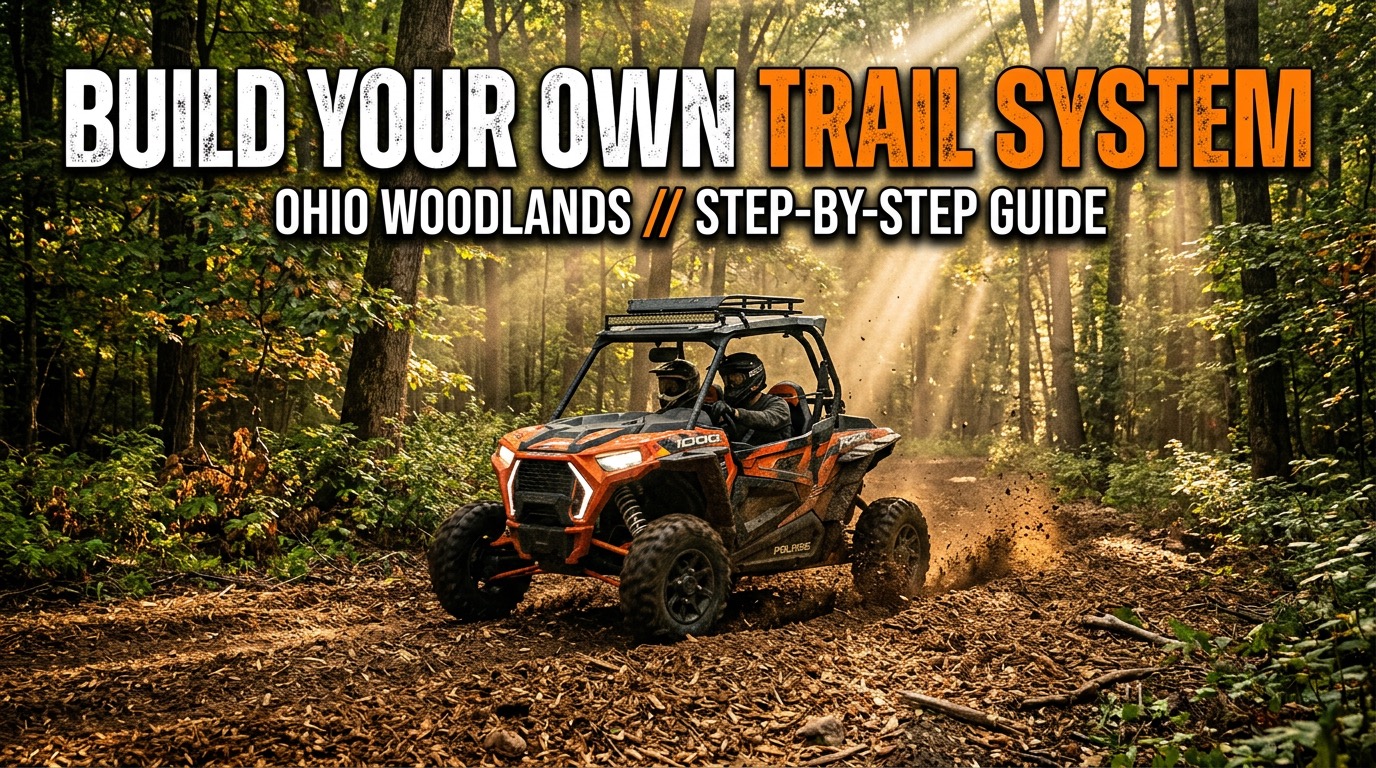
Why Forestry Mulching Is the Best Way to Cut ATV Trails
Most people picture trail building as a guy with a chainsaw dropping trees and dragging them to the side. That works for a hiking path. It does not work for off-road vehicles.
Chainsaws leave stumps. Stumps catch undercarriages, puncture tires, and turn a fun afternoon ride into an expensive repair. You can cut stumps flush, but that's slow work and you still have root systems pushing back up within a year.
Bulldozing creates trails fast, but it strips the topsoil and leaves bare dirt that turns to mud after the first rain. In Ohio, where we get 40+ inches of rain per year, bare dirt trails are mud trails within weeks.
Forestry mulching solves both problems. The mulching head grinds everything — trees, stumps, brush, roots — into wood chips right where it stands. Those chips become your trail surface. They compact under tire traffic, drain water instead of pooling it, and prevent mud from forming. No stumps to dodge. No bare dirt to erode. No hauling debris off-site.
The result is a trail that's rideable the same day it's cut, and it gets better with use as the mulch packs down.
Want to build trails on your property? Get an instant estimate based on your acreage and terrain.
Instant Pricing ToolTrail Width: ATV vs UTV vs Side-by-Side
The first decision is how wide to go. This depends on what you're riding and whether you want one-way or two-way traffic.
| Vehicle Type | Vehicle Width | One-Way Trail | Two-Way Trail |
|---|---|---|---|
| ATV (4-wheeler) | 42-48 inches | 6-8 feet | 12-14 feet |
| UTV / Side-by-Side | 60-68 inches | 8-10 feet | 14-16 feet |
| Full-Size UTV (RZR Pro, Maverick X3) | 64-72 inches | 10-12 feet | 16-18 feet |
Go wider than you think you need. Vegetation grows back from the edges, and within two years your 8-foot trail is really a 6-foot trail. Start at 10 feet for UTV trails and you won't regret it.
On corners and turns, add 2-4 extra feet of width. A UTV swings wide through turns, and tight corners at speed are how you end up wrapped around a tree.
Designing Your Trail System: Ohio Terrain Considerations
Good trail design starts with walking the property. Not on a map, not on Google Earth — on foot. You need to see the terrain, feel the grades, and spot the natural features that will shape your trail layout.
Trail Design Rules for Ohio Properties:
- Follow the contours. Trails that run across a slope (contouring) drain naturally. Trails that run straight downhill become drainage channels and wash out fast.
- Keep grades under 12%. That's roughly a 1-foot rise per 8 feet of travel. Steeper grades are rideable but they erode quickly and get dangerous when wet.
- Use switchbacks on hills. Instead of powering straight up a hillside, zigzag back and forth. Each leg should gain no more than 4-5 feet of elevation.
- Cross creeks at existing low points. Don't cut a trail to a random spot on the creek bank. Find where the bank is already low and firm, and cross there.
- Build in drainage breaks. Every 50-75 feet on any grade, angle the trail slightly to shed water off the downhill side. This is the single most important thing for trail longevity.
- Create pull-offs. On one-way trails, add a wide spot every few hundred feet so two vehicles can pass without backing up.
In the Cincinnati area, most properties have rolling terrain with a mix of ridgetops, hillsides, and creek bottoms. The best trail systems connect all three. Ride the ridge for views, drop down the hillside on switchbacks, follow the creek bottom for a flat stretch, then climb back up.
Properties in Clermont, Brown, and Adams counties often have the most dramatic terrain and the best riding opportunities. Warren and Butler counties tend to be flatter, which makes trail layout simpler but less exciting.
Trail Surface: Why Mulch Beats Everything Else
People ask us about gravel, about crushed limestone, about geotextile fabric. All of those have their place, but for most Ohio ATV trails, forestry mulch is the best starting surface. Here's the comparison:
Forestry Mulch
- ✅ Free — it's created during the clearing process
- ✅ Drains well — water filters through the chips
- ✅ Compacts naturally with use
- ✅ Prevents mud and erosion
- ✅ Breaks down slowly over 3-5 years
- ⚠️ Needs replenishment eventually
Gravel
- ✅ Lasts indefinitely
- ✅ Good for high-traffic areas
- ❌ $15-25 per ton delivered
- ❌ Needs 4-6 inches for stability
- ❌ Rough on tires at speed
- ❌ Migrates downhill on slopes
Our recommendation: start with mulch everywhere. After a season of riding, you'll know which spots need reinforcement. Those are usually creek crossings, steep climbs, and the first 50 feet of trail where vehicles accelerate. Add gravel to those spots and leave the mulch everywhere else.
This approach costs a fraction of graveling the whole system and gives you 90% of the durability.
What ATV Trail Building Costs in Ohio
Trail costs vary based on three things: how dense the vegetation is, how steep the terrain is, and how wide you want the trail.
Trail Building Cost Ranges (per mile):
- Light brush, flat terrain, 8-foot trail: $800 - $1,200
- Medium brush, rolling terrain, 10-foot trail: $1,200 - $2,000
- Heavy brush/small trees, hillside terrain, 10-foot trail: $2,000 - $3,000
- Mature trees (6"+ diameter), steep terrain, 12-foot trail: $3,000 - $4,500
Most residential trail projects in the Cincinnati area run 0.25 to 0.75 miles total. A typical property with 10-20 acres might have a half-mile loop trail that costs $1,500 to $3,000 depending on conditions.
That's a one-time cost for a trail system you'll use for years. Compare that to the cost of your UTV — most side-by-sides run $15,000 to $30,000. Spending $2,000-$3,000 on trails that let you actually enjoy the machine is a no-brainer.
Money-Saving Tip
If you're already hiring us for land clearing on other parts of your property, adding trail cutting to the same job saves on mobilization costs. We're already on-site with the equipment. Cutting trails while we're there is the most cost-effective approach.
Water Management: The Make-or-Break Factor
Water destroys trails. Period. Every failed trail system we've seen came down to one thing: water wasn't managed.
Ohio gets about 41 inches of rain per year. That water has to go somewhere. If your trail catches it and channels it, you'll have ruts 6 inches deep within one season. If your trail sheds water to the sides, it'll last for years.
Water Management Techniques for ATV Trails:
- Crown the trail: Build the center slightly higher than the edges so water runs off both sides. A 2-3 inch crown across a 10-foot trail is enough.
- Install water bars: On grades, angle a small dirt berm across the trail every 50-75 feet. The berm diverts water off the downhill side before it builds momentum.
- Grade dips: These are gentle dips in the trail surface that channel water across and off the trail. Less jarring than water bars and better for faster riding.
- Culverts at crossings: Where trails cross drainage ditches or small streams, install a culvert pipe (12-18 inch diameter is usually enough) and cover it with gravel. This keeps water flowing under the trail instead of over it.
- Outslope on contour sections: Trails that run across a hillside should tilt slightly toward the downhill side (2-3% grade). This prevents water from pooling on the uphill edge.
Get the water management right and your trail will outlast your machine. Skip it and you'll be rebuilding sections every spring.
Trail Building on Ohio Hillsides
Southwest Ohio is hill country. If you have 10+ acres around Cincinnati, you probably have at least some significant elevation changes. That's actually a good thing for trail riding — flat trails get boring fast.
But hillside trails require more thought than flat ones. Here's what works:
Switchback Design
The standard approach for climbing hills with ATV trails. Each switchback leg should be at least 50 feet long (longer is better for UTVs), and the turn at each end needs a 15-20 foot radius to accommodate a side-by-side's turning circle.
Build the outside of each turn slightly banked (higher on the outside edge). This keeps vehicles from sliding off the downhill side during turns, especially in wet conditions.
Bench Cuts
On steep hillsides, you often need to cut into the slope to create a level trail surface. The mulcher removes vegetation, and then light grading creates the bench. The uphill side has a small cut bank, the downhill side has a slight berm to keep vehicles on the trail. This is common on properties in Anderson Township, Mt. Washington, and along the Little Miami River valley.
Brushworks runs an FAE RCU55 remote-controlled mulcher that handles slopes up to 60 degrees. This means we can cut trails on hillsides that tracked or wheeled equipment can't safely access. For steep hillside properties in the Cincinnati area, this opens up trail possibilities that most contractors would turn down.
Common Trail Layouts for Ohio Properties
🔄 The Loop
The most popular layout. A single trail that starts and ends at the same point (usually near the house or barn). Loops work on any size property. A 10-acre lot can easily fit a 0.25-0.5 mile loop. A 50-acre property might have a 1-2 mile loop with spurs branching off to interesting features.
🔀 The Figure-8
Two connected loops that share a common point. This doubles your riding options without doubling the trail length. You can ride the full figure-8 or just one loop depending on how much time you have. Works well on properties with two distinct terrain types (like a hilltop and a bottom).
🌿 The Spine and Spur
One main trail (the spine) runs through the property with shorter trails (spurs) branching off to specific destinations: a hilltop overlook, a creek access point, a food plot, a pond. Good for properties where you want access to multiple features without connecting them all in a loop.
🏠 The Access Network
Less about recreation, more about utility. A network of trails that connects the house to the barn, the barn to the back 40, and provides year-round access to all parts of the property. Double-duty: useful for property management and fun to ride.
Permits and Legal Considerations in Ohio
Building trails on your own private property in Ohio is generally straightforward, but there are a few things to check:
Before You Build:
- Zoning: Most rural Ohio townships have no restrictions on private recreational trails. Some suburban townships might. A quick call to your county zoning office clears this up.
- Stream crossings: If your trail crosses a stream, you may need a permit from the Ohio EPA or Army Corps of Engineers depending on the stream's classification. Small intermittent streams are usually fine. Perennial (year-round) streams need more attention.
- Wetlands: If any part of your trail route crosses a wetland area, stop and get guidance. Wetland regulations are strict and the fines are real.
- Conservation easements: If your property has a conservation easement, read it carefully. Some easements restrict trail building or require approval from the easement holder.
- Noise: Ohio doesn't have statewide ATV noise regulations for private property, but some townships and HOAs do. Know your local rules before you build trails 50 feet from your neighbor's bedroom window.
- Liability: Ohio's Recreational User Statute (ORC 1533.18) provides some liability protection for landowners who allow recreational use of their property. If you plan to let friends or family ride your trails, understand what this does and doesn't cover.
For most residential properties in Hamilton, Clermont, Warren, and Butler counties, trail building on your own land requires no permits. But always verify with your specific jurisdiction.
Trail Maintenance: Keeping Your Trails Rideable
A well-built trail needs minimal maintenance, but it does need some. Here's the annual schedule:
Spring (March-April):
- Walk the entire trail system. Look for winter storm damage, fallen trees, washouts, and erosion.
- Clear any fallen branches or trees. A chainsaw and a UTV with a tow strap handles most of this.
- Check water bars and drainage features. Rebuild any that have been compromised by winter runoff.
- Fill ruts with mulch or gravel.
Summer (June-July):
- Mow or trim trail edges. Vegetation grows aggressively in Ohio summers and will narrow your trail by 1-2 feet per side.
- Spray or cut invasive plants along the trail edges (honeysuckle, multiflora rose).
- Check for erosion on hillside sections after heavy rain events.
Fall (October-November):
- Clear leaves from water bars and drainage features. Packed leaves block drainage and cause pooling.
- Top off any thin spots with fresh mulch or gravel before the ground freezes.
- Trim any overhanging branches that have grown during summer.
Total time investment: maybe 8-12 hours per year for a half-mile trail system. Most of it is riding the trail on your UTV with a chainsaw and some hand tools. It's maintenance, but it's the kind of maintenance that feels like recreation.
Adding Features to Your Trail System
Once the main trails are in, you can add features that make the riding experience better:
🏕️ Rest Areas
Clear a 20x30 foot area at a scenic point along the trail. Add a fire ring and a flat spot for parking a couple of machines. These become the spots where you stop, crack a drink, and enjoy the property.
🌊 Creek Access Points
If your property has a creek, build a gradual approach trail down to a flat, graveled crossing. These are fun to ride through and give your machines a natural wash station.
👀 Overlook Clearings
On ridge tops or high points, clear the brush to open up views. In Southwest Ohio's hill country, you can get surprisingly good views of the surrounding valleys. Worth the extra clearing effort.
🦌 Food Plot Access
If you hunt your property, build trails that connect to food plot locations. You'll use the UTV to haul seed, lime, and fertilizer to plots that would otherwise require a long walk with heavy loads.
Real Trail Projects Around Cincinnati
Here's what typical trail projects look like in our service area:
15 Acres in Clermont County
Rolling terrain with a mix of open field and mature hardwoods. Cut 0.6 miles of 10-foot-wide UTV trail in a loop pattern connecting the house to a ridgetop overlook and a creek bottom. Two switchback sections on the hillside. Project took one day with our Takeuchi TL12 V2 and mulching head. Owner rides it weekly and uses it for firewood hauling in winter.
8 Acres in Warren County
Mostly flat former agricultural land that had grown up in brush and small trees over 10 years. Cut 0.4 miles of 12-foot-wide trail with a large turnaround area at the back of the property. The flat terrain made this a fast job — completed in half a day. Owner uses it for both recreation and property access.
25 Acres in Brown County
Steep, heavily wooded property with 200+ feet of elevation change. Built a 1.2-mile trail system with a spine-and-spur layout. Main spine follows the ridgetop with spurs dropping down to a creek crossing and two food plot locations. Used the FAE RCU55 for the steepest sections. This was a two-day project and one of the most rewarding trail systems we've built.
Frequently Asked Questions
How wide should an ATV trail be?
A standard ATV trail needs 6-8 feet of cleared width. For UTVs and side-by-sides, go 8-12 feet depending on the model. If you want two-way traffic, 14-16 feet is the minimum.
How much does it cost to build ATV trails in Ohio?
Trail cutting with forestry mulching typically runs $800-$2,500 per mile depending on vegetation density and terrain. Most residential trail projects in the Cincinnati area are under a mile and come in between $1,500 and $4,000 for the complete system.
Do I need a permit to build ATV trails on my own property in Ohio?
For private recreational trails on your own land, Ohio doesn't require a specific permit in most cases. Check with your county zoning office if you're in a suburban township, and get guidance if your trail crosses streams or wetlands.
What's the best surface for ATV trails in Ohio?
Forestry mulch is the best starting surface. The shredded wood chips compact naturally, drain well, and prevent mud. Add gravel to high-traffic spots and steep grades after the first season of riding.
Can you build trails on steep hillsides in Ohio?
Yes, with switchbacks and proper grade management. Brushworks uses remote-controlled mulching equipment that handles slopes up to 60 degrees. Keep trail grades under 12% and install water management features on all hillside sections.
How long do mulched ATV trails last before needing maintenance?
A properly built mulched trail lasts 2-4 years before needing significant maintenance. Annual touch-ups like trimming edge regrowth and filling worn spots keep things in shape. Budget 8-12 hours per year for a half-mile system.
Ready to Build Your Trail System?
If you've got the property and the machine, all you're missing is the trails. Brushworks has built trail systems on properties across Greater Cincinnati, from 5-acre residential lots to 50+ acre recreational parcels. We know the terrain, we know the soil types, and we know how to build trails that last.
Spring is when most people start thinking about trail building, and by April our schedule fills up. If you want trails ready for summer riding, now is the time to get on the calendar.
Your side-by-side is sitting in the garage. Let's give it somewhere to go.