
Autumn Olive Removal Ohio | Invasive Shrub Clearing Cincinnati

Autumn olive (Elaeagnus umbellata) is one of Ohio's most ecologically destructive invasive species—and one of the sneakiest. With its attractive silvery leaves and edible red berries, many property owners don't realize they have a problem until autumn olive has taken over entire fields and forest edges. Unlike honeysuckle, which simply crowds out native plants, autumn olive actually changes the soil chemistry to make conditions worse for native species and better for other invasives.

At Brushworks, we specialize in invasive species removal throughout Greater Cincinnati and Ohio. Autumn olive is one of the most challenging invasives we encounter—here's what property owners need to know about identifying, understanding, and removing this aggressive shrub.

What Is Autumn Olive and Why Is It So Destructive?

Autumn olive is a large, deciduous shrub native to Asia that was introduced to the United States in the 1830s. Like many invasive species, it was brought here intentionally—the USDA and state conservation agencies promoted it aggressively from the 1940s through the 1970s for erosion control, wildlife habitat, and mine reclamation. Millions of autumn olive plants were distributed across Ohio and the eastern United States.

What makes autumn olive particularly destructive isn't just that it spreads rapidly—it's how it fundamentally alters the ecosystems it invades:

Nitrogen Fixation: Changing Soil Chemistry

Autumn olive has root nodules containing bacteria that convert atmospheric nitrogen into forms plants can use—a process called nitrogen fixation. While this sounds beneficial, it's actually a major problem in native Ohio ecosystems.

Ohio's native prairies, forests, and old fields evolved with relatively low nitrogen levels. When autumn olive adds nitrogen to the soil, it creates conditions that favor fast-growing invasive species over native plants adapted to nutrient-poor soils. It essentially terraforms the landscape to benefit itself and other invasives.

Allelopathy: Chemical Warfare

Autumn olive produces allelopathic chemicals—compounds released through leaves, roots, and decomposing plant material that inhibit the germination and growth of other plants. These chemicals suppress native plant competitors, giving autumn olive an additional advantage beyond its aggressive growth.

Prolific Seed Production and Dispersal

A single mature autumn olive can produce up to 200,000 berries per year. Birds love these berries and spread seeds across wide areas—often depositing them in fence rows, forest edges, and disturbed areas where they quickly establish. The seeds can remain viable in soil for years, creating a persistent seed bank.

The Triple Threat

The combination of nitrogen fixation, allelopathic chemicals, and massive seed production makes autumn olive uniquely destructive. It doesn't just outcompete native plants—it actively changes the environment to make native plant recovery extremely difficult even after removal. This is why early intervention and thorough removal are so important.

How to Identify Autumn Olive

Proper identification is essential before removal. Autumn olive has several distinctive characteristics that make it relatively easy to identify once you know what to look for:

Leaf Characteristics

  • Silver scales: Both sides of leaves covered with tiny silver scales (most distinctive feature)
  • Underside very silvery: Bottom of leaves notably more silver than top
  • Alternate arrangement: Leaves arranged alternately on stems
  • Elliptical shape: 2-4 inches long, smooth edges
  • Sparkle in sunlight: Silver scales create distinctive shimmer

Fruit and Flowers

  • Red berries: Small (1/4 inch), round, with silver speckles
  • Abundant clusters: Berries in dense clusters along branches
  • Fall ripening: Berries ripen September-November
  • Fragrant flowers: Small, yellow-white, tubular flowers in late spring
  • Sweet smell: Flowers have strong, sweet fragrance

Growth Form

  • Height: 10-20 feet tall at maturity
  • Spread: Can spread 20-30 feet wide
  • Form: Irregular, spreading shrub or small tree
  • Thorns: Some plants have thorns on branches
  • Bark: Gray-brown, becoming furrowed with age

Habitat Preferences

  • Sun lovers: Thrive in full sun to partial shade
  • Disturbed areas: Roadsides, fence rows, old fields
  • Forest edges: Spread from edges into interior
  • Poor soils: Tolerates very poor, dry soils
  • Mine spoils: Common on reclaimed mine land

The Silver Shimmer Test

The easiest way to identify autumn olive is to look for the characteristic silver shimmer on the leaves, especially the undersides. When the wind moves through autumn olive, the silver scales create a distinctive sparkling effect you won't see with any native Ohio shrub. This is visible from a distance, making autumn olive easy to spot once you know what to look for.

Autumn Olive vs. Russian Olive: What's the Difference?

Autumn olive is sometimes confused with its relative, Russian olive (Elaeagnus angustifolia). Both are invasive in Ohio, but they have distinct characteristics:

Autumn Olive

  • • Wider leaves (2-4 inches long)
  • • Red berries with silver speckles
  • • Usually thornless or few thorns
  • • More common in Ohio
  • • Shrub form (10-20 feet)

Russian Olive

  • • Narrow, willow-like leaves
  • • Yellow/silver berries
  • • Often thorny
  • • Less common in Ohio
  • • Tree form (up to 30+ feet)

Both species require the same removal approach—forestry mulching works effectively on either. If you're unsure which species you have, our team can help with identification during a property assessment.

The Ohio Autumn Olive Problem

Autumn olive has become one of Ohio's most widespread invasive shrubs, present in all 88 counties. The problem is particularly severe in:

  • Former agricultural land: Abandoned farms and old fields are prime autumn olive habitat
  • Reclaimed mine lands: Decades of intentional planting created massive populations in eastern Ohio
  • Highway corridors: Seeds spread by birds along roadsides
  • Forest edges: Autumn olive is steadily invading Ohio's woodland boundaries
  • Prairie remnants: Nitrogen fixation is especially damaging to native prairie species

In Greater Cincinnati and surrounding counties, autumn olive is common along fence rows, in overgrown pastures, and on properties that haven't been actively managed. It often grows alongside honeysuckle and other invasives, forming dense thickets that are nearly impossible to penetrate.

Economic Impacts

Beyond ecological damage, autumn olive creates real economic costs for Ohio landowners:

  • Lost pasture: Takes over productive grazing land
  • Reduced timber value: Prevents forest regeneration
  • Decreased property values: Overgrown properties appear neglected
  • Hunting impacts: Alters wildlife habitat (often negatively)

Autumn Olive Removal Methods

Autumn olive is notoriously difficult to control because of its aggressive root sprouting and persistent seed bank. Here's an honest assessment of different removal approaches:

METHOD #1: Forestry Mulching (Most Effective for Large Areas)

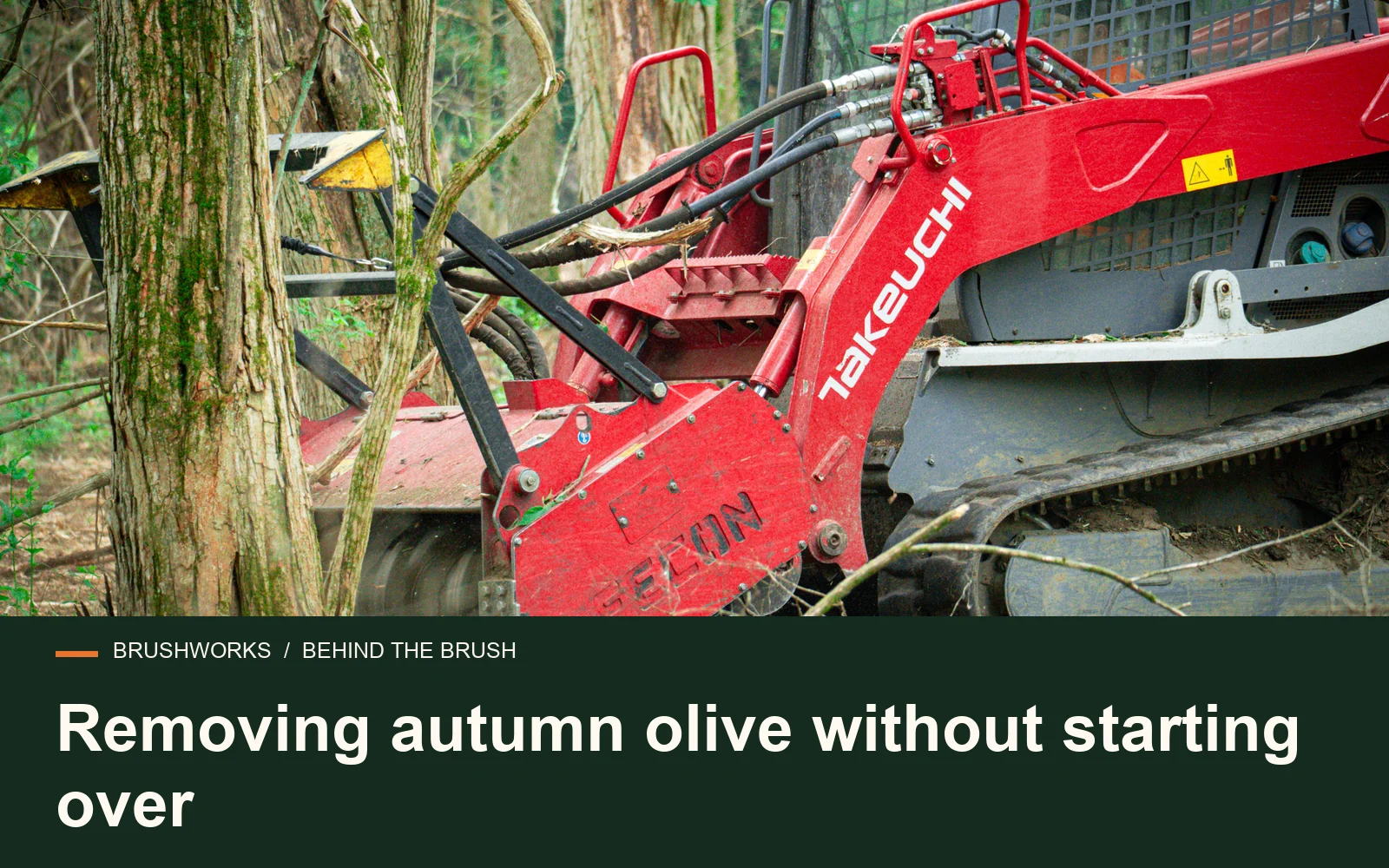
Forestry mulching grinds autumn olive completely—stems, root crowns, and all above-ground material—into fine mulch. This is the fastest and most effective method for large infestations.

  • Fastest by far: Clear acres of autumn olive in a day
  • Root crown destruction: Grinding below soil level prevents resprouting
  • No hauling: All material processed on-site as beneficial mulch
  • Mulch layer benefits: Suppresses seedling germination
  • Works on any terrain: Our equipment handles hills and rough ground

Brushworks Autumn Olive Expertise

We've removed autumn olive from properties throughout Ohio, from small backyard patches to multi-acre infestations. Our high-flow FAE mulching heads process autumn olive efficiently, and our forestry mulching services include guidance on follow-up management.

METHOD #2: Cut-Stump Treatment

Process:

  • • Cut stems at ground level
  • • Immediately apply herbicide to cut surface
  • • Dispose of cut material

Limitations:

  • ⚠️ Very labor-intensive
  • ⚠️ Must treat within minutes of cutting
  • ⚠️ Creates piles of debris
  • ⚠️ Only practical for scattered plants

METHOD #3: Foliar Spray

Process:

  • • Spray herbicide on leaves
  • • Wait for plant to die
  • • Remove dead material later

Limitations:

  • ❌ Takes months to show results
  • ❌ Dead plants still need removal
  • ❌ Risk to nearby desirable plants
  • ❌ Often requires multiple treatments
  • ❌ Less effective on large shrubs

METHOD #4: Mowing/Brush Hogging (Not Recommended)

Standard mowing equipment cannot effectively control autumn olive. The root system survives mowing and resprouts aggressively.

  • ❌ Doesn't affect root system
  • ❌ Plants resprout vigorously after cutting
  • ❌ Can actually increase stem density
  • ❌ Requires repeated treatments with no permanent results

Autumn Olive Removal Costs in Ohio

Forestry mulching costs for autumn olive removal depend on infestation density, terrain, and accessibility. Here are realistic pricing ranges for Greater Cincinnati and Ohio:

Light Infestation

$1,400–$1,800 per acre

Scattered autumn olive mixed with other vegetation. Equipment can work efficiently through the area.

Moderate to Dense

$1,800–$2,400 per acre

Solid stands of autumn olive with overlapping canopies. More processing time required.

Extreme/Hillside

$2,400–$3,200+ per acre

Very dense thickets on steep terrain or difficult access. May require specialized equipment.

Minimum Project

$800–$1,200

Small projects under 1/4 acre have minimum fees to cover equipment mobilization.

Get Accurate Pricing for Your Property

Autumn olive density can vary significantly even within a single property. Use our instant pricing calculator for a quick estimate, or request a detailed quote for accurate, project-based pricing.

Preventing Regrowth: Long-Term Management

Complete elimination of autumn olive often requires a multi-year approach due to the persistent seed bank. Here's what to expect after professional removal:

Year 1: Initial Removal

Forestry mulching removes all above-ground vegetation and grinds root crowns. The mulch layer helps suppress immediate seedling germination. You'll have clean, usable land within days.

Year 2-3: Seedling Management

New seedlings will emerge from the seed bank. These are much smaller and easier to control than mature plants—pull by hand, spot-treat with herbicide, or address with a light follow-up service.

Years 3+: Maintenance Mode

Seedling emergence decreases significantly by year 3-4. Annual monitoring and spot treatment of any new plants keeps the area clear. Consider establishing native vegetation to compete with any stragglers.

Brushworks Follow-Up Services

We provide guidance on long-term management and offer annual touch-up services for properties that need it. The initial removal does the heavy lifting—maintenance is much simpler and less expensive.

Best Time to Remove Autumn Olive

Autumn olive can be removed year-round with forestry mulching, but certain times offer advantages:

Best: Late Summer – Early Fall

  • ✅ Easy to identify by silvery foliage and berries
  • ✅ Ground typically firm and dry
  • ✅ Before seeds are dispersed by birds
  • ✅ Plants have used energy on fruit production

Also Good: Late Winter – Early Spring

  • ✅ Ground frozen or firm
  • ✅ No leaves—better visibility of extent
  • ✅ Before spring growth flush
  • ✅ Easy access through surrounding vegetation

Frequently Asked Questions

Are autumn olive berries edible?

Yes, autumn olive berries are edible and actually high in lycopene (more than tomatoes). Some people make jams, fruit leather, and sauces from them. However, harvesting berries does not control the plant—birds spread far more seeds than humans could ever pick. Removal is still necessary, and any berries you harvest before removal are essentially a bonus.

Will goats eat autumn olive?

Goats will browse autumn olive leaves and can help control small infestations, but they won't eliminate established plants. Goats work best as part of an integrated management approach, not as a standalone solution. They're most useful for maintaining an area after mechanical removal.

How fast does autumn olive spread?

Autumn olive spreads rapidly. A single plant can produce up to 200,000 seeds per year, and seeds remain viable in soil for up to 5 years. Birds can carry seeds miles from the parent plant. An area with a few scattered autumn olive plants can become completely dominated within 5-10 years without intervention.

Does autumn olive have any ecological value?

While birds do eat autumn olive berries, the plant provides poor-quality habitat compared to native alternatives. The berries are high in sugar but low in fat—not ideal for migrating birds that need high-fat foods. The dense shade created by autumn olive thickets eliminates the diverse understory plants that provide better wildlife habitat.

Can I just let autumn olive grow?

You can, but it will spread aggressively and eventually dominate your property. The nitrogen it adds to soil and allelopathic chemicals it produces make recovery of native vegetation increasingly difficult over time. Early removal is always easier and less expensive than waiting.

Service Areas for Autumn Olive Removal

Brushworks provides professional autumn olive removal throughout Greater Cincinnati, Southwest Ohio, and surrounding areas:

Loveland

Mason

Maineville

Lebanon

West Chester

Goshen

Milford

Batavia

Clermont County

Warren County

Hamilton County

Butler County

We also serve Brown County, Clinton County, Highland County, and other areas of Southwest Ohio. Contact us if you're unsure whether we service your location.

Take Action Against Autumn Olive

Autumn olive won't go away on its own—and every year you wait, it produces hundreds of thousands more seeds. The longer autumn olive remains on your property, the more difficult and expensive removal becomes, and the more damage it does to soil chemistry and native plant communities.

Brushworks has the equipment and expertise to handle autumn olive infestations of any size—from small backyard patches to multi-acre invasions. Get an instant price estimate or contact us for a custom quote. Let's reclaim your property from this destructive invasive.

Related Articles

How to Get Rid of Honeysuckle in Ohio

Read Article

Invasive Species Removal Cincinnati

Read Article

Forestry Mulching Pricing Guide

Read Article

Ready to Remove Autumn Olive from Your Property?

Get a clear, honest quote for your Ohio property. No pressure, no gimmicks—just results.