Why Bamboo Is a Bigger Problem Than You Think
Bamboo looks harmless. Maybe even tropical and cool. That's what the previous homeowner thought when they planted a few shoots along the back fence. Fast forward five years and it's 25 feet tall, growing through the neighbor's patio, cracking the driveway, and sending shoots up through gaps in the garage floor.
This isn't an exaggeration. We get calls about bamboo every week in the Greater Cincinnati area. It's one of the most frustrating plant problems a homeowner can face because most people don't realize what they're dealing with until it's already out of control.
The plant you see above ground is only part of the problem. Below the surface, running bamboo builds a dense network of rhizomes (underground stems) that spread horizontally through the soil. These rhizomes are thick, woody, and incredibly tough. They push through compacted clay, under sidewalks, through foundation cracks, and along utility lines.
In Cincinnati's climate, bamboo goes dormant in winter but the rhizome network stays alive underground. When spring hits, it pushes new shoots that can grow several inches per day. A small patch that looked manageable in October becomes a forest by June.
The worst part: bamboo you didn't plant is probably bamboo your neighbor planted. And now it's your problem too.
Running vs. Clumping Bamboo: Know What You Have
Not all bamboo behaves the same way. There are two basic categories, and knowing which one you're dealing with changes your removal strategy.
Running Bamboo (The Problem)
Running bamboo is the one that causes property disputes and headaches. It spreads through underground rhizomes that grow laterally, sometimes covering 15 to 20 feet in a single growing season. The most common running bamboo species in Cincinnati are golden bamboo (Phyllostachys aurea) and yellow groove bamboo (Phyllostachys aureosulcata).
You'll know you have running bamboo if new shoots pop up far from the main clump. If you see bamboo growing in the middle of your lawn 10 or 15 feet from the nearest stand, that's running bamboo doing what it does.
Clumping Bamboo (Usually Fine)
Clumping bamboo grows in tight clusters and expands outward slowly, maybe a few inches per year. It stays where you put it. Clumping varieties are rarely a problem and usually don't need professional removal. If your bamboo grows in a tight mound and you've never seen stray shoots across your yard, you probably have clumping bamboo.
This article focuses on running bamboo because that's what causes 99% of the bamboo removal calls we get in Cincinnati.
How Running Bamboo Spreads in Ohio
Understanding how bamboo spreads is the key to understanding why it's so hard to kill.
Running bamboo spreads through rhizomes, which are thick underground stems that grow horizontally 4 to 12 inches below the soil surface. These rhizomes have joints (nodes) every few inches, and each node can produce a new shoot or a new branching rhizome.
In Cincinnati's soil conditions (mostly heavy clay with varying amounts of organic matter), rhizomes tend to stay in the top 8 to 12 inches of soil. But they can go deeper when they hit obstacles. We've pulled rhizomes from 18 inches deep when they've grown under sidewalks or foundations.
A single rhizome can grow 3 to 5 feet in a season. That doesn't sound fast until you realize the bamboo has hundreds of rhizomes growing simultaneously in every direction. In one year, an established bamboo stand can expand its footprint by 10 to 15 feet on all sides.
The rhizomes are the bamboo's survival mechanism. You can cut every cane to the ground and the rhizome network stays alive underground, ready to send up new shoots. You can burn the above-ground growth and the rhizomes don't care. You can mow it weekly and the rhizomes keep spreading underground, popping up new shoots further from where you're mowing.
Any removal plan that ignores the rhizomes is just a haircut, not a solution.
Bamboo taking over your yard? Get an instant estimate for professional removal.
Get Instant PricingBamboo Removal Methods That Work
There are several approaches to bamboo removal. Each has trade-offs in terms of speed, cost, and effectiveness. Here's what we've seen work in the field across Greater Cincinnati.
1. Mechanical Removal (Fastest)
This is the most direct approach and the fastest way to get bamboo off your property. It works in two stages:
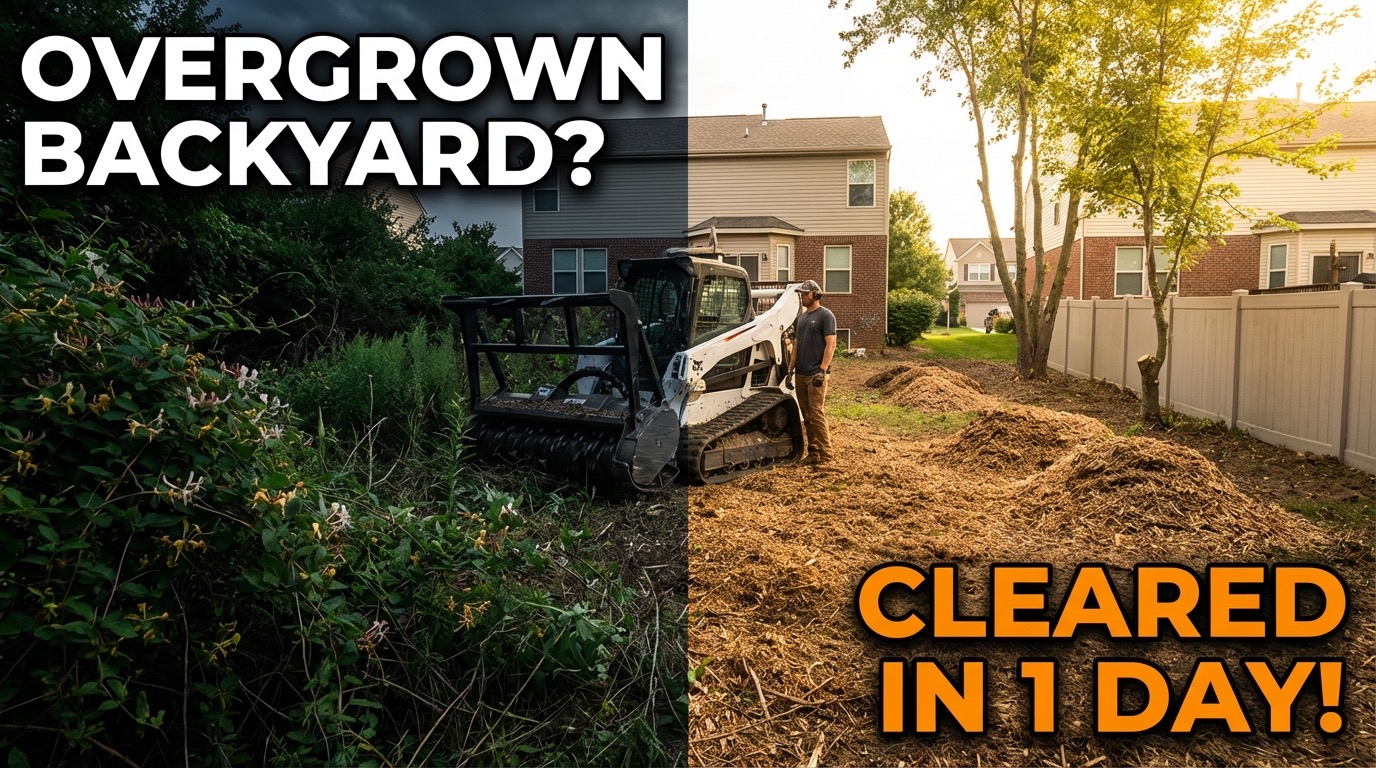
Stage 1: Clear the above-ground growth. Forestry mulching or a skid steer with a brush cutter grinds all the canes down to ground level. For dense bamboo stands, this is faster and more thorough than cutting by hand. A mulching head chews through bamboo canes like grass, reducing everything to ground-level mulch in a single pass.
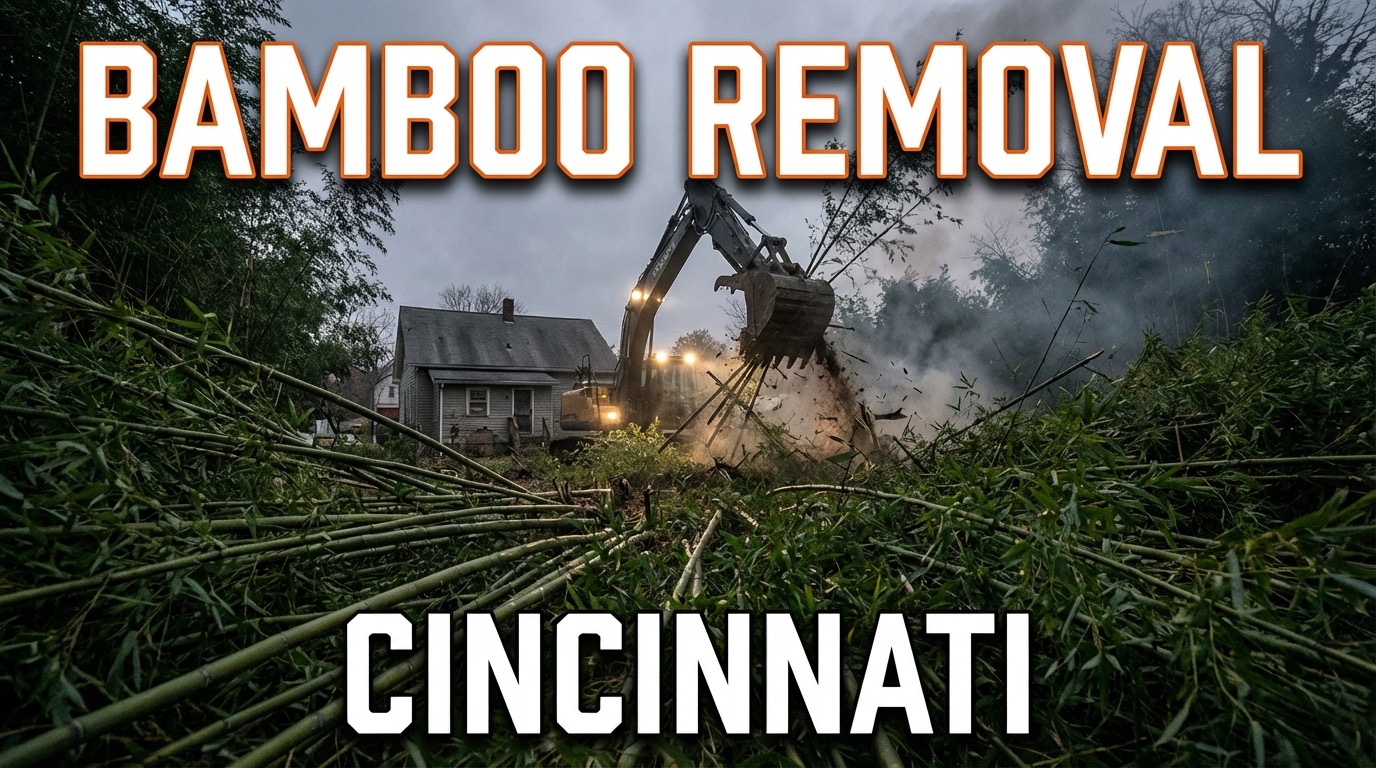
Stage 2: Excavate the rhizomes. Once the canes are gone, a mini excavator or skid steer with a root rake works through the soil to pull out the rhizome network. This is the critical step. The rhizomes come out in tangled mats that look like a giant bird's nest made of woody rope. Every piece needs to come out because any fragment left behind can regrow.
For a typical residential bamboo removal in Cincinnati (500 to 2,000 square feet), mechanical removal takes 1 to 3 days. The property is bamboo-free when we leave, but you'll still need to monitor for regrowth from any missed rhizome fragments over the next 1-2 growing seasons.
2. Cut and Smother (Slowest, Cheapest)
Cut all canes to the ground. Cover the entire area with heavy-duty black landscape fabric or thick black plastic sheeting, overlapping seams by at least 12 inches. Weight the edges with rocks, soil, or landscape staples so nothing lifts.
Leave the cover in place for two full growing seasons (roughly 18-24 months). The idea is to starve the rhizome network by blocking all sunlight. Bamboo stores a lot of energy underground, so it'll keep pushing shoots against the barrier for months. Any shoots that find gaps need to be cut immediately.
This method works but requires patience. It's best for small patches where you don't need the space back quickly. The total cost is low (a few hundred dollars in materials) but the time investment is high.
3. Cut and Treat with Herbicide (Moderate Speed)
Cut all canes to the ground during late summer when the bamboo is actively growing. Allow regrowth to reach 2 to 3 feet tall, then spray the new leaves with a glyphosate-based herbicide at full strength. The bamboo absorbs the herbicide through the leaves and translocates it down to the rhizome network.
One application won't kill the entire rhizome network. Plan for 3 to 4 applications over 2 growing seasons, treating each new flush of growth as it appears. Each round weakens the rhizome network further. By the second season, regrowth is sparse and weak.
This method is more effective than smothering alone and works well on larger areas where excavation isn't practical. The downside is the timeline (12-18 months to full eradication) and the repeated herbicide applications.
4. Combined Approach (Best Results)
For most Cincinnati properties, we recommend a combined approach: forestry mulching to clear the above-ground growth, mechanical removal of as much rhizome as possible, and then targeted herbicide treatment on any regrowth over the following season.
This gives you the fastest visible results (the bamboo is gone in days, not months) while still addressing the underground rhizome network that mechanical removal alone might miss.
What NOT to Do
Don't just cut the canes and call it done. Cutting stimulates the rhizome network to produce more shoots. You'll have twice as many canes next month.
Don't burn it. Burning removes the visible canes but does nothing to the rhizomes underground. It also violates burn ordinances in most Cincinnati-area municipalities. And dry bamboo burns hot and fast, which creates a fire hazard near structures.
Don't use salt or bleach. We hear this one a lot. Pouring salt or bleach on bamboo might kill the visible shoots but it poisons your soil for years. Nothing else will grow there either. You're trading one problem for a worse one.
Don't try to dig it out by hand if the patch is larger than 100 square feet. Bamboo rhizomes in Cincinnati's clay soil are brutally difficult to pull by hand. The labor hours add up fast and you'll still miss pieces that regrow. Save yourself the back surgery and rent equipment or hire a professional.
Don't wait. Bamboo gets exponentially harder to remove every year you ignore it. A patch that costs $1,500 to remove today could cost $5,000 next year after the rhizomes spread under your fence, into the neighbor's yard, and along your foundation.
Bamboo Removal Costs in Cincinnati
Cost depends on the size of the infestation, how far the rhizomes have spread, what the bamboo is growing near (structures, fences, utilities), and how accessible the property is for equipment.
Small Patches (Under 500 sq ft)
Professional removal with rhizome excavation: $800 to $2,000. This covers cutting, rhizome removal, haul-off, and basic site cleanup. If the bamboo is in a tight space where equipment can't access (between houses, for example), costs go higher because of the hand labor involved.
Medium Infestations (500 to 2,000 sq ft)
Professional removal: $2,000 to $5,000. At this size, forestry mulching the above-ground growth makes sense before excavating rhizomes. Equipment access matters a lot at this scale. If we can get a skid steer to the bamboo, the job goes faster and costs less. If it's only accessible through a narrow gate, add 30-50% for hand labor.
Large Infestations (Quarter Acre or More)
Professional removal: $5,000 to $10,000+. These are the jobs where bamboo has been growing unchecked for years, covering large areas and spreading under fences into neighboring properties. Forestry mulching handles the clearing, and extensive excavation addresses the rhizome network. Properties with bamboo growing under structures or through foundations cost more due to the careful work required.
Follow-Up Monitoring
Plan for 1 to 2 follow-up visits over the next growing season at $150 to $400 per visit. These visits catch any rhizome fragments that were missed during initial removal. Missing this step is how bamboo comes back.
Need a quote for bamboo removal? Contact Brushworks for a free property assessment.
Get a Free QuoteBamboo and Ohio Property Law
Bamboo doesn't care about property lines, but Ohio courts do.
Ohio has no statewide law that specifically bans bamboo. But Ohio follows the "Massachusetts Rule" for vegetation disputes, which generally holds that your neighbor can cut anything that crosses onto their property. Sounds simple, but bamboo complicates things because the damage happens underground through rhizomes, not just through visible branches hanging over a fence.
Several Ohio municipalities have nuisance ordinances that can apply to bamboo. If your bamboo spreads onto a neighbor's property and damages their landscaping, hardscaping, or structures, you can be held liable for the damage. Some Cincinnati-area cities are exploring bamboo-specific regulations as the problem grows.
Practically speaking, bamboo disputes between neighbors are one of the most common reasons people call us for removal. Usually the conversation goes like this: "My neighbor planted bamboo ten years ago and now it's coming up in my yard, my garden, and along my foundation. They won't do anything about it."
If you're in this situation, document the damage, communicate with your neighbor in writing, and consider involving code enforcement if your municipality has a nuisance ordinance. And get the bamboo removed before it causes structural damage that makes the problem more expensive for everyone.
Preventing Bamboo from Coming Back
After removal, you need a plan to keep bamboo from returning, especially if your neighbor's bamboo is still alive on the other side of the property line.
Root Barriers
A root barrier is a sheet of thick HDPE plastic (60 mil or thicker) buried vertically along the property line. It needs to go at least 30 inches deep and extend 2 to 4 inches above the soil surface. The above-ground lip is important because bamboo rhizomes will try to grow over the top of a barrier that's flush with the ground.
Root barriers cost $8 to $15 per linear foot installed. For a 50-foot property line, that's $400 to $750. It's cheap insurance against a $5,000 removal job down the road.
Monitoring
Walk the removal area every 2 to 3 weeks during the growing season (April through October in Cincinnati). Look for any new shoots pushing up. If you find one, dig it out immediately and trace it back to the rhizome fragment producing it. One missed rhizome can restart the whole problem.
Replanting
Don't leave bare ground after bamboo removal. Bare soil is an open invitation for weeds and any surviving bamboo rhizomes. Seed the area with a dense grass mix or plant ground cover that will compete for soil space. Native plants with aggressive root systems help prevent bamboo from re-establishing even if a few rhizome fragments survived.
Bamboo in Cincinnati Neighborhoods
Bamboo is all over the Cincinnati metro area. We've removed it from properties in Anderson Township, Hyde Park, Mt. Washington, Loveland, Mason, and dozens of other neighborhoods. It's in Clermont County subdivisions, Hamilton County suburbs, and Warren County rural properties.
The problem is especially bad in older neighborhoods where someone planted ornamental bamboo in the 1980s or 1990s. Back then, garden centers sold running bamboo without warning buyers about its invasive growth habit. Those plantings have had 30+ years to spread, and many have colonized multiple properties by now.
Newer subdivisions aren't immune. Running bamboo is still sold at garden centers and online. People buy it for privacy screening without understanding the maintenance commitment. Within 3 to 5 years, the "privacy hedge" becomes a neighborhood problem.
If you're buying property in the Cincinnati area, check for bamboo during your inspection. Look for thick canes along fence lines and property boundaries. Check the neighbors' yards too. Bamboo on a neighboring property will become your problem eventually.
Can Bamboo Damage Structures?
Yes. Bamboo rhizomes are strong enough to crack asphalt, push through gaps in concrete, displace pavers, and grow into foundation cracks. They don't bore through solid concrete the way tree roots can, but they exploit any existing weakness.
Common structural damage from bamboo in Cincinnati includes:
Cracked driveways and sidewalks: Rhizomes grow under pavement and push up, creating cracks and heaving. Once a rhizome finds the edge of a concrete slab, it grows along the path of least resistance, lifting and cracking as it goes.
Damaged retaining walls: Rhizomes grow into gaps between blocks or stones and expand, pushing the wall apart over time. Cincinnati has a lot of retaining walls due to the hilly terrain, and bamboo near these walls is a constant problem.
Foundation intrusion: Rhizomes enter basements and crawl spaces through existing cracks, pipe penetrations, and construction joints. Once inside, they keep growing and widen the opening. We've pulled bamboo rhizomes out of basement walls in Cincinnati homes.
Fence damage: Bamboo growing through chain-link and wood fences is extremely common. The canes push through openings and the rhizomes undermine fence posts.
If bamboo is growing within 10 feet of a structure, removing it before it causes damage is always cheaper than fixing the damage later.
Frequently Asked Questions
Is bamboo illegal in Ohio?
Ohio has no statewide ban on bamboo. But several municipalities have nuisance ordinances that hold property owners liable when bamboo spreads onto neighboring land. If your bamboo crosses the property line and causes damage, you can be held responsible. The safest approach is to remove running bamboo entirely or install a root barrier at least 30 inches deep.
How much does bamboo removal cost in Cincinnati?
Small patches under 500 square feet run $800 to $2,000. Larger infestations covering a quarter acre or more cost $5,000 to $10,000+. Most properties also need 1-2 seasons of follow-up monitoring at $150-400 per visit to catch missed rhizome fragments.
Can you kill bamboo without chemicals?
Yes. Cut all canes to ground level and cover the area with heavy-duty black plastic or landscape fabric for 18-24 months to starve the rhizomes. Or excavate the rhizomes mechanically. Both approaches work without herbicide, though mechanical removal is much faster.
Will bamboo grow back after cutting?
Every time. Bamboo stores energy in its underground rhizome network. Cutting the canes only removes the visible growth. The rhizomes will send up new shoots within weeks. Cutting alone is never a permanent solution.
What is the fastest way to get rid of bamboo?
Mechanical removal. Forestry mulching grinds all above-ground growth, then an excavator pulls the rhizome network out of the ground. For a typical residential infestation, this takes 1-3 days. Follow-up monitoring is still needed for 1-2 seasons, but the main problem is gone in days.