
Ohio's Bradford Pear Ban: What You Need to Know
On January 1, 2023, Ohio officially banned the sale and distribution of Callery pear trees, including the popular Bradford pear cultivar. This ban makes Ohio one of a growing number of states taking action against this invasive species.
Key Points About the Ohio Ban:
- • Sales prohibited: Nurseries and retailers can no longer sell Bradford pear or other Callery pear cultivars
- • Distribution banned: Sharing or trading Callery pear trees is also prohibited
- • Existing trees not required to be removed: But removal is strongly encouraged
- • Penalties apply: Violations can result in fines for commercial operations
The ban is part of Ohio's broader effort to combat invasive species that threaten the state's native ecosystems. Bradford pears may look beautiful when they bloom in spring, but their impact on Ohio's forests, fields, and native plant communities has been devastating.
The Bradford Pear Story: From Beloved Tree to Banned Invasive
Understanding how we got here helps explain why removal is so important. The Bradford pear story is a cautionary tale about unintended consequences:
1960s-1980s: The "Perfect" Tree
The USDA introduced Callery pear (Pyrus calleryana) from Asia, and nurseries bred the Bradford pear cultivar as a seemingly ideal landscape tree: fast-growing, disease-resistant, beautiful spring blooms, and sterile—meaning it wouldn't produce viable seeds. Developers planted millions along streets and in subdivisions across America.
1990s-2000s: Problems Emerge
Two issues became apparent. First, Bradford pears have a fatal structural flaw—their branches grow at tight angles that split apart in storms, often destroying the tree within 15-25 years. Second, when different Callery pear cultivars were planted near each other, they could cross-pollinate and produce viable, fertile seeds.
2010s-Present: Invasive Explosion
Birds eat the small fruits and spread seeds across the landscape. Unlike the cultivated Bradford pear, these wild offspring revert to the original Callery pear characteristics—including 3-4 inch thorns. These wild Callery pears now form dense thickets throughout Ohio, spreading along roadsides, fence rows, forest edges, and abandoned fields.
Today, wild Callery pears are one of the fastest-spreading invasive trees in the eastern United States. Every Bradford pear in a landscape serves as a potential parent for these invasive offspring.
Bradford Pear vs. Wild Callery Pear: Understanding the Difference
It's important to distinguish between the cultivated Bradford pear in your yard and the wild Callery pear thickets taking over Ohio's landscape:
Cultivated Bradford Pear
- • Location: Yards, streets, parking lots—planted intentionally
- • Shape: Symmetrical, oval to rounded crown
- • Thorns: None (thornless cultivar)
- • Height: 30-50 feet at maturity
- • Lifespan: Often 15-25 years before structural failure
- • Flowers: White, showy clusters in spring
- • Fruit: Small, hard, inedible
Wild Callery Pear (Invasive)
- • Location: Fence rows, roadsides, forest edges, abandoned fields
- • Shape: Irregular, often shrubby when young
- • Thorns: Sharp, 2-4 inches long
- • Height: 25-60 feet; forms dense thickets
- • Lifespan: Long-lived when not removed
- • Flowers: White clusters in early spring
- • Fruit: Small, abundant, spread by birds
The Thorn Problem
Wild Callery pear thorns are nasty—2 to 4 inches of hardened, sharp wood that can puncture tires, injure livestock, and make manual removal dangerous. These thorns are a major reason why professional equipment is essential for clearing Callery pear thickets.
Why Bradford Pears Are an Ecological Problem
Beyond the thorns and structural issues, Bradford pears and their wild offspring cause serious ecological damage:
- • Outcompete native trees: Callery pears leaf out earlier in spring and retain leaves later in fall, giving them a competitive advantage over native species
- • Form dense monocultures: Wild Callery pear thickets shade out native understory plants, reducing biodiversity
- • Provide poor wildlife habitat: Native birds and insects have not evolved to use Callery pear as a food source or nesting site
- • Spread rapidly: Each tree produces thousands of seeds that birds disperse across wide areas
- • Alter soil chemistry: Callery pear leaf litter can change soil conditions, making it harder for native plants to establish
- • Reduce property values: Overgrown Callery pear thickets make land appear neglected and reduce usability
The problem compounds year after year. Every Bradford pear in your neighborhood contributes pollen that helps wild Callery pears reproduce. Removing your Bradford pear is a step toward protecting Ohio's native ecosystems.
Bradford Pear Removal Methods
Removal approach depends on whether you're dealing with a single landscape Bradford pear or a wild Callery pear thicket:
Single Bradford Pear in Your Yard
Traditional tree removal services can handle individual Bradford pears in landscape settings:
- • Cost: $300-$800 depending on size, location, and stump removal
- • Method: Chainsaw felling, sectional removal near structures
- • Stump: Must be ground or treated to prevent resprouting
- • Timeline: Usually same-day for single trees
After removal, consider replacing with a native alternative like serviceberry, eastern redbud, or flowering dogwood.
Wild Callery Pear Thickets: Forestry Mulching
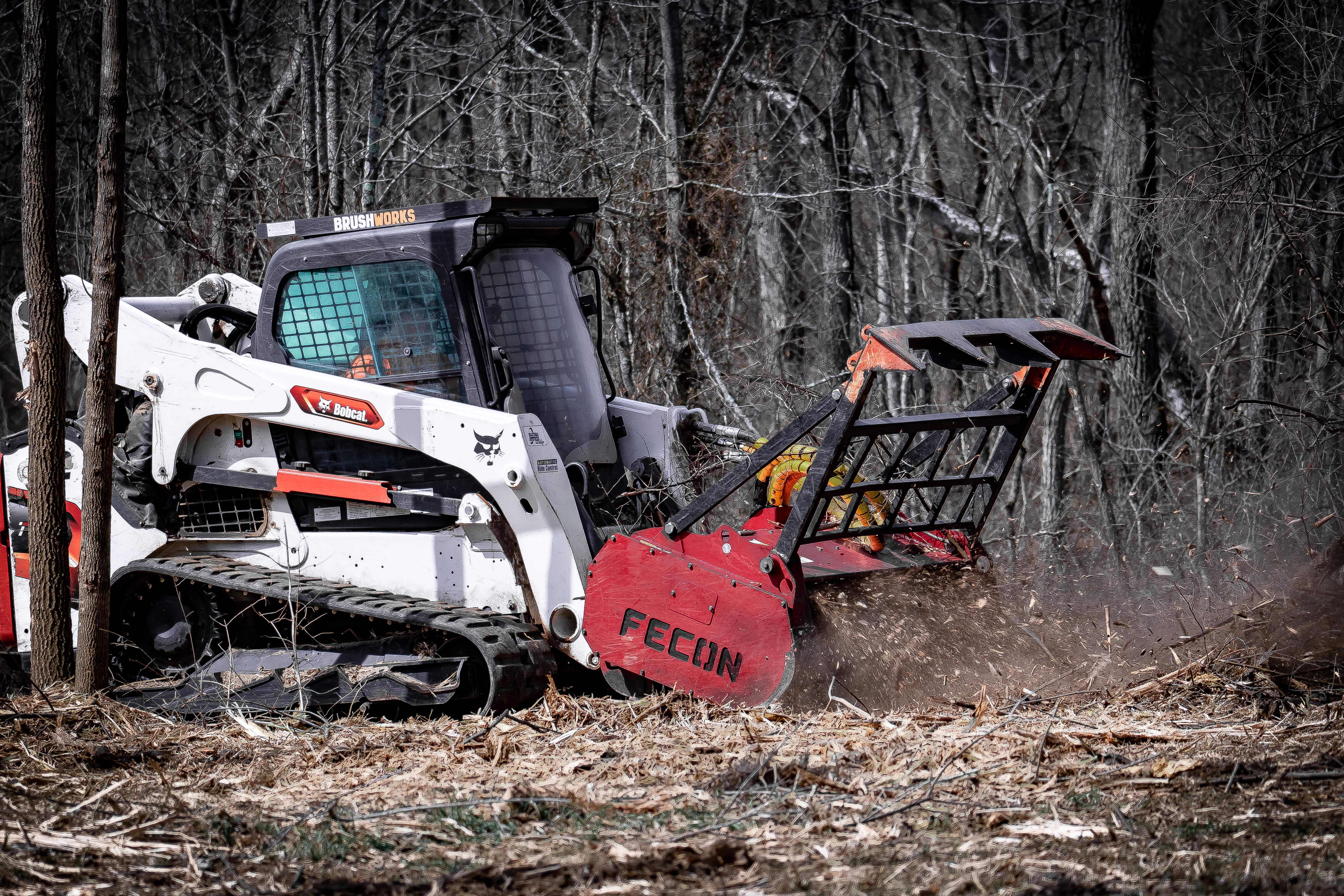
For wild Callery pear infestations covering significant acreage, forestry mulching is the most efficient and cost-effective solution:
- ✅ Handles thorns safely: Operator stays in protected cab—no contact with dangerous thorns
- ✅ Processes entire thickets: Grinds trees, brush, and root crowns into mulch
- ✅ No hauling required: All material processed on-site
- ✅ Prevents resprouting: Grinding the root crown stops regrowth
- ✅ Fast: Clear acres of Callery pear thickets in a day
Brushworks Specializes in Callery Pear Removal
Our equipment handles Callery pear thickets efficiently, regardless of how dense or thorny. We've cleared wild pear infestations throughout Greater Cincinnati—from small backyard areas to multi-acre properties. Learn more about our forestry mulching services.
Bradford Pear and Callery Pear Removal Costs
Costs vary based on whether you're removing individual landscape trees or clearing wild thickets:
Individual Bradford Pear
$300–$800 per tree
Traditional tree removal for landscape Bradford pears. Price varies by size, access, and proximity to structures.
Light Callery Pear Thickets
$1,400–$1,800 per acre
Scattered wild pears mixed with other vegetation. Equipment can work efficiently through the area.
Dense Callery Pear Thickets
$1,800–$2,400+ per acre
Solid walls of Callery pear with larger trees. Requires more processing time due to woody material volume.
Hillside/Difficult Access
$2,400–$3,200+ per acre
Steep terrain or limited access points. May require specialized equipment.
Get Accurate Pricing for Your Property
Every property is unique. Use our instant pricing calculator for a quick estimate, or request a detailed quote. We provide project-based pricing so you know the cost before we start.
How to Identify Wild Callery Pear
Recognizing wild Callery pear is essential for targeting removal efforts. Here's what to look for throughout the year:
Early Spring (March-April)
Easiest time to spot them. Wild Callery pears bloom with clusters of white flowers 2-3 weeks before most native trees leaf out. Drive any rural road in Ohio in early April and you'll see them—white clouds of bloom along fence rows and forest edges. The flowers have a distinctive (unpleasant) smell.
Summer
Glossy, dark green leaves with wavy or finely serrated edges. Leaves are oval to heart-shaped, 2-3 inches long. Young trees and suckers may have visible thorns on branches.
Fall
Leaves turn red, orange, or purple. Small, hard fruits (about 1/2 inch) appear in clusters—initially green, ripening to tan or brown. The fruits persist after leaves fall, providing identification in winter.
Winter
Look for thorns on branches (2-4 inches long, extremely sharp), persistent small fruits, and the characteristic tight-angled branching pattern. Bark is gray-brown and develops scaly ridges with age.
Preventing Regrowth After Removal
Bradford pear and Callery pear are notorious for resprouting after cutting. Here's how to ensure they don't come back:
- • Forestry mulching: Grinding the root crown below soil level is the most effective method to prevent regrowth from existing plants
- • Stump treatment: If cut with a chainsaw, apply herbicide to the fresh stump within 30 minutes
- • Monitor for seedlings: Birds will continue depositing seeds from nearby Callery pears—pull or treat seedlings annually
- • Establish competition: Plant native ground cover or grass to compete with any new seedlings
Long-Term Management
Complete elimination of Callery pear from a landscape often takes 2-3 years of follow-up. The initial forestry mulching removes the bulk of the problem, and annual monitoring catches new seedlings before they become established. We provide guidance on long-term management and can schedule follow-up visits.
Native Alternatives to Bradford Pear
After removing your Bradford pear, consider these beautiful native alternatives that provide similar aesthetic benefits without the invasive downsides:
Serviceberry (Amelanchier)
- • White spring flowers
- • Edible berries for wildlife
- • Beautiful fall color
- • Native to Ohio
Eastern Redbud (Cercis canadensis)
- • Pink-purple spring flowers
- • Heart-shaped leaves
- • Attracts pollinators
- • Native to Ohio
Flowering Dogwood (Cornus florida)
- • White or pink spring bracts
- • Red fall berries for birds
- • Excellent fall color
- • Native to Ohio
American Hornbeam (Carpinus caroliniana)
- • Attractive muscular bark
- • Good fall color
- • Tolerates shade
- • Native to Ohio
Frequently Asked Questions
Is it illegal to have Bradford pear trees in Ohio?
The sale and distribution of Bradford pear is banned, but you're not legally required to remove existing trees on your property. However, removal is strongly encouraged to prevent contributing to the invasive spread of wild Callery pears.
Why do Bradford pears smell bad?
Bradford pear flowers contain trimethylamine, the same compound that gives rotting fish its distinctive odor. The smell attracts pollinating flies. While people describe the fragrance differently—from mildly unpleasant to truly offensive—the odor is another reason to consider removal.
Will removing my Bradford pear affect my property value?
Short-term, removing a mature tree creates a temporary gap in your landscape. Long-term, you're eliminating a tree that will likely split apart within its lifetime and contributing to neighborhood invasive species control. Replacing with a native alternative often improves property value.
How can I tell if my tree is a Bradford pear?
Bradford pears have a distinctive symmetrical, oval shape when mature. They bloom white in early spring with an unpleasant smell. Leaves are glossy and turn red/purple in fall. The bark is gray-brown with shallow furrows. If you're unsure, a local arborist or our team can help identify it during a property assessment.
Are Callery pear thorns dangerous?
Yes. Wild Callery pear thorns are 2-4 inches long, extremely hard, and sharp enough to puncture tires, injure livestock, and cause serious wounds. The thorns can cause infections if wounds aren't properly treated. This is why professional equipment is essential for clearing Callery pear thickets.
Service Areas for Bradford Pear Removal
Brushworks provides Bradford pear and Callery pear removal throughout Greater Cincinnati and surrounding areas:
Loveland
Mason
Maineville
Lebanon
West Chester
Goshen
Milford
Batavia
Clermont County
Warren County
Hamilton County
Butler County
Take Action Against Invasive Bradford Pear
Ohio's Bradford pear ban reflects growing awareness of the damage these trees cause. Whether you have a single Bradford pear in your yard or acres of wild Callery pear thickets on rural property, removal is an investment in Ohio's ecological future.
Brushworks has the equipment and expertise to handle any scale of Bradford or Callery pear removal—safely, efficiently, and affordably. Get an instant price estimate or contact us for a custom quote.