
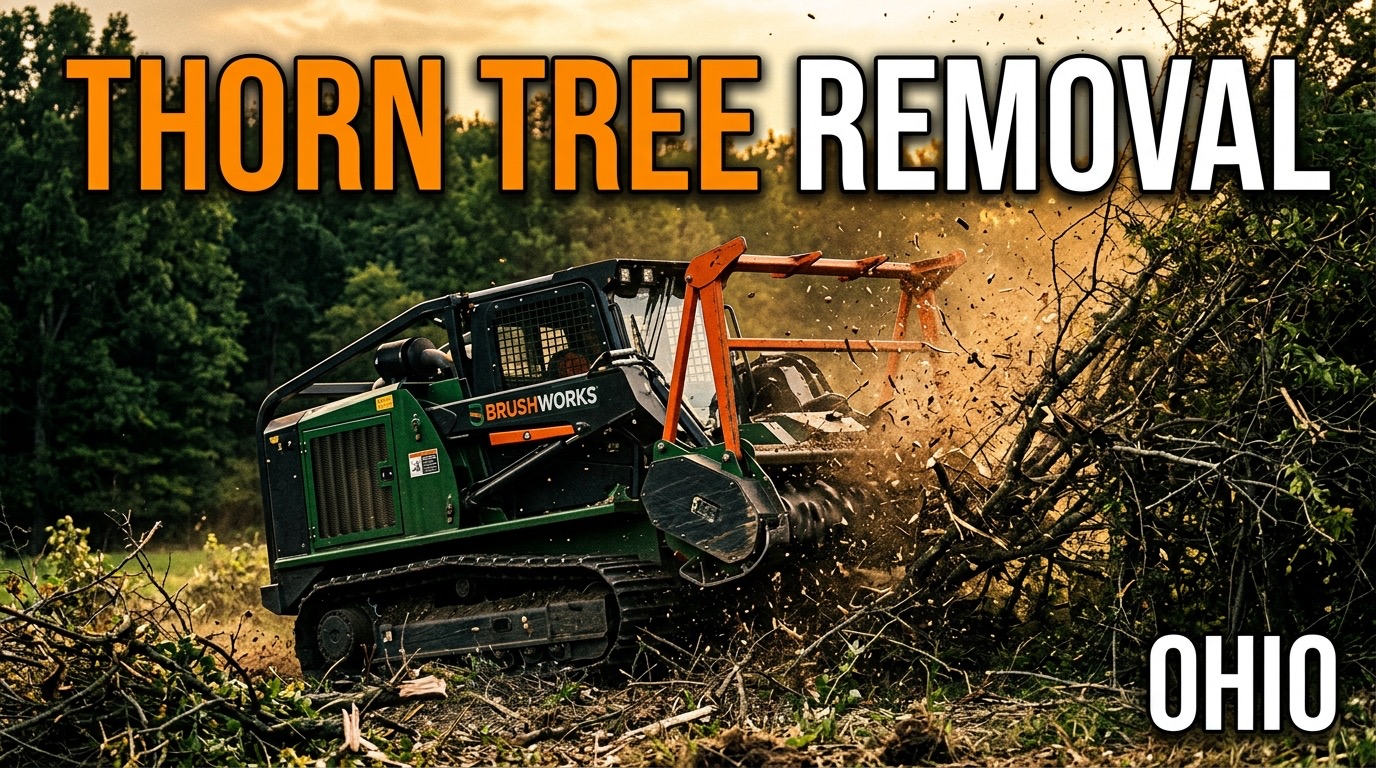
Why honey locust becomes a real problem on Ohio land
Honey locust is a native tree, and in the right place it can be part of a healthy wood line. The problem is where it usually shows up after a property sits. Old cattle ground, neglected pasture edges, abandoned fence rows, creek bottoms, and field corners give it room to spread. Birds and wildlife move seed. Pods drop under mature trees. Young sprouts push into open ground. Before long, a few scattered thorn trees turn into a patch nobody wants to walk through.
The thorns are the part everyone remembers. Honey locust can grow clusters of hard, branched spikes straight out of the trunk and limbs. They can puncture tires, tear sleeves, scratch livestock, and make hand work miserable. Add grapevine, honeysuckle, multiflora rose, dead ash, old woven wire, and uneven ground, and the patch becomes more than ugly. It blocks access.
Brushworks clears honey locust, thorny fence rows, pasture edges, and overgrown access lanes across Greater Cincinnati, Clermont County, Warren County, Butler County, Brown County, and nearby Ohio communities. The goal is simple: open the ground you need, keep useful trees when they make sense, and leave the area reachable so it does not turn right back into a thorn wall.
Know the difference between one thorn tree and a thorn problem
A single honey locust tree near a field edge may not need removal. It might provide shade, hold a bank, or sit far enough from people and equipment that it does not matter. The trouble starts when younger trees spread into places you need to mow, fence, drive, graze, or build. Once the area gets too rough to maintain, the trees keep winning.
Look at how the ground is used now and how you want it used next. A landowner clearing for cattle has different needs than someone opening an ATV trail or preparing a gravel parking area. A fence crew needs room to work on both sides of the line. A mower needs a cleaner edge than a wildlife screen. If you do not decide the end use first, you can spend money clearing the wrong width or saving trees that stay in the way.
Signs the thorn trees are costing you usable ground
- • You avoid mowing near the field edge because of spikes and rough ground
- • Fence wire, posts, or property corners are buried in brush
- • UTV, tractor, or trailer tires keep getting threatened by thorns
- • Livestock trails pinch down or disappear near the tree line
- • Vines and honeysuckle have tied the whole row together
- • You need access for a fence, driveway, barn, pond, or pasture project
Honey locust removal is really a site access decision. If the trees are keeping you from using the land, they need to be handled. If they are useful and out of the way, they may just need thinning around them.
Why thorn tree clearing is slower than normal brush clearing
Thorn trees punish sloppy work. The spikes are hard, sharp, and often hidden inside vines or leaf litter. Mature trees may have thorns on the trunk where an operator, sawyer, or property owner would normally grab or lean. Fallen limbs can leave spikes pointing up in the ground like nails. Even after the canopy is down, those thorns are still part of the cleanup.
The second issue is what grows with honey locust. Around southwest Ohio, thorn tree patches often come with bush honeysuckle, grapevine, autumn olive, multiflora rose, poison ivy, dead ash, and old farm fence. A clean little tree job can turn into a tangled brush and wire job once you get close. That is why photos from the road rarely tell the whole story.
Before clearing, walk the edge if it is safe. Mark gates, corner posts, wire, utilities, wells, septic areas, trees to save, and the line you actually want opened. If the patch is too thorny to inspect, say that up front. A good crew can plan for it. What you do not want is hidden metal, unknown property lines, or a neighbor's fence discovered halfway through the job.
Forestry mulching is usually the right tool, with limits
Forestry mulching works well for honey locust saplings, thorny brush, vines, and overgrown pasture edges because it processes the material in place. Instead of dragging thorn limbs across the property and making piles, the machine can grind the brush into a mulch layer. That leaves the site easier to walk, mow, fence, or treat afterward.
There are limits. Large honey locust trunks, trees grown into woven wire, trees near structures, and trees leaning over roads or utilities may need selective cutting before mulching. A mulcher is powerful, but it is not a magic eraser for every hazard. The best jobs use the machine for production and slow down where thorns, wire, slope, or structures demand it.
| Site condition | Good approach | Watch for |
|---|---|---|
| Young thorn thicket | Mulch sprouts and brush, then maintain with mowing or spot treatment | Sharp debris and root sprouts |
| Old pasture edge | Open a clean corridor wide enough for mower, fence, or livestock access | Hidden holes, wire, dead limbs |
| Mature thorn trees | Decide which trees stay, which get cut, and how trunks are handled | Large spikes, lean, heavy wood |
| Fence row cleanup | Expose the line and remove brush without guessing at boundaries | Woven wire, T-posts, neighbors |
The finished product should be maintainable. If the cleared strip is still too rough to mow, drive, spray, or walk, the thorn trees will start reclaiming it.
What to do about thorns after the trees are down
A common mistake is thinking the thorn problem ends when the tree is cut. The thorns do not disappear. They stay on limbs, trunks, chunks, and mulch until they break down or get removed. That matters if the area will be used for livestock, kids, tires, foot traffic, or a finished yard.
For rough pasture edges, mulching in place may be enough as long as the owner understands that the area needs time and follow-up before it becomes clean grazing or barefoot ground. For trails, campsites, gravel pads, or access lanes, the cleanup standard may need to be higher. Thorn-heavy material near drive paths may need extra processing, raking, or strategic placement away from tires.
Talk through the next use before work starts. If cattle are going back into the area, say so. If you need a UTV trail, say so. If a fence crew will be there next week, they need a corridor they can work in without kneeling in thorn debris. The right finish depends on what happens after the mulcher leaves.
Need thorn trees cleared before they take more ground?
Send wide photos, close-ups of the thorns, the access route, and what you want the area used for next. We will help you decide whether it is a mulching job, selective tree removal, pasture edge cleanup, or a mix.
Regrowth is part of the plan
Honey locust can come back after cutting. Stumps may resprout. Root systems can push new growth. Seeds from old pods can keep showing up in the area. If the property has been dropping pods for years, one clearing pass does not erase the seed bank.
That does not mean clearing is pointless. It means the first pass should make maintenance possible. Once the edge is open, you can mow sprouts before they harden off, spot treat problem stumps where appropriate, and keep vines from tying everything together again. The expensive mistake is clearing a patch but leaving it unreachable, then acting surprised when it grows back.
For pasture reclamation, the follow-up may be mowing, grazing pressure, herbicide by a licensed applicator, seeding, or additional dirt work. For fence rows, the follow-up may be keeping a mower-width lane open. For trails, it may be seasonal cutting and drainage work. Pick the maintenance path before you spend the money to clear.
When to save honey locust instead of removing it
Not every honey locust tree needs to go. Thornless varieties exist, and some mature trees are useful where they are not hurting access. They can shade livestock, hold a creek edge, break wind, or provide wildlife value. Removing every tree just because the species has a bad reputation can create more bare ground and less shade than you wanted.
The practical question is whether the tree serves the property today. A tree in the middle of a future driveway does not. A thorny trunk beside a gate where people work does not. A tree dropping pods and sprouts into a pasture you are trying to reclaim may not. But a healthy tree on the outside edge of a wildlife screen might be worth keeping while the brush around it gets cleaned up.
Selective clearing usually gives the best result. Keep the useful canopy. Remove the thorny sprouts, deadfall, vines, and problem trunks. Open enough room to maintain the edge. That gives you control without turning every wooded border into a bare strip.
Best time of year for thorn tree removal in Ohio
Fall and winter are often the cleanest seasons for honey locust work in Ohio. Leaves are down, visibility is better, and the thorns, wire, stumps, and ground hazards are easier to see. Frozen or drier ground can also make machine access cleaner in low areas.
Spring and summer clearing still happens, especially when a fence, pasture, driveway, or building project is already scheduled. The tradeoff is thicker foliage, more ticks, active poison ivy, softer ground after rain, and less visibility inside the patch. If the project can wait until leaf-off, it may quote and run smoother. If the thorn trees are blocking work now, they can still be handled with the right expectations.
Around Cincinnati, weather matters as much as the calendar. A dry week in May may be better than a wet week in January. Good access, safe working room, and a clear plan beat a perfect season on paper.
What affects the cost of honey locust removal?
Cost depends on what the crew is actually fighting. A flat half-acre of young sprouts is different from a narrow fence row full of mature thorn trees and old barbed wire. Tree size matters, but access, density, hidden metal, cleanup expectations, and the next use of the ground usually matter more.
The biggest time killers are wire inside the trees, steep or wet ground, trees near structures, and unclear boundaries. If the operator has to creep through the row because every ten feet might hide a T-post, production slows down. If the job needs a finish clean enough for a fence crew or regular tire traffic, that takes more care than rough wildlife edge clearing.
Good photos help. Send shots from both ends of the row, close-ups of the largest trees, pictures of the thorns, any visible wire or posts, and the route equipment would use to reach the site. Tell us whether you want the material mulched in place, stacked, opened for fence, prepared for mowing, or cleared for another contractor. That context keeps the quote grounded in the real job.
How Brushworks approaches thorn tree jobs
Brushworks starts with the outcome. Are we opening a fence line? Reclaiming a pasture edge? Making a trail? Preparing for gravel? Cleaning up a rental property? Once the end use is clear, we look at access, hazards, trees to save, wire, slope, and how clean the finish needs to be.
On many Ohio properties, the best result is a usable corridor rather than a stripped-out mess. That might be wide enough for a mower, clean enough for fence work, or open enough for livestock and equipment to move safely. It might also mean saving a few good trees while removing the sprouts and brush that made the area unusable.
Honey locust is nasty, but it is not unbeatable. The key is not pretending it is normal brush. Respect the thorns, mark the wire, decide what the cleared ground needs to do, and build a maintenance path into the plan. That is how a thorn patch turns back into usable Ohio property.
Frequently asked questions
Are honey locust trees common in Ohio?
Yes. Native honey locust trees are common across Ohio, especially along old farms, field edges, creek bottoms, pastures, and disturbed ground. Many have long branched thorns on the trunk and limbs.
Can forestry mulching clear honey locust thickets?
Yes, forestry mulching is often a good fit for honey locust saplings, thorny sprouts, brush, and overgrown fence rows. Large trees, trees in fence wire, or trees near structures may need cutting or a more careful plan first.
Will honey locust grow back after clearing?
It can. Honey locust can resprout from cut stumps and roots, and seed can keep showing up where pods were dropped. Follow-up mowing, spot treatment, and keeping the cleared edge accessible matter.
Do honey locust thorns puncture tractor or UTV tires?
They can. Mature thorns are hard enough to puncture tires, boots, and skin. That is one reason thick honey locust areas should be cleared with equipment and a plan instead of treated like normal brush.
Should every honey locust tree be removed?
No. Some thornless or mature trees may be worth keeping for shade, wildlife, or a field edge. Remove the ones blocking access, damaging fence lines, threatening work areas, or spreading into ground you need to use.
What is the best season to clear honey locust in Ohio?
Fall and winter are usually easiest because leaves are down, thorns and wire are easier to see, and ground conditions may be firmer. Spring and summer clearing can still work when a project cannot wait.
Related articles
Ready to clear thorn trees?
Send the address, photos, and what you want the ground used for next. We will help you open the area without turning a honey locust patch into a bigger headache.