Clearing Land for New Fence Installation in Ohio: The Site Prep Your Fence Contractor Won't Do
A clean fence line starts long before the first post goes in the ground.

You've got the fence contractor lined up, the material picked out, and the install date on the calendar. Then the contractor drives out to your property, walks the fence line, and hits you with the news: "We can't install through this. You need to clear this first."
It happens constantly across Greater Cincinnati. Homeowners, farmers, and rural landowners in Hamilton County, Warren County, Clermont County, and Butler County plan a fencing project without realizing how much site prep goes into creating a clean, buildable fence line. Trees, brush, honeysuckle thickets, fallen timber, old fence remnants, and root systems all need to be dealt with before a single post hole gets drilled.
The fence contractor isn't going to do it. That's not their job, and they don't have the equipment for it. You need the land cleared first, and how you do it determines whether your fence goes in smoothly or turns into a months-long headache.
We clear fence lines every week across southern Ohio. This guide covers everything you need to know about preparing your property for a new fence: what needs to be cleared, how wide the corridor should be, what it costs, the best clearing methods, and the timeline for getting it done before your fence crew shows up.
Why Fence Line Clearing Is a Separate Job
Most people think of fence installation as a single project. Buy the fence, hire the installer, done. In practice, it's two separate jobs that require two different types of equipment and two different skill sets.
Fence contractors are specialists. They set posts, hang panels, stretch wire, and build gates. Their equipment is designed for that work: post hole diggers, augers, wire stretchers, and panel carriers. They are not set up to fell trees, grind stumps, remove brush, or clear root systems. Asking a fence company to clear your fence line is like asking an electrician to frame your walls.
What happens when people skip the clearing step? The fence contractor shows up and either refuses to start until the line is clear, or they try to work around the obstacles. Working around obstacles means the fence deviates from the property line, posts get placed in bad soil, panels don't line up, and you end up with a fence that looks crooked, has gaps, and won't hold up to the first heavy wind or snowfall.
The smart play is always to clear first, then fence. Get the land clearing crew in, give the ground two to four weeks to settle, and then bring in the fence contractor to work on a clean, accessible corridor.
What Needs to Be Cleared Before Fence Installation
Every fence line is different, but here's what we typically encounter on Ohio properties that need clearing before a fence goes in:
Trees and Saplings
Any tree within the fence corridor needs to come down or the fence needs to route around it. On most Ohio properties, the biggest offenders are volunteer trees that have grown up along old property lines: black locust, Osage orange, box elder, and tree of heaven. These fast-growing species thrive on neglected boundaries and can go from sapling to 20-foot tree in a few years.
Larger trees—mature oaks, maples, walnuts—are a judgment call. If a 30-inch oak is sitting right on your property line, you probably don't want to remove it. The fence can route around it or attach to it (though attaching fence to living trees is a bad long-term plan because the tree grows and pushes the fence apart). The better approach is to clear everything else and leave a gap at the tree, with the fence ending and restarting on each side.
Brush and Invasive Species
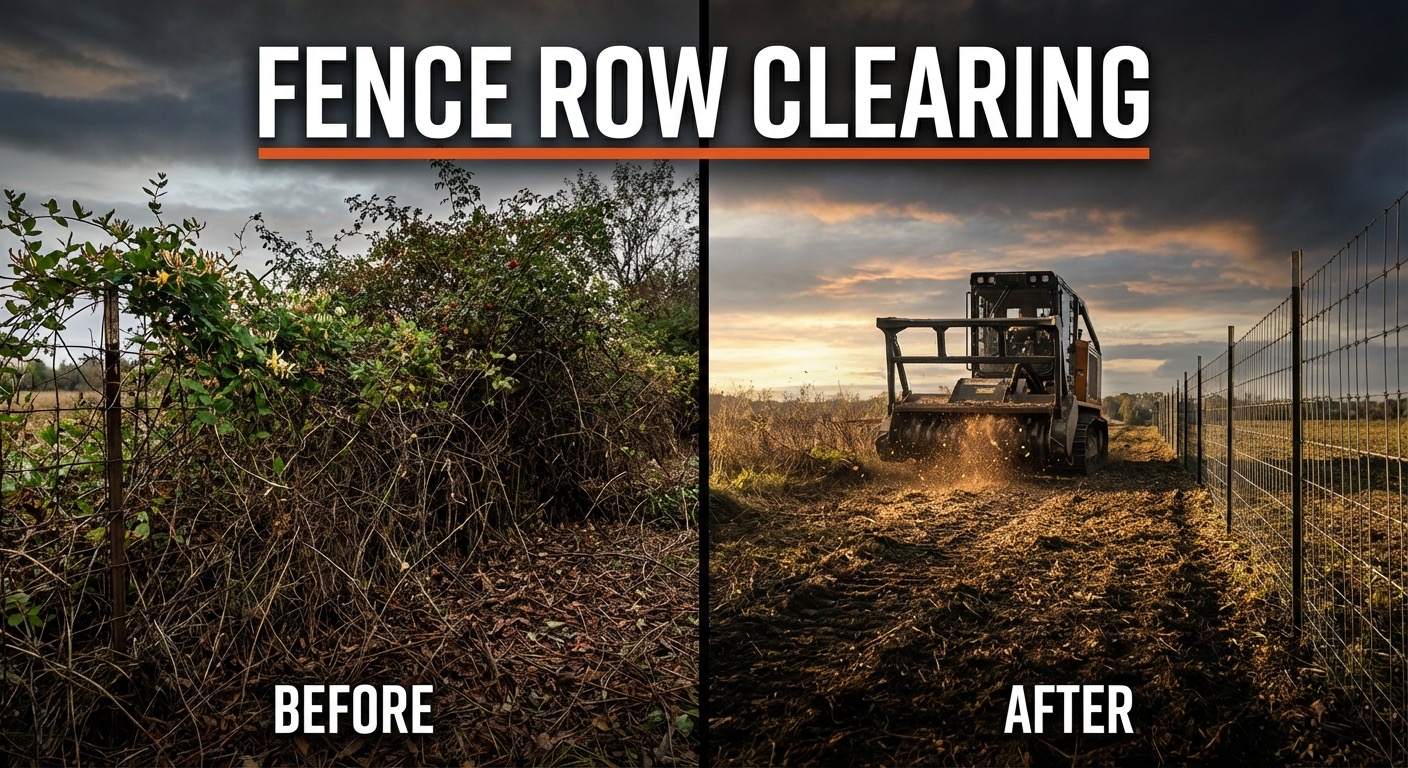
This is the biggest obstacle on most Cincinnati-area properties. Bush honeysuckle, multiflora rose, autumn olive, and other invasive species form impenetrable walls along property lines. These plants thrive on edges—the transition zone between maintained yard and woods—which is exactly where fences go.
A property line in Clermont County or Warren County that hasn't been maintained for five years can have honeysuckle 10 to 15 feet tall and so dense you can't walk through it. Your fence contractor isn't going to hack through that with hand tools. It needs to be mulched down to ground level before anyone can even survey the line, let alone install posts.
Old Fence Remnants
If you're replacing an existing fence, the old one needs to come out first. But here's what catches people off guard: old fences in Ohio often have decades of growth embedded in them. Trees have grown around wire. Posts have rotted and been absorbed into the soil. Barbed wire from the 1950s is buried under six inches of leaf litter and wrapped around root systems.
Pulling old wire out of grown-over fence rows is tedious, dangerous work. The wire is under tension from years of tree growth, and when you cut it, it can whip back. We've pulled hundreds of feet of old barbed wire out of fence rows during clearing jobs. It's much easier to do during the land clearing phase when you have heavy equipment on site than it is for a fence crew with hand tools.
Stumps and Root Systems
Fence posts need to go into the ground 30 to 42 inches deep, depending on the fence type and your county's frost line requirements. If there's a stump or major root system where a post needs to go, you've got a problem. The auger won't cut through it, and even if you muscle a post into a compromised hole, the root decay over the next few years will leave a void that lets the post shift.
Forestry mulching handles most small to medium stumps during the clearing pass. The mulching head grinds them down below grade, which is usually enough for fence post placement. Larger stumps on the fence line may need a dedicated stump grinder.
Terrain and Grade Issues
Ohio isn't flat. Properties in the hills of Clermont County, eastern Hamilton County, and parts of Warren County have significant grade changes that affect fence installation. Your clearing crew can identify and address terrain issues during the clearing phase: minor grading to create a level post line, removing soil berms from old fence rows, and filling washouts or erosion channels that cross the fence path.
Need Your Fence Line Cleared?
Use our instant pricing calculator to get an estimate for clearing your fence line. We work with all the major fence contractors in the Cincinnati area and can time our clearing to match your install schedule.
Get Instant PricingHow Wide to Clear for a Fence
This is one of the most common questions we get, and the answer depends on your fence type and long-term maintenance plan.
Minimum Clearance: 6 to 8 Feet Each Side
At bare minimum, you need 6 to 8 feet of clear ground on each side of the fence line. This gives the fence contractor room to operate their equipment, allows you to walk the fence for inspections and repairs, and keeps immediate vegetation from pressing against the fence.
For residential privacy fences in subdivisions and neighborhoods around Cincinnati, this minimum width is usually sufficient. The land on both sides is maintained as lawn, so regrowth isn't a major concern.
Recommended Clearance: 10 to 15 Feet Each Side
For rural properties, agricultural fencing, and any fence line that borders wooded areas, we recommend clearing 10 to 15 feet on each side. This wider corridor does three things. First, it keeps tree branches from overhanging and dropping limbs on the fence during storms. Second, it slows the encroachment of invasive species. Third, it gives you a maintenance path wide enough to drive a mower or small tractor along the fence for ongoing upkeep.
Honeysuckle and multiflora rose can grow 3 to 5 feet per year in southern Ohio. If you only clear 6 feet, you'll be fighting regrowth against the fence within two seasons. A 15-foot buffer gives you several years before vegetation reaches the fence, and it's wide enough to mow or brush hog to keep it clear.
Agricultural and Livestock Fencing: 15 to 20 Feet Each Side
If you're installing fence for livestock—horses, cattle, goats, or sheep—go wider. Livestock fencing takes a beating from animals leaning on it, rubbing against it, and pushing through vegetation to reach browse on the other side. A 20-foot clear zone on each side keeps the temptation of browse away from the fence line and gives you room to drive a tractor for fence repair.
Horse owners in particular should clear aggressively. Horses will chew on tree bark within reach of the fence, which kills the trees and creates falling hazards. A wide, clean buffer protects both the animals and the fence.
Best Clearing Methods for Fence Lines
You've got several options for clearing a fence line, and they're not all equal. Here's what works and what doesn't for fence prep in Ohio:
Forestry Mulching (Best Overall Option)
Forestry mulching is the gold standard for fence line clearing. A forestry mulcher is a tracked or wheeled machine with a rotating drum that grinds standing trees, brush, and stumps into mulch in a single pass. For fence line work, it's nearly ideal because it clears and processes everything at once with no hauling, no burning, and no debris piles.
The mulch left behind is actually beneficial for the fence corridor. It suppresses weed regrowth for the first season, prevents erosion on sloped terrain, and breaks down into organic matter that improves the soil. After the mulch settles for a few weeks, the ground underneath is firm enough for fence post installation.
We use forestry mulching for the vast majority of our fence line clearing jobs in Hamilton County, Warren County, Clermont County, and Butler County. It's faster than any other method, leaves the cleanest result, and costs less than cutting, hauling, and burning.
Brush Hogging
Brush hogging works for light vegetation: tall grass, weeds, small saplings under 2 inches in diameter, and thin brush. If your fence line runs through an overgrown field rather than through woods, a brush hog may be all you need. But a brush hog won't handle anything with a trunk. It cuts at the surface and leaves the root system intact, which means everything grows back within a season.
For rural properties where the fence line runs through old pasture, brush hogging is a reasonable first step. It gets the vegetation down so you can see the ground and survey the line. If you find trees or heavier brush during the survey, bring in the forestry mulcher for those sections.
Chainsaw and Hand Clearing
Manual clearing with chainsaws and hand tools is the most labor-intensive and expensive option on a per-foot basis. It makes sense for small jobs: clearing a few trees from a short residential fence line, removing a single problem area, or working in tight spaces where equipment can't fit. For anything over 100 feet of moderate to heavy brush, you'll spend more on labor than you would on a mulcher.
The other downside of hand clearing is debris management. Everything you cut has to go somewhere. That means chipping, hauling, or burning, each of which adds cost and time. Forestry mulching eliminates this step entirely.
Bulldozing (Usually Overkill)
Bulldozing a fence line removes everything, including the topsoil. It's effective but destructive. On most Ohio properties, the topsoil layer is 6 to 12 inches of valuable organic material that took centuries to build up. Scraping it off to clear a fence line means you're left with exposed clay subsoil that erodes, doesn't grow grass well, and turns to mud when it rains.
There are situations where dozer work is appropriate for fence lines: when you need to regrade significantly uneven terrain, when there's heavy rock or debris buried in the soil, or when the fence line doubles as a road or utility access. But for standard fence clearing, it's overkill.
Fence Line Clearing Costs in Ohio
Pricing for fence line clearing depends on the length of the run, the density of vegetation, the terrain, and the width of the corridor you need. Here are realistic numbers for the Greater Cincinnati area:
Light clearing (grass, weeds, thin brush, no trees): $1 to $3 per linear foot. A 500-foot residential fence line through overgrown grass runs $500 to $1,500.
Moderate clearing (honeysuckle, small trees under 6 inches, mixed brush): $3 to $6 per linear foot. The same 500-foot run through a honeysuckle thicket runs $1,500 to $3,000.
Heavy clearing (mature trees, dense invasive species, old fence removal, terrain challenges): $5 to $10 per linear foot. A 500-foot run through heavy timber on a hillside can run $2,500 to $5,000.
Most residential fence clearing jobs in the Cincinnati suburbs fall in the moderate range. Rural properties with more perimeter and heavier vegetation run higher, but the per-foot cost often drops on longer runs because the equipment mobilization cost is spread across more footage.
Keep in mind that you're going to spend money on clearing whether you do it now or later. Every year you wait, the brush grows thicker, the trees get bigger, and the cost goes up. Clearing before fence installation is always cheaper than clearing after you've already got a fence in the way.
Timing Your Clearing Before Fence Installation
The timeline between clearing and fence installation matters. Here's how to plan it:
2 to 4 Weeks Before Install
This is the sweet spot. Clear the fence line at least two weeks before the fence crew arrives. This gives the mulch time to settle, lets you spot any issues that were hidden under vegetation (drainage problems, rock outcrops, buried utilities, old fence remnants), and gives the fence contractor a clean look at the ground conditions before they commit to a post layout.
Best Season for Clearing
In Ohio, late fall through early spring (November through March) is the best time to clear fence lines. The ground is firm, there are no leaves to obscure the view, invasive species are dormant, and you can see the actual structure of the land. Clearing in summer means fighting full foliage, soft ground, and active regrowth.
That said, we clear fence lines year-round. If your fence contractor is scheduled for June, don't wait until November. Get the clearing done in April or May and let it settle before the install date.
Coordinating with Your Fence Contractor
Talk to your fence contractor before you schedule the clearing. Ask them exactly what they need: how wide the corridor should be, whether stumps need to be ground below grade, whether they need access for equipment on both sides of the fence, and whether they need the old fence removed. This information helps your clearing crew do the job right the first time so there are no surprises when the fence installer shows up.
We work with dozens of fence contractors across the Cincinnati area. If you need a recommendation for a fence installer, we're happy to connect you with companies we've worked alongside on past projects.
Property Lines, Surveys, and Neighbor Relations
Fence line clearing brings up property line questions that you need to address before any work begins.
Get a Survey First
If you don't have a recent survey showing your exact property lines, get one before clearing. A survey in the Cincinnati area costs $400 to $800 for a standard residential lot and $800 to $1,500 for larger rural parcels. That's a small price compared to the cost of clearing and fencing on the wrong line, then having to move everything when your neighbor disputes it.
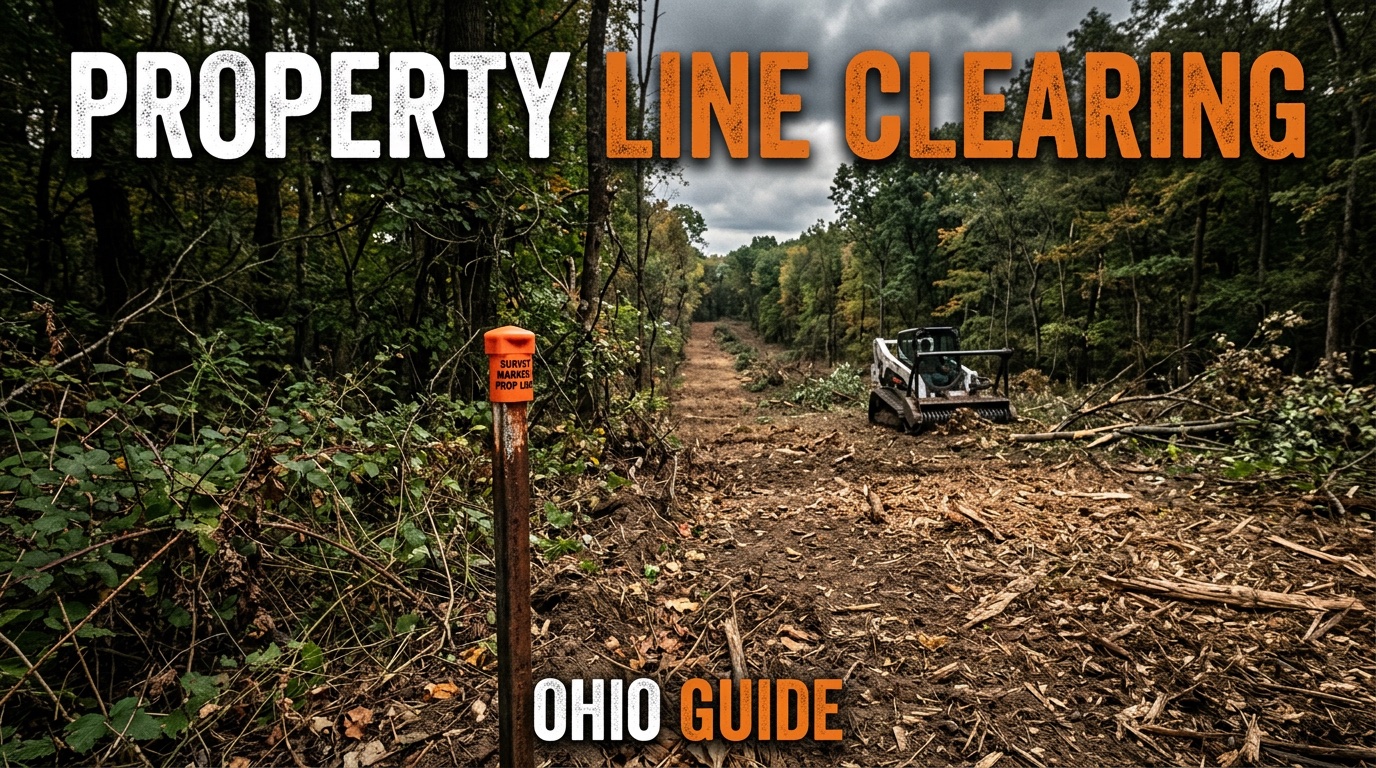
Survey stakes give your clearing crew a precise line to follow. Without them, you're guessing, and guessing on a property line creates legal problems that outlast the fence.
Talk to Your Neighbor
Ohio law treats trees on a property line as shared property. You can trim branches that hang over your side, but you can't remove a tree that straddles the boundary without your neighbor's consent. If you've got trees right on the line that need to come down for the fence, have that conversation before the clearing crew arrives.
In many cases, neighbors are happy to see the fence line cleared. It improves the appearance of both properties, and most people would rather have a clean fence than a wall of honeysuckle. But surprises create conflict. A quick conversation prevents a lot of headaches.
Setback Requirements
Most Ohio municipalities require fences to be set back from the property line, not on it. In Hamilton County, the typical setback is 6 inches to 1 foot. HOA communities may have stricter requirements. Make sure you know your setback before you define the clearing corridor, because the fence will actually sit slightly inside your property line, and the clearing width should be measured from the fence position, not the property boundary.
Ready to Clear Your Fence Line?
Get in touch for a free site assessment. We'll walk your fence line, identify what needs to be cleared, and give you a clear price before any work begins.
Get a Free QuoteCommon Fence Types and Their Clearing Requirements
Different fence types have different ground preparation needs. Here's what to keep in mind for the most common fences installed in Ohio:
Wood Privacy Fence
Privacy fences are the most popular residential fence in the Cincinnati market. They require posts every 6 to 8 feet, each set 30 to 36 inches deep. The ground needs to be completely clear of stumps and roots for the full length of the fence because there's no flexibility in post spacing—every panel is the same width. Clear the corridor to at least 8 feet on each side so the fence contractor can work from both sides during installation.
Chain Link Fence
Chain link is more forgiving of minor ground irregularities because the mesh flexes. But the terminal posts, line posts, and top rail still need to be precisely placed. Clear the same width as a privacy fence. Chain link is common for dog runs, pool enclosures, and property boundaries in suburban Hamilton County.
Split Rail and Post-and-Board Fence
These are the most common fence types on rural Ohio properties and horse farms. Posts are set further apart (8 to 10 feet) and the rails can flex slightly, so minor ground irregularities are less of an issue. However, these fences often run long distances—thousands of feet on a farm property—so the total clearing project is larger even though the per-foot requirement is simpler.
Woven Wire and High-Tensile Fence
Agricultural wire fencing for livestock requires the straightest possible line and even tension across the full run. Any tree, stump, or obstacle that forces the wire to deviate creates a stress point that will eventually fail. Clear a generous corridor—15 to 20 feet—and make sure there are no obstacles that will interfere with the wire stretching process.
Vinyl and Composite Fence
Vinyl fence panels are rigid and unforgiving. They crack if forced into a curve or if the ground shifts underneath them. The fence line needs to be dead straight and the ground needs to be level or uniformly graded. Vinyl fences also need clean post holes because the posts are hollow and rely on concrete fill for strength—any root debris in the hole compromises the set.
After Clearing: Maintaining Your Fence Line
Clearing your fence line is not a one-time project. Ohio's climate and soil are incredibly productive, which means vegetation comes back fast. If you don't maintain the cleared corridor, you'll be back to square one in three to five years.
Here's how to keep your fence line clear after installation:
Mow regularly. If the corridor is wide enough for a mower, run it along both sides of the fence every two to three weeks during the growing season. This prevents new brush from establishing and keeps grass short enough that it doesn't push against the fence.
Spot-treat invasive regrowth. Honeysuckle, multiflora rose, and tree of heaven will sprout from root systems after clearing. Monitor your fence line through the first two growing seasons and treat new sprouts with a targeted herbicide or cut them before they get established.
Inspect annually. Walk the full fence line at least once a year—ideally in late fall when leaves are down and you can see the structure. Look for trees that have grown into the fence, vines climbing the posts, and soil erosion undermining post bases.
Plan for touch-up clearing. Even with regular mowing, you'll likely need a light clearing pass every three to five years to remove saplings and brush that has grown back along the outer edge of the corridor. This maintenance clearing is far less expensive than the initial job.
Frequently Asked Questions
How much does it cost to clear a fence line in Ohio?
Fence line clearing in the Cincinnati area typically costs $2 to $6 per linear foot depending on the density of brush, tree size, and terrain. A standard residential property with 500 feet of fence line runs $1,000 to $3,000 for moderate clearing. Rural properties with heavier timber or steep terrain can run higher.
How wide should I clear for a new fence?
Clear at least 6 to 8 feet on each side of where the fence will be installed for residential fences. For rural and agricultural fencing, clear 15 to 20 feet on each side to prevent trees from falling on the fence and to allow maintenance access.
Do I need to remove tree stumps before installing a fence?
Stumps directly in the path of the fence need to be ground below grade for post placement. Forestry mulching handles most small to medium stumps during the clearing process. Larger stumps may need a dedicated stump grinder.
Can I install a fence on a property line that has trees and brush?
No reputable fence contractor will install posts into root systems or set panels against standing trees. You need a clear corridor along the fence line first. Trees on the property line are considered shared property under Ohio law, so discuss removal with your neighbor before clearing.
How long before fence installation should I clear the land?
Clear the fence line at least 2 to 4 weeks before your fence contractor is scheduled. This gives time for the ground to settle, lets you identify hidden obstacles, and ensures the mulch has started to compact for stable post installation.
Do I need a permit to clear land for a fence in Ohio?
The clearing itself typically does not require a permit in most Ohio counties. However, the fence installation often does. Hamilton County, Warren County, and Clermont County all have setback requirements and height restrictions for fences. Check with your local zoning office and HOA before starting work.
Bottom Line
A new fence is only as good as the ground it sits on. Skipping the clearing step—or doing it poorly—sets up every fence problem you'll deal with for the next 20 years: leaning posts, misaligned panels, vegetation damage, and premature rot from organic material packed against the fence base.
The investment in proper fence line clearing pays for itself almost immediately. Your fence contractor works faster on clean ground, which saves you money on labor. The fence goes in straighter, which means it looks better and lasts longer. And a clean corridor with regular maintenance means you're not paying for emergency repairs every time a branch falls or a tree grows into the wire.
If you're planning a fence project anywhere in Greater Cincinnati—Hamilton County, Warren County, Clermont County, Butler County, or the surrounding areas—get the fence line cleared first. It's the single best investment you can make in the longevity of your fence.
Give us a call or use the pricing calculator to get a quick estimate. We'll walk the fence line with you, identify what needs to go, and have the corridor ready before your fence contractor arrives.