
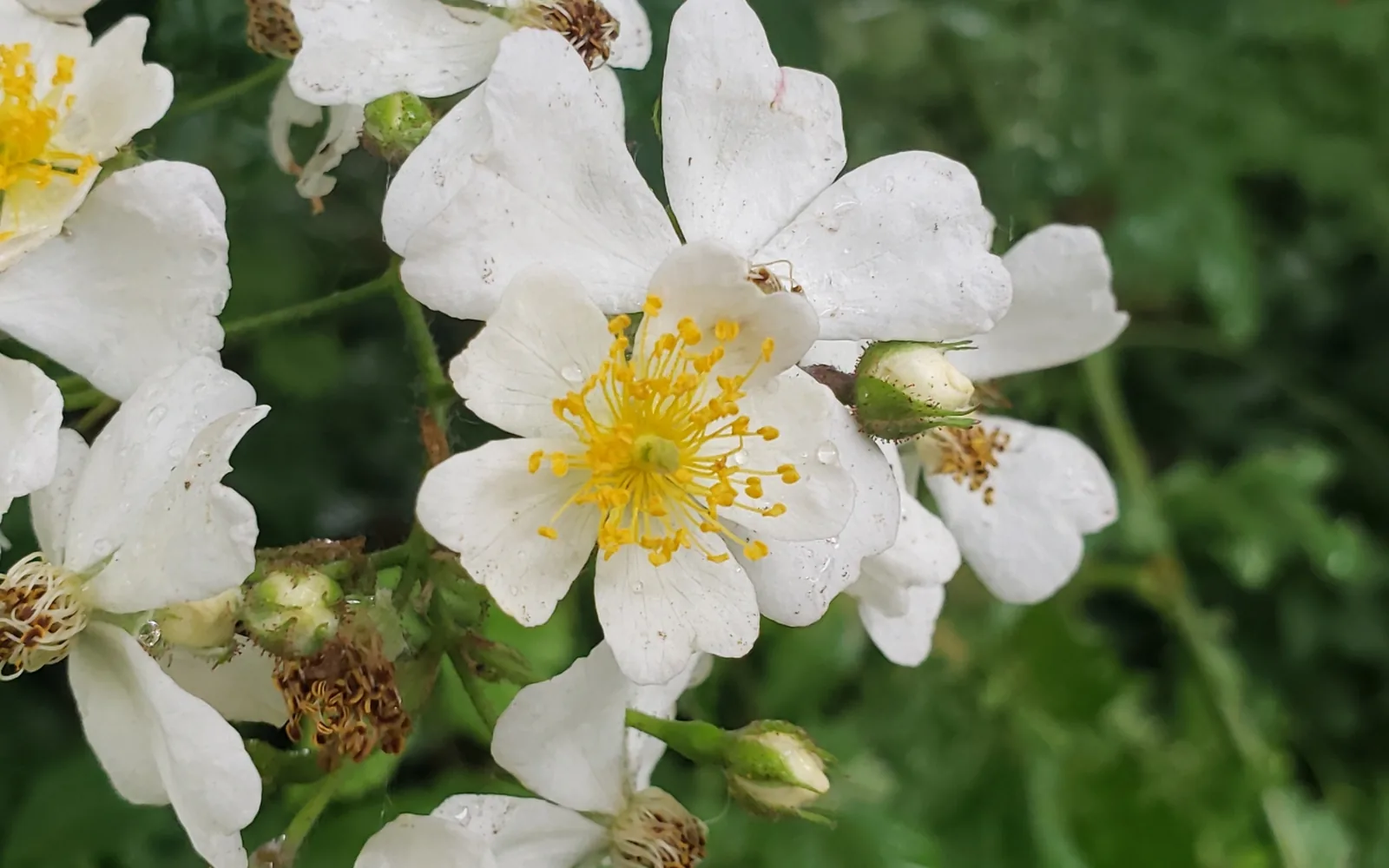
What Is Multiflora Rose and Why Is It a Problem?
Multiflora rose (Rosa multiflora) is an invasive shrub that was originally introduced from Asia in the 1860s. The USDA promoted it heavily in the mid-20th century for erosion control, living fences, and wildlife habitat. What they didn't anticipate was how aggressively it would spread and dominate native ecosystems.
Today, multiflora rose is classified as a noxious weed in Ohio and many other states. It's illegal to sell or plant it, but the damage is already done—it has spread across millions of acres of farmland, forests, and residential properties throughout the Midwest.
Here's why multiflora rose is such a serious problem:
- • Grows 6–15 feet tall with arching, thorny canes—creates impenetrable walls that block access to your property
- • Curved thorns that grab and tear—unlike straight thorns, these hook into skin and clothing, causing painful lacerations
- • Produces up to 500,000 seeds per plant annually—birds eat the rose hips and spread seeds across wide areas
- • Forms dense thickets that shade out native plants—creates monocultures where nothing else can grow
- • Root systems resprout aggressively—cut stems regrow quickly unless the root crown is destroyed
- • Harbors ticks and provides cover for unwanted wildlife—the dense growth is perfect habitat for pests
Multiflora rose is actually worse than honeysuckle.
While honeysuckle removal is difficult, at least you can push through it without bleeding. Multiflora rose's curved thorns make every inch of progress painful and dangerous. The thorns can cause infections if wounds aren't properly cleaned.
How to Identify Multiflora Rose
Before you can effectively remove multiflora rose, you need to correctly identify it. Here are the key characteristics to look for:
Spring/Summer Identification
- • White flowers in clusters—small, fragrant white or pink flowers bloom in May-June
- • Compound leaves—5-11 leaflets per leaf, with serrated edges
- • Fringed stipules—distinctive feathery projections where leaf meets stem (key identifier)
- • Arching canes—long, flexible branches that arch over and root where they touch ground
Fall/Winter Identification
- • Small red rose hips—clusters of small (1/4") red fruits persist through winter
- • Thorny canes visible—curved thorns clearly visible on bare branches
- • Dense thicket structure—even without leaves, the tangled growth pattern is distinctive
- • Last year's rose hips—dried hips often remain on the plant
The Fringed Stipule Test
The easiest way to confirm multiflora rose is to look at the base of the leaf stem where it attaches to the main cane. Multiflora rose has distinctive fringed (feathery) stipules that look like tiny combs. Native roses have smooth or only slightly toothed stipules.
The Ohio Multiflora Rose Problem: A Brief History
Understanding how multiflora rose spread helps explain why it's so difficult to control. The plant's invasion of Ohio happened in several waves:
- • 1930s-1960s: USDA and state agencies actively promoted multiflora rose as a "living fence" for livestock and erosion control
- • 1940s-1950s: Ohio conservation programs distributed millions of free multiflora rose seedlings to farmers
- • 1960s-1980s: The plant began escaping cultivation and spreading into forests, roadsides, and abandoned fields
- • 1980s-present: Ohio classified multiflora rose as a noxious weed, but populations continue to expand
Today, multiflora rose is found in all 88 Ohio counties. It's particularly problematic in the rolling hills of southern Ohio and the agricultural areas around Cincinnati, where it invades fence rows, forest edges, pastures, and residential properties.
The same characteristics that made it attractive for living fences—fast growth, dense thorny structure, and prolific seed production—make it nearly impossible to control without professional equipment.
Multiflora Rose Removal Methods: What Works and What Doesn't
Property owners dealing with multiflora rose infestations have several removal options, but not all are equally effective or practical. Here's an honest assessment of each method:
METHOD #1: Forestry Mulching (Best Solution)
Professional forestry mulching uses high-powered rotary drum mulchers to grind multiflora rose—thorns, canes, and root crowns—into chips. The equipment doesn't care about thorns, and the operator stays safely inside the cab.
- ✅ Fastest method by far—clear an acre of dense multiflora rose in a day
- ✅ Safest for humans—no contact with thorns required
- ✅ Destroys the root crown—dramatically reduces regrowth
- ✅ No hauling or burning required—material is mulched in place
- ✅ Works on any terrain—our RCU-55 handles steep hillsides where multiflora rose often grows
Brushworks Specializes in Thorny Invasive Removal
Our FAE mulching heads are specifically designed for woody invasive species. We've removed multiflora rose from hundreds of properties across Cincinnati—from quarter-acre backyards to multi-acre farm fields. Learn more about our forestry mulching services.
METHOD #2: Cut and Treat
Process:
- • Cut canes with loppers or chainsaw
- • Immediately apply herbicide to cut stumps
- • Dispose of thorny debris
Limitations:
- ⚠️ Extremely slow and dangerous
- ⚠️ High risk of injury from thorns
- ⚠️ Debris disposal is problematic
- ⚠️ Must treat within 30 minutes of cutting
- ⚠️ Only practical for small patches
METHOD #3: Herbicide Foliar Spray
Process:
- • Spray leaves with herbicide
- • Wait for plant to die back
- • Remove dead material
Limitations:
- ❌ Takes months to show results
- ❌ Dead thorny canes still need removal
- ❌ Risk to nearby desirable plants
- ❌ Multiple treatments often needed
- ❌ Doesn't prevent regrowth from roots
METHOD #4: Mowing/Brush Hogging (Not Recommended)
Standard mowing equipment cannot effectively handle multiflora rose. The thorny canes wrap around mower decks, clog equipment, and leave sharp debris scattered across the property.
- ❌ Doesn't destroy root crown—promotes regrowth
- ❌ Thorns damage equipment
- ❌ Leaves dangerous sharp debris
- ❌ Must be repeated multiple times per year
How Much Does Multiflora Rose Removal Cost in Cincinnati?
Multiflora rose removal typically costs 10-20% more than standard honeysuckle removal due to the slower processing speeds required by the thorny canes. Here are realistic pricing ranges for forestry mulching in Greater Cincinnati:
Light to Moderate Infestation
$1,600–$2,200 per acre
Scattered multiflora rose bushes mixed with other vegetation. Equipment can navigate around and between plants.
Dense Thickets
$2,200–$3,200+ per acre
Solid walls of multiflora rose with overlapping canes. Requires slower, more methodical processing to fully grind material.
Hillside/Difficult Access
$2,800–$3,800+ per acre
Steep terrain or limited access points. May require specialized equipment like our remote-controlled RCU-55.
Minimum Project Fee
$800–$1,200
Small projects (under 1/4 acre) have minimum fees to cover equipment mobilization and setup.
Get Your Specific Price
Every property is different. Use our instant pricing calculator for a quick estimate, or request a custom quote for a detailed assessment. We provide project-based pricing—not open-ended hourly rates—so you know the cost before work begins.
Removal Timeline: How Long Does It Take?
Forestry mulching is dramatically faster than any manual method. Here are realistic timelines for multiflora rose removal:
Small Backyard Patch
2-4 hours for most residential properties with scattered multiflora rose. Includes setup and cleanup time.
Half Acre to One Acre
4-8 hours depending on density. Most single-acre projects are completed in one full day.
Multi-Acre Properties
1-3 days for 2-5 acres. Larger properties may require multiple days, especially with dense infestations or challenging terrain.
Compare this to manual removal: a single acre of dense multiflora rose could take a crew of workers several weeks to clear by hand—assuming they're willing to endure the constant thorn injuries.
Preventing Regrowth After Removal
Forestry mulching destroys the root crown of multiflora rose, which prevents regrowth from existing plants. However, the soil likely contains thousands of seeds that can remain viable for years. Here's how to prevent reinfestation:
- • Monitor annually in spring—new seedlings are much easier to control when small
- • Pull or spot-treat seedlings—young multiflora rose plants have smaller thorns and can be removed manually
- • Establish competing vegetation—dense native plantings or grass can outcompete seedlings
- • Consider follow-up herbicide treatment—targeted application can prevent seedlings from establishing
Brushworks Provides Ongoing Support
We offer guidance on long-term maintenance and can schedule annual touch-up visits if needed. The key is catching new growth early before it develops the extensive root system and thorny structure of mature plants.
Best Time to Remove Multiflora Rose
While we can remove multiflora rose year-round when ground conditions allow, certain times offer advantages:
Best: Late Fall – Early Spring
- ✅ Leaves are gone—better visibility of cane structure
- ✅ Ground is firm—better equipment traction
- ✅ Plant is dormant—less sap in canes
- ✅ Easier to identify extent of infestation
Good: Late Spring – Summer
- ✅ Flowering helps confirm identification
- ✅ Full leaf coverage shows plant boundaries
- ⚠️ Denser foliage slows processing slightly
- ⚠️ May need to work around wet conditions
Frequently Asked Questions
Is multiflora rose removal more expensive than honeysuckle removal?
Yes, typically 10-20% more. The thorny canes require slower processing speeds to ensure complete grinding. Dense multiflora rose thickets take more time than equivalent honeysuckle walls.
Can I remove multiflora rose myself?
Small patches (under 10 bushes) can be removed manually if you have thick leather gloves, long sleeves, loppers, and a mattock for digging out roots. However, this is exhausting, painful work with high injury risk. For anything larger than a small patch, professional removal is far more practical.
Will goats eat multiflora rose?
Goats will browse multiflora rose leaves and can help control small infestations, but they won't eliminate established plants. They can suppress growth when used as part of an integrated management approach, but they're not a standalone solution for clearing dense thickets.
What should I do with the thorny debris after removal?
With forestry mulching, there's no debris to dispose of—everything is ground into mulch that remains on site. This is a major advantage over manual removal methods, which leave piles of thorny material that are dangerous to handle and difficult to dispose of.
Will the thorns break down in the mulch?
Yes. The mulching process grinds thorns into small fragments that decompose relatively quickly. Within a few months, the thorny material will have broken down enough that the area is safe to walk on.
Service Areas for Multiflora Rose Removal
Brushworks provides professional multiflora rose removal throughout Greater Cincinnati and surrounding areas:
Loveland
Mason
Maineville
Lebanon
West Chester
Goshen
Milford
Batavia
Clermont County
Warren County
Hamilton County
Butler County
Ready to Reclaim Your Property from Multiflora Rose?
Don't let thorny invasive species control your land. Brushworks can remove years of multiflora rose overgrowth safely and efficiently—without you having to touch a single thorn.
Whether you're dealing with a few aggressive bushes in your backyard, multiflora rose walls along your fence line, or acres of thorny thickets on rural property, we have the equipment and expertise to clear it quickly. Get an instant price estimate or contact us for a custom quote.
