
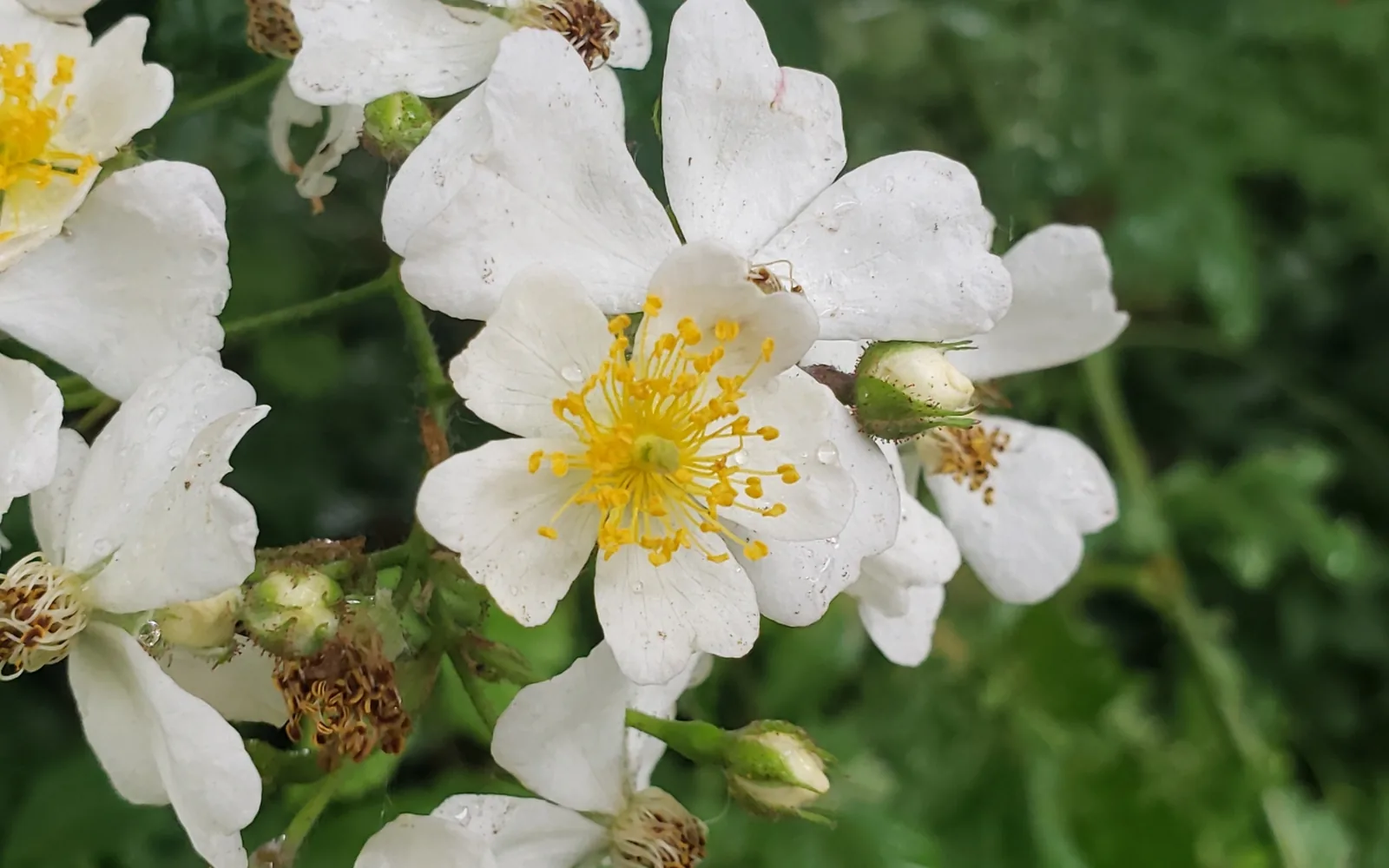
What Is Multiflora Rose and Why Is It Everywhere in Ohio?
Multiflora rose (Rosa multiflora) is an invasive shrub from East Asia that the U.S. government actually told people to plant. From the 1930s through the 1960s, the USDA, the Ohio Department of Natural Resources, and county soil and water districts promoted multiflora rose as a "living fence" for livestock, erosion control on highway medians, and wildlife habitat for birds and small game.
That turned out to be one of the worst conservation mistakes in Ohio history.
A single multiflora rose bush produces up to a million seeds per year. Birds eat the small red rose hips and spread seeds everywhere they perch. Each seed can sit dormant in the soil for 10 to 20 years waiting for the right conditions to sprout. One plant becomes a thicket. One thicket becomes an impenetrable wall of thorns that swallows fence lines, pastures, forest edges, and abandoned lots across the entire state.
Today, multiflora rose grows in all 88 Ohio counties. Ohio classified it as a noxious weed under state law, which means you can technically be required to control it on your land. It's in fence rows, woodlots, old fields, road ditches, stream banks, and any piece of ground that hasn't been actively managed for a few years.
If you own rural property in Ohio, you've almost certainly got it.
How to Identify Multiflora Rose
Multiflora rose gets confused with other thorny plants in Ohio, so correct identification matters before you spend money on removal. Here's what to look for:
Growth Habit
Multiflora rose grows as a dense, arching shrub that can reach 10-15 feet tall and 10-15 feet wide. The canes arch over and root where they touch the ground, which is how a single plant spreads into a thicket without birds carrying seeds. Old plants develop thick woody bases 3-4 inches in diameter at the root crown.
Thorns
The thorns curve downward along the canes, like tiny fishhooks. This is why multiflora rose is so nasty to walk through. The thorns grab clothing and skin and pull you deeper into the bush rather than just poking you. They're smaller than black locust thorns but more numerous and harder to avoid.
Leaves
Compound leaves with 5-11 leaflets, each with serrated edges. The dead giveaway is the fringed stipule at the base of each leaf stem. This fringed stipule (it looks like a tiny comb or fringe of hairs) is unique to multiflora rose and separates it from other wild roses in Ohio.
Flowers and Fruit
White to pinkish flowers bloom in clusters from late May through June. Each flower is small, about 3/4 inch across, with five petals. By fall, the flowers turn into clusters of small red rose hips about 1/4 inch in diameter. These hips hang on the plant through winter, feeding birds that spread seeds across your property and your neighbor's property and every property in between.
Common Look-Alikes
Ohio has several native wild roses that are worth keeping. Carolina rose and pasture rose both have pink flowers and thorns, but they grow as low shrubs (under 3 feet) and have straight thorns rather than curved ones. They also lack the fringed stipules. If you're not sure what you have, snap a photo and send it to your county extension office. They'll tell you for free.
Why Multiflora Rose Is Such a Problem on Ohio Properties
Multiflora rose isn't just ugly. It causes real damage to Ohio properties in ways that cost landowners money:
Pasture Loss
Cattle won't graze near multiflora rose. The thorns cut their mouths and faces. A single bush in a pasture creates a dead zone around it where cattle refuse to go, and that dead zone grows bigger every year as the rose spreads. Ohio livestock farmers lose hundreds of acres of productive pasture to multiflora rose every season.
Fence Destruction
Multiflora rose loves growing along fence lines. The canes wrap through the wire, weigh it down, and eventually pull posts out of the ground. Clearing a fence row that's been taken over by multiflora rose means replacing the fence too, because the wire is bent, stretched, and embedded in thorny growth.
Timber Stand Damage
In Ohio woodlots, multiflora rose forms a dense understory that blocks native tree seedlings from growing. Oaks, hickories, maples, and walnuts can't regenerate because the rose takes all the light and space at ground level. Over decades, this thins out the canopy as mature trees die with no replacements coming up underneath.
Property Value
Try selling a 10-acre parcel that's half multiflora rose thicket. Buyers see it and mentally subtract the clearing cost from their offer. In parts of southern and eastern Ohio where multiflora rose has taken over entire hillsides, property values reflect the problem.
Safety
Multiflora rose thickets are genuinely dangerous to walk through. The curved thorns grab and don't let go. Every year, landowners end up in urgent care with deep scratches, puncture wounds, and infections from trying to cut through multiflora rose by hand without proper equipment. The thorns can penetrate leather gloves and heavy canvas clothing.
Multiflora Rose Removal Methods: What Works and What Doesn't
Not all removal methods are equal. Here's an honest breakdown of your options in Ohio:
Forestry Mulching (Best for Large Areas)
A forestry mulcher grinds the entire plant — canes, root crown, and all — into wood chips in a single pass. The mulcher head spins at high RPM and processes multiflora rose without anyone having to touch the thorny canes by hand. The operator stays in an enclosed cab and drives through the infestation.
This is the fastest and most effective method for anything over a quarter acre of multiflora rose. The mulcher destroys the root crown, which prevents regrowth from the existing plant. The ground cover left behind suppresses new seedlings and prevents erosion.
One thing to know: multiflora rose canes can wrap around the mulcher drum and slow production compared to processing honeysuckle or other woody invasives. Experienced operators know how to manage this, but it's why multiflora rose removal costs a bit more than standard brush clearing.
Get an instant estimate for multiflora rose removal →
Herbicide Treatment (Best for Scattered Plants)
For isolated bushes or small patches, targeted herbicide application works well. Cut the canes to the ground and immediately paint the cut stumps with triclopyr or glyphosate. The "cut stump" method gets herbicide directly into the root system. Foliar spraying works too, but you'll hit everything around the rose and kill native plants you might want to keep.
Herbicide alone is impractical for dense infestations. You can't spray what you can't reach, and walking into a multiflora rose thicket to do cut-stump treatment is a bloody, miserable experience.
Mechanical Removal + Herbicide Combo
For the most stubborn situations, forestry mulching followed by targeted herbicide on any regrowth gives the best long-term results. The mulcher removes 95% of the problem in one pass. Then you come back 6-12 months later and spray or cut-stump treat the handful of plants that resprout from root fragments or germinate from the seed bank.
Brush Hogging (Temporary Fix)
Brush hogging knocks down the top growth but leaves the root crown intact. Multiflora rose resprouts from the roots within weeks. You'll be mowing the same area multiple times per year, every year, forever. Brush hogging is fine as a maintenance tool after the root crowns have been destroyed, but it's not a removal method on its own.
Hand Removal (Small Scale Only)
If you have fewer than a dozen bushes and they're not full-grown monsters, you can remove them by hand. Use thick leather gloves (not cloth — the thorns go right through), loppers, a brush saw, and a mattock or pulaski to dig out the root crown. This is hard, slow, painful work. Most people try it once and then call a professional.
Goats (Slow but Effective for Ongoing Control)
Goats eat multiflora rose, thorns and all. They won't eliminate an established thicket quickly, but they'll steadily browse it back over a couple of growing seasons. Some Ohio landowners bring in goat herds for invasive management, and it works well as a follow-up to mechanical clearing. The goats handle the regrowth and seedlings that pop up after the mulcher does the heavy lifting.
Multiflora Rose Removal Costs in Ohio
Pricing depends on how dense the infestation is and how much area you need cleared. Here's what we typically see across Ohio:
Light Infestation (Scattered Bushes in Otherwise Clear Ground)
- Density: Less than 30% ground coverage
- Cost: $1,600 - $2,200 per acre
- Timeline: Half day per acre
- Common in: Pasture edges, fence rows, woodlot margins
Moderate Infestation (Rose Mixed with Other Brush)
- Density: 30-60% ground coverage
- Cost: $2,200 - $2,800 per acre
- Timeline: Full day per acre
- Common in: Abandoned fields, old homesteads, neglected woodlots
Heavy Infestation (Dense Thicket, Rose Everywhere)
- Density: Over 60% ground coverage
- Cost: $2,800 - $3,500 per acre
- Timeline: 1-2 days per acre
- Common in: Overgrown CRP land, stream corridors, old fence lines that haven't been maintained in 10+ years
These prices reflect forestry mulching. Hand clearing or herbicide-only approaches cost less per visit but require repeated treatments, so total cost over 2-3 years often exceeds what you'd pay for one mulching pass plus a follow-up spray.
Cost-Saving Tip
If you're clearing multiflora rose from a fence row, combine it with clearing the fence row on both sides. Running the mulcher down a fence line is most efficient when you do the full width in one pass rather than coming back later for the second side. Most operators charge a mobilization fee ($300-$500), so batching work into one visit saves money.
Multiflora Rose by Region: Where It's Worst in Ohio
Multiflora rose grows in every Ohio county, but some regions have it worse than others:
Southwest Ohio (Cincinnati, Dayton, Hamilton, Butler, Warren, Clermont Counties)
The hilly terrain and mix of forest and pasture in southwest Ohio creates perfect conditions for multiflora rose. Steep hillsides that are hard to mow become multiflora rose strongholds. The mix of rural and suburban properties means some parcels get maintained while neighboring parcels become seed sources that reinfest the whole area. This is our home territory, and we see multiflora rose on the majority of properties we quote.
Southeast Ohio (Appalachian Foothills)
Strip-mined land, abandoned farmsteads, and steep terrain make southeast Ohio one of the most heavily infested regions. Many of these properties haven't been actively managed in decades. The rose moved in alongside autumn olive and honeysuckle and now controls the understory across thousands of acres.
Central Ohio (Columbus Metro, Franklin, Delaware, Licking Counties)
Suburban expansion in central Ohio creates a constant supply of neglected edges — highway interchanges, utility easements, retention basins, and the back corners of subdivisions that nobody maintains. Multiflora rose fills these gaps fast.
Northwest Ohio (Agricultural Flat Land)
Less of a problem in the flat, heavily farmed areas because annual tillage and mowing keep it in check. But anywhere there's a woodlot, drainage ditch, or unfarmed corner, multiflora rose shows up. Fence rows between fields are a common trouble spot.
Ohio Regulations on Multiflora Rose
Ohio law classifies multiflora rose as a noxious weed under Ohio Revised Code 901:5-37. Here's what that means for property owners:
- County weed boards can require control: If your multiflora rose is spreading onto neighboring properties, the affected neighbor can file a complaint with the county weed board. The board can issue a notice requiring you to control the weed within a set timeframe.
- Enforcement is rare: In practice, most county weed boards in Ohio don't actively enforce multiflora rose control. They have limited budgets and bigger issues to deal with. But the legal mechanism exists, and complaints between neighbors do happen.
- No permits needed for removal: You don't need a permit to remove multiflora rose from your property. It's listed as a noxious weed, so the state actively wants you to get rid of it.
- ODNR programs may help with costs: Check with your county soil and water conservation district about cost-share programs for invasive species removal. Some counties have programs through ODNR or USDA EQIP that reimburse landowners for part of the cost of removing invasive plants from their property.
After Removal: Keeping Multiflora Rose From Coming Back
Removing the existing plants is the easy part. Keeping multiflora rose from re-establishing is the real challenge, because those seeds in the soil don't quit. Here's a realistic management plan:
Year One: Initial Clearing
Forestry mulching removes all the existing plants. The mulch layer on the ground suppresses germination of seeds near the surface. You'll see some resprouts from root fragments in the first growing season. Monitor the cleared area monthly during the first summer and fall.
Year Two: Follow-Up Treatment
Walk the area in late spring and early summer looking for new seedlings and resprouts. Young multiflora rose is easy to pull by hand when it's small, or spot-spray with herbicide. This is the most critical year. Miss the regrowth now and you're back to square one in 3-4 years.
Years Three Through Five: Annual Monitoring
Check the area once or twice per year. New seedlings will keep popping up from the seed bank and from bird-deposited seeds. The volume drops each year as the seed bank depletes. By year five, you should be dealing with only a handful of new plants per acre per year.
Establish Competing Vegetation
The best defense against multiflora rose regrowth is dense, competitive ground cover. In pastures, maintain thick grass through proper grazing rotation and fertility. In woodlots, promote native understory plants that shade out rose seedlings. On open ground, seed with a native grass and wildflower mix that fills in fast and crowds out invasive seedlings.
Questions about multiflora rose on your property? Contact us →
Frequently Asked Questions
Is multiflora rose illegal in Ohio?
Yes. Ohio lists multiflora rose as a noxious weed under Ohio Revised Code 901:5-37. County commissioners can require landowners to control it on their property. In practice, enforcement is rare, but your neighbors can file complaints with the county weed board if your multiflora rose is spreading onto their land.
How much does multiflora rose removal cost per acre in Ohio?
Forestry mulching of multiflora rose runs $1,800-$3,500 per acre in Ohio depending on density. Light infestations with scattered bushes cost less. Dense thickets where rose has taken over the understory take longer to process because of the thorny canes wrapping around the mulcher head. Most properties fall in the $2,000-$2,800 range.
Will multiflora rose grow back after removal?
Existing plants won't regrow if the root crown is destroyed, which forestry mulching does well. But multiflora rose seeds stay viable in soil for 10-20 years, and birds constantly spread new seeds. Plan on monitoring your cleared area annually and spot-treating any seedlings that pop up. The first two years after clearing are the most important.
What's the best time to remove multiflora rose in Ohio?
Late fall through early spring when the plant is dormant and leaves are gone. You can see the thorny canes clearly, the ground is firm for equipment access, and there's no risk of disturbing nesting birds. That said, forestry mulching can handle multiflora rose year-round if scheduling demands it.
Can I remove multiflora rose with a brush hog?
A brush hog will knock down the top growth but won't kill the plant. Multiflora rose resprouts aggressively from the root crown after mowing. You'll be mowing the same patch 2-3 times per year forever. Forestry mulching grinds the root crown below ground level, which actually kills the plant rather than just giving it a haircut.
Related Articles
Invasive Species Removal Cincinnati
Complete guide to removing honeysuckle, autumn olive, and other invasive plants in the Cincinnati area.
Read Article →Bush Honeysuckle Removal Ohio
Deep dive on Ohio's number one invasive shrub and the most effective removal strategies.
Read Article →Fence Row Clearing Ohio
How to reclaim fence rows from brush, invasives, and overgrowth on Ohio farms and rural properties.
Read Article →