
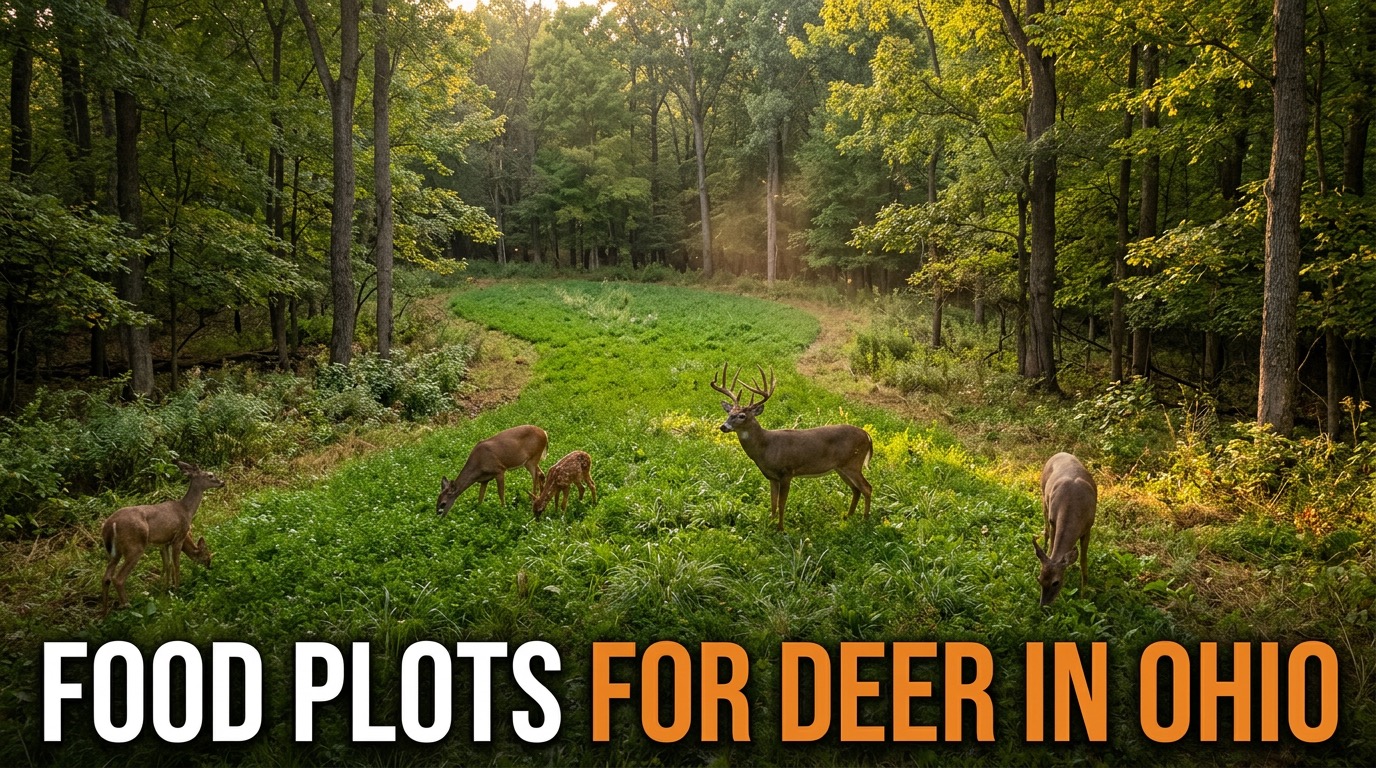
Why Food Plots Matter for Ohio Deer Hunting
Ohio produces big deer. The state consistently ranks in the top 10 for Boone and Crockett entries, and southern Ohio counties like Adams, Pike, Scioto, and Brown are known for growing true giants. But trophy bucks do not just happen. They need nutrition, cover, and a reason to stay on your property instead of the neighbor's.
That is where food plots come in. A well-placed food plot does three things at once: it provides high-protein nutrition that helps bucks grow bigger antlers and does produce healthier fawns, it concentrates deer movement into predictable patterns you can hunt, and it gives deer a reason to bed and feed on your ground instead of wandering to the next property.
Ohio's natural food sources are decent. Acorns, browse, and agricultural crops all contribute to the deer diet. But there are gaps. Late winter is brutal when acorns are gone and crops have been harvested. Late summer, before acorn drop, is another dead zone for nutrition. Food plots fill those gaps and keep deer on your property year-round.
The hunting benefit is obvious. Deer that use your food plots regularly create trails you can pattern. You know where they are going to be, when they are going to be there, and you can set stands accordingly. A food plot is not a magic deer magnet, but it is the single best habitat improvement most Ohio property owners can make.
Picking the Right Location on Your Property
Location matters more than seed selection, fertilizer, or any other variable. A perfect food plot in a bad location will not get used during daylight. A mediocre plot in the right spot will have deer on it every afternoon.
Proximity to Bedding Areas
The best food plot locations sit between bedding cover and other food sources. In Ohio, deer typically bed on ridge points, in thick brush on hillsides, or in overgrown CRP-type cover. They travel from bedding to food in the late afternoon and return before dawn. Put your plot along that travel route, close enough to bedding that deer reach it while there is still shooting light.
For small kill plots, 50 to 150 yards from bedding is ideal. Deer feel safe stepping into a small opening that close to cover, and they will use it during legal shooting hours. Bigger destination plots can be farther away since deer will commit to walking the distance for a large food source.
Terrain and Sunlight
Most food plot plants need at least 4 to 6 hours of direct sunlight per day. In heavily wooded Ohio properties, this means you either need to find existing openings, create them by clearing trees, or work with shade-tolerant varieties.
South-facing and west-facing slopes get the most sun. Bottomland areas along creeks stay wetter, which helps during dry summers but can flood in spring. Ridgetop plots drain well but dry out faster. Match the location to your seed choice and the natural drainage of your property.
Wind and Access
Think about how you will access your stand without blowing deer out of the plot. The best food plot in the world is useless if you cannot get to your stand without walking through the feeding area. Plan entry and exit routes that keep you downwind and out of sight. Use terrain features like creek bottoms, ridges, and thick cover as natural travel corridors to your stand locations.
Ohio-Specific Tip
Southern Ohio's hilly terrain gives you a huge advantage for food plot placement. Bench areas on hillsides, saddles between ridges, and small hollows are natural funnels where deer travel. Clear a plot at one of these pinch points and you have built a hunting setup that works for years.
Clearing Land for Food Plots: Your Options
Unless you are planting into an existing field or old pasture, you need to clear ground first. In Ohio, most hunting properties have at least some wooded or brushy areas that need to be opened up before you can plant.
Forestry Mulching: The Best Option for Most Ohio Properties
Forestry mulching is the fastest and most practical way to create food plots on wooded Ohio hunting land. A tracked mulcher grinds trees, brush, stumps, and invasive plants down to mulch in a single pass. The mulch stays on the ground as a natural ground cover that prevents erosion and breaks down over time.
For food plots, forestry mulching has specific advantages over other clearing methods:
No stumps to work around. The mulcher grinds stumps below grade, so you can run a disc or drag over the plot right away. With chainsaw clearing, you are planting around stumps for years until they rot out.
No debris to burn or haul. Everything gets processed in place. You do not need to organize a burn pile or pay for debris removal. On a remote hunting property with no easy truck access, this is a big deal.
Soil stays intact. Unlike a bulldozer that scrapes topsoil and exposes clay, the mulcher leaves the soil profile undisturbed. That topsoil is where your food plot's nutrients live. Stripping it off means years of soil building before you get good growth.
Fast turnaround. A half-acre food plot carved out of Ohio woods takes a mulcher about half a day. You can clear in the morning and be ready to prep soil within a few weeks once the mulch settles. The whole process from standing trees to planted food plot can happen in a single season.
What It Costs to Clear for a Food Plot
Forestry mulching for food plot clearing typically runs $2,500 to $4,500 per acre in Ohio, depending on vegetation density. Most food plots are well under an acre, so a typical half-acre plot costs $1,500 to $2,500 to clear. That includes everything: trees, brush, stumps, and invasive species like honeysuckle and multiflora rose.
Small minimum project fees apply since mobilizing equipment to a remote hunting property costs the same regardless of plot size. Expect minimums of $1,500 to $2,500 for small jobs.
Get a Quick Estimate
Use our instant pricing calculator to get a ballpark estimate for clearing your food plot area. Drop a pin on your property, outline the area, and get numbers in about a minute.
DIY Clearing: Chainsaw and Sweat
If your budget is tight, you can clear a small food plot with a chainsaw, brush cutter, and a lot of weekends. For a quarter-acre plot with mostly small trees and brush, figure on 3 to 5 full days of hard work. You will still have stumps to deal with, and the debris pile needs to go somewhere.
The math often favors hiring a mulcher. Ten weekends of your time has a value, and the result is usually worse than a few hours of machine work. But if you enjoy the process and you are clearing a small plot with light vegetation, doing it yourself is viable.
Bulldozer Clearing: Usually Overkill
Bulldozers work for large agricultural conversions, but they are too destructive for food plots on hunting properties. A dozer strips topsoil, compacts subsoil, leaves the plot looking like a construction site, and destroys the natural transitions between woods and opening that deer feel comfortable using. Forestry mulching creates soft edges that deer prefer.
Soil Preparation: Getting the Ground Ready
After clearing, you need to prep the soil before planting. Skip this step and your food plot will underperform no matter what seed you use.
Soil Testing
Get a soil test before you do anything else. Ohio State University Extension offers soil testing through county offices across the state. The test costs about $15 and tells you exactly what your soil pH and nutrient levels are. Most Ohio soils test acidic, in the 5.0 to 6.0 pH range. Food plot plants like clover and brassicas want pH between 6.0 and 7.0.
Do not skip this. Throwing seed on acidic soil without liming first is throwing money away. The lime and fertilizer recommendations from a soil test will save you more than the test costs.
Liming
Ohio's clay-heavy soils almost always need lime. Plan on 1 to 3 tons per acre depending on your soil test results. Apply lime as early as possible before planting since it takes 3 to 6 months to fully adjust pH. If you are clearing in spring for a fall planting, lime right after clearing. If you are doing everything in one season, lime the day you prep soil and plant anyway. Even partial pH correction helps.
Pelletized lime is easier to spread by hand or with an ATV spreader. Agricultural lime is cheaper per ton but requires a truck-mounted spreader. For small food plots, pelletized is the practical choice.
Working the Soil
After forestry mulching, you need to break up the remaining mulch and expose mineral soil for seed-to-soil contact. Options include:
ATV disc or drag: Best for small to medium plots. A pull-behind disc or chain drag works well on mulched ground. Multiple passes create a reasonable seedbed.
Tractor and disc: For larger plots over a half acre, a tractor-pulled disc harrow gives better results. More weight means better soil breaking on Ohio clay.
No-till drill: If you can rent or borrow one, a no-till drill plants directly through mulch residue. This is the least soil disturbance method and works well for clover plantings on mulched ground.
Hand broadcasting: The budget option. Broadcast seed by hand, then drag the plot with a section of chain-link fence behind an ATV. Not as precise as a drill, but it works for small plots and broadcast-friendly seeds like clover and cereal grains.
Best Food Plot Seeds for Ohio
Ohio's climate sits in USDA hardiness zones 5b to 6b. You get real winters, warm humid summers, and enough rainfall (38 to 42 inches annually) to grow most food plot species without irrigation. Here is what works best.
Clover (Perennial - Plant Once, Hunt for Years)
White clover is the bread and butter of Ohio food plots. Ladino varieties like Durana and Patriot are popular because they are persistent, handle Ohio winters, and deer eat them from April through November. Plant at 8 to 10 pounds per acre in early spring or late summer.
Clover fixes nitrogen in the soil, so it actually improves your ground over time. A well-managed clover plot lasts 3 to 5 years before it needs replanting. Mow it 2 to 3 times per year to keep it thick and prevent weeds from taking over.
Red clover is another option. It grows taller, produces more forage, but does not last as long as white clover. Crimson clover is an annual that grows fast for fall plots but dies over winter.
Brassicas (Fall Hunting Powerhouse)
Turnips, radishes, and rapeseed are the go-to for fall and winter food plots in Ohio. They grow fast when planted in August, and deer hit them hard after the first frost converts starches to sugars. A brassica plot in November and December is one of the best deer attractors you can build in Ohio.
Plant brassicas at 5 to 8 pounds per acre in mid-August. They need at least 60 days before the first hard freeze to mature. In southern Ohio, that means planting by August 15. Northern Ohio hunters should plant by August 1.
The roots (turnip bulbs, radish tubers) provide food well into January and February, filling that critical late-season nutrition gap when everything else is gone.
Cereal Grains (Easy and Reliable)
Winter wheat, oats, and cereal rye are simple to grow and deer use them consistently. Plant in September at 100 to 120 pounds per acre. They germinate fast, green up quickly, and give deer something to browse through fall and into winter.
Cereal rye is the most cold-tolerant and will stay green later into winter than wheat or oats. It is also the easiest to establish on rough seedbeds since the large seeds do not need perfect soil contact.
Soybeans (Summer Nutrition)
If you want to keep deer fed through summer, soybeans are hard to beat. Plant in late May at 50 to 60 pounds per acre. The catch with soybeans is that deer will eat them down to nothing if your plot is too small. You need at least 2 to 3 acres of beans to survive browsing pressure in most parts of Ohio. For smaller properties, stick with clover for warm-season nutrition.
The Ohio Hunter's Food Plot Calendar
March-April: Soil test, lime, clear ground if needed
Late April-May: Plant spring clover, soybeans
June-July: Mow clover plots, spray weeds if needed
August 1-15: Plant brassicas, overseed clover
September: Plant cereal grains, winter wheat
October-November: Hunt over your plots
December-February: Scout, plan next year's plots
Food Plot Sizes and Shapes That Work in Ohio
Bigger is not always better. Plot size and shape should match your hunting strategy and the terrain of your property.
Kill Plots (1/10 to 1/4 Acre)
Small, secluded openings tucked close to bedding cover. These are designed for one purpose: putting a mature buck within bow range during daylight. Shape them as irregular ovals or kidney shapes that follow natural terrain features. A kill plot on an Ohio hillside bench or in a saddle between ridges is deadly for early-season archery hunting.
Transition Plots (1/4 to 1 Acre)
Medium plots that connect bedding areas to larger food sources. These work well along travel corridors, field edges, and logging roads. Long, narrow shapes (bowling alley plots) work great in Ohio's wooded terrain since they fit between tree lines and follow natural contours.
Destination Plots (1 to 3+ Acres)
Larger plots that provide serious nutrition and can handle browsing pressure from multiple deer. These are better for gun hunting where shot distances are longer. Place destination plots where you can observe them from elevated positions. In Ohio's hilly terrain, a plot in a valley bottom visible from a ridge stand gives you long sight lines and good wind.
The best approach for most Ohio hunting properties is a combination: one or two kill plots near bedding, connected by trails to a larger destination plot. This gives you options for different wind directions, seasons, and hunting methods.
Dealing with Ohio's Invasive Species Problem
If you own hunting property in Ohio, you have invasive plants on it. Bush honeysuckle, multiflora rose, autumn olive, and Bradford pear are everywhere, and they are directly competing with your food plots.
Honeysuckle is the worst offender. It leafs out before native plants and stays green after they drop, stealing sunlight and nutrients from everything around it. A honeysuckle thicket next to your food plot will creep in and choke it out within a few years if you do not deal with it.
Forestry mulching handles invasive removal and food plot clearing in the same pass. When we clear a food plot, we also push back the invasive brush surrounding it. This gives your plot room to grow and reduces the seed bank of invasive species nearby.
For ongoing management, spot-spray honeysuckle and multiflora rose regrowth with triclopyr or glyphosate in fall. Cutting these plants only makes them come back thicker. Chemical treatment of cut stumps or foliar spray in late October (when the invasives are still green but native plants are dormant) is the most effective long-term control.
Building the Complete Hunting Property: Beyond Food Plots
Food plots are one piece of the puzzle. The best Ohio hunting properties combine food, cover, and access into an integrated system.
Shooting Lanes
Clear shooting lanes from your stand locations to the food plot edges. A forestry mulcher can cut precise 10 to 15-foot wide lanes through timber, giving you clear shots without opening up too much canopy. In Ohio's hardwood forests, even a single missed shooting lane can mean the difference between a shot opportunity and watching a buck walk through dense cover.
Access Trails
Cut ATV or walking trails that let you access stands without disturbing the food plots. Route trails along ridge lines, through creek bottoms, and behind terrain features that block your scent and noise from deer using the plots. Forestry mulching creates clean, quiet trails through woods that last for years.
Hinge Cutting for Bedding Cover
If your property lacks thick bedding cover, hinge-cut trees near your food plots to create it. Cut trees at chest height so they fall but stay alive, creating horizontal cover that deer love to bed in. Combine hinge-cut bedding areas with nearby food plots and you have a self-contained system that keeps deer on your property around the clock.
Water Sources
Ohio usually gets enough rain that water is not a limiting factor, but a reliable water source near your food plot adds one more reason for deer to stick around. If your property has a creek, spring, or low spot that holds water, factor that into your plot placement.
Maintaining Your Food Plots Year After Year
A food plot is not a plant-it-and-forget-it project. Ongoing maintenance determines whether your plot produces for one season or ten.
Mowing: Mow clover plots 2 to 3 times during the growing season to keep them thick and prevent grass from taking over. Mow to about 6 inches. Do not mow after early September so the plot has height going into hunting season.
Weed control: Grass is the biggest enemy of clover food plots in Ohio. Clethodim (Select, Arrest) kills grass without hurting clover. Spray when grass is actively growing in spring or early summer.
Fertilizing: A soil test every 2 to 3 years tells you what to add. Most Ohio food plots benefit from annual applications of 0-20-20 fertilizer (no nitrogen for clover since it makes its own) and additional lime as needed.
Overseeding: Frost-seed clover plots in February by broadcasting seed over frozen ground. The freeze-thaw cycles work seed into the soil surface. This keeps plots thick without replanting from scratch.
Rotation: Rotate brassica plots annually since planting the same spot with brassicas every year leads to disease buildup. Alternate between brassicas and cereal grains, or move the brassica planting to a different part of the food plot each year.
Ohio Hunting Regulations to Know
Food plots are legal in Ohio and do not count as baiting. Ohio law prohibits hunting over bait (any product placed to lure game for hunting purposes), but a planted and growing food plot is specifically exempt. You can hunt directly over your food plots during all Ohio deer seasons.
Key Ohio deer season dates for planning your plot timing:
Archery: Late September through early February. This is the longest season and the one where food plots pay off the most. Early season clover, mid-season brassicas, and late-season cereal grains cover the entire archery window.
Gun: One week in late November/early December. Destination plots with standing brassicas or cereal grains pull deer into open areas where gun hunters can take longer shots.
Muzzleloader: Early January. Brassica roots and cereal grains are still available and heavily used by deer in this late-season window.
Ready to Build Food Plots on Your Ohio Hunting Property?
Get your food plot clearing estimate today
We clear food plots, shooting lanes, and access trails on hunting properties across Ohio and northern Kentucky. Use our instant pricing tool for a quick estimate, or contact us to talk about your property.
Related Articles
Hunting Land Management Ohio
Transform your property for better deer hunting with food plots, shooting lanes, and habitat improvement.
ATV and UTV Trail Building Ohio
Build trails on your Ohio property for hunting access, recreation, and property management.
Pasture Reclamation Ohio
How to reclaim overgrown pasture land in Ohio. Clearing, reseeding, and restoring productive ground.