
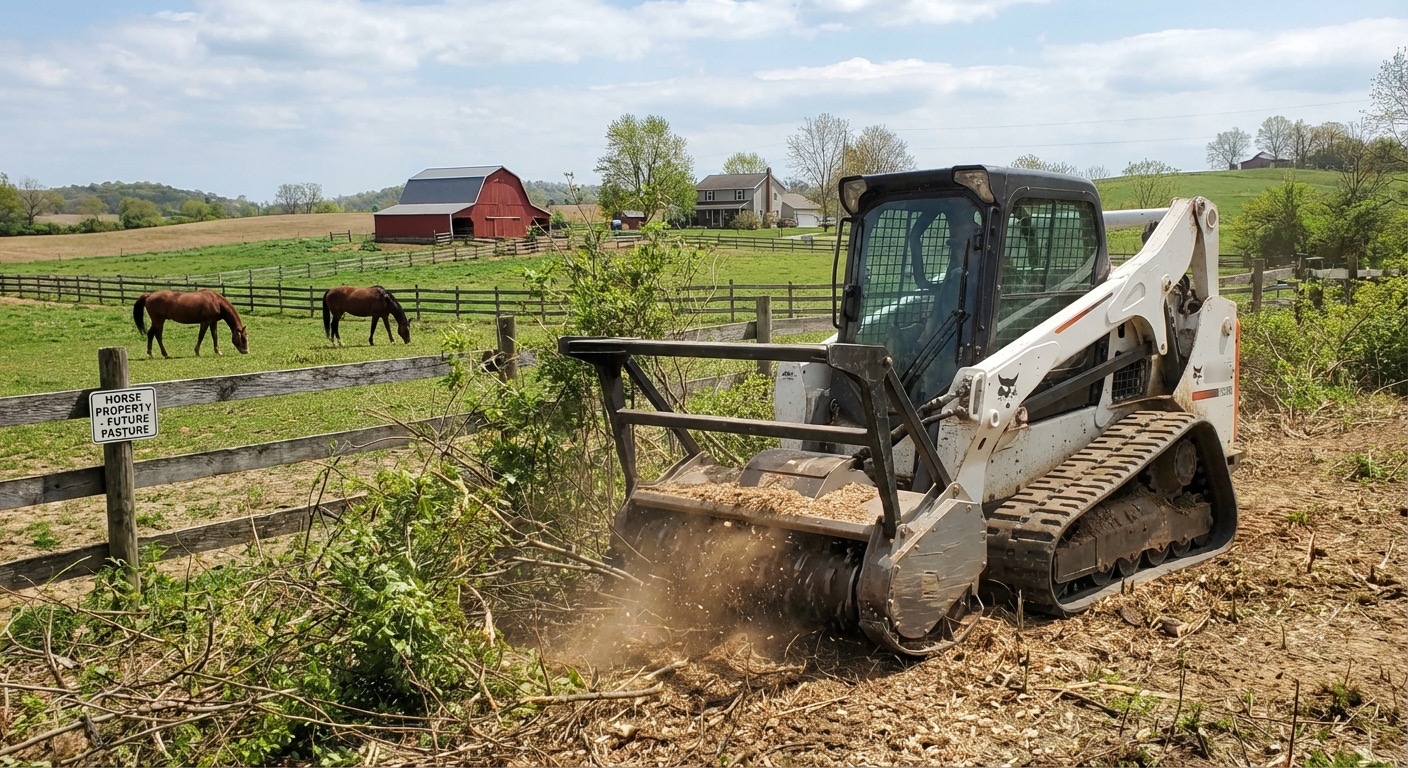
Why Horse Properties Need Specialized Clearing
Horse property clearing isn't the same as general land clearing. Equestrian properties have unique requirements:
Safety Comes First
Horses are curious and put everything in their mouths. The clearing method and materials left behind matter enormously. We use forestry mulching specifically because it's safe—no chemicals, no debris piles, just natural wood mulch that breaks down over time.
Working Around Existing Infrastructure
Horse properties have fencing everywhere—board fence, electric tape, high-tensile wire. Plus water troughs, run-in sheds, and gates. We navigate around all of it, clearing right up to fence lines without damage.
Grass Establishment Matters
You're not just clearing land—you need it to become productive pasture. Our process leaves behind nutrient-rich mulch that actually improves soil quality as it decomposes, giving grass a better foundation.
Horses Can't Just "Wait Somewhere"
We understand the logistics of horse management. We can phase projects to keep horses in rotation, clear sections while others graze, and work around your feeding and turnout schedule.
The Cincinnati Equestrian Landscape
Greater Cincinnati is horse country. From the rolling pastures of Warren and Clermont counties to the established equestrian communities in Indian Hill and Milford, we've cleared hundreds of acres of horse property. We understand the terrain, the invasive species pressures (hello, honeysuckle), and what local horse owners need.
Common Horse Property Clearing Projects
Pasture Reclamation & Expansion
The most common request we get from horse owners: "I used to have 10 acres of pasture, now I have 6."
- → Brush-invaded pastures: Clearing honeysuckle, autumn olive, and multiflora rose that's crept into your grazing areas
- → Expanding into wooded areas: Converting that stand of scrubby trees into usable turnout space
- → Back field restoration: The field that got away from you during a busy season
- → Sacrifice paddock creation: Clearing and preparing designated high-traffic areas
Result: More grazing acreage, healthier grass from reduced competition, better pasture management options.
Riding Trail Development
One of our favorite projects: creating winding trails through your wooded acreage.
- → Trail width: Typically 8-12 feet wide for comfortable single-track riding
- → Canopy preservation: We clear the understory while maintaining shade trees overhead
- → Natural footing: The mulch we leave behind makes excellent trail surface
- → Connection trails: Linking pastures, barns, and riding areas
Result: Private riding trails on your own property, perfect for conditioning rides or just enjoying your land.
Fence Line Clearing
Overgrown fence lines create multiple problems: hidden damage, escaped horses, and fire risk.
- → Perimeter clearing: Restoring visibility and access around your property boundary
- → Interior fence lines: Between paddocks and pastures
- → Wire fence protection: We work carefully around hot wire and high-tensile
- → Board fence access: Creating maintenance access for painting and repairs
Result: Fences you can actually see and maintain, reduced fire risk, better property appearance.
New Paddock & Turnout Construction
Expanding your horse operation or improving turnout rotation.
- → Additional paddock creation: Converting brush to usable turnout
- → Mare/foal paddocks: Safe, visible areas for breeding operations
- → Quarantine paddocks: Isolated turnout for new arrivals
- → Round pen sites: Level, cleared areas for training facilities
Result: More turnout options, better horse management, room to grow your operation.
The Forestry Mulching Advantage for Horse Properties
Why do we recommend forestry mulching over traditional clearing methods for horse properties? The difference matters for equine safety and pasture health.
Traditional Clearing Problems
- ✗ Burn piles leave toxic ash
- ✗ Brush piles attract snakes and pests
- ✗ Exposed soil leads to erosion
- ✗ Stump grinding leaves holes
- ✗ Hauling creates repeated truck traffic
- ✗ Heavy equipment ruts pastures
Forestry Mulching Benefits
- ✓ Nothing to burn or haul away
- ✓ Natural mulch layer protects soil
- ✓ Root systems prevent erosion
- ✓ Trees mulched below ground level
- ✓ Single-pass process, minimal traffic
- ✓ Tracked machines distribute weight
What About the Mulch and Horses?
Common question: "Is it safe for horses to be around the mulch?"
Short answer: Yes, with basic precautions.
- → Keep horses off freshly mulched areas for 2-4 weeks while mulch settles
- → Fresh mulch may have sharp edges that soften with weathering
- → Some horses investigate and mouth the mulch—this isn't harmful
- → No toxic chemicals or treatments in our process
- → By the time grass grows through, the mulch is well-integrated into soil
Planning Your Horse Property Clearing Project
Step 1: Assess Your Goals
Before reaching out, think through what you want to accomplish:
- → How many additional acres of pasture do you need?
- → Where would riding trails add the most value?
- → Which fence lines are most problematic?
- → Are you planning to add fencing after clearing?
- → Do you need grass established by a certain date?
Step 2: Plan for Horse Management
Consider how you'll manage horses during and after the project:
- → During clearing: Horses should be in a separate pasture—not for safety from us, but from their own curiosity about equipment
- → Phased clearing: We can clear one section while horses use another, then rotate
- → Post-clearing: Plan 2-4 weeks of rest before turnout on mulched areas
- → Grass establishment: If seeding, horses need to stay off until grass is 4-6 inches
Step 3: Consider Timing
Best times to clear horse pastures in Ohio:
- → Fall (September-November): Clear now, seed, have established grass by spring turnout. Our top recommendation.
- → Late Winter (February-March): Clear before spring growth, seed for summer establishment
- → Summer: Good for trail work; pasture seeding needs irrigation
- → Spring: Workable but requires attention to wet conditions
Step 4: Prepare Your Property
Before we arrive:
- → Mark trees to preserve: Ribbon or paint any trees you want to keep
- → Note infrastructure: Show us water lines, electric runs, septic locations
- → Clear access routes: We need to get equipment to the work area
- → Secure horses: Have a plan for where they'll be during work
- → Walk fence lines: Note any weak sections we should know about
Horse Property Clearing Costs in Cincinnati
Pricing for horse property clearing depends on vegetation density, terrain, and project scope.
2026 Horse Property Clearing Prices
| Project Type | Price Range |
| Pasture reclamation (light brush) | $1,800 - $2,500/acre |
| Pasture reclamation (heavy brush/saplings) | $2,500 - $3,500/acre |
| Wooded area conversion | $3,500 - $5,000/acre |
| Trail cutting (8-12 ft wide) | $4 - $10/linear foot |
| Fence line clearing | $3 - $8/linear foot |
| Minimum project | $2,500 |
Factors That Affect Price
- → Vegetation density and tree size
- → Terrain (flat vs. sloped)
- → Amount of fence line navigation
- → Access difficulty
- → Total project acreage
Volume Discounts
- • 2.25 - 5 acres: 10% discount
- • 5.25 - 10 acres: 15% discount
- • 10+ acres: 20% discount
Larger horse properties see significant savings.
Sample Horse Property Project
10-acre Warren County horse farm:
- → 3 acres brush-invaded pasture reclamation: $7,500
- → 2,000 linear feet fence line clearing: $8,000
- → 800 linear feet riding trail: $5,600
- → Volume discount (20%): -$4,220
- → Total: $16,880
After Clearing: Establishing Grass for Pasture
Clearing is step one. Here's how to turn mulched ground into productive pasture.
Seeding Options for Horse Pastures
Ohio horse pastures typically use these grass mixes:
- → Orchardgrass: High yield, good palatability, recovers well from grazing
- → Kentucky Bluegrass: Forms dense sod, excellent for high-traffic areas
- → Perennial Ryegrass: Quick establishment, good for overseeding
- → Timothy: Classic horse hay grass, lower sugar content
- → Tall Fescue (endophyte-free): Drought tolerant, avoid endophyte-infected varieties for horses
Your local ag extension office can recommend specific mixes for your soil type.
Seeding Timeline After Clearing
- Week 1-2: Let mulch settle, assess any needed soil amendments
- Week 2-4: Soil test if desired, apply lime or fertilizer as needed
- Week 4-6: Seed directly into mulch (no tillage needed)
- Week 6-14: Germination and establishment (water if dry)
- Week 14+: First light grazing when grass is 4-6 inches
Can You Seed Into Mulch?
Yes—and it often works better than bare soil. The mulch retains moisture, moderates soil temperature, and reduces erosion. Broadcast seed directly onto the mulch; rain and weathering work it down to soil contact. Our mulch layer is typically 2-4 inches, which grass easily grows through.
Managing Invasive Species on Horse Properties
Cincinnati-area horse properties face constant pressure from invasive species. Here's what we commonly clear and how to prevent regrowth.
Most Common Invasives
- → Bush Honeysuckle: The #1 pasture invader
- → Autumn Olive: Silvery-leafed shrub, spreads aggressively
- → Multiflora Rose: Thorny nightmare in fence lines
- → Bradford Pear: Escapees from ornamental plantings
- → Tree of Heaven: Spreads by root suckers
Why They Love Pasture Edges
- → Horses don't eat them (too bitter/thorny)
- → Birds spread seeds from fence line perches
- → Full sun at pasture edges fuels growth
- → Mowing doesn't reach the margins
- → Each year's growth produces more seed
Preventing Regrowth
Forestry mulching destroys the above-ground plant, but some invasives sprout from roots. Options for long-term control:
- → Establish competitive grass: Dense grass shades out seedlings
- → Annual maintenance mowing: Knock back regrowth before it matures
- → Spot treatment: Herbicide on persistent regrowth (consult your vet about horse-safe products)
- → Goat grazing: Some horse owners bring in goats to manage browse
- → Re-mulch problem areas: Second pass catches regrowth before it spreads
Horse Property Clearing Case Study: Warren County
The Project
A 15-acre horse property in Morrow, Ohio with four horses and a growing honeysuckle problem.
- Challenge: 4 acres of pasture had been lost to brush invasion over 8 years
- Goal: Reclaim pasture, clear fence lines, add riding trail to back woods
- Timeline: Needed grass established before spring turnout
The Solution
- → Cleared in October (prime seeding window)
- → Phased approach: cleared west pasture while horses used east
- → 4 acres pasture reclamation + 3,000 feet fence line + 1,200 feet trail
- → Owner seeded with orchardgrass/bluegrass mix two weeks after clearing
- → Horses on reclaimed pasture by May 1st
The Result
- → 4 additional acres of grazing restored
- → Better pasture rotation = healthier grass overall
- → Beautiful riding trail through back woods
- → Fence lines visible and maintainable
- → Property value increased significantly
Frequently Asked Questions
Will the equipment scare my horses?
Most horses are curious rather than scared, which is exactly why we ask that they be in a separate pasture during work. The forestry mulcher is loud, but we've worked on many horse properties without incident. Some horses watch intently from their paddock; others ignore us completely.
Can you work around my barn and outbuildings?
Yes. We regularly clear around run-in sheds, barns, arenas, and other structures. We maintain safe distances from buildings and can hand-clear tight spots if needed. Just show us what needs protection during our site visit.
What about my electric fence?
Turn off hot wire in the work area before we arrive. We can clear up to and around electric tape, high-tensile wire, and board fencing. For extremely overgrown fence lines where wire is buried in brush, we may need to work in stages or have you temporarily remove sections.
Do you remove the stumps?
Forestry mulching grinds stumps below ground level—typically 2-4 inches deep. The root system remains in place (which prevents erosion), and the stump material decomposes over 2-3 years. You won't trip over stumps or hit them with a mower.
How long does horse property clearing take?
Depends on scope, but typical projects: 1-2 acres of pasture clearing takes 4-6 hours. 2,000 feet of fence line clearing takes 3-4 hours. A half-mile riding trail takes a full day. Most horse property projects complete in 1-2 days.
Service Areas for Horse Property Clearing
We serve horse properties throughout Greater Cincinnati and surrounding counties:
Ohio Counties
- → Warren County
- → Clermont County
- → Hamilton County
- → Butler County
- → Clinton County
- → Brown County
Kentucky Counties
- → Boone County
- → Kenton County
- → Campbell County
- → Grant County
- → Pendleton County
Indiana Counties
- → Dearborn County
- → Ohio County
- → Ripley County
- → Franklin County
Ready to Reclaim Your Horse Property?
Whether you need to expand pastures, create trails, or clear overgrown fence lines, we're here to help. Let's discuss your property and create a plan that works for you and your horses.
Get Your Free Horse Property Estimate
Use our instant pricing calculator for a quick ballpark, or contact us to discuss your specific equestrian needs.
Or call us directly: (513) 790-4150
What to Include in Your Request
- → Property address and total acreage
- → Acres of pasture to reclaim or expand
- → Linear feet of fence line to clear
- → Trail development plans (if any)
- → Number of horses and current turnout situation
- → Timeline goals (spring turnout, construction, etc.)