
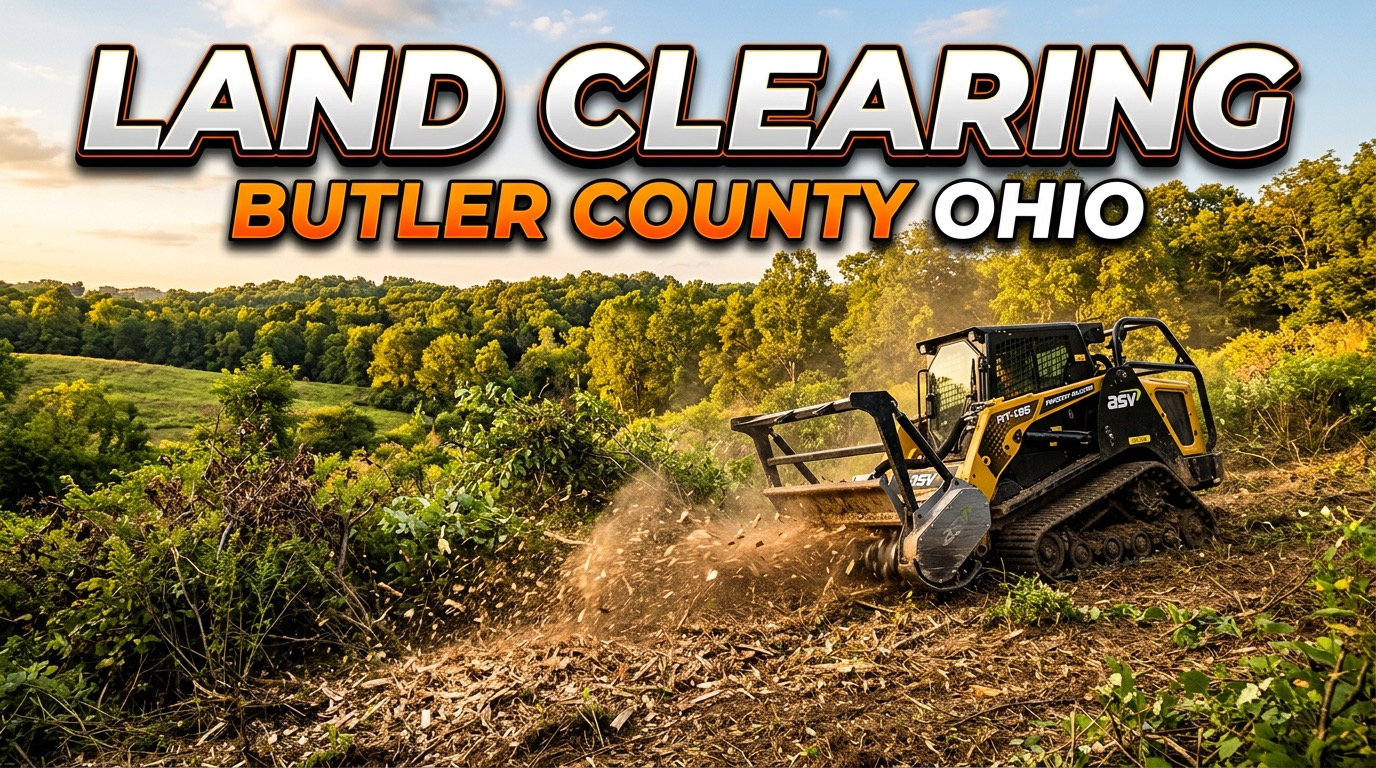
Butler County's Land: What You're Working With
Butler County covers about 470 square miles between Hamilton and Warren counties. The Great Miami River cuts right through the middle, creating a mix of flat river bottoms and rolling upland terrain. If you own property here, you already know the landscape changes fast depending on where you are.
The eastern half of the county—West Chester, Liberty Township, Fairfield—has seen massive development over the past 20 years. Lots that were farmland or woodlots in 2005 now have subdivisions on them. But there's still plenty of overgrown parcels, wooded lots waiting for construction, and neglected fence lines that haven't been touched in decades.
Head west toward Oxford, Reily, or Morgan Township and you're in more rural territory. Bigger parcels, more mature timber, and properties that have been sitting untouched long enough for the honeysuckle and multiflora rose to take over completely. These areas are where we see the most acreage-scale clearing work.
The southern end of Butler County borders Hamilton County, and that zone around Fairfield and the I-275 corridor has a lot of commercial and residential development pushing outward. Property owners down there are usually clearing for construction or trying to clean up lots that have been sitting vacant.
Butler County by the Numbers
Population over 390,000 and climbing. West Chester Township alone has more than 60,000 residents. The county had over $1.2 billion in building permits in recent years. All that growth means more land clearing—for new homes, commercial sites, and infrastructure projects.
What Land Clearing Costs in Butler County
Pricing depends on three things: how dense the vegetation is, how big the area is, and how easy it is to access with equipment. Here's what Butler County property owners can expect.
Light Clearing: $2,500 to $3,500 per Acre
This covers properties with saplings, brush, small trees under 6 inches in diameter, and invasive species like honeysuckle or autumn olive. A lot of the suburban lots in West Chester, Liberty Township, and Mason fall into this category. The previous owner let it grow for a few years, and now it's a tangled mess of brush and vines but nothing too heavy.
Light clearing goes fast. A good mulcher can knock out an acre of this stuff in half a day or less.
Medium Clearing: $3,500 to $4,500 per Acre
Mixed vegetation with some mature trees (6 to 12 inches in diameter), dense undergrowth, and possibly some terrain challenges. This is common in the rural townships—Ross, Hanover, Madison, St. Clair—where properties have been sitting for 10 to 20 years without maintenance.
Medium clearing usually takes a full day per acre, sometimes more depending on the mix of trees and brush.
Heavy Clearing: $4,500 to $5,500+ per Acre
Mature hardwood forest with trees 12 inches and larger, dense canopy, and heavy undergrowth. You'll find this on the bigger rural parcels in western and northern Butler County. Old growth areas near Hueston Woods, properties along Indian Creek, and the wooded ravines that run through the county's hill country.
Heavy clearing is slower work. Larger trees take more passes with the mulcher, and the debris volume is significantly higher. Plan on 1.5 to 2 days per acre for heavy woods.
Small Lot Minimums
If you're clearing a quarter-acre backyard or a small building pad, most companies (including us) have a minimum project fee. It costs roughly the same to mobilize equipment for a small job as a large one—trailer, truck, fuel, travel time. In Butler County, expect minimums between $1,500 and $2,500.
Get a Quick Estimate
Use our instant pricing calculator for a ballpark estimate on your Butler County property. Drop a pin, mark the area, and get numbers in under a minute.
Butler County Permit Requirements
This is one of the first questions every property owner asks, and the answer depends on exactly where your property sits and what you're planning to do after clearing.
Unincorporated Butler County
For most residential forestry mulching in unincorporated areas, you don't need a permit just to clear vegetation. Forestry mulching doesn't involve grading, earthwork, or soil disturbance, so it doesn't trigger the county's grading permit requirements. You're grinding vegetation in place—the ground surface stays where it is.
The exception: if you're clearing near streams, wetlands, or the Great Miami River floodplain. Butler County Soil and Water Conservation District manages riparian setback rules that apply to properties within 300 feet of certain waterways. If your clearing gets close to water, check with them first.
Inside City or Village Limits
Hamilton, Middletown, Fairfield, Mason, Monroe, Trenton, and Oxford all have their own zoning codes. Some require tree removal permits for trees above a certain caliper (often 6 inches DBH or larger). Others have tree preservation ordinances in newer subdivisions.
Mason's tree preservation code is one of the stricter ones in the county. If you're clearing a lot inside Mason city limits, especially in a planned development, check with their planning department before you start.
Fairfield also has specific requirements for commercial clearing—stormwater management plans, erosion and sediment control, the whole package. Residential clearing is typically simpler, but call the building department to confirm.
If You're Building After Clearing
Land clearing itself may not need a permit, but what you do next might. If you're clearing for a new house, addition, or commercial structure, your building permit will include site preparation requirements. Erosion and sediment control plans are standard for any project disturbing more than one acre in Ohio—that's an NPDES permit through Ohio EPA.
The smart move: clear the land first with forestry mulching (no permit needed for the clearing), then apply for your building permit with a clean site that's easy to survey and plan on.
Why Forestry Mulching Works Better Than Traditional Clearing in Butler County
Traditional land clearing means bringing in a bulldozer, pushing trees into piles, then burning or hauling the debris. It works, but it creates problems that matter more in Butler County than people realize.
Butler County's Soil Problem
Most of Butler County sits on heavy clay soils—specifically the Celina-Crosby-Kokomo soil associations that dominate southwestern Ohio. These soils drain slowly. When you strip topsoil with a bulldozer, you expose raw clay that turns into a mudpit every time it rains. The topsoil took thousands of years to build up. Scraping it off in an afternoon creates erosion problems that last for years.
Forestry mulching keeps the topsoil in place. The mulched material stays on the ground as a natural layer that prevents erosion, retains moisture, and breaks down into organic matter over time. On Butler County clay, that mulch layer is the difference between a property that grows grass in a few months and one that stays muddy for a year.
No Burn Piles, No Hauling
Butler County, like most of southwestern Ohio, has open burning restrictions. In incorporated areas (Hamilton, Middletown, Fairfield, etc.), open burning is either banned outright or heavily restricted. Even in unincorporated areas, you need to follow Ohio EPA and local fire district rules.
With forestry mulching, there's nothing to burn and nothing to haul. The mulcher processes everything on-site. No burn permits, no smoke complaints from neighbors, no trucking costs for debris removal. On a typical 2-acre residential clearing in Butler County, skipping the debris removal saves $2,000 to $4,000 compared to traditional clearing.
One Machine, One Pass
A forestry mulcher handles the entire job. Trees, brush, saplings, stumps—ground to mulch in a single pass. No chainsaw crew, no skid steer to pile debris, no chipper, no dump truck. That simplicity translates directly into lower cost and faster turnaround. Most Butler County residential jobs finish in 1 to 3 days.
Common Clearing Projects in Butler County
Every property is different, but we see the same types of projects come up over and over in this county.
New Home Construction Lots
West Chester, Liberty Township, and the Mason area have a constant stream of custom home builds on wooded lots. Buyers purchase a 1 to 3-acre parcel, then need the building pad and driveway area cleared before construction starts. Forestry mulching handles this quickly and leaves the rest of the property's trees intact—which is usually exactly what the homeowner wants.
Overgrown Backyards and Fence Lines
Older neighborhoods in Hamilton, Middletown, and Fairfield have plenty of backyards that haven't been maintained in years. Honeysuckle takes over fast in this part of Ohio—give it three years and a managed backyard turns into a wall of brush. We do a lot of these smaller residential jobs, usually a quarter-acre to a full acre.
Farm Fence Row Clearing
The agricultural areas in western Butler County—Reily, Morgan Township, Milford Township—have fence rows that haven't been cleaned out in decades. Trees grow through the fence wire, brush gets 15 feet wide on both sides, and the fence itself disappears into the vegetation. Mulching opens these back up so farmers can replace or repair fencing.
Hunting Property Improvement
There's decent deer hunting in Butler County, especially in the northern and western townships. Property owners clear shooting lanes, build ATV trails, and open up food plot areas with forestry mulching. It's a targeted approach—remove the junk trees and invasive brush while leaving the oaks, hickories, and other mast-producing trees that attract deer.
HOA Common Areas
West Chester and Liberty Township have dozens of HOAs with common areas, walking paths, and retention basin perimeters that need periodic clearing. Honeysuckle and other invasive brush creep into these areas constantly. HOA boards budget for clearing every few years to keep common spaces usable and looking maintained.
Butler County's Invasive Species Problem
If you own property in Butler County, you have invasive plants on it. That's not an exaggeration—bush honeysuckle alone covers an estimated 70% of natural areas in southwestern Ohio.
The biggest offenders in Butler County are:
Bush honeysuckle (Amur and Morrow): The undisputed champion of Butler County invasive plants. It leafs out earlier than native species and drops leaves later, shading out everything underneath. Left alone, it forms impenetrable thickets that choke out the forest understory. Mulching flattens it in one pass.
Multiflora rose: Thorny, aggressive, and miserable to deal with by hand. Originally planted as a "living fence" by the USDA in the 1950s and 1960s—that worked out about as well as you'd expect. Now it's everywhere in Butler County fence rows and woodland edges.
Autumn olive: The silver-leaved shrub that's taking over field edges and roadsides. Grows fast, produces thousands of berries that birds spread everywhere, and nitrogen-fixes in the soil which actually makes it harder for native plants to compete.
Bradford pear (Callery pear): These were planted as ornamentals for decades, and now their wild offspring are colonizing roadsides, fence rows, and disturbed areas across Butler County. Ohio actually banned their sale starting in 2023.
Forestry mulching is the fastest way to knock back all of these species. One mulcher can clear an acre of invasive brush in a few hours—work that would take a crew with chainsaws and brush cutters a week or more.
Getting to Butler County: Our Service Area
We're based in Loveland, which puts us about 25 minutes from the southern end of Butler County (Fairfield area) and 40 to 45 minutes from the northern reaches around Monroe and Middletown. Oxford is the farthest at about 50 minutes.
Travel time factors into pricing, but it's not a deal-breaker for Butler County. We're up there regularly enough that we often schedule multiple jobs in the area during the same week to keep costs down for everyone.
Butler County is one of our core service areas alongside Hamilton County, Clermont County, and Warren County. If you're in Butler County and need land cleared, you're not on the fringe of our coverage—you're in the middle of it.
Butler County Townships We Serve
Fairfield Township, Hanover Township, Lemon Township, Liberty Township, Madison Township, Milford Township, Morgan Township, Oxford Township, Reily Township, Ross Township, St. Clair Township, Wayne Township, West Chester Township. Plus Hamilton, Middletown, Fairfield, Mason, Monroe, Trenton, Oxford, Seven Mile, Jacksonburg, New Miami, Somerville, College Corner, and Millville.
How to Get Started on Your Butler County Clearing Project
The process is simple. Here's what it looks like from first contact to finished project.
Step 1: Get a quick estimate. Use our instant pricing calculator to get a ballpark number. It takes about 60 seconds—drop a pin on your property, outline the area you want cleared, and you'll get an estimate based on the acreage and vegetation type.
Step 2: Site visit (for larger projects). For projects over 2 acres or properties with unusual access issues, we'll schedule a site visit to walk the property and give you a firm price. For smaller residential jobs, photos and the satellite view are usually enough to quote accurately.
Step 3: Schedule the work. We book projects on a first-come, first-served basis. During busy season (April through November), lead times run 2 to 4 weeks. Winter and early spring are slower, so you can often get on the schedule within a week or two.
Step 4: Clearing day. We show up with the mulcher, clear the area, and leave you with a clean property. No debris piles, no stumps sticking up, no mess. The mulched material stays on the ground as ground cover.
Step 5: What comes next. After clearing, you can seed with grass, start construction, install fencing, or just enjoy the usable space. The mulch layer breaks down over 6 to 12 months and actually enriches the soil beneath it.
Ready to Clear Your Butler County Property?
Get your free estimate today
Use our instant pricing tool for a quick ballpark, or contact us directly for a detailed quote on your Butler County project.