
Why Hamilton County Property Owners Clear Land
Hamilton County has 800,000 people spread across 49 cities, villages, and townships. But population density does not mean every lot is built out. Huge portions of the county are covered in overgrown brush, invasive honeysuckle, and wooded terrain that property owners have been ignoring for years.
The reasons people call us for clearing break down into a few categories:
Honeysuckle and invasive species. This is the number one reason Hamilton County property owners reach out. Bush honeysuckle has taken over every wooded area in the county. It chokes out native plants, destroys sightlines, and makes walking through your own property nearly impossible. The problem is especially bad along creek corridors and in the eastern townships.
Overgrown lot restoration. Cincinnati has thousands of properties that have been neglected for five, ten, twenty years. Brush and saplings creep in, and before you know it, a usable backyard or buildable lot looks like untouched woodland. Clearing it back opens up the space and raises the property value.
New construction site prep. Builders working in Hamilton County need clean, accessible lots. Forestry mulching clears brush and small trees while keeping topsoil intact, which means less erosion control work before foundation work starts.
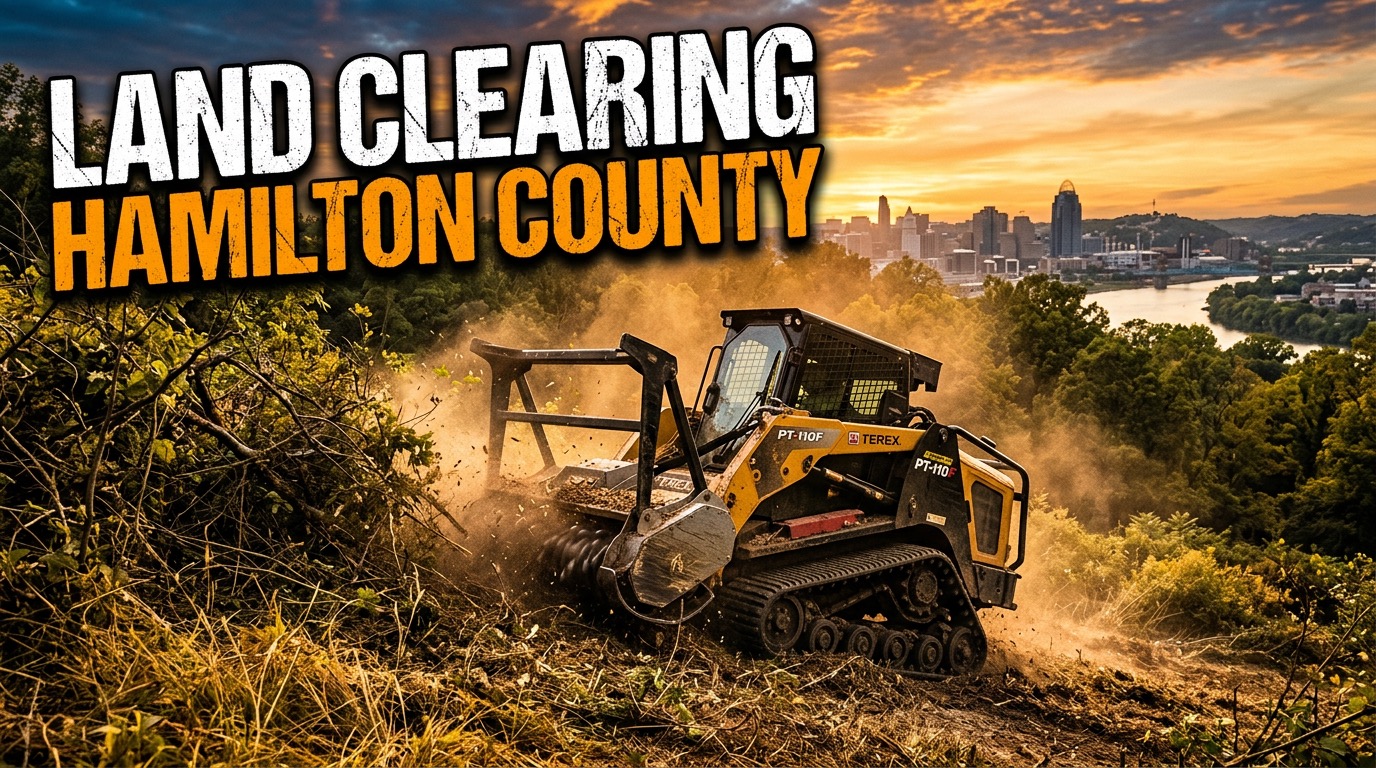
Hillside clearing. Hamilton County sits in the Ohio River valley, and the terrain is steep. Properties in Mt. Washington, Anderson Township, Delhi Township, and along the river bluffs have hillsides that are completely overgrown. Standard equipment cannot work these slopes. You need specialized gear and operators who know steep terrain.
Property line and fence row work. In the outer townships, property boundaries disappear under decades of unchecked growth. Clearing fence lines and property edges is one of the most common requests we get.
Recreational improvements. Some of the larger properties in Indian Hill, Miami Township, and Whitewater Township have owners building walking trails, clearing shooting lanes, or opening up views. Land clearing turns raw woodland into usable recreational space.
Hamilton County Terrain: Why It Matters
If you have driven around Hamilton County, you already know the terrain is not flat. This county is cut through with valleys, creek beds, and hillsides that make land clearing more complicated than it is in most of Ohio.
The Ohio River Bluffs
The southern edge of Hamilton County drops steeply toward the Ohio River. Properties in Delhi Township, Sayler Park, and the west side of Cincinnati sit on or above these bluffs. The soil is clay-heavy and prone to sliding when disturbed. Clearing here requires careful equipment selection and operators who understand erosion control on steep grades.
Eastern Hamilton County
Anderson Township, Newtown, and the areas around the Little Miami River have deep ravines, wooded ridgelines, and creek valleys. This is where the biggest residential clearing projects happen. Lots are larger, vegetation is denser, and the terrain is consistently hilly. Many of these properties have not been touched in decades.
Indian Hill and Madeira
Indian Hill is one of the wealthiest communities in Ohio, and the lots are big. Five, ten, even twenty-acre residential estates with mature hardwood forests and thick understory. Clearing work here often involves selective removal, where the goal is to open up views and walking paths while keeping specimen trees. Madeira has smaller lots but similar density of invasive growth.
Western Hamilton County
Green Township, Colerain Township, and Whitewater Township have a mix of suburban development and rural acreage. The terrain is gentler on the west side, which makes clearing faster and more straightforward. But the honeysuckle is just as bad out here as anywhere else in the county.
Urban Cincinnati
Inside the city proper, clearing jobs tend to be smaller lots with tight access. Getting equipment between houses, through narrow gates, and around fences is part of the job. Mt. Adams, Clifton, and East Walnut Hills have steep residential hillsides that are covered in invasive growth. Hyde Park and Oakley have overgrown backyards and vacant lots that need clearing before they can be developed or sold.
Local Knowledge Counts
Brushworks is based in Loveland, right on the Hamilton County border. We have cleared properties across every township in the county and know where the clay gets slick, where the slopes require remote-controlled equipment, and where access is tight. That experience means faster work, cleaner results, and fewer surprises.
Land Clearing Costs in Hamilton County
Pricing depends on vegetation density, tree size, terrain, and access. Here is what Hamilton County property owners typically pay:
Residential Lots (Under 1 Acre)
Most residential clearing in Hamilton County costs $1,500 to $4,000. A half-acre lot in Madeira with moderate honeysuckle and brush might run $1,500 to $2,500. A heavily wooded three-quarter-acre lot in Anderson Township with 10 to 14 inch hardwoods and steep terrain could push $3,000 to $4,000.
Acreage Projects (1 to 10+ Acres)
Per-acre rates run $2,500 to $5,000 depending on conditions. Light brush and small saplings on relatively flat ground sit at the low end. Dense honeysuckle thickets mixed with mature trees on steep hillsides push higher. A five-acre clearing project on rolling terrain in Whitewater Township might come in around $14,000 to $20,000.
What Drives Price Up
Steep hillsides are the biggest cost factor in Hamilton County. When we need to bring in remote-controlled mulching equipment for slopes that standard machines cannot handle safely, the day rate is higher. Large-diameter trees slow things down too. Tight access through neighborhoods, between houses, or through narrow gates adds setup time.
What Keeps Price Down
Flat or gently rolling terrain, open access, and vegetation that is mostly brush with few large trees all keep costs lower. Winter clearing is typically more efficient because firm ground supports equipment better and dormant vegetation processes faster.
Get an Exact Quote
Every property is different. Use our instant pricing calculator for a ballpark estimate, or send us photos and a property pin for an exact price. We quote every job individually so you know the total before we start.
Permits and Regulations in Hamilton County
Permit requirements vary depending on where in the county your property sits.
Unincorporated Hamilton County
For most residential land clearing in unincorporated areas, no permit is needed. Forestry mulching does not grade or disturb soil, so it does not trigger erosion control or grading permits. You are removing vegetation on your own property, which is your right as a landowner.
City of Cincinnati
Cincinnati has a hillside overlay zoning district that covers steep slopes throughout the city. Properties in this overlay may have restrictions on vegetation removal, especially on slopes steeper than 25%. The goal is erosion prevention. If your property is in a hillside overlay area, check with Cincinnati's Department of Buildings and Inspections before clearing. Forestry mulching is typically allowed because it does not disturb the root structure or soil, but it is worth confirming.
Cincinnati also has a tree ordinance that applies to development projects. If you are clearing for new construction, you may need to submit a tree preservation plan. Residential property owners doing maintenance clearing are generally exempt.
Indian Hill
Indian Hill has strict tree preservation regulations. The village requires permits for removing trees above a certain diameter, and the planning commission reviews clearing plans. If you own property in Indian Hill, contact their building department before starting any clearing work. The rules exist to protect the community's wooded character, and violations come with penalties.
Other Municipalities
Madeira, Mariemont, Wyoming, and several other Hamilton County municipalities have their own tree ordinances. Most apply only to trees above 6 inches in diameter and mainly affect development projects rather than residential maintenance. A five-minute call to your local building department clears up any questions.
Stream and Wetland Buffers
Hamilton County has extensive creek systems, and the Ohio EPA regulates clearing near waterways. Properties along the Little Miami, Great Miami, Mill Creek, and their tributaries may need to maintain vegetated buffers. The Hamilton County Soil and Water Conservation District at (513) 772-7645 can tell you what applies to your specific property.
Forestry Mulching: Why It Works Best in Hamilton County
Hamilton County's terrain makes forestry mulching the clear winner over other clearing methods. Here is why:
Erosion control built in. The mulch layer left behind protects exposed soil from washing downhill. On Hamilton County's steep clay hillsides, this matters more than almost anywhere else in Ohio. Bulldozing strips topsoil and creates erosion nightmares. Mulching prevents them.
No hauling required. Everything gets processed on site. In a county where tight residential lots and narrow access roads make debris removal expensive and logistically painful, that is a big deal. No dumpsters, no burn piles, no trips to the dump.
Slope capability. With remote-controlled mulching equipment, we clear hillsides that standard machines cannot touch. Hamilton County has more steep-terrain clearing demand than almost any market we work in, and our equipment handles it.
Regrowth suppression. The mulch layer blocks sunlight from reaching the soil surface, which slows down honeysuckle and other invasive resprouts. Combined with targeted herbicide treatment on stumps and resprouts in the first growing season, forestry mulching gives you the most durable results.
Same-day results. When we leave at the end of the day, the property looks finished. No piles of brush waiting to be burned. No exposed dirt waiting for seed. Clean mulch layer, visible trees, usable land.
The Honeysuckle Problem in Hamilton County
Hamilton County may have the worst honeysuckle infestation in the state. Every park, every wooded lot, every creek corridor is overrun with Amur and Morrow honeysuckle. The Great Parks of Hamilton County have spent millions trying to manage it, and the problem keeps spreading.
On private property, the situation is often worse because nobody has been managing it at all. We regularly clear lots where honeysuckle has grown eight to twelve feet tall and so dense you cannot see more than a few feet into the woods. Property owners are shocked at how much space they actually have once the honeysuckle is gone.
The eastern half of the county is hit hardest. Anderson Township, Newtown, and the Little Miami corridor are completely saturated. But the west side is not far behind. Colerain Township, Green Township, and Cheviot all have severe honeysuckle problems.
Forestry mulching clears honeysuckle faster than any other method. A machine can grind through an acre of dense honeysuckle in a single day, turning it into a flat mulch layer. Follow-up herbicide treatment on resprouts in the first growing season makes the removal stick. Skip the follow-up and you will be fighting it again in two to three years.
We have cleared thousands of acres of honeysuckle in the greater Cincinnati area, and Hamilton County properties make up a huge percentage of that work. The transformation from impassable thicket to open, usable woodland is one of the most satisfying things we do.
Steep Hillside Clearing in Hamilton County
Hamilton County has more steep-terrain clearing demand than any other county in our service area. The Ohio River carved deep valleys through this landscape, and residential development followed the ridgetops and river terraces, leaving the hillsides to grow wild.
Standard skid steers and track loaders are limited to slopes of about 30 degrees before they become unsafe. Hamilton County has plenty of 40, 50, even 60-degree slopes covered in brush and invasives that property owners want cleared.
Brushworks runs an FAE RCU55 remote-controlled mulcher built specifically for this kind of work. The operator controls it from a safe distance while the machine crawls up slopes that would roll conventional equipment. It weighs less than a standard skid steer, which means less ground pressure and less risk of triggering slides on clay hillsides.
We have cleared hillsides in Anderson Township behind residential properties, along the Ohio River bluffs in Delhi Township, and on the steep ravine walls in Mt. Washington and East Walnut Hills. If you have a hillside that other companies have turned down, there is a good chance we can handle it.
Got a Steep Slope?
Send us photos and your property address. We will tell you if our equipment can handle it and what the cost will be. Most of the hillside projects other companies refuse are routine work for us. Get a quote here.
Best Time to Clear Land in Hamilton County
You can clear land any time of year in Hamilton County, but the season affects efficiency and cost.
Late fall through early spring (November to March) is ideal. Leaves are down, the ground is firm or frozen, and dormant vegetation processes faster. Hamilton County's clay soil is notoriously bad when wet, so frozen or dry winter ground is your best friend. This is also when honeysuckle is easiest to identify and remove because native trees have dropped their leaves while honeysuckle keeps its green foliage into December.
Spring (April and May) brings mud. Hamilton County gets steady spring rain, and once that clay soil gets saturated, it turns into a greasy mess. Equipment ruts get worse, slopes get slippery, and jobs take longer. Dry spring weeks work fine, but we watch weather closely before scheduling.
Summer (June through September) is doable but slower. Dense foliage hides obstacles and makes it harder to identify property lines and trees worth keeping. The heat wears on operators and equipment. The upside is that this is when property owners are outside seeing their overgrown land and deciding they want to do something about it.
Early fall (October) is a sweet spot. Temperatures cool down, the ground is typically dry after summer, and leaf-off is starting. Great time to get on the schedule before winter demand picks up.
Hamilton County Communities We Serve
We work across the entire county. Here is what we commonly see in each area:
Anderson Township — Our busiest area in Hamilton County. Large lots, steep ravines, and massive honeysuckle problems. Residential clearing, trail building, and hillside work.
Indian Hill — Large estate properties with selective clearing needs. Understory removal, invasive management, and trail creation on wooded acreage. Strict tree ordinances require planning.
Mt. Washington — Steep residential hillsides covered in brush and honeysuckle. Tight access through established neighborhoods. Remote-controlled equipment gets heavy use here.
Delhi Township — Ohio River bluff properties and residential lot clearing. Clay hillsides that need careful erosion management.
Green Township — Mix of suburban lots and rural acreage on the west side. More straightforward terrain with easier access. Good honeysuckle removal demand.
Colerain Township — Larger parcels with a mix of flat and hilly terrain. Fence row clearing, property line work, and overgrown lot restoration.
Madeira — Smaller residential lots with dense invasive growth. Backyard clearing and property line honeysuckle removal. HOA-related work.
Hyde Park and Oakley — Urban lots with tight access. Overgrown vacant parcels and backyard reclamation. Equipment access between houses is the main challenge.
Whitewater Township — Rural western Hamilton County. Larger properties, more acreage projects, and pasture reclamation work. Terrain is gentler than the east side.
Newtown — Little Miami River corridor with steep, wooded terrain. Honeysuckle is everywhere. Large residential lots with significant clearing potential.
What to Expect During Your Clearing Project
Here is how a typical Hamilton County project works from start to finish:
1. Quote. Send us photos and your property address or pin. Google Maps aerial views help too. We can usually quote from photos alone. Complex sites with steep terrain or restricted access may need a quick site visit.
2. Scheduling. Once you approve the quote, we get you on the calendar. Most Hamilton County projects start within one to three weeks depending on season and workload.
3. Pre-work walkthrough. Before equipment fires up, we walk the property with you. We mark trees to save, confirm boundaries, locate underground utilities, and talk through the finished look you want.
4. Clearing. Our crew brings the right equipment for your terrain and vegetation. Most residential lots clear in one day. Larger projects or steep hillside work may take several days. The site is clean at the end of each day.
5. Final walkthrough. We walk the property again with you to make sure everything meets your expectations. Touch-ups happen on the spot.
6. Follow-up recommendations. For honeysuckle projects, we recommend checking for resprouts in the first growing season and treating them with targeted herbicide. We can schedule a follow-up visit or walk you through the DIY approach.
Choosing a Land Clearing Company in Hamilton County
Hamilton County's terrain makes choosing the right contractor more important than in most areas. Here is what to look for:
Steep terrain experience. If your property has any slope to it, ask what equipment the company will use. A general landscaper with a skid steer is not the same as a dedicated mulching company with remote-controlled slope equipment. Hamilton County properties demand the right tools.
Local knowledge. A company that works Hamilton County regularly knows where the clay turns to mud, where access is tricky, and what invasive species are on your property. That knowledge translates directly to better results and fewer cost surprises.
Project-based pricing. Get a flat price before work starts. Avoid companies that charge by the hour or day without guaranteeing what they will finish. You should know exactly what you are paying before a single machine starts up.
Insurance. Any company working on your property should carry general liability and equipment insurance. On Hamilton County's steep terrain, this is not optional.
Tree identification skills. A good clearing company knows the difference between invasive honeysuckle and native spicebush. They can spot a valuable walnut tree from fifty feet away. This matters because grinding up a mature black walnut or white oak by mistake costs you real money.
Ready to Clear Your Hamilton County Property?
Brushworks is based right next to Hamilton County, and we work here more than any other county in our service area. We have the equipment for flat lots and steep hillsides, the local knowledge to avoid surprises, and the experience to get it done right the first time.
Get Your Free Quote
Send us your property address and a few photos. We will get back to you with an exact price within 24 hours.
Or call us directly at (513) 790-4150. We answer the phone.