
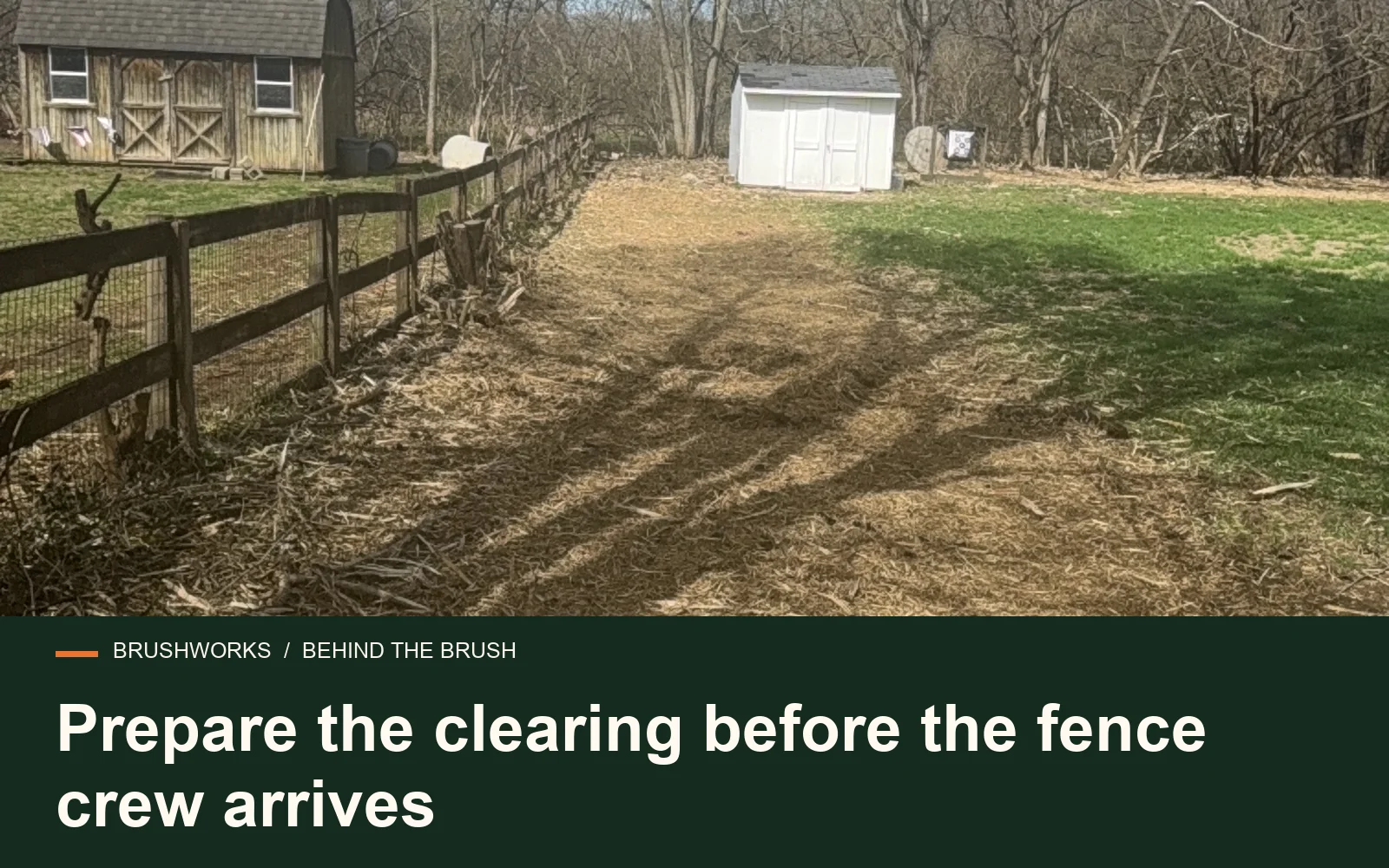
Before you start
- Verify the surveyed line rather than following old wire.
- Mark corners, braces, gates, and access turns.
- Agree who removes stumps where posts need to go.
Why Fence Line Clearing Is a Separate Job
Fence contractors are specialists. They set posts, hang panels, stretch wire, and build gates. Their equipment is designed for that work: post hole diggers, augers, wire stretchers, and panel carriers. They are not set up to fell trees, grind stumps, remove brush, or clear root systems. Asking a fence company to clear your fence line is like asking an electrician to frame your walls.
What happens when people skip the clearing step? The fence contractor shows up and either refuses to start until the line is clear, or they try to work around the obstacles. Working around obstacles means the fence deviates from the property line, posts get placed in bad soil, panels don't line up, and you end up with a fence that looks crooked, has gaps, and won't hold up to the first heavy wind or snowfall.
What Needs to Be Cleared Before Fence Installation
This is the biggest obstacle on most Cincinnati-area properties. Bush honeysuckle, multiflora rose, autumn olive, and other invasive species form impenetrable walls along property lines. These plants thrive on edges—the transition zone between maintained yard and woods—which is exactly where fences go.
Ohio isn't flat. Properties in the hills of Clermont County, eastern Hamilton County, and parts of Warren County have significant grade changes that affect fence installation. Your clearing crew can identify and address terrain issues during the clearing phase: minor grading to create a level post line, removing soil berms from old fence rows, and filling washouts or erosion channels that cross the fence path.
How Wide to Clear for a Fence
For residential privacy fences in subdivisions and neighborhoods around Cincinnati, this minimum width is usually sufficient. The land on both sides is maintained as lawn, so regrowth isn't a major concern.
Horse owners in particular should clear aggressively. Horses will chew on tree bark within reach of the fence, which kills the trees and creates falling hazards. A wide, clean buffer protects both the animals and the fence.
Timing Your Clearing Before Fence Installation
The timeline between clearing and fence installation matters. Here's how to plan it:
This is the sweet spot. Clear the fence line at least two weeks before the fence crew arrives. This gives the mulch time to settle, lets you spot any issues that were hidden under vegetation (drainage problems, rock outcrops, buried utilities, old fence remnants), and gives the fence contractor a clean look at the ground conditions before they commit to a post layout.
Property Lines, Surveys, and Neighbor Relations
Fence line clearing brings up property line questions that you need to address before any work begins.
Survey stakes give your clearing crew a precise line to follow. Without them, you're guessing, and guessing on a property line creates legal problems that outlast the fence.
Ohio law treats trees on a property line as shared property. You can trim branches that hang over your side, but you can't remove a tree that straddles the boundary without your neighbor's consent. If you've got trees right on the line that need to come down for the fence, have that conversation before the clearing crew arrives.
In many cases, neighbors are happy to see the fence line cleared. It improves the appearance of both properties, and most people would rather have a clean fence than a wall of honeysuckle. But surprises create conflict. A quick conversation prevents a lot of headaches.
Common Fence Types and Their Clearing Requirements
Different fence types have different ground preparation needs. Here's what to keep in mind for the most common fences installed in Ohio:
Chain link is more forgiving of minor ground irregularities because the mesh flexes. But the terminal posts, line posts, and top rail still need to be precisely placed. Clear the same width as a privacy fence. Chain link is common for dog runs, pool enclosures, and property boundaries in suburban Hamilton County.
Vinyl fence panels are rigid and unforgiving. They crack if forced into a curve or if the ground shifts underneath them. The fence line needs to be dead straight and the ground needs to be level or uniformly graded. Vinyl fences also need clean post holes because the posts are hollow and rely on concrete fill for strength—any root debris in the hole compromises the set.
After Clearing: Maintaining Your Fence Line
Clearing your fence line is not a one-time project. Ohio's climate and soil are incredibly productive, which means vegetation comes back fast. If you don't maintain the cleared corridor, you'll be back to square one in three to five years.
Here's how to keep your fence line clear after installation:
Mow regularly. If the corridor is wide enough for a mower, run it along both sides of the fence every two to three weeks during the growing season. This prevents new brush from establishing and keeps grass short enough that it doesn't push against the fence.
Inspect annually. Walk the full fence line at least once a year—ideally in late fall when leaves are down and you can see the structure. Look for trees that have grown into the fence, vines climbing the posts, and soil erosion undermining post bases.
Agree on the handoff
Before work begins, define what the next person needs to find on site. A rough mulched opening may still contain roots, stump remnants, and uneven ground. Grading, structural preparation, planting, surfacing, and specialist tree work are separate unless explicitly included.
Keep the marked work map with the quote. At completion, compare the limits and finish, document any follow-up, and decide who will maintain the area. Photos help record the result, but they do not replace checking the ground and access.
Plan the work for your property
Send the site address, recent photos, a marked clearing area, and the finish you want. We can discuss where clearing fits and what needs a different trade.
Discuss your project → Explore pricing