
Before you start
- Ask the builder for pad, delivery, and staging limits.
- Protect septic evaluation and replacement areas.
- Decide whether organic material will be removed from construction zones.
Why site prep makes or breaks a barndominium build
Most people fall in love with the barndominium idea because it looks simple. Big steel frame, open floor plan, shop on one side, living space on the other. And from the outside, a barndo on a finished lot looks straightforward. The reality is that the steel goes up in a few days. The site prep is what usually takes weeks.
Across southern Ohio, the properties where people build barndominiums are rarely nice flat open pastures. They are old family land, wooded hilltops, hobby farms, neglected acreage, or a back corner of a larger parcel. That means the first real cost is not the building. It is getting the site into shape so a builder and excavator can actually work.
What real barndominium site prep actually includes
There is no single step called "site prep." It is a stack of work that happens in a specific order, and each piece depends on the one before it. On most Ohio barndo builds, the pieces look like this.
Clearing: brush, saplings, small trees, invasives, and debris around the building footprint
Selective tree work: removing only the trees that are in the way, protecting the rest
Driveway and access: cutting in a stable route that equipment and concrete trucks can actually use
Why forestry mulching is the right first step
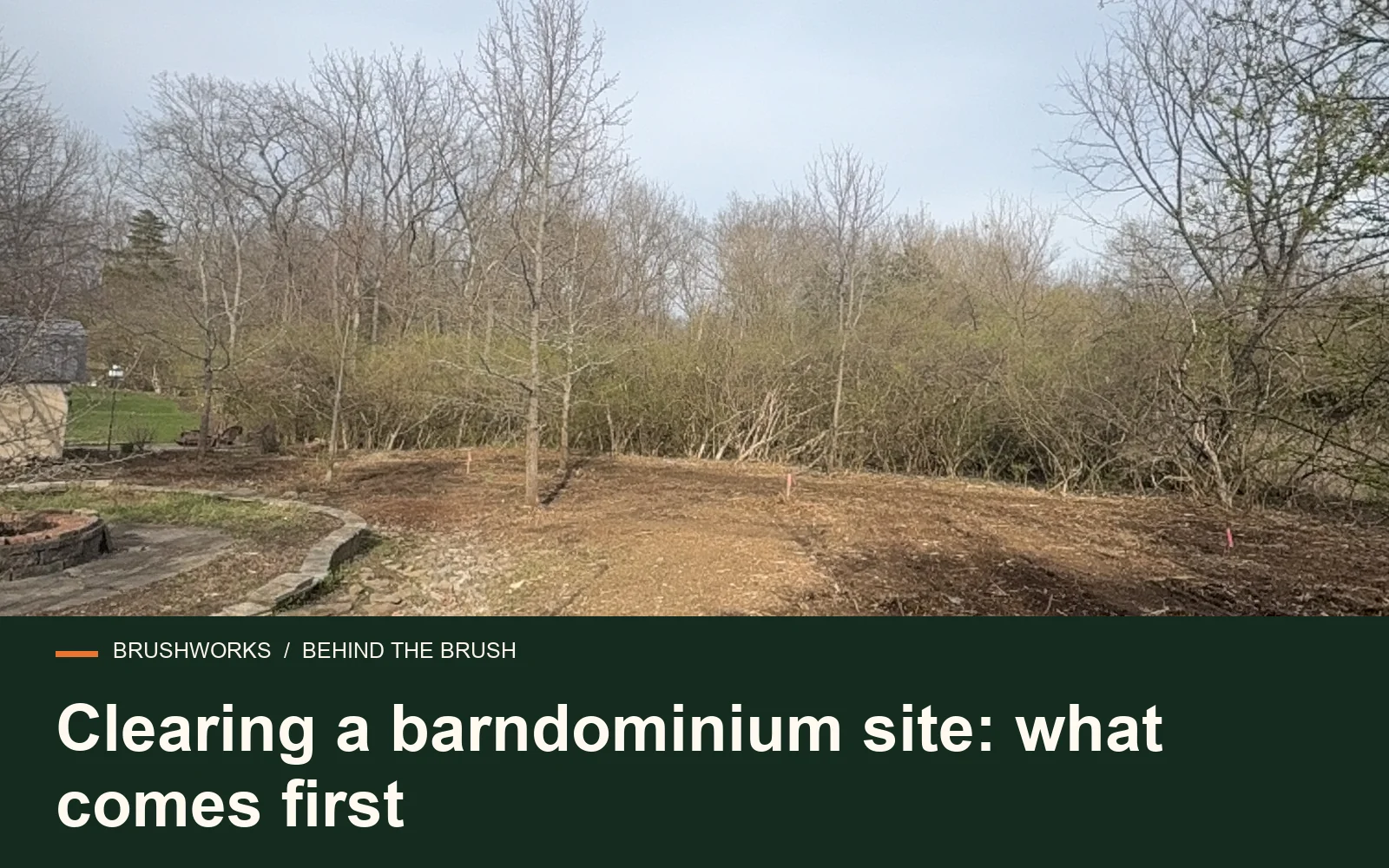
Before mulching, you are squinting through a wall of honeysuckle and volunteer maples trying to guess where the pad should go. After mulching, you can actually see the slope, the sight lines, the drainage patterns, and any surprises the property was hiding. That is a better place to make a decision that will sit underneath your home for fifty years.
This is one of those cases where spending a little money early actually saves money later. A well-cleared barndo site makes the excavator's job faster and cheaper. It also lets your builder commit to a pad location with a lot more confidence.
Picking the right pad location on Ohio land
A lot of first-time barndo owners have a dream spot picked out before they ever walk the property with an experienced eye. That spot might still be the right one. But in Ohio, you have to sanity-check it against a few real variables that can make or break the project.
Water is the number one enemy of any rural Ohio build. Pad locations that sit in a low spot, at the base of a hill, or in the natural drainage path of the property will fight you forever. A good site visit will identify where surface and subsurface water actually wants to go, and place the pad out of that path.
Your pad is only as good as the route you use to reach it. A great building site with a bad driveway is a recipe for stuck concrete trucks, damaged lawns, and delayed framing. A lot of Ohio barndo projects end up moving the pad slightly just to get a cleaner approach for big trucks.
Long utility runs add cost quickly. If the pad sits four hundred feet from the road, that is four hundred feet of electric, four hundred feet of water line, and a real conversation about generator service, cisterns, or well systems. Not necessarily a deal breaker, but it changes the budget.
Driveway access for barndominium builds
Access is often the most under-planned part of a rural Ohio build. The barndo itself may only need a modest driveway to look finished, but during construction you need a route that can handle concrete trucks, lumber trailers, dump trucks, steel delivery, and boom trucks. That is heavier traffic than the finished driveway has to support long-term.
A typical good-access plan includes a widened, reinforced driveway with turnaround space near the build site, proper culverts for any ditches or streams, and enough room for trucks to stage. Forestry mulching and brush removal are usually the first step here too, since most rural parcels have a driveway corridor that is choked with overgrowth long before the first load of gravel arrives.
Clearing order of operations on a typical Ohio barndo project
Here is a simple order most Ohio barndominium projects benefit from. It is not the only way, but it avoids the majority of expensive rework.
Walk the land with a clearing contractor, builder, and if possible an excavator. Talk through pad, access, and drainage.
Forestry mulch the building zone and driveway corridor to expose real terrain.
Confirm pad location once you can see the ground, not just the treetops.
Permits and local rules around Cincinnati
Barndominium permitting in Ohio is mostly handled at the county and township level. That means rules vary a lot from one parcel to the next, even within the same county. Rural Clermont, Warren, and Brown County parcels often have more flexibility than parcels inside village or city limits.
Agree on the handoff
Before work begins, define what the next person needs to find on site. A rough mulched opening may still contain roots, stump remnants, and uneven ground. Grading, structural preparation, planting, surfacing, and specialist tree work are separate unless explicitly included.
Keep the marked work map with the quote. At completion, compare the limits and finish, document any follow-up, and decide who will maintain the area. Photos help record the result, but they do not replace checking the ground and access.
Plan the work for your property
Send the site address, recent photos, a marked clearing area, and the finish you want. We can discuss where clearing fits and what needs a different trade.
Discuss your project → Explore pricing