
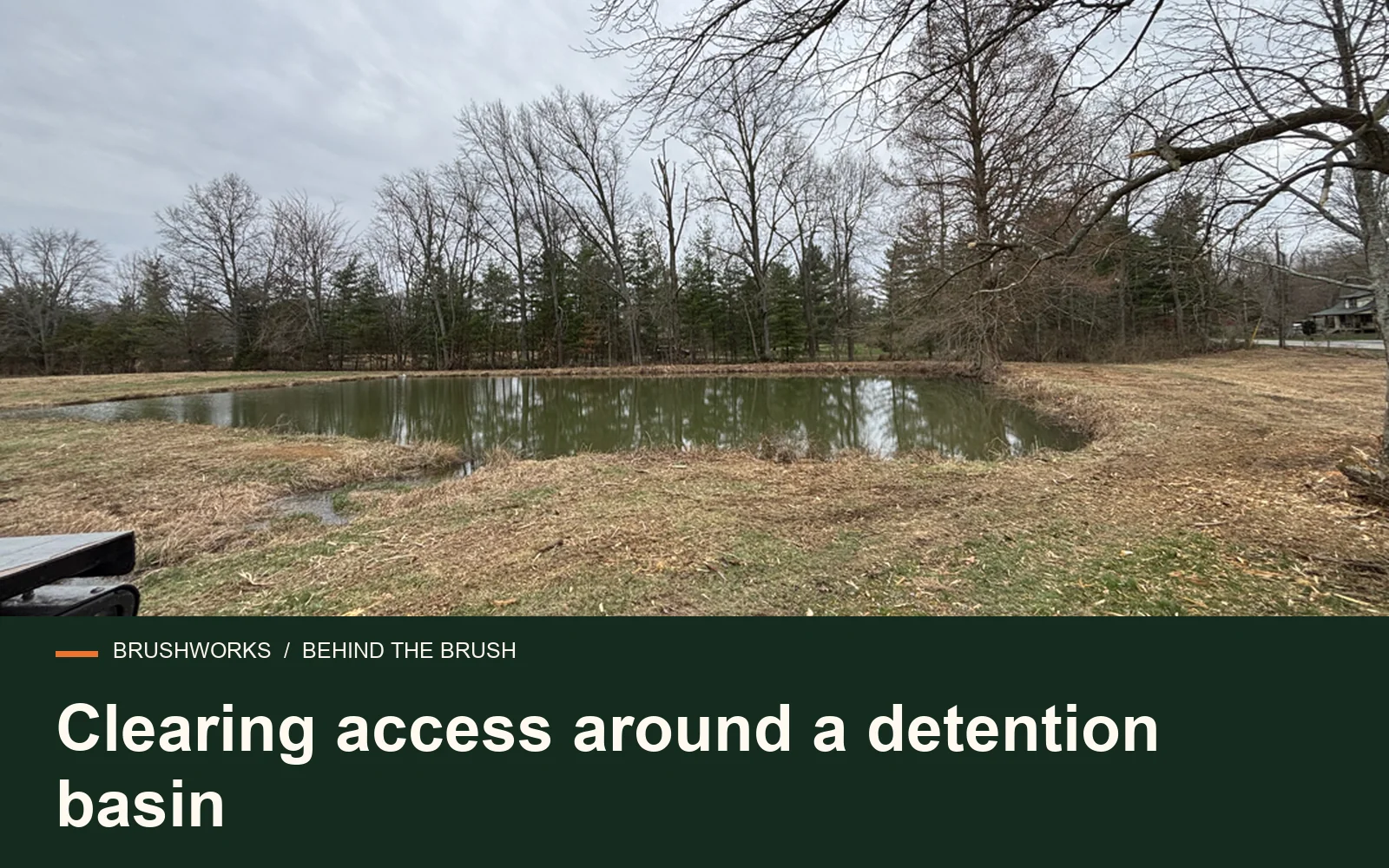
Before you start
- Locate inlets, outlets, spillways, and maintenance paths.
- Confirm the approved vegetation and mowing plan.
- Keep heavy equipment away from soft banks and hidden structures.
What a detention basin is supposed to do
That basic job depends on access and visibility. Someone has to be able to inspect the basin after storms. They need to see whether the inlet is blocked, whether the outlet is clogged, whether water is standing too long, whether a slope is eroding, and whether woody roots are growing where they should not be.
When brush takes over, every part of that work gets harder. A basin full of waist-high weeds and saplings can hide deep holes, wet spots, trash, concrete structures, wire, animal burrows, and broken pipe ends. If the access path disappears, even simple maintenance becomes a fight.
Why detention basins get overgrown so quickly
Detention basins are built to collect water, sediment, sunlight, and seed. That combination grows brush. The upper banks may dry out and grow honeysuckle, autumn olive, locust, cedar, cottonwood, willow, grapevine, and briars. The lower areas may stay damp long enough for cattails, rough grass, woody sprouts, and mud-loving growth to fill in.
The work is easy to postpone because basins are often tucked out of view. A property manager sees the parking lot every day. A homeowner sees the front entrance. The basin behind the tree line may only get attention when the mowing crew refuses to enter it or a neighbor complains about standing water.
Once woody growth gets established, mowing alone will not fix it. A mower may knock down grass and light weeds, but it will not handle multi-stem honeysuckle, willow trunks, deadfall, vines, or saplings around outlets and fences. That is when brush clearing becomes the reset.
Start with the maintenance goal
"Clear the basin" is too vague for a stormwater feature. A good scope starts with the reason for the work. Does the owner need to reopen the access path? Does the outlet need to be visible? Is the slope too overgrown to mow? Did an inspector flag woody vegetation? Is the basin holding water because brush and sediment are blocking flow? Does a fence need repairs?
Access paths matter more than people think
A detention basin without access is a maintenance problem waiting to get expensive. Inspectors, landscapers, stormwater contractors, and repair crews need a route in. That route should be wide enough for the expected equipment and stable enough to use without chewing up yards or slopes.
In many Cincinnati subdivisions and commercial sites, the original access path is still on the plan, but nobody can see it anymore. It may run between lots, behind a fence, from a parking lot corner, along a utility easement, or across a grass strip that has filled with brush. Clearing that route first helps everyone understand the rest of the job.
Access is also where property boundaries matter. Basins often sit near HOA common areas, neighboring lots, utility easements, or commercial parcel lines. Before work begins, confirm where equipment can enter and where it must stop. If a crew has to cross private yards or a shared drive, get permission before the work date.
What should usually be cleared
Most detention basin clearing starts with woody growth that blocks inspection or maintenance. That can include honeysuckle, willow sprouts, cottonwood saplings, autumn olive, locust, tree of heaven, multiflora rose, grapevine, dead ash limbs, and volunteer trees growing in the wrong place.
Outlets, inlets, emergency spillways, fence gates, access paths, concrete structures, riprap, and low flow channels should be visible enough for the responsible party to inspect. If a basin has a dam or embankment, woody growth on that structure deserves attention because roots can create long term problems.
Perimeter brush is often cleared to make mowing possible. A narrow strip may be enough in some basins. Others need a wider area opened so a mower can turn, a stormwater crew can work, or a manager can walk the basin without pushing through thorns.
What should not be done blindly
A basin is not a vacant lot. Do not scrape slopes bare just because brush is annoying. Bare clay can erode during the next storm, especially on steep banks. Do not pile mulch, logs, or cut brush in a swale, channel, spillway, or place where stormwater needs to move. Do not drive heavy equipment into wet bottoms just to save a few hours of hand work.
Utilities and structures also need room. Storm pipes, underdrains, headwalls, outlet control structures, manholes, grates, buried lines, fences, and monitoring points can sit inside or near the basin. Some are obvious. Some are hidden by weeds or sediment. Mark known features before clearing, and slow down near anything that looks like drainage infrastructure.
Tree removal should also be selective. A big healthy tree on the upper perimeter may not be a problem. A willow growing out of an outlet structure probably is. The point is function, access, and maintainability, not making every basin look like a lawn.
Where forestry mulching fits
Forestry mulching can work well around detention basins when the ground is firm and access is reasonable. It is useful for reclaiming overgrown edges, clearing access corridors, knocking down dense honeysuckle, and opening wooded perimeter areas without hauling every piece of brush off site.
The mulch layer can help cover exposed ground where the machine works, but it should not be treated like a cure for every drainage issue. Mulch does not fix a clogged pipe, broken structure, undersized outlet, sediment-filled basin, or slope failure. It clears the way so the right people can inspect and repair those problems.
Good basin work often uses more than one method. A mulcher may handle the dry perimeter and access path. A saw crew may cut around concrete structures, fences, steep banks, wet pockets, and utility features. A mower or maintenance crew may take over after the woody material is reset.
HOA detention basin maintenance
For HOA boards, the scope should be clear enough to explain to homeowners. Which basin is being cleared? Why now? What will be removed? What will stay? Will privacy change behind certain lots? Where will equipment enter? How long will the work take?
That communication matters. People get nervous when equipment appears behind their fence. They get more nervous when a wooded buffer changes overnight. A short notice with the work area, date range, purpose, and contact person prevents a lot of confusion.
Commercial and multifamily basins
Commercial properties, apartment communities, churches, schools, warehouses, and retail centers have a different set of concerns. The basin may sit near parking, dumpsters, loading areas, playgrounds, sidewalks, or property lines. Work needs to avoid customer traffic, parked cars, tenants, underground utilities, and regular business operations.
For these sites, timing and access are part of the job. A morning window may work better than a busy afternoon. Cones, temporary access limits, and manager communication may be needed. If the basin has trash, dumped debris, shopping carts, wire, concrete, pallets, or fencing buried in the brush, that should be discussed before equipment enters.
Commercial owners should also keep records. Before and after photos, contractor invoices, maps, and inspection notes can help show that the property is maintaining its stormwater feature. That does not replace engineering work when repairs are needed, but it helps document routine maintenance.
Agree on the handoff
Before work begins, define what the next person needs to find on site. A rough mulched opening may still contain roots, stump remnants, and uneven ground. Grading, structural preparation, planting, surfacing, and specialist tree work are separate unless explicitly included.
Keep the marked work map with the quote. At completion, compare the limits and finish, document any follow-up, and decide who will maintain the area. Photos help record the result, but they do not replace checking the ground and access.
Plan the work for your property
Send the site address, recent photos, a marked clearing area, and the finish you want. We can discuss where clearing fits and what needs a different trade.
Discuss your project → Explore pricing