
Before you start
- Get the utility owner's work limits and clearance requirements.
- Identify overhead as well as underground services.
- Keep mulch and debris out of inspection points and drainage.
What Is a Utility Easement?
In Ohio, utility easements are recorded on your property deed. They were usually granted when the subdivision was platted or when the utility infrastructure was first installed, sometimes decades ago. The easement specifies the width of the corridor and what the utility company can do within it.
Why Easement Clearing Matters
Overgrown utility easements cause real problems for property owners:
Power outages. Trees growing into overhead power lines are the number one cause of power outages in Ohio. Duke Energy reports that vegetation contact causes more than half of their outage events. If that overgrown easement behind your house takes out your power during a storm, the utility company will clear it. But wouldn't you rather it was cleared before the ice storm?
Property access. If a utility company needs to access their infrastructure for repairs, they'll clear whatever is in their way. They're not going to be gentle about it. A utility company clearing a neglected easement in an emergency will use whatever method gets them access fastest. If you maintain it yourself, you control how it looks.
Property value. An overgrown easement running through your backyard looks bad. A clean, maintained easement with a mowed path or mulched corridor actually adds to your usable space.
Who Pays for Easement Clearing?
This is the question everyone asks first. The answer depends on the situation:
Utility companies are responsible for maintaining their rights-of-way to protect their infrastructure. Duke Energy, AEP, and the pipeline companies all have vegetation management programs and budgets. They contract with tree service companies and right-of-way clearing crews to maintain their easements on a rotating cycle.
The catch: they work on their schedule, not yours. A utility company might clear your easement this year or three years from now. It depends on their maintenance cycle, their budget, and how high-risk your particular section is. High-voltage transmission lines get cleared more frequently than distribution lines.
If you want the easement cleared on your timeline, you're paying for it yourself. Many property owners in Greater Cincinnati hire us to clear utility easements because they don't want to wait for the utility company's schedule. This is especially common when:
How We Clear Utility Easements
Forestry mulching is the go-to method for utility easement clearing. Here's why it works better than the alternatives:
Everything gets processed on site. The mulcher grinds brush, saplings, and small trees into wood chips that stay on the ground. For long easement corridors that might be half a mile or more, not having to haul debris out saves a huge amount of time and money. Traditional cutting and hauling on a long easement can take three to four times as long as mulching.
Power Line Easement Clearing in Ohio
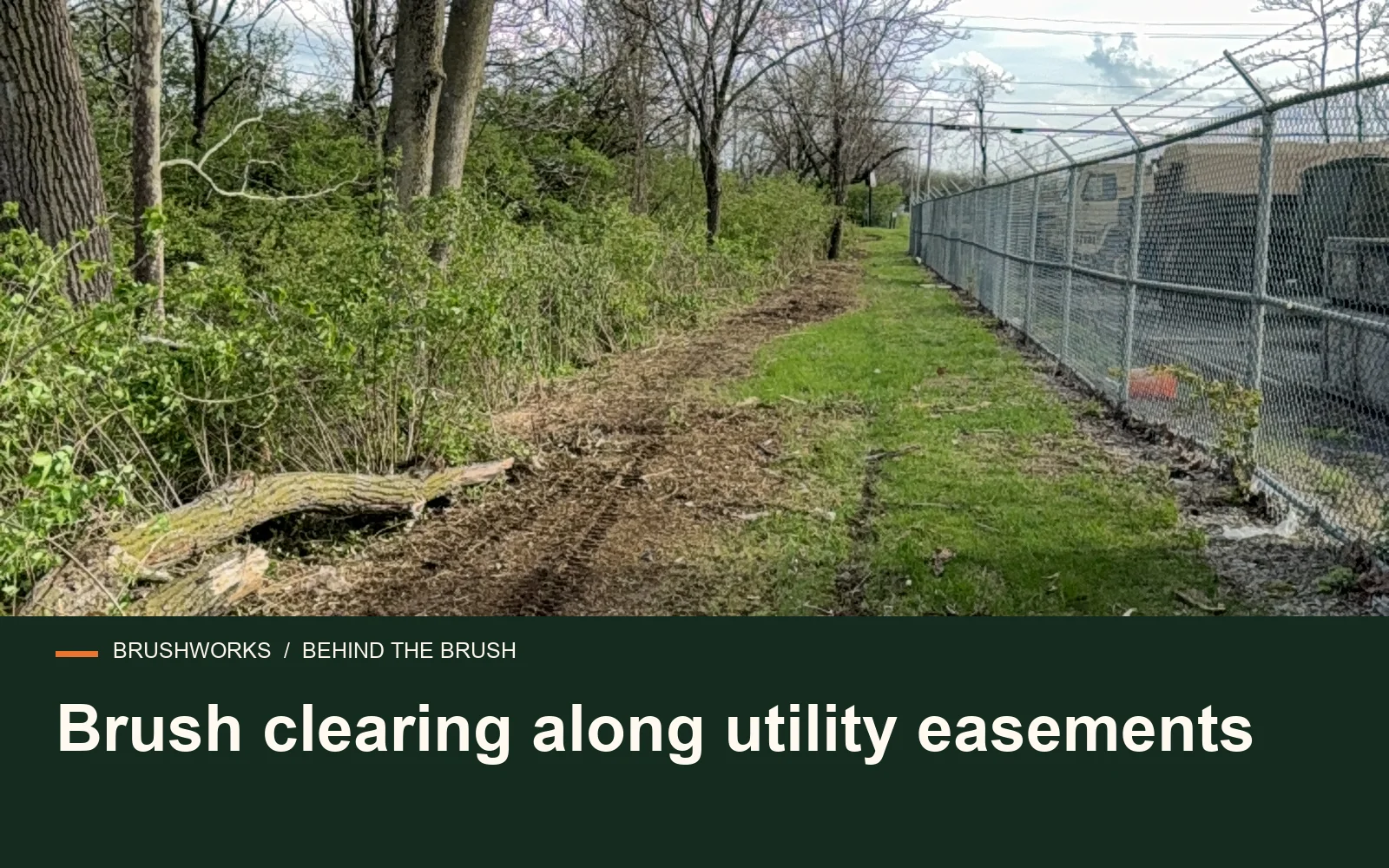
Here's what a typical power line easement clearing looks like:
Pipeline Right-of-Way Clearing
Pipeline easements have stricter rules than power line easements. The pipeline companies take vegetation management seriously because overgrown rights-of-way create real safety and inspection problems.
No structures. Don't build fences, sheds, decks, or any structures on a pipeline easement. The pipeline company has the right to remove them.
Keep it accessible. Pipeline companies need to drive trucks and equipment along their rights-of-way for inspections and maintenance. Don't block access with berms, ditches, or landscaping.
Some pipeline companies will actually reimburse property owners for vegetation management or will hire contractors directly to maintain their easements. It's worth calling the pipeline company's land department to ask before you spend your own money.
Transmission Line Corridor Clearing
Property owners with transmission easements usually don't need to hire their own clearing because the transmission companies maintain these corridors more aggressively. But there are situations where it makes sense:
Between maintenance cycles. If the utility cleared the corridor two years ago and it's already growing back thick, you might want it maintained more frequently than the utility's schedule.
Edge cleanup. Utility crews clear within the easement boundary but not an inch beyond it. If the vegetation on the edges is encroaching into your yard or fields, that's on you.
Trail use. Some property owners with transmission easements use the cleared corridor for ATV trails, walking paths, or equipment access roads. Maintaining it for these purposes is the property owner's responsibility.
Clearing Easements on Steep Terrain
Southwest Ohio has plenty of hilly terrain, and utility easements go straight through it. Power lines and pipelines don't care about topography. They follow the most direct route from point A to point B, and that route often includes steep ravines, hillsides, and creek crossings.
Utility Easement Maintenance Schedule
If the easement has been neglected for years, the first clearing is the most expensive. You're dealing with established trees, thick brush, and dense invasive species. After the initial clearing, maintenance is much cheaper and faster.
After mulching, the easement corridor can be maintained with annual mowing if the regrowth stays small. A brush hog or heavy-duty mower handles first-year regrowth well. This keeps the easement clean without needing a mulcher every year.
Agree on the handoff
Before work begins, define what the next person needs to find on site. A rough mulched opening may still contain roots, stump remnants, and uneven ground. Grading, structural preparation, planting, surfacing, and specialist tree work are separate unless explicitly included.
Keep the marked work map with the quote. At completion, compare the limits and finish, document any follow-up, and decide who will maintain the area. Photos help record the result, but they do not replace checking the ground and access.
Plan the work for your property
Send the site address, recent photos, a marked clearing area, and the finish you want. We can discuss where clearing fits and what needs a different trade.
Discuss your project → Explore pricing