
Before you start
- Define inspection routes and test areas.
- Confirm owner authorization before due-diligence clearing.
- Avoid clearing beyond the current evaluation scope.
Why CRE land sites get stuck in the brush stage
In southwest Ohio, bush honeysuckle is often the main culprit. It fills wooded edges, old fence rows, and low ground fast. Add grapevine, multiflora rose, locust sprouts, box elder, maple saplings, autumn olive, dead ash, and unmanaged field growth, and a site can become hard to inspect from the road or from the property line.
That hurts more than appearance. It slows due diligence. It makes listing photos weak. It raises questions for buyers because the site looks uncertain. It can keep surveyors, soil evaluators, engineers, appraisers, and contractors from doing clean field work. If a property cannot be walked safely, every next step takes longer.
What forestry mulching does well on commercial sites
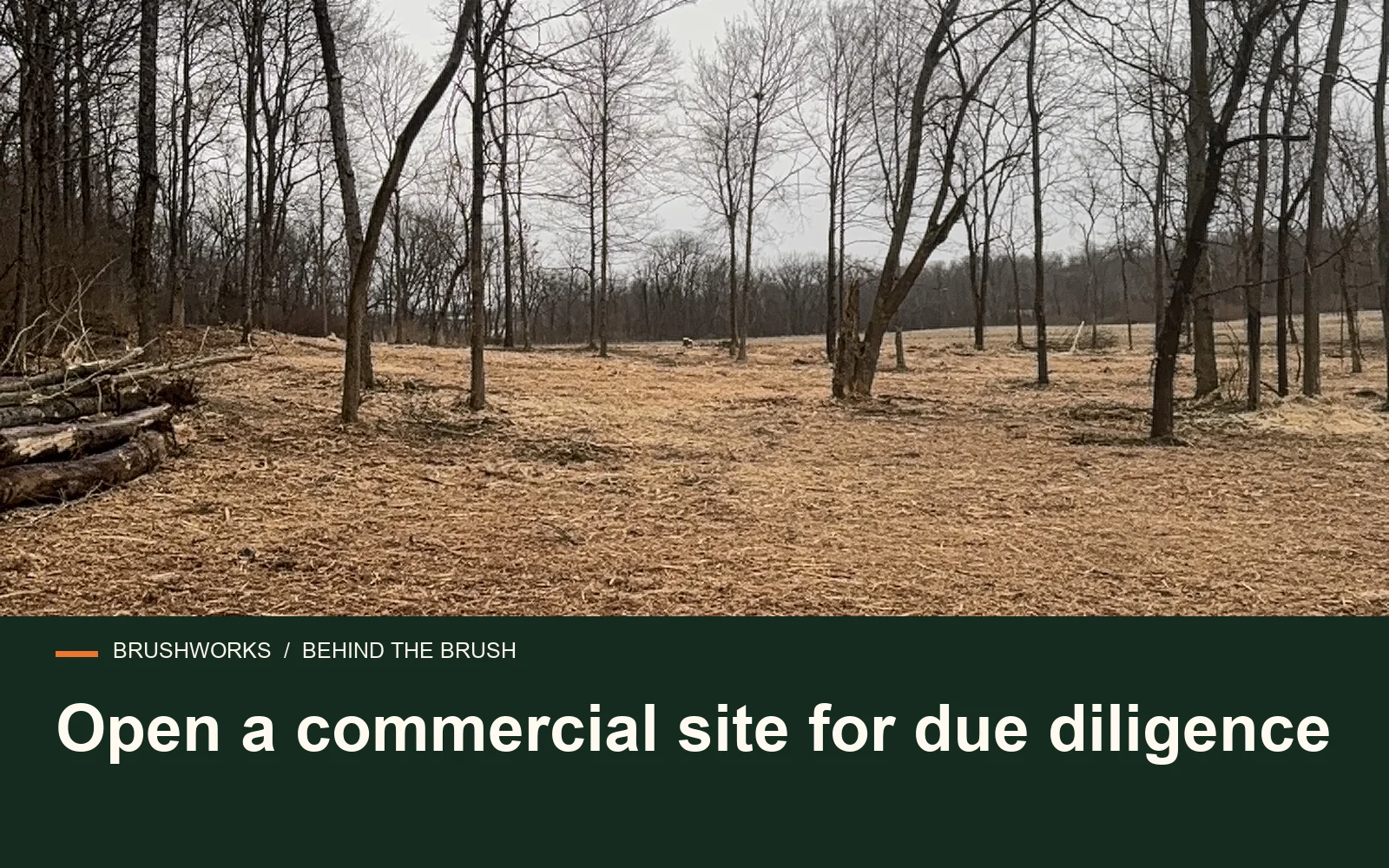
Forestry mulching is useful when the goal is to open visibility and access without stripping the whole site bare. A mulching machine can cut and grind brush, saplings, invasive shrubs, vines, and smaller trees. The material stays on site as a mulch layer instead of being hauled away in piles.
For CRE land, that can mean opening a frontage window so drivers can see the parcel. It can mean clearing a lane from the road to the back acreage. It can mean exposing a fence line, old drive, drainage swale, culvert, utility corridor, detention basin edge, or future staging area. It can also mean cutting inspection paths so a team can evaluate the site without fighting through brush.
The biggest value is often clarity. Once the rough growth is down, owners can see what land is flat enough to use, where water holds, where old debris sits, which trees are worth keeping, and which areas need a different contractor. Good forestry mulching makes the next decision better informed.
What forestry mulching does not replace
That is not a weakness. It is the reason mulching can be useful early. Before you spend money on full site work, you can open enough ground to inspect the parcel and decide where deeper work belongs. You can also avoid clearing areas that should remain buffered, wooded, protected, or reserved for later phases.
Use it before listing a land site
For brokers and owners preparing a commercial parcel for sale, first impressions matter. A site covered in brush can look smaller, wetter, rougher, and less usable than it really is. Buyers may assume the worst because they cannot see the slope, entrance, usable bench, back acreage, or road frontage.
Selective forestry mulching can make the listing more honest and more useful. The goal is not to fake a finished site. The goal is to show the land. Open the frontage enough for visibility. Reclaim the old access lane if one exists. Clear inspection paths to the main features. Open around signs, gates, property corners, and drainage features. Remove enough invasive brush that buyers can walk the property without guessing.
Good clearing can also help photography. Wide shots, drone shots, and walk-through videos all work better when the land has visible edges and access points. For a Cincinnati-area CRE site, that can be the difference between a buyer seeing a problem parcel and seeing a property with potential.
Use it during due diligence
Due diligence depends on field access. Survey crews need to find pins and shoot lines. Soil evaluators need to reach test areas. Engineers need to inspect drainage, slopes, swales, culverts, and possible utility corridors. Environmental consultants may need to walk wooded edges, low spots, or suspected wet areas.
Before mulching for due diligence, mark sensitive areas clearly. If wetlands, streams, sinkholes, steep slopes, protected trees, or known environmental concerns may be present, those areas should be treated carefully. Sometimes the right answer is a narrow access path, not a broad clearing pass.
Use it for vacant site maintenance
Not every CRE land site is ready for sale or construction. Some parcels need to be held clean enough to inspect, show, and manage. Brushy frontage can make a site look abandoned. Overgrown access points can keep owners from monitoring dumping, trespass, stormwater problems, and fence damage. Growth around detention basins or drainage features can make routine inspection harder than it needs to be.
Forestry mulching can reset those problem areas. A maintenance-focused scope might include frontage cleanup, driveway edge clearing, access lane reopening, fence line visibility, detention basin access, sign visibility, and brush removal around gates or culverts. That kind of work keeps the parcel manageable while bigger decisions wait.
The important part is leaving the site maintainable after the first pass. If a cleared edge cannot be mowed or reached again, it will close back in. Build the clearing width around the equipment that will maintain it later.
Start with boundaries and easements
Commercial sites often have layers of constraints. Property lines, road right-of-way, utility easements, drainage easements, access easements, setbacks, neighboring parcels, signage areas, and future road improvements can all affect where clearing should happen. Do not rely on the visible brush line as the boundary. It is often wrong.
Protect drainage and stormwater features
Drainage is one of the first things people need to understand on an Ohio land site. Brush can hide swales, ditches, culverts, pond edges, outlets, and low areas. Mulching can reveal those features, but the work needs to be done with water in mind.
Mulch should not be shoved into channels, culvert mouths, basin outlets, or flow paths. Slopes and banks may need selective clearing instead of a hard reset. If a detention basin is already part of the site, access should be opened in a way that helps inspection and maintenance without damaging the feature.
Cincinnati clay soils can hold water after heavy rain. A parcel may look dry from the road and still have soft areas inside. Timing matters. So does equipment access. Ruts made during early cleanup can create problems that have nothing to do with the final development plan.
Separate presentation clearing from development clearing
A site being prepared for a listing does not need the same scope as a site being prepared for mass grading. Presentation clearing is about sight lines, access, clean edges, and showing usable ground. Development clearing is tied to approved plans, erosion control, tree removal, stump handling, topsoil, grading, utilities, and construction sequencing.
Mixing those scopes can waste money. If final plans are not done, clearing too much can remove useful buffers, create erosion exposure, or open areas that will sit unmanaged. If the site only needs to be shown, walkable, and inspected, a lighter forestry mulching scope may be enough.
Once plans are ready, the civil contractor can handle the deeper site work. The early mulching pass should make that process easier, not pretend to be the final step.
Agree on the handoff
Before work begins, define what the next person needs to find on site. A rough mulched opening may still contain roots, stump remnants, and uneven ground. Grading, structural preparation, planting, surfacing, and specialist tree work are separate unless explicitly included.
Keep the marked work map with the quote. At completion, compare the limits and finish, document any follow-up, and decide who will maintain the area. Photos help record the result, but they do not replace checking the ground and access.
Plan the work for your property
Send the site address, recent photos, a marked clearing area, and the finish you want. We can discuss where clearing fits and what needs a different trade.
Discuss your project → Explore pricing