
Before you start
- Confirm the parcel's local permitting contacts.
- Mark drainage routes and retained trees.
- Discuss access and finish during an on-site review.
Start with the end use
Land clearing sounds broad, but the end use controls the whole job. If you are clearing for a driveway, the route, width, turning radius, sight distance, and drainage matter more than making the woods look pretty. If you are clearing for a home site, the builder needs access, staging room, and enough visibility to confirm layout. If you are reclaiming pasture, the focus is invasive brush, fence rows, shade, and future mowing.
For a backyard or rural residential lot, selective clearing usually beats stripping everything. Most owners want usable ground, not a moonscape. Around Clermont County, good trees can add shade, privacy, and property value. Junk growth like bush honeysuckle, tree of heaven, dead ash, wild grapevine, and thorny locust often creates the problem. A good plan removes the growth that blocks use while protecting the trees that make the property worth owning.
Before work starts, walk the area and decide what success looks like. Do you want a path to the creek? A clean line for a fence contractor? A place to park equipment? A pad for a future barn? A better view from the house? Those details save time on site and keep the clearing limits honest.
Permits and local rules to check
Check before clearing near streams, creeks, drainage ditches, ponds, wetlands, floodplain, road right-of-way, steep slopes, or areas tied to a building project. Clermont County, townships, villages, cities, the health district, the engineer, soil and water, and the Army Corps can all matter depending on the site. That sounds like a lot, but most ordinary jobs only need a quick local check.
If you are preparing for a house, garage, barn, septic system, driveway entrance, or commercial site, talk with the builder, excavator, surveyor, or local office before widening the work area. Septic locations, driveway sight distance, culverts, erosion control, and stormwater rules can affect where clearing should happen.
The practical rule is simple: if water, roads, utilities, septic, or construction are involved, ask before you clear aggressively. It is cheaper to leave a buffer than to repair a violation.
Forestry mulching versus bulldozing
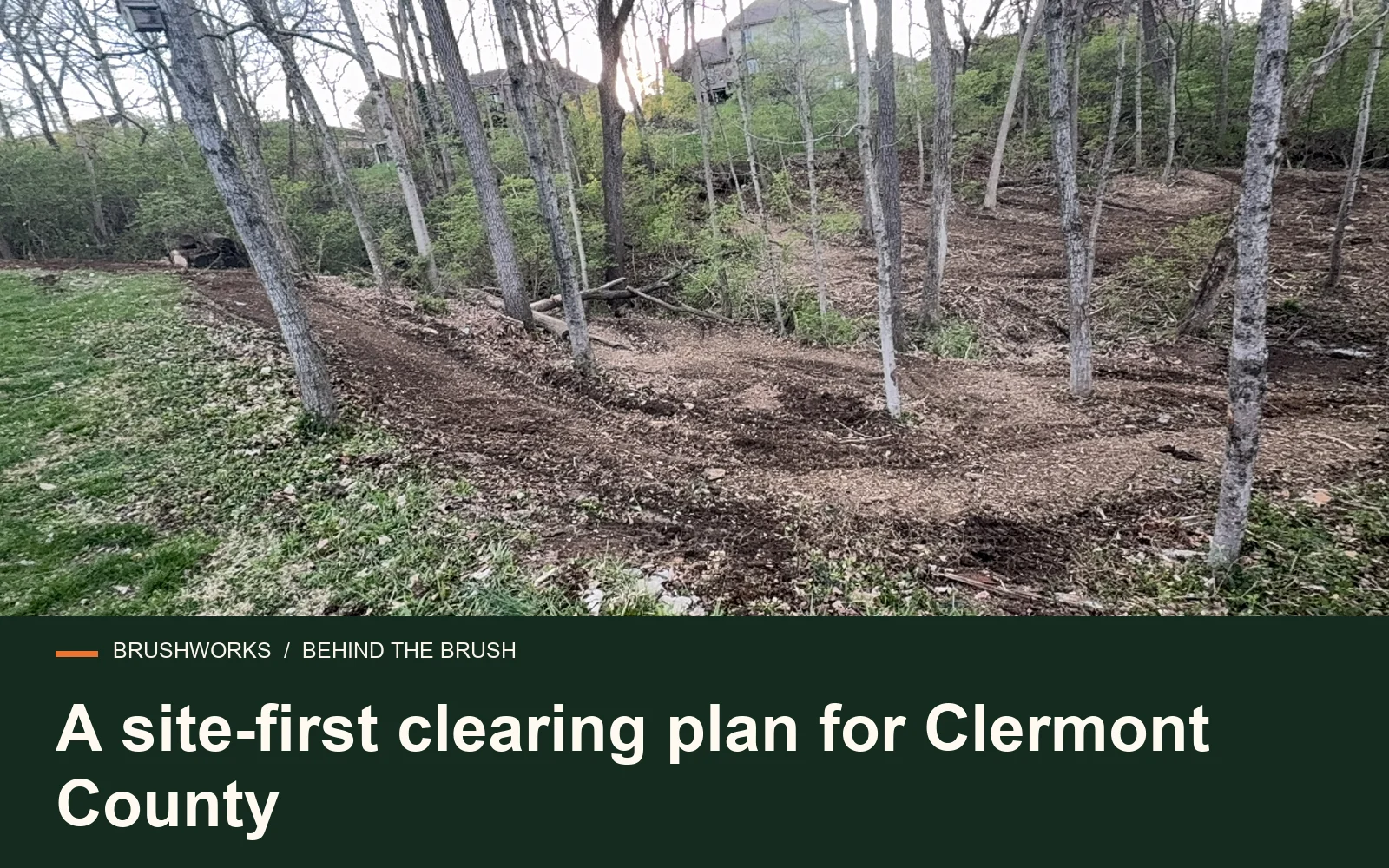
Forestry mulching and bulldozing solve different problems. A forestry mulcher grinds brush, saplings, vines, and small trees in place. It leaves a rough mulch layer that helps protect the soil and makes the ground easier to walk. That is a strong fit for trails, fence rows, access lanes, invasive brush, hunting land, yard expansion, and selective clearing.
Common Clermont County clearing projects
A lot of Clermont County calls start with access. Someone bought acreage and cannot get to the back. A driveway is too narrow for a builder. A surveyor cannot find corners. A creek, pond, or field edge is buried behind honeysuckle. Opening a sensible lane changes the whole property fast.
Another common project is reclaiming yard edges and wooded lots. In areas like Loveland, Milford, Goshen, Batavia, Amelia, New Richmond, Williamsburg, and Bethel, invasive brush can take over the line between lawn and woods. The owner still has trees, but the understory is a wall. Mulching can knock that wall back, open sight lines, and make the space maintainable again.
Rural properties often need fence rows, pasture edges, barn sites, food plots, trails, and equipment access cleared. Those jobs are less about a perfect lawn and more about useful ground. You need to move around, maintain the property, and stop brush from stealing acres every year.
Construction prep is another major category. Builders and excavators do better when they can see the ground. Clearing for a home, pole barn, detached garage, septic test area, or utility route can prevent bad layout decisions before concrete and gravel enter the picture.
Invasive brush is usually the real enemy
When someone says their land is overgrown, they often picture trees. In Clermont County, the bigger problem is usually invasive understory. Bush honeysuckle is everywhere. Autumn olive, multiflora rose, tree of heaven, callery pear, privet, grapevine, and thorny locust show up often too. These plants fill the middle layer, block access, shade out native growth, and make a property feel smaller than it is.
The first clearing pass gives you control. Maintenance keeps it. Waiting five years between touchups is how the same acre disappears twice.
How to prepare before the crew arrives
Good prep does not need to be complicated. Mark the work area with flags, paint, stakes, ribbon, or a simple map. Mark trees that should stay. Mark known property corners. If you have a survey, site plan, septic layout, or builder sketch, share it. If you do not, photos and a rough phone markup are still useful.
Move vehicles, trailers, lawn furniture, fencing supplies, firewood, and anything else you want protected. If there is hidden junk in the brush, mention it. Metal, wire, concrete, tires, and old debris are hard on machines and can change the plan.
Protect water, slopes, and good trees
Clermont County has plenty of properties with creeks, ravines, wet pockets, and clay slopes. Those areas need respect. Clearing every stem off a creek bank can make erosion worse. Running heavy traffic through a soft drainage can create ruts that hold water. Removing shade from a steep bank may create a maintenance problem that did not exist before.
Selective clearing is usually smarter around water. Open access where needed, remove invasive growth, and keep enough root structure and cover to protect the bank. If a regulated stream, wetland, or floodplain may be involved, check first.
Good trees deserve the same attention. Mature oak, hickory, walnut, maple, sycamore, and other healthy trees can be worth saving. Before clearing, decide which trees are part of the finished property. Give them room. Avoid piling mulch against trunks, changing grade around roots, or driving the same path over the root zone all day if there is a better option.
What happens after clearing
A freshly cleared property feels like the finish line, but it is really the start of maintenance. If the site will become lawn, pasture, driveway, garden, or building area, the next step should follow soon. Seed bare spots, mow regrowth, bring in stone, install fence, schedule grading, or keep traffic controlled before weeds take advantage of the sunlight.
Mulch left on the ground can help with erosion and moisture, but it is not final landscaping. In non-structural areas, that layer can be useful. Under driveways, pads, patios, and building areas, organic material may need to be removed as part of excavation and base prep.
If you cleared invasive brush, expect follow-up. Small resprouts are easy to handle. Woody regrowth that gets ignored for two summers becomes another clearing job. A simple maintenance plan is cheaper than starting over.
Agree on the handoff
Before work begins, define what the next person needs to find on site. A rough mulched opening may still contain roots, stump remnants, and uneven ground. Grading, structural preparation, planting, surfacing, and specialist tree work are separate unless explicitly included.
Keep the marked work map with the quote. At completion, compare the limits and finish, document any follow-up, and decide who will maintain the area. Photos help record the result, but they do not replace checking the ground and access.
Plan the work for your property
Send the site address, recent photos, a marked clearing area, and the finish you want. We can discuss where clearing fits and what needs a different trade.
Discuss your project → Explore pricing