
Before you start
- Rank areas by intended use.
- Separate trash removal from vegetation work.
- Match each phase to the follow-up equipment and budget.
Start with access, not acres
When a property is badly overgrown, the first problem is usually access. You may not be able to reach the back field, old barn, creek crossing, fence corner, hunting stand, drainage area, or proposed building spot. If the crew cannot reach it safely, the acreage number does not mean much.
A practical cleanup starts with the route in. That may mean opening an old lane, widening a driveway edge, clearing around a gate, cutting a path along a fence, or mulching a route to the main work area. Once access is open, the rest of the project can be inspected and priced with fewer guesses.
For Cincinnati properties with hills, clay soil, narrow drives, or wooded edges, access also affects timing. Wet ground can rut. Steep ground changes machine choices. Low limbs and tight turns slow work. Before clearing whole sections, identify where trucks and equipment can park, enter, turn around, and leave without tearing up finished areas.
Decide what the land should become
Overgrown acreage cleanup goes better when the owner has a clear next use. Clearing for pasture is different from clearing for a walking trail. Clearing for a pole barn is different from opening a wooded view. Clearing for a future driveway is different from cleaning up an inherited property before sale.
Write down the main use before the work starts. Do you need mower access? Do you want a fence line visible? Are you trying to create a trail loop? Do you need room for a septic replacement, gravel lane, barn pad, garden, food plot, or equipment storage area? The answer helps shape the clearing line, the amount of brush removed, and what gets left alone.
Without that goal, it is easy to spend money on the wrong part of the property. A machine can make quick visual progress, but the useful work is opening the ground you will actually maintain or improve. Start with the area that gives you access to the rest of the property.
Common growth on overgrown Cincinnati acreage
Every parcel is different, but the same trouble shows up often around Cincinnati and southwest Ohio. Bush honeysuckle is one of the main problems. It grows thick under better trees, leafs out early, holds leaves late, and blocks line of sight across the property. It also hides trash, old wire, stumps, and deadfall.
Multiflora rose, blackberry, greenbrier, and other thorny brush make fence rows and field edges painful to work around. Grapevine can climb into the canopy, add weight to trees, and tie multiple stems together. Volunteer maples, box elders, elm, locust, and cedar can fill old pasture or field ground until it becomes a young woods.
Poison ivy is common along edges, old trees, and neglected fence lines. Tree of heaven, privet, autumn olive, and other invasive plants can also be part of the mix. A cleanup plan should account for what is growing there, because some plants resprout hard after cutting and need follow-up management.
Forestry mulching is often the first pass
Forestry mulching is a strong fit for many overgrown acreage cleanup projects. The machine grinds brush and smaller trees in place, leaving the material as mulch on the ground. That avoids hauling truckload after truckload of brush and can open several problem areas faster than hand cutting.
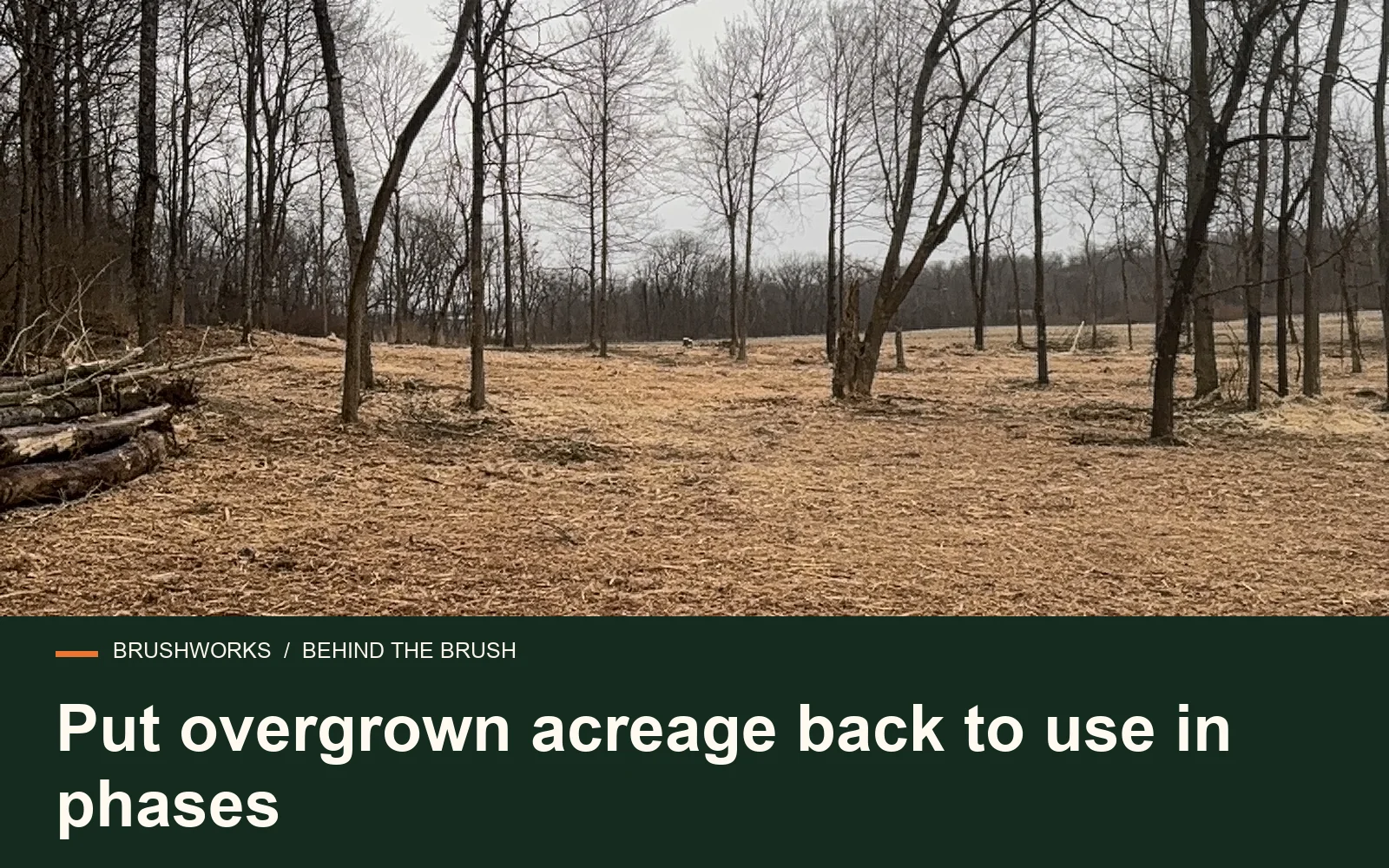
The mulch layer is not finish grading and it is not a lawn. It is a rough reset. It helps cover bare soil, returns organic material to the ground, and makes the shape of the land visible again. After mulching, owners can see low spots, old ruts, drainage paths, remaining stumps, useful trees, and the next work that needs to happen.
Do not clear good trees just because they are in the way visually
When acreage has been neglected, the rough brush makes everything look worse than it is. Under the vines and honeysuckle, there may be good oaks, maples, walnuts, hickories, sycamores, or other trees worth keeping. Removing the understory can change the whole property without stripping the canopy.
Before work starts, mark trees that should stay. Also mark trees that need to go because they block access, threaten a fence, crowd a future building area, or sit in a planned lane. If there are dead ash trees, leaning trees, split trunks, or large limbs over structures, bring in the right tree service for that part of the job.
Fence lines are usually a priority
Fence lines tell the story of an overgrown property. They collect vines, saplings, honeysuckle, thorn bushes, down limbs, old posts, and buried wire. Once a fence line disappears, it is hard to inspect boundaries, repair livestock fence, install new fence, or keep neighboring growth from pushing in.
Clearing fence lines early helps owners find corners, gates, damaged sections, and access points. It also gives surveyors, fence contractors, and equipment operators room to work. If the boundary matters, do not guess from the brush line. Check pins, plats, county GIS, or a current survey before clearing close to a neighbor.
For rural acreage, a maintainable fence line is better than a perfect-looking line that cannot be mowed later. Leave enough room for the equipment that will do future trimming or mowing. If the opening is too narrow, the brush will take it back.
Open trails and lanes with maintenance in mind
Many acreage owners want trails before they want full clearing. A trail can make the property walkable, show what is on the land, and create access for hunting, firewood, mowing, fence work, and future projects. The mistake is cutting a trail too narrow or too winding to maintain.
A good trail or lane should match its future use. A walking trail can be narrower than a UTV route. A tractor lane needs more width, better turns, and overhead clearance. A future gravel drive needs a different level of planning, drainage, and base work. If a trail will be mowed, it needs enough room for the mower, including turns and side clearance.
Drainage matters too. Trails that run straight down a slope can become ruts. Lanes that cross low ground can hold water. In Cincinnati clay soil, water will find the weak spot after heavy rain. Opening the route is only step one. Keeping it usable means paying attention to grade, soil, and where water already wants to go.
Look for hidden hazards before the machine starts
Old acreage often hides more than brush. There may be woven wire under leaves, metal T-posts, old farm junk, concrete chunks, dumped tires, bottles, abandoned landscape edging, buried plastic, low stumps, old wells, cisterns, drainage tile, private electric, propane lines, invisible fence, septic components, or unmarked water lines.
Walk what you can before the job. Flag what you know. If the growth is too thick to inspect, tell the crew what might be there. Public utility locates are important for digging and ground disturbance, but they may not mark private lines. The owner often knows more about old utilities and hazards than any map does.
Hidden metal is a real issue for mulching equipment. So are trash piles and old fence. Cleaning up known debris first can save time, reduce damage risk, and keep the project moving.
Be careful around water, slopes, and regulated areas
Cincinnati-area acreage often includes ditches, creeks, pond edges, drainage swales, wooded slopes, and wet spots. Clearing can make those areas easier to maintain, but it needs care. Removing the wrong vegetation on a bank or slope can expose soil and start erosion. Pushing mulch into a water path can block flow.
If the project touches a creek, wetland, pond bank, right-of-way, road ditch, utility easement, or stormwater feature, check the rules before work begins. Basic brush cleanup in an upland field is not the same as grading, filling, dredging, building a driveway, or disturbing a stream corridor.
Agree on the handoff
Before work begins, define what the next person needs to find on site. A rough mulched opening may still contain roots, stump remnants, and uneven ground. Grading, structural preparation, planting, surfacing, and specialist tree work are separate unless explicitly included.
Keep the marked work map with the quote. At completion, compare the limits and finish, document any follow-up, and decide who will maintain the area. Photos help record the result, but they do not replace checking the ground and access.
Plan the work for your property
Send the site address, recent photos, a marked clearing area, and the finish you want. We can discuss where clearing fits and what needs a different trade.
Discuss your project → Explore pricing